2002 BMW M3 COUPE ECU
[x] Cancel search: ECUPage 77 of 151

77n
OverviewControlsMaintenanceRepairsDataIndex
Dynamic Stability Control (DSC) Flat Tire MonitorTo deactivate DSCPress the DSC button briefly; the indi-
cator lamp will light up and stay on.
The vehicle does not execute the
stability-enhancement and traction-
control functions when DSC is deacti-
vated.
We recommend that you deactivate
DSC for increased traction:
>When rocking the vehicle or starting
off in deep snow or on loose surfaces
>When driving with snow chains.
To maintain vehicle stability,
always drive with the DSC acti-
vated on whenever possible.<
Reactivating the DSCPress the button again; the indicator
lamp goes out.Dynamic Brake Control (DBC)DBC is an integral component of the
DSC system.
If you apply the brakes rapidly, this
system automatically generates
maximum braking force boost and thus
helps to achieve the shortest possible
braking distance in "panic braking" situ-
ations. All of the benefits of the ABS
system are exploited under these
circumstances.
Do not reduce the pressure on the
brake pedal for the duration of the
brake application. When the brake
pedal is released, the DBC is deacti-
vated.
The conceptAs you drive, the Flat Tire Monitor
keeps track of pressure levels in all four
tires in order to detect and warn of any
substantial pressure loss.
The system actually detects pressure
loss by monitoring differences in the
relative speeds of the four wheels. It
interprets variations outside specified
limits as severe pressure loss, and then
responds by generating a warning.
Page 94 of 151

94n
Through-loading system
Folding the rear backrest down1. To unlock, pull the lever corre-
sponding to the section (arrow)
2. The rear backrest section will move
forward slightly when it is unlocked.
Reach into the gap and pull the
backrest down.
When folding the backrest back
into its original position always
ensure that the detent engages
securely. A loose backrest might fail to
prevent cargo from entering the
passenger compartment during sudden
braking or evasive maneuvers, posing a
potential hazard to occupants.<
Center 3-point-safety belt in the
rear
*
You can retract the 3-point-safety belt
in the rear, before folding the through-
loading system back:
Retracting the 3-point-safety belt:
Loosen the safety belt and insert the
buckle latch into the support mount
provided on the rear window shelf
(arrow).
Always use the outside safety
belts to install child-restraint
systems. Use the middle safety belt
only if it is necessary to install three
child-restraint systems.
Do not modify the child-restraint
system in any way. If you do so, it will
not provide your child with maximum
protection.<
Page 95 of 151

95n
OverviewControlsMaintenanceRepairsDataIndex
Ski bag
*
The ski bag allows the safe and clean
transport of up to 4 pairs of standard
skis or up to two snowboards.
The length of the ski bag and the addi-
tional space provided in the luggage
compartment make it possible to carry
skis up to 6.8 ft long (2.1 0 m). Because
of the tapered shape of the ski bag, it
can only accommodate two pairs of
skis 6.8 ft long (2.1 0 m).
Loading1. Fold the center armrest outward.
Loosen the trim from the upper
Velcro¨ fastener and place it on the
armrest
2. Press button 1 downward and swing
the cover forward
3. Extend the ski bag between the front
seats. The zipper provides conve-
nient access to stored items. It may
be opened to allow the ski bag to dry
4. Press knob 2: the cover in the
luggage compartment is unlocked.
To store the ski bag, perform the above
steps in reverse sequence.
Securing the loadSecure the bag's contents by tightening
down the retaining strap at the buckle.
Please be sure that the skis are
clean before loading them into the
bag. Be careful to avoid damage from
sharp edges.<
Page 96 of 151

96n
Cargo loading
Always position and secure the
load correctly. If you do not, it can
endanger the passengers during
braking or evasive maneuvers.
Do not exceed the approved gross
weight and the approved axle loads
(refer to page 138), otherwise the
vehicle's operating safety is no longer
assured and you are in violation of the
law.
Do not stow heavy or hard objects in
the passenger compartment without
first securing them. Otherwise they
would be thrown around during braking
and evasive maneuvers and endanger
the passengers.<
Stowing cargo If you are transporting a load in your
BMW:
>Load heavy cargo as far forward as
possible Ð directly behind the back-
rests or the luggage compartment
partition Ð and as low as possible
>Cover sharp edges and corners
>Do not pile objects higher than the
top edge of the backrest
>For very heavy loads when the rear
seat is not occupied, secure each
safety belt in the opposite buckle
(refer to illustration).
Page 97 of 151

97n
OverviewControlsMaintenanceRepairsDataIndex
Cargo loading Roof-mounted luggage rack
*
Securing the cargo in the luggage
compartment >For small, light items, use the rubber-
lined non-skid side of the floor mat or
secure with a luggage compartment
net
* or elastic straps, refer to
page 36
>For large, heavy pieces, see your
BMW center for load-securing
devices
*. Lashing eyes (arrow) are
provided at the inner corners of the
luggage compartment for attaching
these load-securing devices.
Read and comply with the information
enclosed with the load-securing
devices.
A special luggage system is available
as an option for your BMW. Please
observe the precautions included with
the installation instructions.AnchorsAccess to the anchors:
To fold up the covers (arrow), please
use the tool which is provided with the
luggage system.Loading and driving notesBecause roof racks raise the center of
gravity of the vehicle when loaded, they
exercise a major effect on its handling
and steering response.
When loading, be sure to remember not
to exceed the approved roof weight,
the approved gross vehicle weight or
the axle loads. You will find the specifi-
cations under "Technical Data" on
page 138.
Make sure that the load is not too
heavy, and attempt to distribute it
evenly. Always load the heaviest pieces
first (on the bottom). Be sure that
adequate clearance is maintained for
raising the sliding/tilt sunroof, and that
objects do not project into the opening
path of the luggage compartment lid.
Secure the roof luggage correctly
and securely to prevent it from
shifting or being lost during driving
(danger for following traffic).<
Drive smoothly and avoid sudden
acceleration or braking. Do not corner
at high speeds.
Page 107 of 151
107n
OverviewControlsMaintenanceRepairsDataIndex
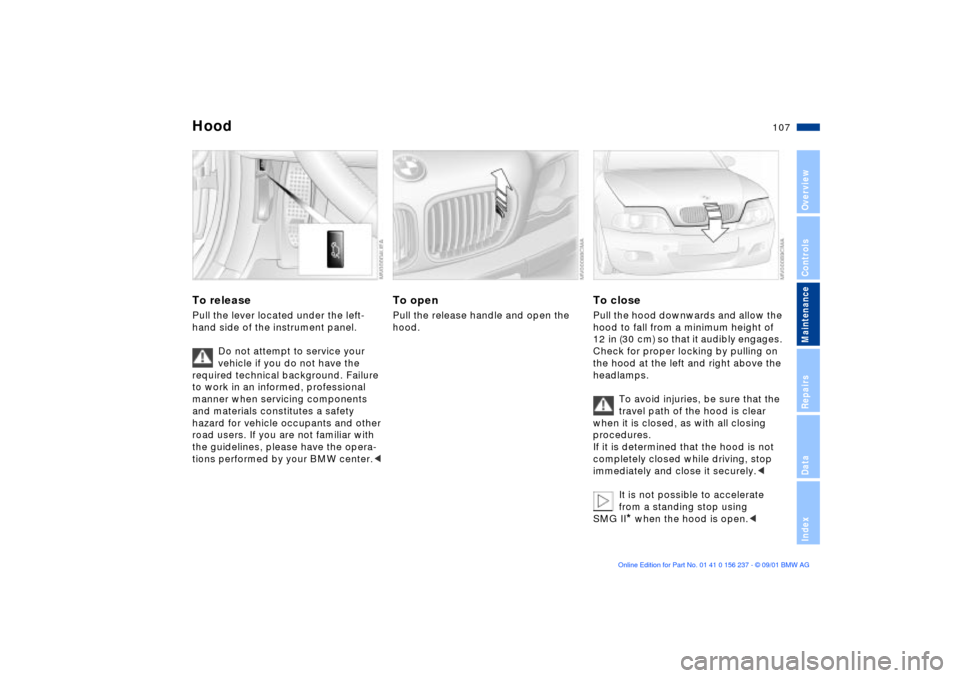
To releasePull the lever located under the left-
hand side of the instrument panel.
Do not attempt to service your
vehicle if you do not have the
required technical background. Failure
to work in an informed, professional
manner when servicing components
and materials constitutes a safety
hazard for vehicle occupants and other
road users. If you are not familiar with
the guidelines, please have the opera-
tions performed by your BMW center.<
To openPull the release handle and open the
hood.
To closePull the hood downwards and allow the
hood to fall from a minimum height of
12 in (30 cm) so that it audibly engages.
Check for proper locking by pulling on
the hood at the left and right above the
headlamps.
To avoid injuries, be sure that the
travel path of the hood is clear
when it is closed, as with all closing
procedures.
If it is determined that the hood is not
completely closed while driving, stop
immediately and close it securely.<
It is not possible to accelerate
from a standing stop using
SMG II
* when the hood is open.<
Hood
Page 130 of 151

130n
Battery Fuses
Battery posts, terminals, and
related accessories contain lead
and lead compounds. Wash hands after
handling.<
Battery careThe battery is completely maintenance-
free. That means that the original
battery acid will normally last for the
service life of the battery under
moderate climate conditions.
Please consult your BMW center
whenever you have any questions
concerning the battery. Since the
battery is absolutely maintenance-free,
the following statements are for your
information only.<
Never disconnect the battery
when the engine is running; the
ensuing voltage surge would seriously
damage the vehicle's onboard elec-
tronic systems.<
Charging the battery Charge the battery in the vehicle only
when the engine is not running. Use the
connections provided in the engine
compartment (for correct connections,
refer to "Jump-starting" on page 131.
Return used batteries to a recy-
cling point or your BMW center.
Maintain the battery in an upright posi-
tion for transport and storage. Secure
the battery against tilting in transit.<
Open the glove compartment and turn
the two white quick-release fasteners
outward.
Do not attempt to repair a burned
fuse or replace it with a fuse
having a different color or ampere
rating. To do this could cause a fire in
the vehicle resulting from a circuit over-
load.<
Page 143 of 151

Everything from A to Z
143n
OverviewControlsMaintenanceRepairsDataIndex
Caring for headlamp covers,
refer to the "Caring for your
vehicle" manual
Caring for your vehicle's
paintwork, refer to the
"Caring for your vehicle"
manual
CBC (Cornering Brake
Control)101
warning lamp18
Cellular phone92
refer also to the separate
Owner's Manual
Center (high-mount) brake
lamp125
Center armrest91
Central locking system28
key33
Check Control72
Checking
engine coolant112t
engine oil level110t
tire inflation
pressures24t
Child seat security54
Child-restraint systems52
Cigarette lighter93
Clean the headlamps67 Clean the windshield67
Clock72
also refer to the "Radio
Owner's Manual"
Clothes hooks93
Cockpit14
Coin box91
Combination switch65
Compression136
Computer72
refer also to the "Onboard
Computer Owner's
Manual"
Configuring individual
settings with Vehicle and
Key Memory55
Connecting car vacuum
cleaner93
Consumption74
Consumption display71
Control elements14
Coolant112
Coolant system,
capacity139
Coolant temperature
gauge71
Copyright4 Cornering Brake Control
(CBC)101
warning lamp18
Cover, sun blinds89
Cruise control68
Cruising range74
Curb weight138
D
Data
dimensions137
engine136
technical136
weights138
Daytime driving lamps80
DBC (Dynamic Brake
Control)77
Deep water101
Defrostable rear window88
Defroster, rear window84
Defrosting windows87
Dimensions137
Dipstick, engine oil110
Disc brakes102
Displacement136
Display lighting81
Distance warning75
Divided rear backrest94
Door key28 Doors
electrical
malfunction29t
manual operation29t
operating manually29
remote control30
unlocking and
locking29, 30
Draft-free ventilation85, 88
Driving notes
aquaplaning101
brakes101
DSC (Dynamic Stability
Control)76
indicator lamp19
Dynamic Brake Control
(DBC)77
Dynamic Stability Control
(DSC)76
indicator lamp19
E
Electric power windows39
Electrical malfunction
doors29t
fuel filler door22t
luggage compartment
lid34
sliding/tilt sunroof41t