2001 YAMAHA XJ900S torque
[x] Cancel search: torquePage 44 of 100
6-1
6
EAU00462
6-PERIODIC MAINTENANCE AND MINOR REPAIR
EAU00464
Safety is an obligation of the owner.
Periodic inspection, adjustment and lu-
brication will keep your vehicle in the
safest and most efficient condition pos-
sible. The most important points of in-
spection, adjustment, and lubrication
are explained on the following pages.
The intervals given in the periodic
maintenance and lubrication chart
should be simply considered as a gen-
eral guide under normal riding condi-
tions. However, DEPENDING ON THE
WEATHER, TERRAIN, GEOGRAPHI-
CAL LOCATION, AND INDIVIDUAL
USE, THE MAINTENANCE INTER-
VALS MAY NEED TO BE
SHORTENED.
EW000060
WARNING
@ If you are not familiar with motor-
cycle maintenance work, have a
Yamaha dealer do it for you. @
EAU03394
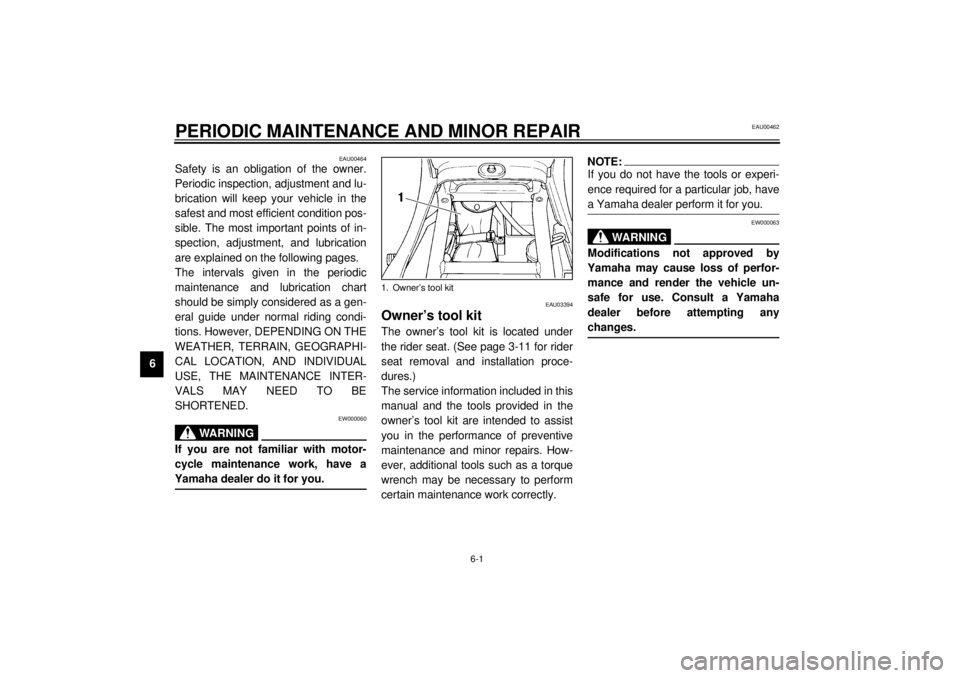
Owner’s tool kit The owner’s tool kit is located under
the rider seat. (See page 3-11 for rider
seat removal and installation proce-
dures.)
The service information included in this
manual and the tools provided in the
owner’s tool kit are intended to assist
you in the performance of preventive
maintenance and minor repairs. How-
ever, additional tools such as a torque
wrench may be necessary to perform
certain maintenance work correctly.
NOTE:@ If you do not have the tools or experi-
ence required for a particular job, have
a Yamaha dealer perform it for you. @
EW000063
WARNING
@ Modifications not approved by
Yamaha may cause loss of perfor-
mance and render the vehicle un-
safe for use. Consult a Yamaha
dealer before attempting any
changes. @
1. Owner’s tool kit
E_4km.book Page 1 Thursday, September 7, 2000 9:32 AM
Page 50 of 100

PERIODIC MAINTENANCE AND MINOR REPAIR
6-7
6
EAU01880
Checking the spark plugs The spark plugs are important engine
components, which should be checked
periodically, preferably by a Yamaha
dealer. Since heat and deposits will
cause any spark plug to slowly erode,
they should be removed and checked
in accordance with the periodic mainte-
nance and lubrication chart. In addition,
the condition of the spark plugs can re-
veal the condition of the engine.
The porcelain insulator around the cen-
ter electrode of each spark plug should
be a medium-to-light tan (the ideal col-
or when the motorcycle is ridden nor-
mally), and all spark plugs installed in
the engine should have the same color.
If any spark plug shows a distinctly dif-
ferent color, the engine could be defec-
tive. Do not attempt to diagnose such
problems yourself. Instead, have a
Yamaha dealer check the motorcycle.If a spark plug shows signs of electrode
erosion and excessive carbon or other
deposits, it should be replaced.
Before installing a spark plug, the spark
plug gap should be measured with a
wire thickness gauge and, if necessary,
adjusted to specification.
Clean the surface of the spark plug
gasket and its mating surface, and then
wipe off any grime from the spark plug
threads. Specified spark plug:
DPR8EA-9 (NGK) or
X24EPR-U9 (DENSO)
a. Spark plug gap
Spark plug gap:
0.8–0.9 mm
Tightening torque:
Spark plug:
17.5 Nm (1.75 m·kg)
E_4km.book Page 7 Thursday, September 7, 2000 9:32 AM
Page 51 of 100

PERIODIC MAINTENANCE AND MINOR REPAIR
6-8
6
NOTE:@ If a torque wrench is not available when
installing a spark plug, a good estimate
of the correct torque is 1/4–1/2 turn
past finger tight. However, the spark
plug should be tightened to the speci-
fied torque as soon as possible. @
EAU02938
Engine oil and oil filter
cartridge The engine oil level should be checked
before each ride. In addition, the oil
must be changed and the oil filter car-
tridge replaced at the intervals speci-
fied in the periodic maintenance and
lubrication chart.
To check the engine oil level
1. Place the motorcycle on the cen-
terstand.NOTE:@ Make sure that the motorcycle is posi-
tioned straight up when checking the oil
level. A slight tilt to the side can result in
a false reading. @2. Start the engine, warm it up for
several minutes, and then turn it
off.3. Wait a few minutes until the oil set-
tles, and then check the oil level
through the check window located
at the bottom-right side of the
crankcase.
NOTE:@ The engine oil should be between the
minimum and maximum level marks. @4. If the engine oil is below the mini-
mum level mark, add sufficient oil
of the recommended type to raise
it to the correct level.1. Engine oil level check window
2. Maximum level mark
3. Minimum level mark
E_4km.book Page 8 Thursday, September 7, 2000 9:32 AM
Page 53 of 100
PERIODIC MAINTENANCE AND MINOR REPAIR
6-10
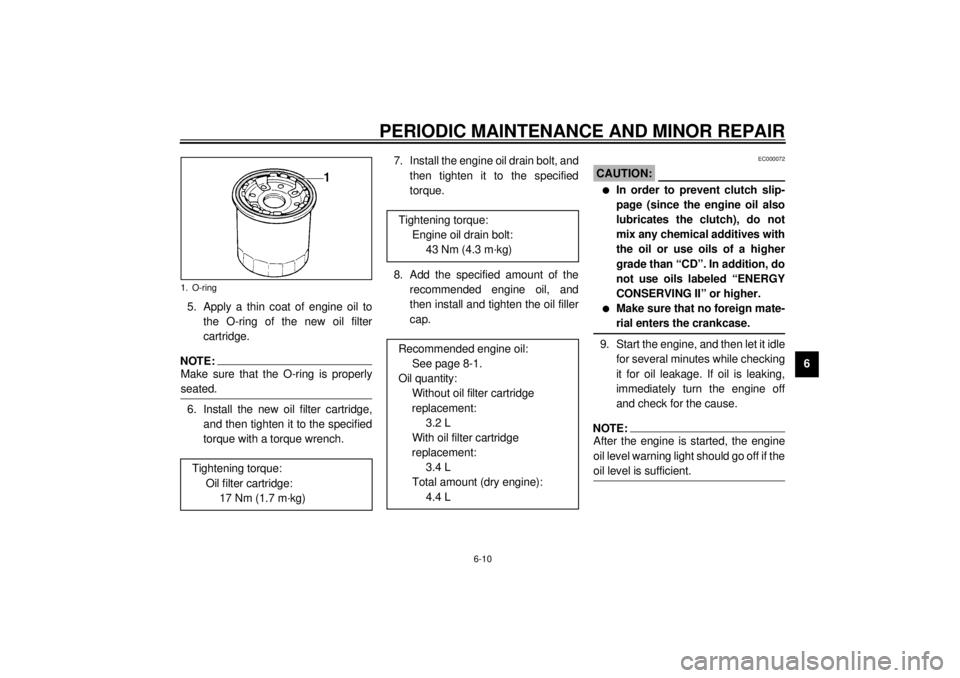
6 5. Apply a thin coat of engine oil to
the O-ring of the new oil filter
cartridge.
NOTE:@ Make sure that the O-ring is properly
seated. @6. Install the new oil filter cartridge,
and then tighten it to the specified
torque with a torque wrench.7. Install the engine oil drain bolt, and
then tighten it to the specified
torque.
8. Add the specified amount of the
recommended engine oil, and
then install and tighten the oil filler
cap.
EC000072
CAUTION:@ l
In order to prevent clutch slip-
page (since the engine oil also
lubricates the clutch), do not
mix any chemical additives with
the oil or use oils of a higher
grade than “CD”. In addition, do
not use oils labeled “ENERGY
CONSERVING II” or higher.
l
Make sure that no foreign mate-
rial enters the crankcase.
@9. Start the engine, and then let it idle
for several minutes while checking
it for oil leakage. If oil is leaking,
immediately turn the engine off
and check for the cause.NOTE:@ After the engine is started, the engine
oil level warning light should go off if the
oil level is sufficient. @
1. O-ring
Tightening torque:
Oil filter cartridge:
17 Nm (1.7 m·kg)
Tightening torque:
Engine oil drain bolt:
43 Nm (4.3 m·kg)
Recommended engine oil:
See page 8-1.
Oil quantity:
Without oil filter cartridge
replacement:
3.2 L
With oil filter cartridge
replacement:
3.4 L
Total amount (dry engine):
4.4 L
E_4km.book Page 10 Thursday, September 7, 2000 9:32 AM
Page 55 of 100
PERIODIC MAINTENANCE AND MINOR REPAIR
6-12
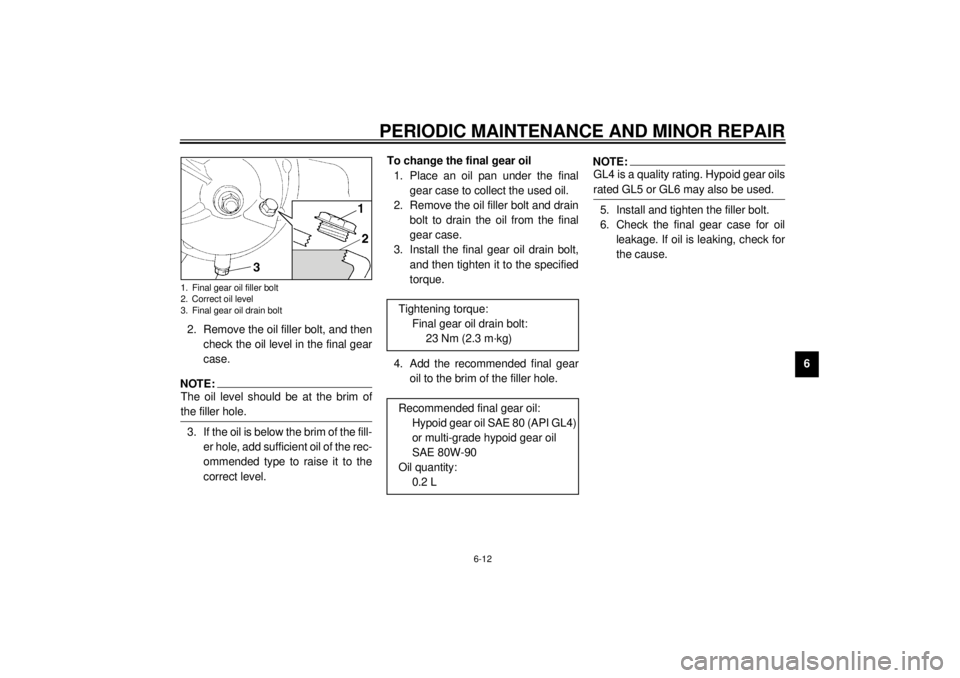
6 2. Remove the oil filler bolt, and then
check the oil level in the final gear
case.
NOTE:_ The oil level should be at the brim of
the filler hole. _3. If the oil is below the brim of the fill-
er hole, add sufficient oil of the rec-
ommended type to raise it to the
correct level.To change the final gear oil
1. Place an oil pan under the final
gear case to collect the used oil.
2. Remove the oil filler bolt and drain
bolt to drain the oil from the final
gear case.
3. Install the final gear oil drain bolt,
and then tighten it to the specified
torque.
4. Add the recommended final gear
oil to the brim of the filler hole.
NOTE:_ GL4 is a quality rating. Hypoid gear oils
rated GL5 or GL6 may also be used. _5. Install and tighten the filler bolt.
6. Check the final gear case for oil
leakage. If oil is leaking, check for
the cause.
1. Final gear oil filler bolt
2. Correct oil level
3. Final gear oil drain bolt
Tightening torque:
Final gear oil drain bolt:
23 Nm (2.3 m·kg)
Recommended final gear oil:
Hypoid gear oil SAE 80 (API GL4)
or multi-grade hypoid gear oil
SAE 80W-90
Oil quantity:
0.2 L
E_4km.book Page 12 Thursday, September 7, 2000 9:32 AM
Page 75 of 100
PERIODIC MAINTENANCE AND MINOR REPAIR
6-32
6
EAU03420
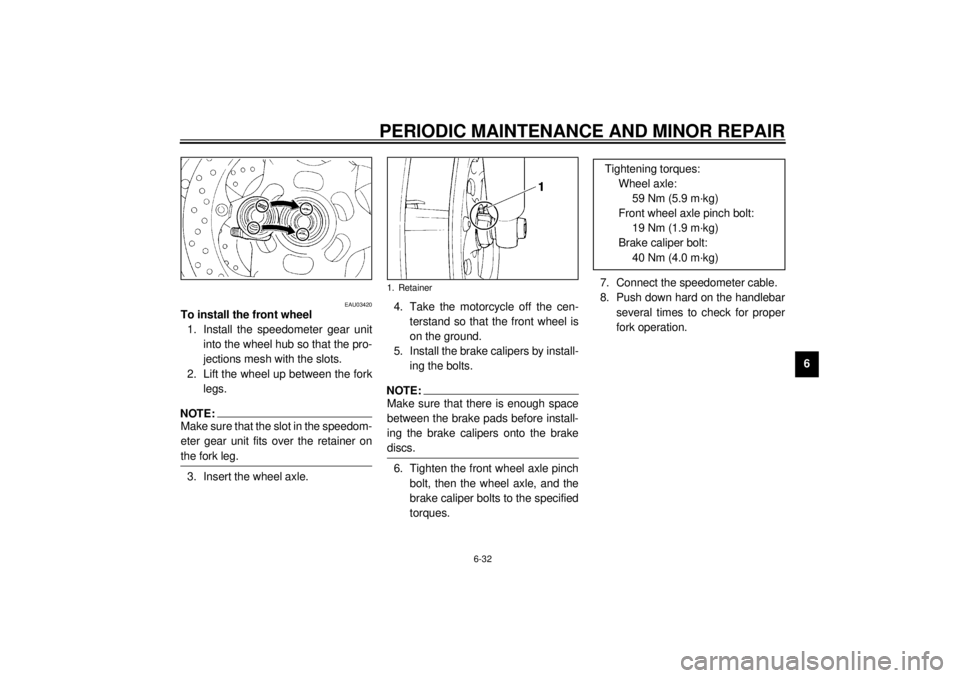
To install the front wheel
1. Install the speedometer gear unit
into the wheel hub so that the pro-
jections mesh with the slots.
2. Lift the wheel up between the fork
legs.NOTE:@ Make sure that the slot in the speedom-
eter gear unit fits over the retainer on
the fork leg. @3. Insert the wheel axle.4. Take the motorcycle off the cen-
terstand so that the front wheel is
on the ground.
5. Install the brake calipers by install-
ing the bolts.
NOTE:@ Make sure that there is enough space
between the brake pads before install-
ing the brake calipers onto the brake
discs. @6. Tighten the front wheel axle pinch
bolt, then the wheel axle, and the
brake caliper bolts to the specified
torques.7. Connect the speedometer cable.
8. Push down hard on the handlebar
several times to check for proper
fork operation.1. Retainer
Tightening torques:
Wheel axle:
59 Nm (5.9 m·kg)
Front wheel axle pinch bolt:
19 Nm (1.9 m·kg)
Brake caliper bolt:
40 Nm (4.0 m·kg)
E_4km.book Page 32 Thursday, September 7, 2000 9:32 AM
Page 76 of 100
PERIODIC MAINTENANCE AND MINOR REPAIR
6-33
6
EAU03410
Rear wheel To remove the rear wheel
EW000122
WARNING
@ l
It is advisable to have a Yamaha
dealer service the wheel.
l
Securely support the motor-
cycle so that there is no danger
of it falling over.
@
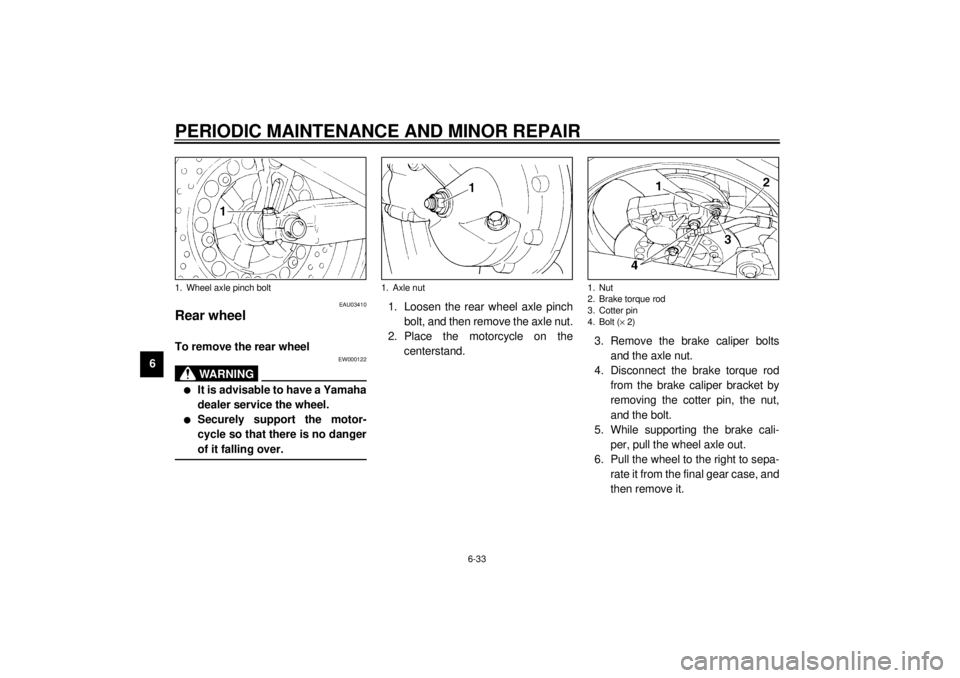
1. Loosen the rear wheel axle pinch
bolt, and then remove the axle nut.
2. Place the motorcycle on the
centerstand.3. Remove the brake caliper bolts
and the axle nut.
4. Disconnect the brake torque rod
from the brake caliper bracket by
removing the cotter pin, the nut,
and the bolt.
5. While supporting the brake cali-
per, pull the wheel axle out.
6. Pull the wheel to the right to sepa-
rate it from the final gear case, and
then remove it.
1. Wheel axle pinch bolt
1. Axle nut
1. Nut
2. Brake torque rod
3. Cotter pin
4. Bolt (´ 2)
E_4km.book Page 33 Thursday, September 7, 2000 9:32 AM
Page 77 of 100
PERIODIC MAINTENANCE AND MINOR REPAIR
6-34
6
ECA00062
CAUTION:@ Do not push the brake pedal after
the wheel has been removed togeth-
er with the brake disc, otherwise the
brake pads will be forced shut. @
EAU03411
To install the rear wheel
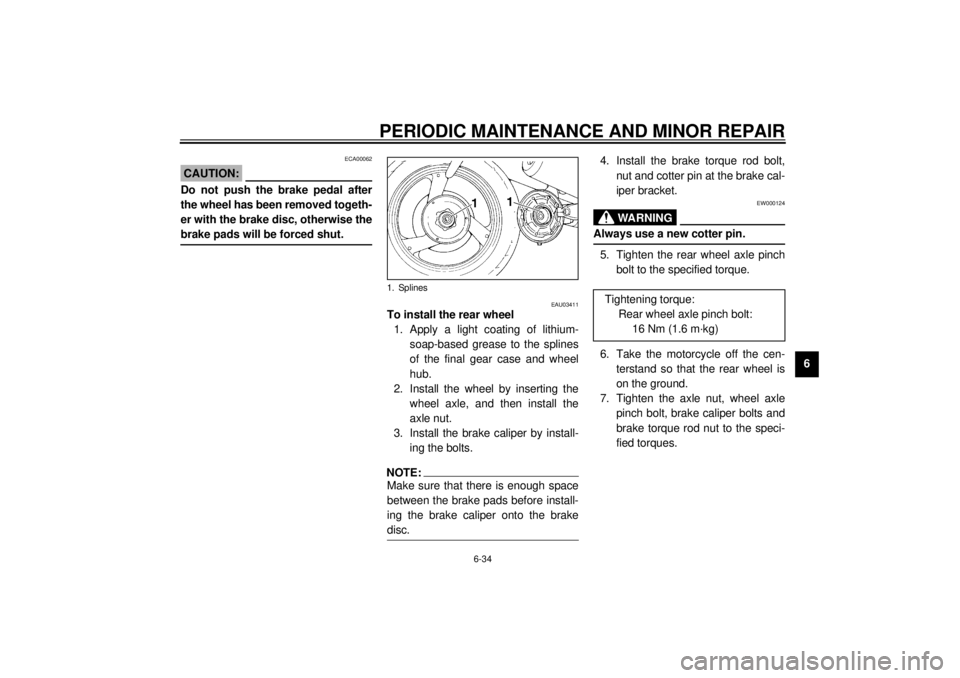
1. Apply a light coating of lithium-
soap-based grease to the splines
of the final gear case and wheel
hub.
2. Install the wheel by inserting the
wheel axle, and then install the
axle nut.
3. Install the brake caliper by install-
ing the bolts.NOTE:@ Make sure that there is enough space
between the brake pads before install-
ing the brake caliper onto the brake
disc. @
4. Install the brake torque rod bolt,
nut and cotter pin at the brake cal-
iper bracket.
EW000124
WARNING
@ Always use a new cotter pin. @5. Tighten the rear wheel axle pinch
bolt to the specified torque.
6. Take the motorcycle off the cen-
terstand so that the rear wheel is
on the ground.
7. Tighten the axle nut, wheel axle
pinch bolt, brake caliper bolts and
brake torque rod nut to the speci-
fied torques.
1. Splines
Tightening torque:
Rear wheel axle pinch bolt:
16 Nm (1.6 m·kg)
E_4km.book Page 34 Thursday, September 7, 2000 9:32 AM