Page 28 of 100
INSTRUMENT AND CONTROL FUNCTIONS
3-13
3
EAU00285
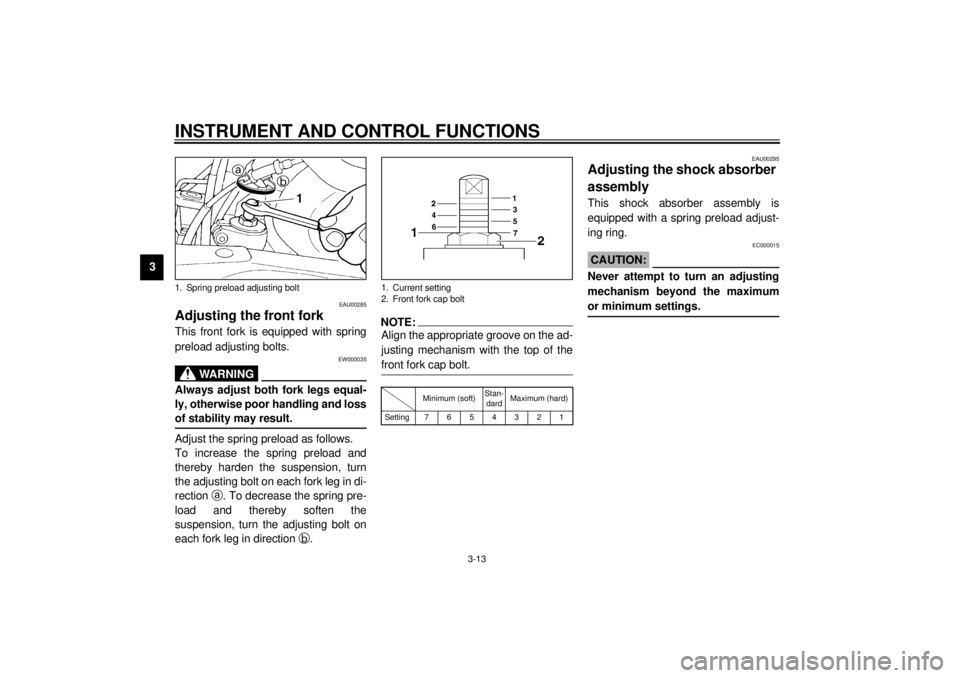
Adjusting the front fork This front fork is equipped with spring
preload adjusting bolts.
EW000035
WARNING
@ Always adjust both fork legs equal-
ly, otherwise poor handling and loss
of stability may result. @Adjust the spring preload as follows.
To increase the spring preload and
thereby harden the suspension, turn
the adjusting bolt on each fork leg in di-
rection
a. To decrease the spring pre-
load and thereby soften the
suspension, turn the adjusting bolt on
each fork leg in direction
b.
NOTE:@ Align the appropriate groove on the ad-
justing mechanism with the top of the
front fork cap bolt. @CI-01EEAU00295
Adjusting the shock absorber
assembly This shock absorber assembly is
equipped with a spring preload adjust-
ing ring.
EC000015
CAUTION:@ Never attempt to turn an adjusting
mechanism beyond the maximum
or minimum settings. @
1. Spring preload adjusting bolt
1. Current setting
2. Front fork cap bolt
Minimum (soft)Stan-
dardMaximum (hard)
Setting7654321
E_4km.book Page 13 Thursday, September 7, 2000 9:32 AM
Page 29 of 100

INSTRUMENT AND CONTROL FUNCTIONS
3-14
3
Adjust the spring preload as follows.
To increase the spring preload and
thereby harden the suspension, turn
the adjusting ring in direction
a. To de-
crease the spring preload and thereby
soften the suspension, turn the adjust-
ing ring in direction
b.
NOTE:@ Align the appropriate notch in the ad-
justing ring with the position indicator
on the shock absorber. @
CI-01EEAU00315
WARNING
@ This shock absorber contains high-
ly pressurized nitrogen gas. For
proper handling, read and under-
stand the following information be-
fore handling the shock absorber.
The manufacturer cannot be held re-
sponsible for property damage or
personal injury that may result from
improper handling.l
Do not tamper with or attempt to
open the gas cylinder.
l
Do not subject the shock ab-
sorber to an open flame or other
high heat sources, otherwise it
may explode due to excessive
gas pressure.
l
Do not deform or damage the
gas cylinder in any way, as this
will result in poor damping per-
formance.
l
Always have a Yamaha dealer
service the shock absorber.
@
1. Spring preload adjusting ring
2. Position indicator
1. Special wrench
Minimum
(soft)Stan-
dardMaximum (hard)
Setting1234567
E_4km.book Page 14 Thursday, September 7, 2000 9:32 AM
Page 30 of 100

INSTRUMENT AND CONTROL FUNCTIONS
3-15
3
EAU00330
Sidestand The sidestand is located on the left side
of the frame. Raise the sidestand or
lower it with your foot while holding the
motorcycle upright.NOTE:@ The built-in sidestand switch is part of
the ignition circuit cut-off system, which
cuts the ignition in certain situations.
(See further down for an explanation of
the ignition circuit cut-off system.) @
EW000044
WARNING
@ The motorcycle must not be ridden
with the sidestand down, or if the
sidestand cannot be properly
moved up (or does not stay up), oth-
erwise the sidestand could contact
the ground and distract the opera-
tor, resulting in a possible loss of
control. Yamaha’s ignition circuit
cut-off system has been designed to
assist the operator in fulfilling the
responsibility of raising the side-
stand before starting off. Therefore,
check this system regularly as de-
scribed below and have a Yamaha
dealer repair it if it does not function
properly. @
EAU00332
Ignition circuit cut-off system The ignition circuit cut-off system (com-
prising the sidestand switch, clutch
switch and neutral switch) has the fol-
lowing functions.l
It prevents starting when the trans-
mission is in gear and the side-
stand is up, but the clutch lever is
not pulled.
l
It prevents starting when the trans-
mission is in gear and the clutch
lever is pulled, but the sidestand is
still down.
l
It cuts the running engine when
the sidestand is moved down.
Periodically check the operation of the
ignition circuit cut-off system according
to the following procedure.
E_4km.book Page 15 Thursday, September 7, 2000 9:32 AM
Page 31 of 100
INSTRUMENT AND CONTROL FUNCTIONS
3-16
3
EW000046
WARNING
@ l
The vehicle must be placed on
the centerstand during this
inspection.
l
If a malfunction is noted, have a
Yamaha dealer check the sys-
tem before riding.
@
E_4km.book Page 16 Thursday, September 7, 2000 9:32 AM
Page 35 of 100

PRE-OPERATION CHECKS
4-2
4
NOTE:@ Pre-operation checks should be made each time the motorcycle is used. Such an inspection can be accomplished in a very
short time; and the added safety it assures is more than worth the time involved. @
EWA00033
WARNING
@ If any item in the Pre-operation check list is not working properly, have it inspected and repaired before operating
the motorcycle. @Wheels and tires• Check for damage.
• Check tire condition and tread depth.
• Check air pressure.
• Correct if necessary.6-17–6-20
Brake and shift pedals• Make sure that operation is smooth.
• Lubricate pedal pivoting points if necessary.6-24
Brake and clutch levers• Make sure that operation is smooth.
• Lubricate lever pivoting points if necessary.6-24
Centerstand, sidestand• Make sure that operation is smooth.
• Lubricate pivots if necessary.6-25
Chassis fasteners• Make sure that all nuts, bolts and screws are properly tightened.
• Tighten if necessary.—
Instruments, lights, signals
and switches• Check operation.
• Correct if necessary.—
Sidestand switch• Check operation of ignition circuit cut-off system.
• If system is defective, have Yamaha dealer check vehicle.3-15 ITEM CHECKS PAGE
E_4km.book Page 2 Thursday, September 7, 2000 9:32 AM
Page 38 of 100

5-1
5
EAU00372
5-OPERATION AND IMPORTANT RIDING POINTS
EAU00373
WARNING
@ l
Become thoroughly familiar
with all operating controls and
their functions before riding.
Consult a Yamaha dealer re-
garding any control or function
that you do not thoroughly
understand.
l
Never start the engine or oper-
ate it in a closed area for any
length of time. Exhaust fumes
are poisonous, and inhaling
them can cause loss of con-
sciousness and death within a
short time. Always make sure
that there is adequate
ventilation.
l
Before starting out, make sure
that the sidestand is up. If the
sidestand is not raised com-
pletely, it could contact the
ground and distract the opera-
tor, resulting in a possible loss
of control.
@
EAU01627*
Starting a cold engine In order for the ignition circuit cut-off
system to enable starting, one of the
following conditions must be met:l
The transmission is in the neutral
position.
l
The transmission is in gear with
the clutch lever pulled and the
sidestand up.
EW000054
WARNING
@ l
Before starting the engine,
check the function of the igni-
tion circuit cut-off system ac-
cording to the procedure
described on page 3-17.
l
Never ride with the sidestand
down.
@1. Turn the key to “ON” and make
sure that the engine stop switch is
set to “ ”.
EC000035
CAUTION:@ If the fuel level warning light comes
on, check the fuel level, and, if nec-
essary, refuel as soon as possible. @2. Shift the transmission into the neu-
tral position.NOTE:@ When the transmission is in the neutral
position, the neutral indicator light
should be on, otherwise have a
Yamaha dealer check the electrical
circuit. @3. Turn the starter (choke) on and
completely close the throttle. (See
page 3-10 for starter (choke) oper-
ation.)
4. Start the engine by pushing the
start switch.
E_4km.book Page 1 Thursday, September 7, 2000 9:32 AM
Page 39 of 100

OPERATION AND IMPORTANT RIDING POINTS
5-2
5
NOTE:@ If the engine fails to start, release the
start switch, wait a few seconds, and
then try again. Each starting attempt
should be as short as possible to pre-
serve the battery. Do not crank the en-
gine more than 10 seconds on any one
attempt. @
EC000038
CAUTION:@ l
The oil level warning light and
fuel level warning light should
come on when the start switch
is pushed, and they should go
off when the start switch is re-
leased.
l
If the oil level warning light flick-
ers or remains on after starting,
immediately stop the engine,
and then check the engine oil
level and the vehicle for oil leak-
age. If necessary, add engine
oil, and then check the warning
light again. If the warning light
does not come on when push-
ing the start switch, or if it doesnot go off after starting with suf-
ficient engine oil, have a
Yamaha dealer check the elec-
trical circuit.
l
If the fuel level warning light re-
mains on after starting, stop the
engine, and then check the fuel
level. If necessary, refuel as
soon as possible, and then
check the warning light again. If
the warning light does not come
on when pushing the start
switch, or if it does not go off af-
ter starting with sufficient fuel,
have a Yamaha dealer check the
electrical circuit.
@5. After starting the engine, move the
starter (choke) lever back halfway.
ECA00045
CAUTION:@ For maximum engine life, never ac-
celerate hard when the engine is
cold! @6. When the engine is warm, turn the
starter (choke) off.
NOTE:@ l
The engine is warm when it re-
sponds normally to the throttle
with the starter (choke) turned off.
l
When the engine is idling with the
starter (choke) on, the radiator fan
will automatically be switched on
and off regardless of the radiator
coolant temperature, and the en-
gine idling speed will vary at times,
but this is not a malfunction.
@
E_4km.book Page 2 Thursday, September 7, 2000 9:32 AM
Page 42 of 100
OPERATION AND IMPORTANT RIDING POINTS
5-5
5
EAU00448*
0–500 kml
Avoid prolonged operation above
5,000 r/min.
l
After every hour of operation, stop
the engine, and then let it cool for
five to ten minutes.
l
Vary the engine speed from time
to time. Do not operate the engine
at one set throttle position.
500–1,000 km
l
Avoid prolonged operation above
6,000 r/min.
l
Rev the engine freely through the
gears, but do not use full throttle at
any time.
EC000056*
CAUTION:@ After 1,000 km of operation, the en-
gine oil and final gear oil must be
changed, and the oil filter cartridge
replaced. @
1,000 km and beyond
The vehicle can now be operated
normally.
EC000053
CAUTION:@ l
Keep the engine speed out of
the tachometer red zone.
l
If any engine trouble should oc-
cur during the engine break-in
period, immediately have a
Yamaha dealer check the
vehicle.
@
EAU00460
Parking When parking, stop the engine, and
then remove the key from the main
switch.
EW000058
WARNING
@ l
Since the engine and exhaust
system can become very hot,
park in a place where pedestri-
ans or children are not likely to
touch them.
l
Do not park on a slope or on
soft ground, otherwise the
motorcycle may overturn.
@
E_4km.book Page 5 Thursday, September 7, 2000 9:32 AM