2001 VOLVO S60 tow
[x] Cancel search: towPage 86 of 128

Never leave the car unattended when the engine is running. If, by mistake, the gear selector is moved from P, the
car may start moving.
R (Reverse)
Never engage R while the car is moving forward.
N (Neutral)
Neutral - no gear engaged. Use the parking brake.
D (Drive)
D is the normal driving position and should be used as often as possible to help improve fuel economy. The car
should not be moving when shifting from R to the D position.
Automatic transmission - adaptive system
The automatic transmission is controlled by an adaptive control system that constantly monitors the way in which the
transmission functions. It senses and adapts each gear shift for optimal performance. The system also monitors your
particular driving style and adapts gear shifting accordingly.
Automatic transmission - shift gate positions
You can move the gear selector freely between the (MAN) ual and (D) rive positions while driving.
Depress the button on the front of the gear selector knob to move between the R, N, D, and P positions.
pg. 136 Geartronic (option )
Manual shifting - Geartronic
You can move the gear selector freely between the (MAN) ual and (D) rive positions while driving. Gears 3, and 4
have a "lock - up" function which reduces engine speed and helps save fuel.
The currently selected gear will be displayed in the instrument panel (see page 30
).
To access the (MAN) ual shifting position from (D) rive, move the gear selector to the left to MAN.
To return to the (D) rive position from MAN, move the gear selector to the right.
While driving
If you select the (MAN) ual position while driving, the gear that was being used in the (D) rive position will also
initially be selected in (MAN) ual position.
Move the gear selector forward (toward "+") to shift to a higher gear or rearward (toward "-") to shift to a lower
gear.
If you hold the gear selector toward "-", the transmission will downshift, one gear at a time, and will utilize the
braking power of the engine. If the current speed is too high for using a lower gear, the downshift will not occur until
the speed has decreased enough to allow the lower gear to be used.
ProCarManuals.com
Page 87 of 128

If you slow down to a very low speed, the transmission will automatically shift down.
When starting in the (MAN) ual position, 3rd gear is the highest gear that may be selected.
NOTE: Kickdown does not function when the transmission is in the manual shift (Geartronic) mode.
Kickdown
Automatic shift to a lower gear (kickdown) is achieved by depressing the accelerator pedal fully and briskly. An
upshift will occur when approaching the top speed for a particular gear or by releasing the accelerator pedal slightly.
Kickdown can be used for maximum acceleration or when passing at highway speeds.
Kickdown does not function when the transmission is in the manual shift (Geartronic) mode.
W - Winter/ Wet driving mode - enhanced vehicle traction
Mode W will only function if the gear selector is in the (D) rive position.
Press the button at the base of the gear selector to engage/ disengage this driving mode (see illustration).
When the W driving mode is engaged, this is displayed in the instrument panel (see page 30).
This mode may be selected for starting/ moving off on slippery roads.
pg. 137 Brake system
BRAKE Brake circuit malfunction
If one of the brake circuits were to malfunction, the red warning light would come on, the pedal travel would increase
slightly, the pedal would feel softer, and extra pressure would be required for normal braking. If the light comes on
while driving or braking, stop immediately and check the brake fluid level in the reservoir.
WARNING!
If the fluid level is below the MIN mark in the reservoir or if a "Brake failure - Service urgent" message is
displayed in the text window: DO NOT DRIVE. Have the car towed to a Volvo retailer and have the brake system
inspected.
NOTE: When the car is at a standstill and the engine is idling, e. g. at a traffic light and the brake pedal is depressed,
the pedal may go down slightly. This is a normal function of the power- assisted brake system.
If the brake power- assist does not function
The power assist to the brakes functions only when the engine is running. When the car is moving without the engine
running, the brake pedal pressure required to stop the car is increased by 3- 4 times and the brake pedal feels stiff.
Water on brake discs and brake pads affects braking
Driving in rain and slush or passing through an automatic car wash can cause water to collect on the brake discs and
pads. This will cause a delay in braking effect when the pedal is depressed. To avoid such a delay when the brakes are
ProCarManuals.com
Page 88 of 128

needed, depress the pedal occasionally when driving through rain, slush etc. This will remove the water from the
brakes. Check that brake application feels normal. This should also be done after washing or starting in very damp or
cold weather.
Severe strain on the brake system
The brakes will be subject to severe strain when driving in mountains or hilly areas or towing. Vehicle speed is
usually slower, which means that the cooling of the brakes is less efficient than when driving on level roads. To
reduce the strain on the brakes, it is advisable not to use the brakes excessively. Instead, shift into a lower gear and let
the engine help with the braking. Do not forget that, if you are towing a trailer, the brakes will be subjected to a
greater than normal load.
pg. 138 Brake system
Anti-lock brakes (ABS)
If the warning lamp lights up there is a malfunction of the ABS system (the standard braking system will however
function) and the vehicle should be driven cautiously to a Volvo retailer for inspection. The Anti-lock Braking
System (ABS) helps to improve vehicle control (stopping and steering) during severe braking conditions by limiting
brake lockup. When the system "senses" impending lockup, braking pressure is automatically modulated in order to
help prevent lockup, which could lead to a skid.
The system performs a self - diagnostic test when the engine is started and when the vehicle first reaches a
speed of approximately 12 mph (20 km/ h). The brake pedal will pulsate several times and a sound may be audible
from the ABS control module. This is normal.
To obtain optimal effect from the ABS system, constant pressure should be kept on the brake pedal, keep constant
pressure on the brake pedal. Do not pump the brake pedal.
The switching of the ABS modulator will be audible and the brake pedal will pulsate during braking. Please be aware
that ABS does not increase the absolute braking potential of the vehicle. While control will be enhanced, ABS will
not shorten stopping distances on slippery surfaces.
ABS with EBD (Electronic Brake Force Distribution)
EBD is an integrated part of the ABS system. EBD regulates the hydraulic pressure to the rear brakes to help provide
optimal braking capacity.
If the BRAKE and ABS warning lights come on at the same time, this could indicate a fault in the brake system.
Stop the car in a suitable place and switch off the engine.
Restart the engine.
If both warning lights go off, no further action is required.
If both lights are still on after the engine has been restarted, switch off the engine again and check the brake fluid
level (see page 170 for the location of the brake fluid reservoir).
If the brake fluid level is above the MIN mark, drive carefully to an authorized Volvo retailer and have the brake
system inspected.
WARNING!
If the fluid level is below the MIN mark in the reservoir or if a "Brake failure - Service urgent" message is
displayed in the text window: DO NOT DRIVE. Have the car towed to a Volvo retailer and have the brake system
inspected.
ProCarManuals.com
Page 97 of 128
2 0 0 1
VOLVO S60
Car care
pg. 159 Car care
Washing and cleaning the car 160
Paint touch up162
pg. 160 Washing and cleaning the car
Washing and cleaning the car
The car should be washed at regular intervals since dirt, dust, insects and tar spots adhere to the paint and may
cause damage. It is particularly important to wash the car frequently in the wintertime to prevent corrosion, when salt
has been used on the roads.
When washing the car, do not expose it to direct sunlight. Use lukewarm water to soften the dirt before you wash
with a sponge, and plenty of water, to avoid scratching.
Bird droppings: Remove from paintwork as soon as possible. Otherwise the finish may be permanently damaged.
A detergent can be used to facilitate the softening of dirt and oil.
A water- soluble grease solvent may be used in cases of sticky dirt. However, use a wash place equipped with a
drainage separator.
Dry the car with a clean chamois and remember to clean the drain holes in the doors and rocker panels.
Tar spots can be removed with kerosene or tar remover after the car has been washed.
A stiff- bristle brush and lukewarm soapy water can be used to clean the wiper blades. Frequent cleaning improves
visibility considerably.
Wash off the dirt from the underside (wheel housings, fenders, etc.).
In areas of high industrial fallout, more frequent washing is recommended.
CAUTION:
During high pressure washing, the spray mouthpiece must never be closer to the vehicle than 13" (30 cm). Do not
spray into the locks.
When washing or steam cleaning the engine, avoid spraying water or steam directly on the electrical components or
toward the rear side of the engine.
After cleaning the engine, the spark plug wells should be inspected for water and blown dry if necessary.
Suitable detergents: Special car washing detergents should be used. A suitable mixture is about 2.5 fl. oz. (8.5 cl) of
detergent to 2.6 US gal. (10 liters) of warm water. After washing with a detergent the car should be well rinsed with
clean water.
Bumpers: Wash the bumpers with the same cleaning agent used on the rest of the car. Never clean the bumpers with
gasoline or paint thinner. Difficult spots can be removed with denatured alcohol. To avoid scratches, do not dry the
bumpers with paper.
NOTE: When washing the car, remember to remove dirt from the drain holes in the doors and sills.
ProCarManuals.com
Page 99 of 128

Bear in mind
Take extra care when removing stains such as ink or lipstick since the coloring can spread.
Use solvents sparingly. Too much solvent can damage the seat padding.
Start from the outside of the stain and work toward the center.
pg. 162 Paint touch up
Paint touch up
Paint damage requires immediate attention to avoid rusting. Make it a habit to check the finish regularly - when
washing the car for instance. Touch- up if necessary.
Paint repairs require special equipment and skill. Contact your Volvo retailer for any extensive damage.
Minor scratches can be repaired by using Volvo touch- up paint.
NOTE: When ordering touch- up paint from your Volvo retailer, use the paint code indicated on the model plate. The
plate is located in the engine compartment.
Color code
Make sure you have the right color. The color code number is on the data plate in the engine compartment.
Minor stone chips and scratches
Material:
Primer - can
Paint - touch- up pen
Brush
Masking tape
If the stone chip has not gone down to the bare metal and an undamaged color coat remains, you can add paint
immediately after removing dirt.
NOTE: When touching up the car, it should be clean and dry. The surface temperature should be above 60° F (15°
C).
Minor scratches on the surface
If the stone chip has not penetrated down to the metal and an undamaged layer of paint remains, the touch- up paint
can be applied as soon as the spot has been cleaned.
Deep scratches
1. Place a strip of masking tape over the damaged surface. Pull the tape off so that any loose flakes of paint adhere to
it.
2. Thoroughly mix the primer and apply it with a small brush.
When the primer surface is dry, the paint can be applied using a brush. Mix the paint thoroughly; apply several thin
paint coats and let dry after each application.
3. If there is a longer scratch, you may want to protect surrounding paint by masking it off.
ProCarManuals.com
Page 107 of 128
pg. 171 Oils and fluids
Oil quality
Meeting minimum ILSAC specification GF- 2, including ACEA A1, API SJ, SJ/ CF and SJ/ Energy Conserving.
Your Volvo has been certified using ILSAC oil specification GF- 2 5W/ 30.
Depending on your driving habits, premium or synthetic oils may provide superior fuel economy and engine
protection. Consult your Volvo retailer for recommendations on premium or synthetic oils. Volvo does not
recommend the use of oil additives.
Volvo recommends use of oil with a quality rating equal to or higher than ILSAC GF- 2. Equivalent and better oils
include ACEA A1, API SJ, SJ/ CF, and SJ/ Energy conserving. Lower quality oils may not offer the same fuel
economy, engine performance, or engine protection.
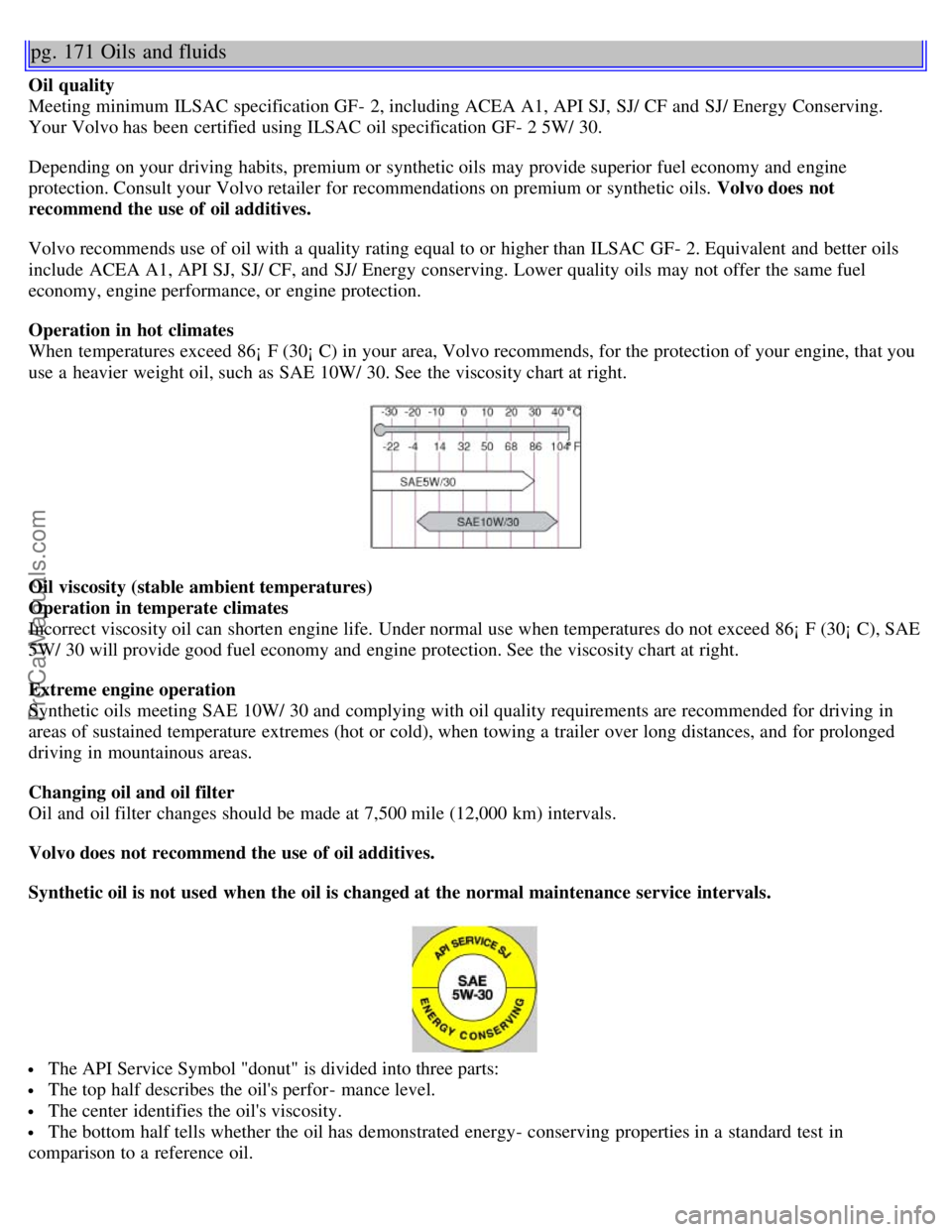
Operation in hot climates
When temperatures exceed 86¡ F (30¡ C) in your area, Volvo recommends, for the protection of your engine, that you
use a heavier weight oil, such as SAE 10W/ 30. See the viscosity chart at right.
Oil viscosity (stable ambient temperatures)
Operation in temperate climates
Incorrect viscosity oil can shorten engine life. Under normal use when temperatures do not exceed 86¡ F (30¡ C), SAE
5W/ 30 will provide good fuel economy and engine protection. See the viscosity chart at right.
Extreme engine operation
Synthetic oils meeting SAE 10W/ 30 and complying with oil quality requirements are recommended for driving in
areas of sustained temperature extremes (hot or cold), when towing a trailer over long distances, and for prolonged
driving in mountainous areas.
Changing oil and oil filter
Oil and oil filter changes should be made at 7,500 mile (12,000 km) intervals.
Volvo does not recommend the use of oil additives.
Synthetic oil is not used when the oil is changed at the normal maintenance service intervals.
The API Service Symbol "donut" is divided into three parts:
The top half describes the oil's perfor - mance level.
The center identifies the oil's viscosity.
The bottom half tells whether the oil has demonstrated energy- conserving properties in a standard test in
comparison to a reference oil.
ProCarManuals.com
Page 113 of 128
Capacity weight
All models
USA 890 lbs (400 kg)
Canada 400 kg
Permissible axle weights, front *
5 cyl.
USA 2330 lbs (1057 kg)
Canada 1060 kg
5 cyl. turbo
USA 2400 lbs (1089 kg)
Canada 1010 kg
Permissible axle weights, rear *
All models
USA 2220 lbs (1007 kg)
Canada 1010 kg
Curb weight
5 cyl.
USA 3220- 3330 lbs (1461- 1510 kg)
Canada 1470- 1515 kg
5 cyl. turbo
USA 3370- 3470 lbs (1529- 1547 kg)
Canada 1535- 1580 kg
Max. loads,
Max. roof load 220 lbs 100 kg
Max. trailer weight
without brakes 1100 lbs (500 kg)
with brakes 2" ball 3300 lbs (1500 kg)
1 7/ 8" ball 3300 lbs (1500 kg)
Max. tongue weight ** 165 lbs (75 kg)
* Permissible axle weight or gross vehicle weight must never be exceeded.
** See also section "Trailer towing"
WARNING!
When adding accessories, equipment, luggage and other cargo to your vehicle, the total capacity weight must not be
exceeded.
pg. 194 Capacities
Fuel tank 18.5/ 21.1 US gal. (70/ 80 liters) *
Engine oil
ProCarManuals.com
Page 125 of 128

SRS12
Stability system139
Start inhibitor (immobilizer)116
Starter switch and steering wheel lock129
Starting the car128
STC (Stability Traction Control)34, 37, 139
Steering wheel adjustment36
Steering wheel lock129
Stone chips162
STOP ENGINE35
STOP SAFELY ASAP35
Storage compartments107
Storage compartments in the passenger compartment106
Studded tires153
Sun roof (electrically operated)49
Sun visor50
Supplemental Restraint System (SRS)12
Supplemental Restraint System (SRS) - warning light33
Suspension197
Switches in the center console37
T
Tachometer30
Temperature (climate control)55
Temperature gauge30
Temporary spare tire154
Text window - messages35
Tire economy - improving152
Tires152
Tires - tread wear indicators155
Tools113
Towing141
Towing a trailer144
Trailer indicator lamp33
Trailer towing144
Trip computer43
Trip odometer30
Trunk - unlocking120
Type designations192
U
Uniform Tire Quality Grading157
, 158
Unlocking119
Unlocking the trunk120
V
Vanity mirror105
ProCarManuals.com