2001 VOLVO S60 tow
[x] Cancel search: towPage 64 of 128

release of the powder may appear as smoke- like matter. This is a normal characteristic and does not indicate fire.
NOTE: Volvo's dual- threshold, dual- stage airbags use special sensors that are integrated with the front seat buckles.
The point at which the airbag deploys is determined by whether or not the seat belt is being used, as well as the
severity of the collision. Collisions can occur where only one of the airbags deploys.
If the impact is less severe, but severe enough to present a clear injury risk, the dual- stage airbags are triggered at
just 70% of their total capacity. If the impact is more severe, the dual- stage airbags are triggered at full capacity.
WARNING!
Do not use child safety seats or child booster cushions/ backrests in the front passenger's seat. We also recommend
that occupants under 4 feet 7 inches (140 cm) in height who have outgrown these devices sit in the rear seat with the
seat belt fastened. Never drive with the airbags deployed. The fact that they hang out can impair the steering of your
car. Other safety systems can also be damaged. The smoke and dust formed when the airbags are deployed can
cause skin and eye irritation in the event of prolonged exposure.
pg. 14 Airbags (Supplemental Restraint System)
WARNING!
Children must never be allowed in the front passenger's seat. Volvo recommends that ALL occupants (adults and
children) shorter than 4 feet 7 inches (140 cm) be seated in the back seat of any vehicle with a front passenger -side
airbag. See page 28
for guidelines.
Occupants in the front passenger's seat must never sit on the edge of the seat, sit leaning toward the instrument
panel or otherwise sit out of position. The occupant's back must be as upright as comfort allows and be against the
seat back with the seat belt properly fastened.
Feet must be on the floor, e. g. not on the dash, seat or out of the window. No objects or accessory equipment, e. g.
dash covers, may be placed on, attached to, or installed near the SRS hatch (the area above the glove compartment)
or the area affected by airbag deployment (see illustration on page 12
).
There should be no loose articles, e. g. coffee cups, on the floor, seat or dash area. Never try to open the SRS cover
on the steering wheel or the passenger side dash. This should only be done by an authorized Volvo service
technician.
Failure to follow these instructions can result in injury to the vehicle occupants
Warning light in the instrument panel
A self - diagnostic system incorporated in the sensor monitors the SRS. This system does not, however, monitor the
Side Impact Protection System (SIPS) airbags. If a fault is detected, the warning light will illuminate. The light is
included in the warning/ indicator light cluster in the instrument panel. Normally, the SRS warning lamp should light
ProCarManuals.com
Page 65 of 128

up when the ignition key is turned to positions I, II or III and should go out after 7 seconds or when the engine is
started. Check that this light is functioning properly every time the car is started.
The following items are monitored by the self - diagnostic system:
Sensor unit
Cable harness
Gas generator
WARNING!
If the SRS warning light stays on after the engine has started or if it comes on while you are driving, drive the car to
the nearest authorized Volvo retailer for inspection as soon as possible.
pg. 15 Airbags (Supplemental Restraint System)
NOTE: The information on this page does not pertain to the Side Impact Protection System airbags.
When are the airbags deployed?
The SRS system is designed to deploy during certain frontal or front -angular collisions, impacts, or decelerations,
depending on the crash severity, angle, speed and object impacted. The SRS sensor is designed to react to both the
impact of the collision and the inertial forces generated by it and to determine if the intensity of the collision is
sufficient for the seat belt tensioners or airbags to be deployed. If the airbags have been deployed, we recommend the
following:
Have the car towed to an authorized Volvo retailer. Never drive with the airbags deployed.
Have an authorized Volvo retailer replace the SRS system components.
Use only new, Genuine Volvo Parts when replacing SRS components (airbags, seat belts, tensioners, etc.).
When are the airbags NOT deployed?
Not all frontal collisions activate the SRS system. If the collision involves a nonrigid object (e. g., a snow drift or
bush), or a rigid, fixed object at a low speed, the SRS system will not necessarily deploy. Front airbags do not
normally deploy in a side impact collision, in a collision from the rear or in a rollover situation. The amount of
damage to the bodywork does not reliably indicate if the airbags should have deployed or not.
Seat belts - the heart of the Volvo safety system
The heart of the Volvo safety system is the three-point seat belt (a Volvo invention)! In order for the SRS system to
provide the protection intended, seat belts must be worn at all times by everyone in the car. The SRS system is a
supplement to the seat belts.
WARNING!
Never drive with the airbags deployed. The fact that they hang out can impair the steering of your car. Other safety
systems can also be damaged. The smoke and dust formed when the airbags are deployed can cause skin and eye
irritation in the event of prolonged exposure.
pg. 16 Airbags (Supplemental Restraint System)
WARNING!
ProCarManuals.com
Page 66 of 128
If your car has been subjected to flood conditions (e. g. soaked carpeting/ standing water on the floor of the vehicle)
or if your car has become flood-damaged in any way, do not attempt to start the vehicle or put the key in the
ignition before discon- necting the battery (see below). This may cause airbag deployment which could result in
personal injury. Have the car towed to an authorized Volvo retailer for repairs.
Automatic transmission:
Before attempting to tow the car, use the following procedure to override the shiftlock system to move the gear
selector to the neutral position.
Switch off the ignition for at least 10 minutes and disconnect the battery
Wait at least one minute
Insert the key in the ignition and turn it to position II
Press firmly on the brake pedal.
Move the gear selector from (P) ark to the (N) eutral position.
There is no maintenance to perform on the SRS yourself. The month and year shown on the decal on the door pillar
indicate when you should contact your Volvo retailer for specific servicing or replacement of airbags and seat belt
tensioners. This service must be performed by an authorized Volvo retailer.
Should you have any questions about the SRS system, please contact your authorized Volvo retailer or Volvo
Customer Support.:
In the USA:
Volvo Cars of North America
Customer Relations
P.O. Box 914
Rockleigh, New Jersey 07647-0914
800-458-1552
In Canada:
Volvo Canada Ltd.
175 Gordon Baker Road
Willowdale, Ontario M2H 2N7
800-663-8255
pg. 17 Airbags (Supplemental Restraint System)
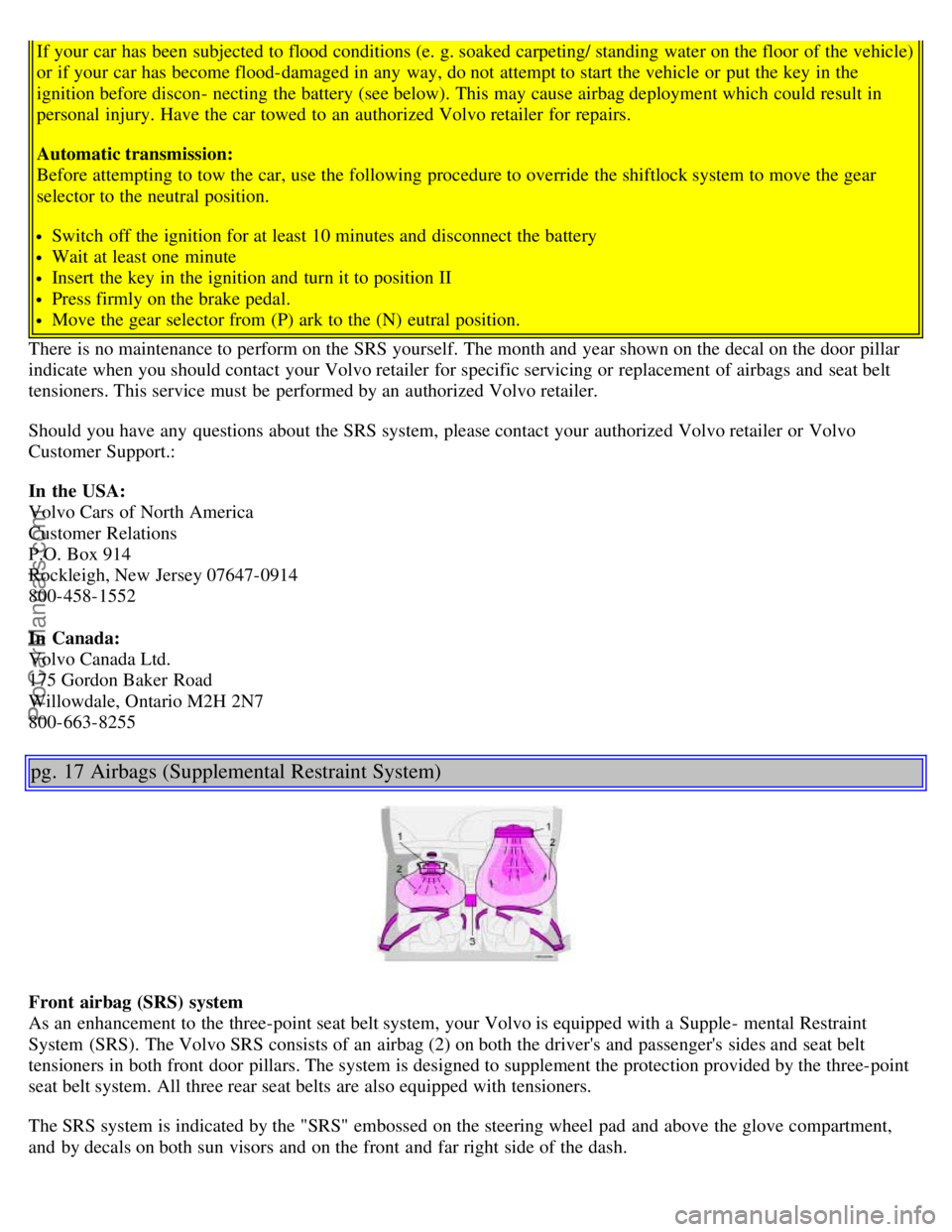
Front airbag (SRS) system
As an enhancement to the three-point seat belt system, your Volvo is equipped with a Supple- mental Restraint
System (SRS). The Volvo SRS consists of an airbag (2) on both the driver's and passenger's sides and seat belt
tensioners in both front door pillars. The system is designed to supplement the protection provided by the three-point
seat belt system. All three rear seat belts are also equipped with tensioners.
The SRS system is indicated by the "SRS" embossed on the steering wheel pad and above the glove compartment,
and by decals on both sun visors and on the front and far right side of the dash.
ProCarManuals.com
Page 69 of 128
2 0 0 1
VOLVO S60
Locks and alarm
pg. 115 Locks and alarm
Keys and remote controls 116
Locking and unlocking119
Child safety lock121
Alarm122
pg. 116 Keys and remote controls
Keys
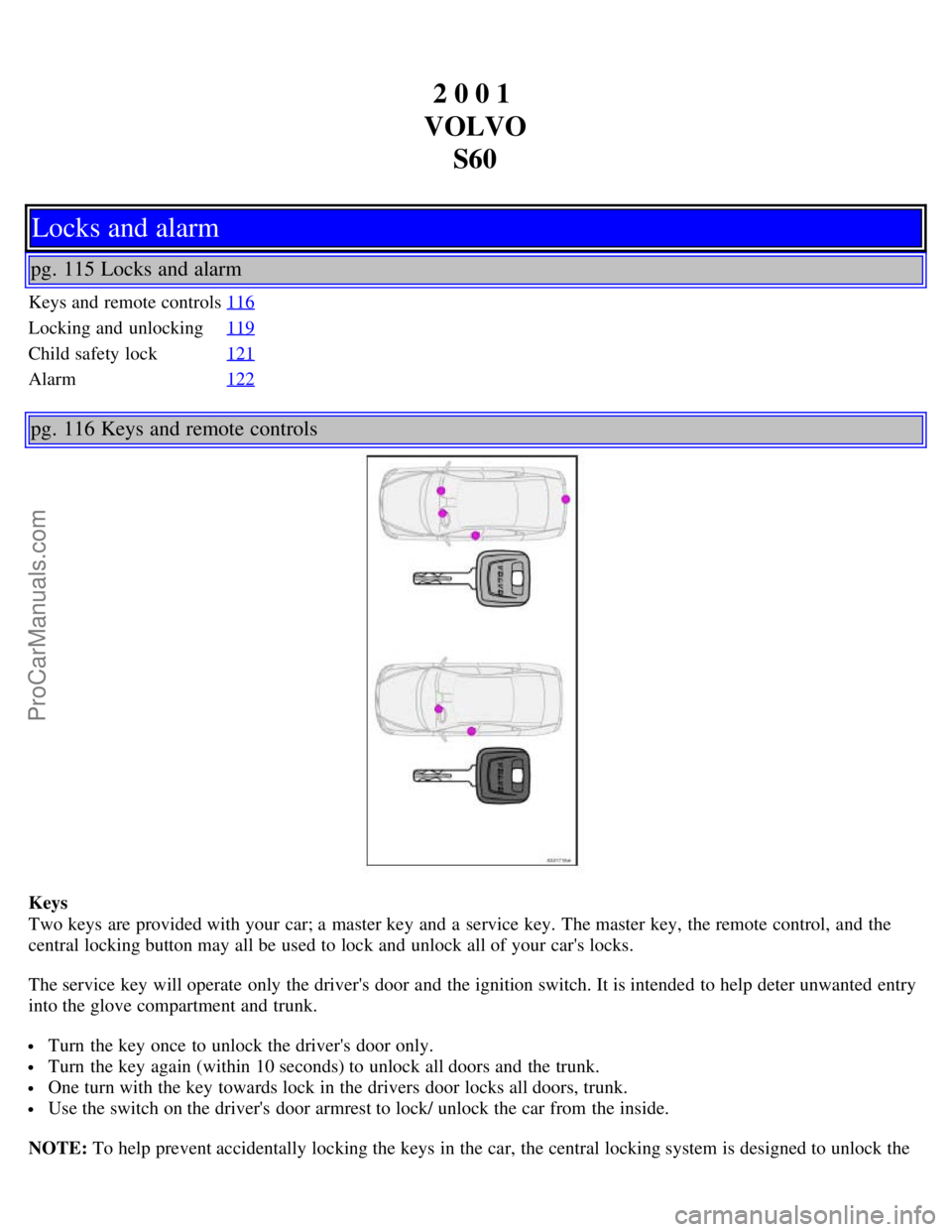
Two keys are provided with your car; a master key and a service key. The master key, the remote control, and the
central locking button may all be used to lock and unlock all of your car's locks.
The service key will operate only the driver's door and the ignition switch. It is intended to help deter unwanted entry
into the glove compartment and trunk.
Turn the key once to unlock the driver's door only.
Turn the key again (within 10 seconds) to unlock all doors and the trunk.
One turn with the key towards lock in the drivers door locks all doors, trunk.
Use the switch on the driver's door armrest to lock/ unlock the car from the inside.
NOTE: To help prevent accidentally locking the keys in the car, the central locking system is designed to unlock the
ProCarManuals.com
Page 74 of 128

Manual child safety locks - rear doors
The controls are located on the rear door jambs. Use a screwdriver to adjust these controls.
A The door cannot be opened from the inside. Normal operation from the outside.
B The door lock functions normally.
WARNING!
Remember, in the event of an accident, the rear seat passengers cannot open the doors from the inside with the
buttons in position A
pg. 122 Alarm
Alarm The alarm is automatically armed whenever you lock your car.
When armed, the alarm continuously monitors a number of points on the car. The following conditions will set off the
alarm:
The hood is forced open.
The trunk is forced open.
A door is forced open.
The ignition switch is tampered with.
If there is movement in the passenger compartment (if the car is equipped with the optional movement sensor).
The car is lifted or towed (if the car is equipped with the optional inclination sensor).
The battery is disconnected (while the alarm is armed).
The siren is disconnected when the alarm is disarmed.
ProCarManuals.com
Page 77 of 128

2 0 0 1
VOLVO S60
Starting and driving
pg. 125 Starting and driving
Refueling 126
Starting the car128
General information130
Manual transmission132
Automatic transmission (option)133
Geartronic (option )135
Brake system137
Stability system139
Towing141
Jump starting143
Towing a trailer144
Detachable trailer hitch - installing146
Detachable trailer hitch - removing147
Attaching load carriers148
Cold weather precautions149
Before a long distance trip150
pg. 126 Refueling
ENGINE OIL
Although some oil consumption occurs during normal engine operation, more oil is consumed when the engine is new
as the internal parts generate higher friction while wearing- in to each other. From the time the engine is new until the
first service is performed, the oil consumption could be higher than normal. For this reason, it is especially important
to check the oil every time you refuel your car during this period. See page 172
.
Fuel requirements
Octane rating
Volvo engines are designed for optimum performance on unleaded premium gasoline with an AKI octane rating of 91
or above. AKI (ANTI KNOCK INDEX) is an average of the Research Octane Number, RON, and the Motor Octane
Number, MON. (RON + MON/ 2). The minimum octane requirement is AKI 87 (RON 91).
Deposit control gasoline (detergent additives)
Volvo recommends the use of gasoline containing deposit control additives. These additives have shown to be
effective in keeping injectors and intake valves clean. Consistent use of deposit control gasolines will help ensure
good driveability and fuel economy. If you are not sure whether the gasoline contains deposit control additives, check
with the service station operator.
NOTE: Volvo does not recommend the use of external fuel injector cleaning systems. Unleaded fuel Each Volvo has
a three-way catalytic converter and must use only unleaded gasoline. U. S. and Canadian regulations require that
ProCarManuals.com
Page 80 of 128
Automatic transmission
The engine should be idling when you move the gear selector. Never accelerate until after you feel the transmission
engage! Acceler- ating immediately after selecting a gear will cause harsh engagement and premature transmission
wear.
Selecting P or N when idling at a standstill for prolonged periods of time will help prevent overheating of the
automatic trans - mission fluid.
WARNING!
Always place the gear selector in Park and apply the parking brake before leaving the vehicle. Never leave the car
unattended with the engine running.
Always open garage doors fully before starting the engine inside a garage to ensure adequate ventilation. The
exhaust gases contain carbon monoxide, which is invisible and odorless but very poisonous
Do not race a cold engine immediately after starting. Oil flow may not reach some lubrication points fast enough to
prevent engine damage.
* If two of the keys to your car are close together, e. g., on the same key ring, when you try to start the car, this could
cause interference in the immobilizer system and result in the car not starting. If this should occur, remove one of the
keys from the key ring before trying to start the car again.
pg. 129 Starting the car
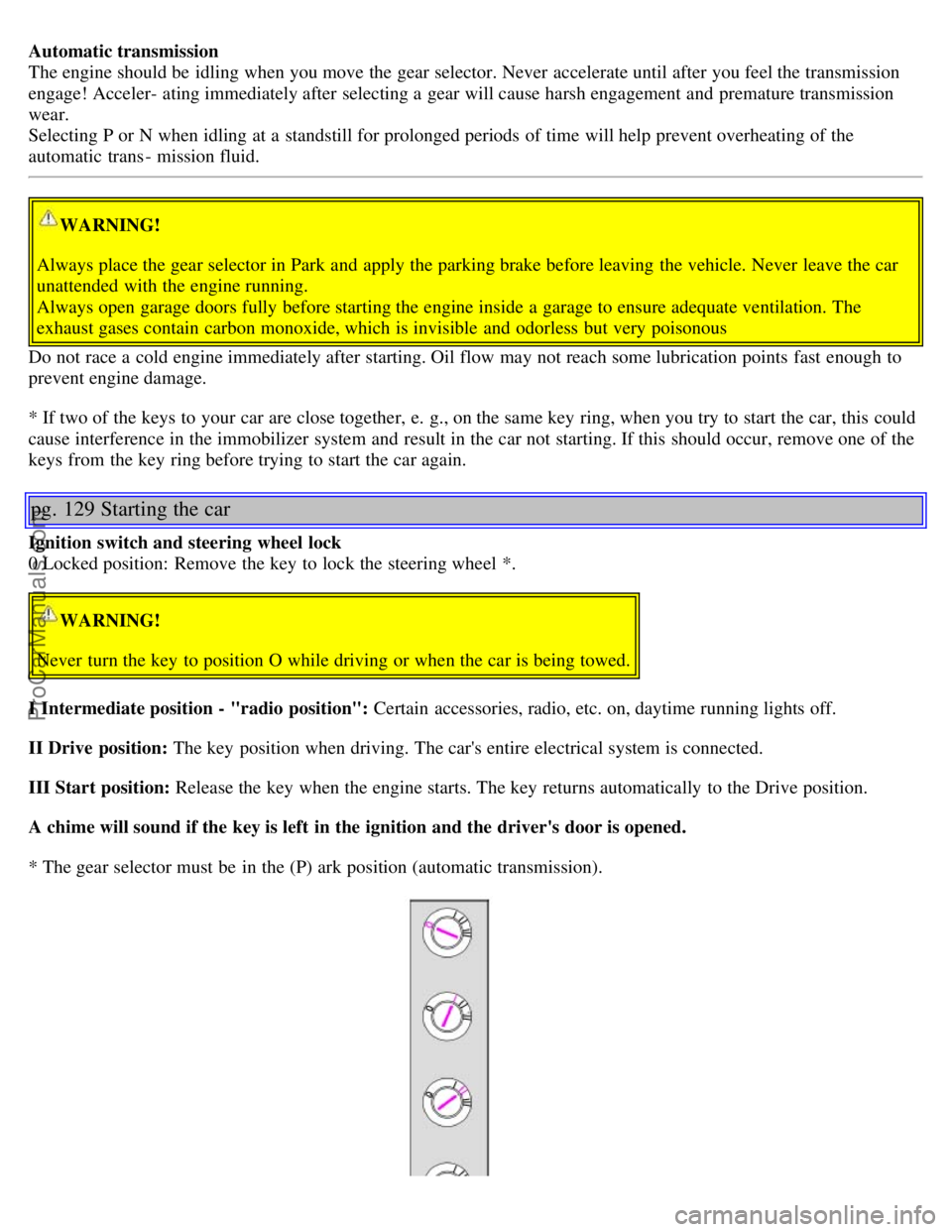
Ignition switch and steering wheel lock
0 Locked position: Remove the key to lock the steering wheel *.
WARNING!
Never turn the key to position O while driving or when the car is being towed.
I Intermediate position - "radio position": Certain accessories, radio, etc. on, daytime running lights off.
II Drive position: The key position when driving. The car's entire electrical system is connected.
III Start position: Release the key when the engine starts. The key returns automatically to the Drive position.
A chime will sound if the key is left in the ignition and the driver's door is opened.
* The gear selector must be in the (P) ark position (automatic transmission).
ProCarManuals.com
Page 84 of 128

D (Drive)
D is the normal driving position and should be used as often as possible to help improve fuel economy. The car
should not be moving when shifting from R to the D position.
Neutral control
When the engine is idling, the gear selector is in the Drive position and the brake pedal is depressed, the
transmission will automatically switch to neutral.
The transmission will automatically return to Drive when the brake pedal is released.
This function has been added to help reduce emissions and fuel consumption.
4 (Intermediate gear)
The transmission will shift automatically between gears 4, 3, 2 or 1 from this position. The transmission cannot shift
up to (D) rive from fourth gear.
3 (Intermediate gear)
The transmission will shift automatically between gears 3, 2 and 1 from this position. The transmission cannot shift up
to fourth gear or (D) rive from third gear.
L (Low gears)
The transmission is locked in gears 1 and 2 when the selector is in this position.
NOTE: Gears 4, 3, or L can be used if you are driving in a mountainous area, towing a trailer or to increase engine
braking effect.
The transmission has a built- in limiter designed to help prevent excessive engine speeds (high rpm) when gears 4, 3
or L are selected.
pg. 134 Automatic transmission (option)
W - Winter/ Wet driving mode - enhanced vehicle traction
Mode W will only function if the gear selector is in the (D) rive position.
Press the button at the base of the gear selector to engage/ disengage this driving mode (see illustration).
When the W driving mode is engaged, this is displayed in the instrument panel (see page 30).
This mode may be selected for starting/ moving off on slippery roads.
ProCarManuals.com