2001 VOLVO S60 service
[x] Cancel search: servicePage 88 of 128

needed, depress the pedal occasionally when driving through rain, slush etc. This will remove the water from the
brakes. Check that brake application feels normal. This should also be done after washing or starting in very damp or
cold weather.
Severe strain on the brake system
The brakes will be subject to severe strain when driving in mountains or hilly areas or towing. Vehicle speed is
usually slower, which means that the cooling of the brakes is less efficient than when driving on level roads. To
reduce the strain on the brakes, it is advisable not to use the brakes excessively. Instead, shift into a lower gear and let
the engine help with the braking. Do not forget that, if you are towing a trailer, the brakes will be subjected to a
greater than normal load.
pg. 138 Brake system
Anti-lock brakes (ABS)
If the warning lamp lights up there is a malfunction of the ABS system (the standard braking system will however
function) and the vehicle should be driven cautiously to a Volvo retailer for inspection. The Anti-lock Braking
System (ABS) helps to improve vehicle control (stopping and steering) during severe braking conditions by limiting
brake lockup. When the system "senses" impending lockup, braking pressure is automatically modulated in order to
help prevent lockup, which could lead to a skid.
The system performs a self - diagnostic test when the engine is started and when the vehicle first reaches a
speed of approximately 12 mph (20 km/ h). The brake pedal will pulsate several times and a sound may be audible
from the ABS control module. This is normal.
To obtain optimal effect from the ABS system, constant pressure should be kept on the brake pedal, keep constant
pressure on the brake pedal. Do not pump the brake pedal.
The switching of the ABS modulator will be audible and the brake pedal will pulsate during braking. Please be aware
that ABS does not increase the absolute braking potential of the vehicle. While control will be enhanced, ABS will
not shorten stopping distances on slippery surfaces.
ABS with EBD (Electronic Brake Force Distribution)
EBD is an integrated part of the ABS system. EBD regulates the hydraulic pressure to the rear brakes to help provide
optimal braking capacity.
If the BRAKE and ABS warning lights come on at the same time, this could indicate a fault in the brake system.
Stop the car in a suitable place and switch off the engine.
Restart the engine.
If both warning lights go off, no further action is required.
If both lights are still on after the engine has been restarted, switch off the engine again and check the brake fluid
level (see page 170 for the location of the brake fluid reservoir).
If the brake fluid level is above the MIN mark, drive carefully to an authorized Volvo retailer and have the brake
system inspected.
WARNING!
If the fluid level is below the MIN mark in the reservoir or if a "Brake failure - Service urgent" message is
displayed in the text window: DO NOT DRIVE. Have the car towed to a Volvo retailer and have the brake system
inspected.
ProCarManuals.com
Page 96 of 128

greased.
pg. 158 Uniform Tire Quality Grading
Uniform Tire Quality Grading
ALL PASSENGER CAR TIRES MUST CONFORM TO FEDERAL SAFETY REQUIREMENTS IN
ADDITION TO THESE GRADES
Quality grades can be found, where appli- cable, on the tire sidewall between the tread shoulder and maximum
section width. For example:
Treadwear 200 Traction AA Temperature A
TREADWEAR
The treadwear grade is a comparative rating based on the wear rate of the tire when tested under controlled conditions
on a specified government test course. For example, a tire graded 150 would wear one and one half (1 1/ 2) times as
well on the government course as a tire graded 100. The relative performance of tires depends upon the actual
conditions of their use, however, and many depart significantly from the norm due to variation in driving habits,
service practices and differences in road charac- teristics and climate.
TRACTION
The traction grades, from highest to lowest, are AA, A, B, and C, as measured under controlled conditions on
specified government test surfaces of asphalt and concrete. A tire marked C may have poor traction performance..
WARNING!
The traction grade assigned to this tire is based on braking (straight- ahead) traction tests and is not a measure of
cornering (turning) traction.
TEMPERATURE
The temperature grades are AA (the highest), A, B, and C, representing the tire's resistance to the generation of heat
and its ability to dissipate heat when tested under controlled conditions on a specified indoor laboratory test wheel.
Sustained high temperature can cause the material of the tire to degenerate and reduce tire life, and excessive
temperature can lead to sudden tire failure. The grade C corresponds to a minimum level of performance that all
passenger car tires must meet under the Federal Motor Safety Standard No. 109. Grades B and A represent higher
levels of performance on the laboratory test wheel than the minimum required by law.
WARNING!
The temperature grade for this tire is established for a tire that is properly inflated and not overloaded. Excessive
speed, under-inflation, or excessive loading, either separately or in combination, can cause heat buildup and
possible tire failure.
Contents | Top of Page
ProCarManuals.com
Page 101 of 128

2 0 0 1
VOLVO S60
Maintenance and service
pg. 163 Maintenance and service
Volvo service 164
Maintenance Schedule165
Working on your car168
Hood and engine compartment170
Oils and fluids171
Wiper blades175
Battery176
Bulbs179
Fuses186
pg. 164 Volvo service
Maintenance service
Volvo advises you to follow the service program outlined in the Warranty and Service Records Information booklet.
This maintenance program contains inspections and services necessary for the proper function of your car. The
maintenance services contain several checks which require special instruments and tools and therefore must be
performed by a qualified technician. To keep your Volvo in top condition, specify time- tested and proven Genuine
Volvo Parts and Accessories.
The Federal Clean Air Act - U. S.
The Clean Air Act requires vehicle manufacturers to furnish written instructions to the ultimate purchaser to assure
the proper functioning of those components that control emissions. The maintenance instructions listed in this manual
represent the minimum maintenance required. These services are not covered by the warranty. You will be required to
pay for labor and material used. Refer to your Warranty and Service Records Information booklet for further details.
Maintenance services
Your Volvo has passed several major inspec- tions before being delivered to you, according to Volvo specifications.
The maintenance services outlined in this book should be performed as indicated. The extended maintenance service
intervals make it even more advisable to follow this program. Inspection and service should also be performed any
time a malfunction is observed or suspected. It is recommended that receipts for vehicle emission services be retained
in the event that questions arise concerning maintenance. See your Warranty and Service Records Information
booklet. Applicable warranties - U. S. In accordance with U. S. Federal Regulations, the following list of applicable
U. S. warranties is provided. For Canadian specification vehicles, see your separate warranty booklet.
New Car Limited Warranty
Parts and Accessories Limited Warranty
Corrosion Protection Limited Warranty
Seat Belt and Supplemental Restraint Systems Limited Warranty
Emission Design and Defect Warranty
Emission Performance Warranty
ProCarManuals.com
Page 102 of 128

These are the Federal warranties; other warranties are provided as required by state law. Refer to your separate
Warranty and Service Records Information booklet for detailed information concerning each of the warranties.
pg. 165 Maintenance Schedule2001
MAINTENANCE SCHEDULE S60
For complete maintenance information, please refer to your
Warranty and Service Records Information Booklet.
R = Replace
I = Inspect (Correct or Replace if necessary)
L = Lubricate
Maintenance Operationthousand miles 7.51522.5 3037.5 4552.5 6067.5 7582.5
90 2
(thousand km)(12)(24)(36) (48)(60)(72)(84)(96) (108) (120)(132)(144)
EMISSION SYSTEM MAINTENANCE
Engine oil and filter
1R RR RRRRR R RRR
Engine drive belt (accessory belt) I
Air cleaner filter R R R
Spark plugs R R R
Automatic transmission fluid I I I I I I
Timing belt - all engines
3
1) See section "Engine oil" for detailed information.
NOTE: The oil should be changed at these intervals, after 750 hours of driving or after 12 months, whichever
occurs first.
2) For services beyond 90,000 miles (144,000 km), please refer to the Warranty and Service Records
Information Booklet".
3) For proper functioning of the vehicle and its emission control systems, the timing belt and tensioner must be
replaced every 105,000 miles (168,000 km).
pg. 166 Maintenance Schedule
2001
MAINTENANCE SCHEDULE S60
R = Replace
I = Inspect (Correct or Replace if necessary)
L = Lubricate
Maintenance Operationthousand miles 7.51522.5 3037.5 4552.5 6067.5 7582.5 90
ProCarManuals.com
Page 107 of 128
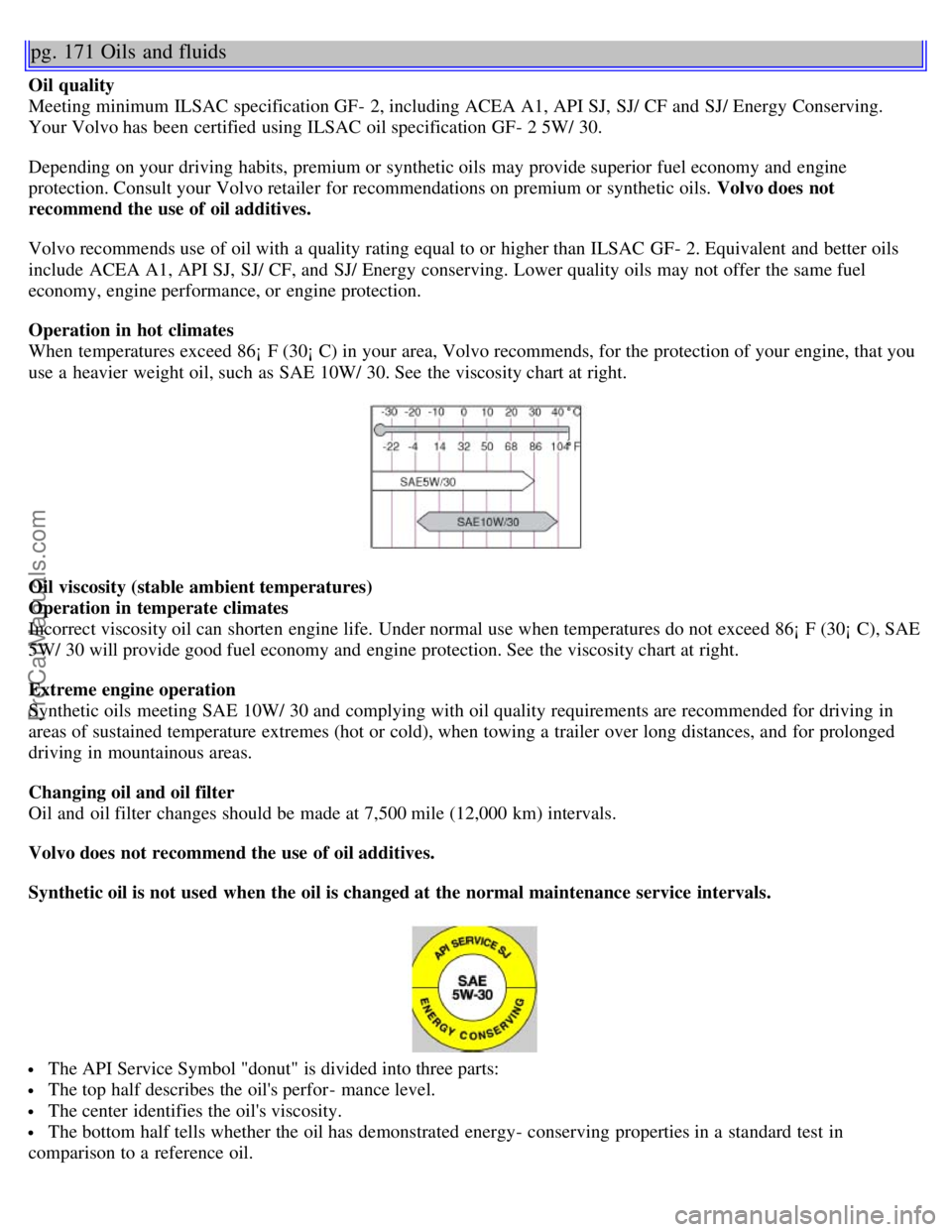
pg. 171 Oils and fluids
Oil quality
Meeting minimum ILSAC specification GF- 2, including ACEA A1, API SJ, SJ/ CF and SJ/ Energy Conserving.
Your Volvo has been certified using ILSAC oil specification GF- 2 5W/ 30.
Depending on your driving habits, premium or synthetic oils may provide superior fuel economy and engine
protection. Consult your Volvo retailer for recommendations on premium or synthetic oils. Volvo does not
recommend the use of oil additives.
Volvo recommends use of oil with a quality rating equal to or higher than ILSAC GF- 2. Equivalent and better oils
include ACEA A1, API SJ, SJ/ CF, and SJ/ Energy conserving. Lower quality oils may not offer the same fuel
economy, engine performance, or engine protection.
Operation in hot climates
When temperatures exceed 86¡ F (30¡ C) in your area, Volvo recommends, for the protection of your engine, that you
use a heavier weight oil, such as SAE 10W/ 30. See the viscosity chart at right.
Oil viscosity (stable ambient temperatures)
Operation in temperate climates
Incorrect viscosity oil can shorten engine life. Under normal use when temperatures do not exceed 86¡ F (30¡ C), SAE
5W/ 30 will provide good fuel economy and engine protection. See the viscosity chart at right.
Extreme engine operation
Synthetic oils meeting SAE 10W/ 30 and complying with oil quality requirements are recommended for driving in
areas of sustained temperature extremes (hot or cold), when towing a trailer over long distances, and for prolonged
driving in mountainous areas.
Changing oil and oil filter
Oil and oil filter changes should be made at 7,500 mile (12,000 km) intervals.
Volvo does not recommend the use of oil additives.
Synthetic oil is not used when the oil is changed at the normal maintenance service intervals.
The API Service Symbol "donut" is divided into three parts:
The top half describes the oil's perfor - mance level.
The center identifies the oil's viscosity.
The bottom half tells whether the oil has demonstrated energy- conserving properties in a standard test in
comparison to a reference oil.
ProCarManuals.com
Page 108 of 128

pg. 172 Oils and fluids
Checking the oil level
The oil level should be checked every time the car is refueled. This is especially important during the period up to the
first service.
CAUTION:
Not checking the oil level regularly can result in serious engine damage if the oil level becomes too low.
Park the car on a level surface and wait for at least 5 minutes after the engine has been switched off. Be sure the oil
level is maintained between the upper and lower marks on the dipstick. Low oil level can cause internal damage to
the engine and overfilling can result in high oil consumption. The distance between the dipstick marks represents
approx. 1.6 US qt (1.5 liter). The oil should preferably be checked when cold, before the engine has been started.
NOTE: The engine must be stopped when checking the oil.
WARNING!
Do not allow oil to spill onto or come into contact with hot exhaust pipe surfaces.
Adding oil (topping up)
Add oil of the same kind as already used.
Capacity (including filter): Normally- aspirated 5- cylinder engine - 5.8 US qts (5.5 liters). Turbo 5- cylinder
engine - 6.1 US qts (5.8 liters).
The oil filter should be replaced at every oil change.
pg. 173 Oils and fluids
Washer fluid reservoir
The washer fluid reservoir is located in the engine compartment and holds approx. 4.7 US qts. (4.5 liters).
During cold weather, the reservoir should be filled with windshield washer solvent containing antifreeze.
ProCarManuals.com
Page 117 of 128

Bore (mm)8381 83
Stroke (mm) 9090 90
Cylinder displacement (dm
( l)) 2.44
2.3 2. 44
Compression ratio 10.3: 18.5: 1 9. 0: 1
Charge air cooler (Intercooler)
Turbocharged engines employ a turbocompressor to force air into the engine inlet manifold and a charge air cooler to
cool the compressed inlet air. The resulting increase in air flow raises pressure in the intake manifold and increases
engine power over that developed by the normally-aspirated engine. The charge air cooler (which resembles a
radiator) is located between the turbo- compressor and inlet manifold.
Fuel system
The engine is equipped with a multiport fuel injection system.
pg. 201 Transmission
Gear ratios Gear M56HM56LAW55-50
1st 3.07: 13.39: 14.77: 1
2nd 1.77: 11.90: 13.00: 1
3rd 1.19: 11.19: 11.96: 1
4th 0.87: 10.87: 11.32: 1
5th 0.70: 10.70: 11.02: 1
Reverse 2.99: 13.30: 13.23: 1
Final drive 4.25: 14.00: 12.44: 1
pg. 202 Volvo On Call
Volvo On Call
Your new Volvo comes with a four year ON CALL road assistance. Additional information, features, and benefits are
described in a separate information package in your glove compartment.
If you have misplaced your package, dial:
In the U. S. A.
1- 800-638-6586 (1-800-63-VOLVO)
In Canada:
1-800-263-0475
Mechanic certification
Volvo supports Voluntary Mechanic Certification by the A. S. E. (pertains to the USA only). Certified mechanics
have demonstrated a high degree of competence in specific areas. Besides passing exams each mechanic must also
have worked in the field for two or more years before a certificate is issued. These professional mechanics are fully
able to analyze vehicle problems and perform the necessary service procedures to keep your Volvo at peak operating
condition.
ProCarManuals.com
Page 121 of 128

Direction indicators40
Dolby Surround Pro Logic78
Door mirror defroster42
Door mirrors37
Driving economically130
DSTC (Dynamic Stability Traction Control)34 , 38
Dual - threshold airbags13
E
ECC54
Economical driving130
Electric socket38 , 45
Electrical system199
Electrically operated windows46
Engine - starting128
Engine compartment170
Engine oil171
Engine oil, capacity194
Engine specifications200
Engine oil - checking172
Environment3
F
Fan55
, 59
Federal Clean Air Act164
FIX NEXT SERVICE35
Floor mats105
Fog lamp33 , 183
Front seat - backrest101
Front seats100
Front seats - heated42
Front seats - manual adjustment100
Front seats - power102
Front seats - power(programming the memory)103
Front suspension197
Fuel2 , 126
Fuel filler cap2 , 127
Fuel filler door2 , 127
Fuel gauge30
Fuel tank, capacity194
Fuses186
G
Gasoline126
Gear position132
Geartronic135
Geartronic - kickdown136
ProCarManuals.com