2001 SUZUKI GRAND VITARA ACC WIRE
[x] Cancel search: ACC WIREPage 260 of 656

ENGINE GENERAL INFORMATION AND DIAGNOSIS (H27 ENGINE) 6-1-99
1) Connect scan tool to DLC with ignition switch OFF.
2) Turn ON ignition switch and clear DTC, pending DTC and freeze frame data by using scan tool.
3) Start engine and warm up it completely.
4) Increase vehicle speed to 55 km/h (35 mph) or more.
5) Keep driving above vehicle speed for 20 min or more (Change of vehicle speed is permitted in this step).
6) Release accelerator pedal, stop vehicle and run engine at speed for 2 min.
7) Check DTC and pending DTC by using scan tool.
TROUBLESHOOTING
Step Action Yes No
1 Was “ENGINE DIAG. FLOW TABLE” per-
formed?Go to Step 2. Go to “ENGINE DIAG.
FLOW TABLE” in this
section.
2 Check EVAP canister purge system for opera-
tion referring to “EVAP CANISTER PURGE
SYSTEM INSPECTION” in this section.
Is check result satisfactory?Intermittent trouble or
faulty ECM (PCM).
Check for intermittent
referring to “INTERMIT-
TENT AND POOR CON-
NECTION” in Section 0A.Go to Step 3.
3 Check EVAP canister purge valve for resistance
referring to “EVAP CANISTER PURGE VALVE
INSPECTION” in this section.
Is resistance as specified?“GRN/BLK” or “BLU/BLK”
circuit open or short.
If wire and connections
are OK, substitute a
known-good ECM (PCM)
and recheck.Replace EVAP canister
purge valve.
Page 267 of 656
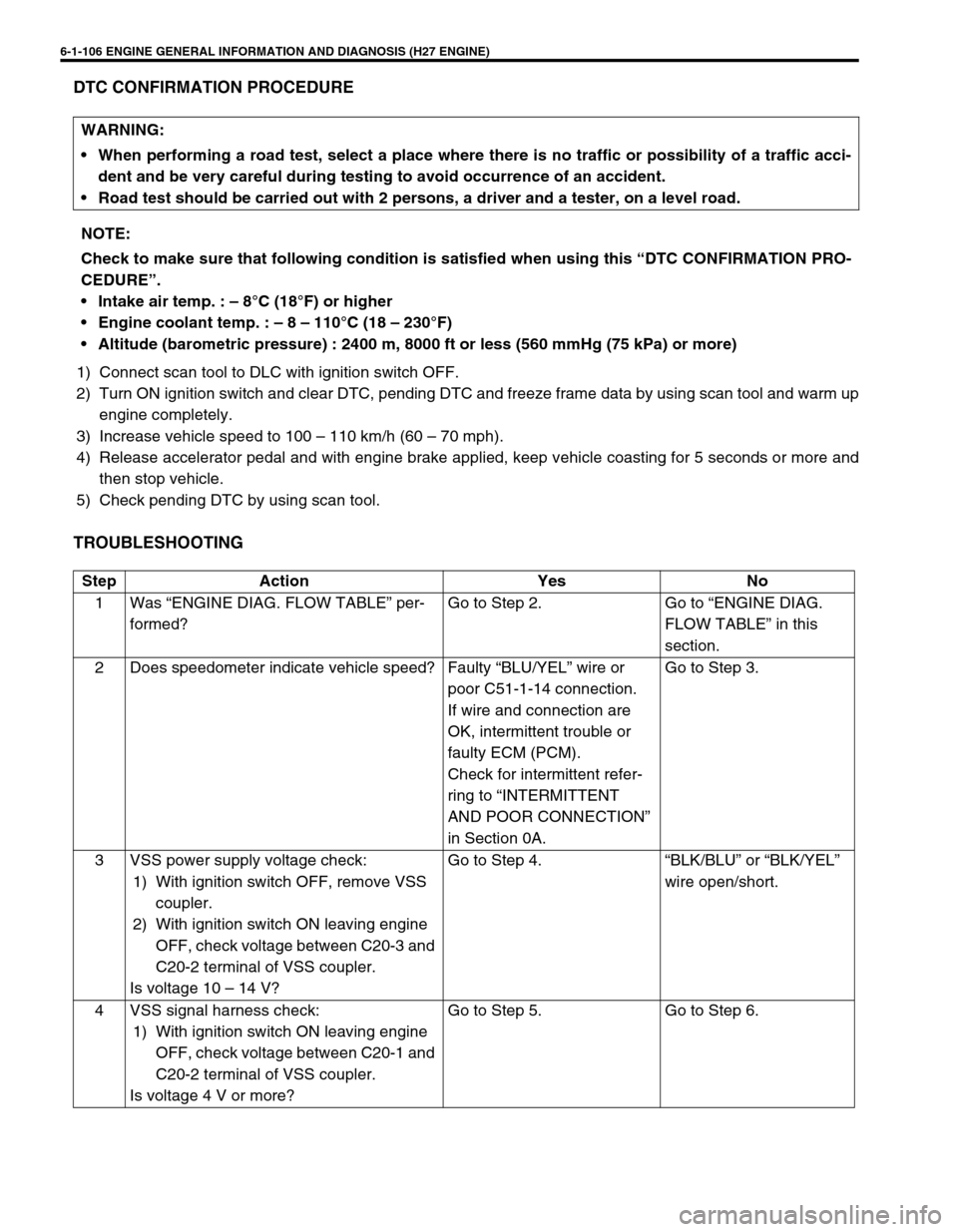
6-1-106 ENGINE GENERAL INFORMATION AND DIAGNOSIS (H27 ENGINE)
DTC CONFIRMATION PROCEDURE
1) Connect scan tool to DLC with ignition switch OFF.
2) Turn ON ignition switch and clear DTC, pending DTC and freeze frame data by using scan tool and warm up
engine completely.
3) Increase vehicle speed to 100 – 110 km/h (60 – 70 mph).
4) Release accelerator pedal and with engine brake applied, keep vehicle coasting for 5 seconds or more and
then stop vehicle.
5) Check pending DTC by using scan tool.
TROUBLESHOOTING
WARNING:
When performing a road test, select a place where there is no traffic or possibility of a traffic acci-
dent and be very careful during testing to avoid occurrence of an accident.
Road test should be carried out with 2 persons, a driver and a tester, on a level road.
NOTE:
Check to make sure that following condition is satisfied when using this “DTC CONFIRMATION PRO-
CEDURE”.
Intake air temp. : – 8°C (18°F) or higher
Engine coolant temp. : – 8 – 110°C (18 – 230°F)
Altitude (barometric pressure) : 2400 m, 8000 ft or less (560 mmHg (75 kPa) or more)
Step Action Yes No
1Was “ENGINE DIAG. FLOW TABLE” per-
formed?Go to Step 2. Go to “ENGINE DIAG.
FLOW TABLE” in this
section.
2 Does speedometer indicate vehicle speed? Faulty “BLU/YEL” wire or
poor C51-1-14 connection.
If wire and connection are
OK, intermittent trouble or
faulty ECM (PCM).
Check for intermittent refer-
ring to “INTERMITTENT
AND POOR CONNECTION”
in Section 0A.Go to Step 3.
3 VSS power supply voltage check:
1) With ignition switch OFF, remove VSS
coupler.
2) With ignition switch ON leaving engine
OFF, check voltage between C20-3 and
C20-2 terminal of VSS coupler.
Is voltage 10 – 14 V?Go to Step 4.“BLK/BLU” or “BLK/YEL”
wire open/short.
4 VSS signal harness check:
1) With ignition switch ON leaving engine
OFF, check voltage between C20-1 and
C20-2 terminal of VSS coupler.
Is voltage 4 V or more?Go to Step 5. Go to Step 6.
Page 283 of 656

6-1-122 ENGINE GENERAL INFORMATION AND DIAGNOSIS (H27 ENGINE)
3 Check IAC valve referring to “IAC VALVE
INSPECTION” in Section 6E2.
Is check result as specified?Go to Step 4. IAC valve malfunction, “BLU/
BLK”, “LT GRN/BLK”, “PPL/
BLK”, “GRY/BLU” or “PPL/
YEL” wire open or short or
poor coupler connection.
If all above are OK, substi-
tute a known-good ECM
(PCM) and recheck.
4 Was idle speed within specification in
Step 1?Check for following :
FIA valve, Vacuum leaks, air inhal-
ing, EVAP canister purge control
system, accessory engine load,
stuck of PCV valve, clog of idle air
passage, MAF sensor, TP sensor,
ECT sensor, EGR valve malfunc-
tion (leakage from valve seat), A/C
signal, transmission range switch
signal and power steering switch
signal.Go to Step 5.
5 Was idle speed higher than specification
in Step 1?Go to Step 6. Go to Step 8.
6 Check A/C (input) signal circuit referring
to Step 1 of “Table B-5”. (A/C signal can
be also checked by using SUZUKI scan
tool.)
Is it in good condition?Go to Step 7. A/C signal circuit open or
short, or A/C system mal-
function.
7 Was IAC duty less than about 2% in Step
1 of this table?
Check FIA valve.
Check abnormal air inhaling from
intake manifold, throttle body, PCV
valve and EVAP canister purge
control system.Check TP sensor (closed
throttle position) and ECT
sensor for performance.
If sensors are OK, substitute
a known-good ECM (PCM)
and recheck.
8 Check transmission range switch signal
referring to “INSPECTION OF ECM
(PCM) AND ITS CIRCUIT” in this section.
Is check result satisfactory?Go to Step 9. Transmission range switch
malfunction or its circuits
open or short.
9 Was IAC duty more than about 30% in
Step 1 of this table?Check parts or system which can
cause engine low idle.
Check FIA valve.
Air inhaling from between throttle
body and MAF sensor, EGR valve
malfunction (leakage from valve
seat), accessory engine load, clog
of idle air passage and etc.Substitute a known-good
ECM (PCM) and recheck. Step Action Yes No
Page 291 of 656

6A2-4 ENGINE MECHANICAL (H27 ENGINE)
8) Disconnect accelerator cable (1) and A/T throttle cable (2)
(for A/T vehicle) from throttle body.
9) Disconnect water hoses (3) from throttle body.
10) Disconnect injector wire (1) coupler.
11) Disconnect brake booster hose (2) from intake manifold.
12) Disconnect couplers of TP sensor (1) and IAC valve (2).
13) Disconnect earth terminal (3) from intake collector.
14) Remove clamp bracket (4) from intake collector.
15) Disconnect couplers from manifold absolute pressure (MAP)
sensor, EVAP canister purge valve, earth terminal and EGR
valve.
16) Disconnect PCV hose from cylinder head cover.
Disconnect breather hoses from throttle body or cylinder
head cover.
17) Disconnect hoses of EVAP canister purge valve and heater.
18) Remove EGR pipe.
12
33
2
1
2
14
3
1. EVAP canister purge valve 6. PCV hose
2. EGR valve 7. Water hose
3. EGR pipe 8. Breather hose
4. EVAP canister purge valve hose 9. Earth terminal coupler
5. Heater hose
9
4
1 7
6
2
35
8
Page 296 of 656

ENGINE MECHANICAL (H27 ENGINE) 6A2-9
26) Upon completion of installation, verify that there is no fuel
leakage at each connection according to procedure
described in Section 6.
Exhaust Manifold
REMOVAL
1) Disconnect negative (–) cable at battery.
2) Remove air cleaner upper case and intake air hose if right
side exhaust manifold is removed.
3) Detach couplers from their bracket and disconnect oxygen
sensor lead wires at couplers. WARNING:
To avoid danger of being burned, do not service exhaust
system while it is still hot. Service should be performed
after system has cooled off.
1. Left (No.1) exhaust manifold
Right (No.2) exhaust manifold
2. Exhaust manifold cover
3. Exhaust No.1 pipe
A. Without WU-TWC
B. With WU-TWC
1. HO2S-1 (Green connector)
2. HO2S-2 (Black connector)
Page 316 of 656

ENGINE MECHANICAL (H27 ENGINE) 6A2-29
3) Tighten bolts and nuts fastening cylinder block and transmis-
sion to specified torque.
Tightening torque
Transmission to cylinder block bolt and nut (b) :
85 N·m (8.5 kg-m, 61.5 lb-ft)
4) Remove lifting device
5) Tighten torque converter bolts to specified torque (for A/T
vehicle).
Tightening torque
Torque converter bolt (c) :
65 N·m (6.5 kg-m, 47.0 lb-ft)
6) Tighten bolts and nuts of exhaust No.1 pipe (1) to specified
torque.
Tightening torque
Exhaust No.1 pipe bolt and nut (d) :
50 N·m (5.0 kg-m, 36.5 lb-ft)
7) Install front differential housing with differential to chassis if
removed. Refer to “REMOUNTING” in Section 7E.
8) Install steering shaft lower assembly. Refer to “STEERING
LOWER SHAFT ASSEMBLY” in Section 3C1.
9) Install A/C compressor assembly. Refer to “COMPRESSOR
ASSEMBLY” in Section 1B.
10) Install P/S pump assembly. Refer to “POWER STEERING
PUMP” in Section 3B1.
11) Connect hoses, cables and electric wires.
12) Adjust accelerator cable play and A/T throttle cable play (for
A/T vehicle). Refer to “ACCELERATOR CABLE ADJUST-
MENT” and “A/T THROTTLE CABLE ADJUSTMENT (A/T
VEHICLE)” in Section 6E2.
13) Refill engine with engine oil referring to “ENGINE OIL
CHANGE” in Section 0B.
14) Refill cooling system, referring to “COOLING SYSTEM
FLUSH AND REFILL” in Section 6B.
15) Check to ensure that all fasteners and clamps are tightened.
16) Upon completion of installation, verify that there is no fuel
leakage, coolant leakage, P/S fluid leakage or exhaust gas
leakage at each connection.
1. Bolt (short)
2. Bolt (Long)
Page 348 of 656

ENGINE AND EMISSION CONTROL SYSTEM (SEQUENTIAL MULTIPORT FUEL INJECTION FOR H27 ENGINE) 6E2-15
Idle Speed/Idle Air Control (IAC) Duty Inspec-
tion
Before idle speed/IAC duty check, make sure of the following.
•Lead wires and hoses of engine/emission control systems
are connected securely.
•Accelerator cable is adjusted.
•Ignition timing is within specification.
•All accessories (wipers, heater, lights, A/C, etc.) are out of
service.
•Air cleaner has been properly installed and is in good condi-
tion.
•ECM (PCM) does not detect any malfunction DTC.
After above items are all confirmed, check idle speed and IAC
duty as follows.
[Using SUZUKI scan tool]
1) Connect SUZUKI scan tool to DLC with ignition switch OFF.
Special tool
(A) : SUZUKI scan tool
2) Warm up engine to normal operating temperature.
3) Check IAC duty and idle speed by using “Data List” mode of
SUZUKI scan tool.
Engine idle speed:
A/C OFF: 700 ± 50 r/min.
A/C ON: 750 ± 50 r/min.
IAC duty at specified idle speed:
5 – 40 % (at A/C OFF)
4) If duty and/or idle speed is out of specifications, check idle
air control system referring to “DIAG. FLOW TABLE B-4” in
Section 6-1.
5) Check that specified engine idle speed is obtained with A/C
ON if vehicle is equipped with A/C. If not, check A/C ON sig-
nal circuit and idle air control system. NOTE:
Before starting engine, place transmission gear shift
lever in “Neutral” (shift selector lever to “P” range for A/T
vehicle), and set parking brake and block drive wheels.
Page 353 of 656

6E2-20 ENGINE AND EMISSION CONTROL SYSTEM (SEQUENTIAL MULTIPORT FUEL INJECTION FOR H27 ENGINE)
CLEANING
Clean throttle body bore and bypass air passages (1) by blowing
compressed air.
INSTALLATION
1) Clean mating surfaces and install throttle body gasket to
intake collector (1) with new gasket (2).
2) Install throttle body to intake collector and tighten bolts.
3) Connect PCV hose.
4) Install throttle body and intake collector to intake manifold
with new intake collector gaskets.
5) Install EGR pipe with new gaskets.
6) Connect breather hose and EVAP canister purge valve hose
and install PCV valve to cylinder head.
7) Connect connectors of EVAP canister purge valve, MAP
sensor and EGR valve.
Fix wire harness with clamps.
8) Install clamp bracket to intake collector.
9) Connect ground wire connector.
10) Connect connectors of TP sensor, ground and IAC valve.
11) Install surge tank pipe to intake manifold with new gaskets
and intake air pipe to throttle body. Install surge tank cover.
12) Connect engine coolant hoses to throttle body.
13) Connect accelerator cable and A/T throttle cable (A/T).CAUTION:
Do not blow compressed air through bypass air pas-
sage with IAC valve installed to throttle body. This will
cause IAC valve to malfunction.
TP sensor, idle air control valve or other components
containing rubber must not be places in a solvent or
cleaner bath.
A chemical reaction will cause these parts to swell,
harden or get distorted.