Page 629 of 656
10B-52 AIR BAG SYSTEM
LIVE (UNDEPLOYED) AIR BAG (INFLATOR) MODULES
Special care is necessary when handling and storing a live (unde-
ployed) air bag (inflator) modules.
The rapid gas generation produced during deployment of the air
bag could cause the air bag (inflator) module, or an object in front
of the air bag (inflator) module, to be thrown through the air in the
unlikely event of an accidental deployment.
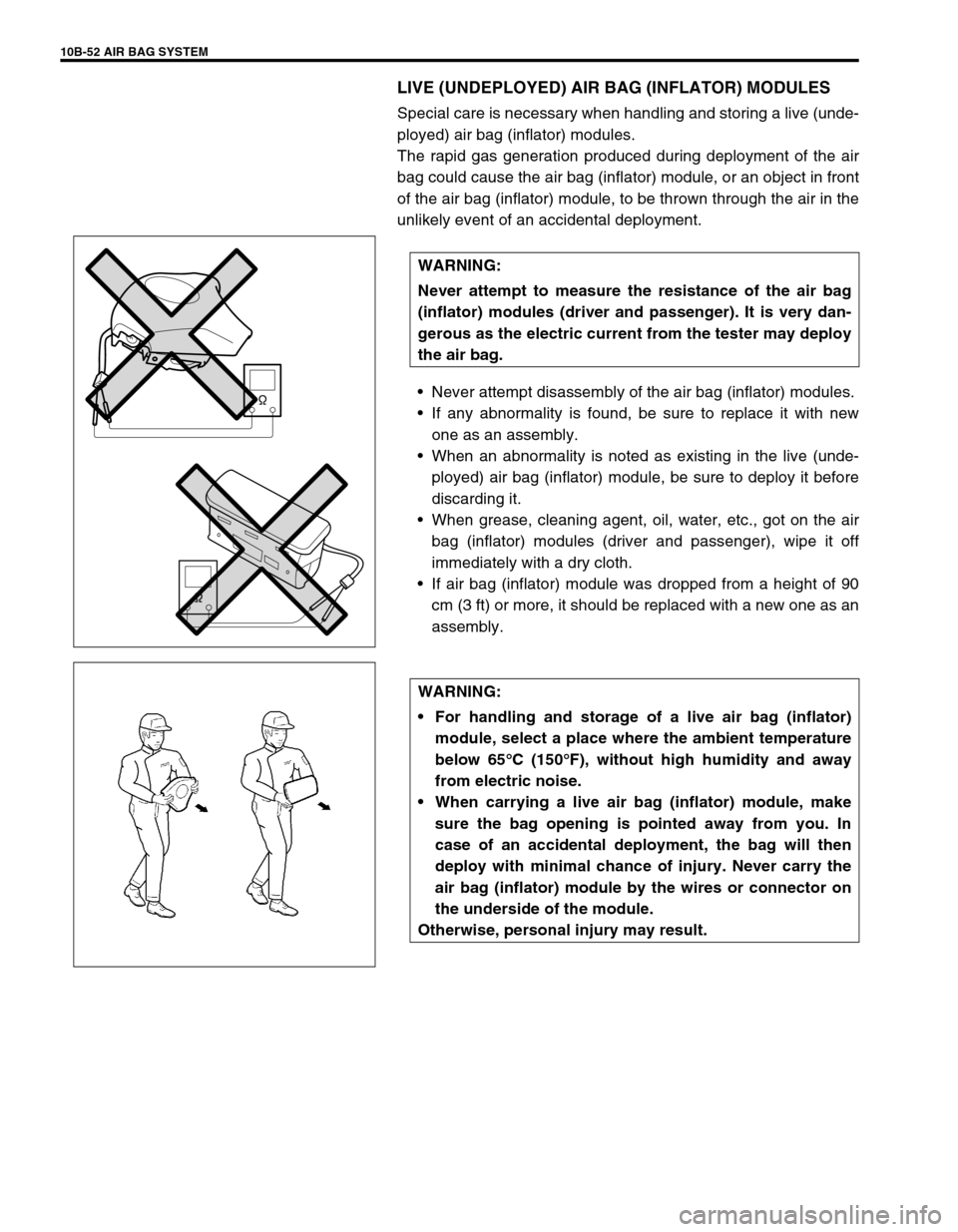
•Never attempt disassembly of the air bag (inflator) modules.
•If any abnormality is found, be sure to replace it with new
one as an assembly.
•When an abnormality is noted as existing in the live (unde-
ployed) air bag (inflator) module, be sure to deploy it before
discarding it.
•When grease, cleaning agent, oil, water, etc., got on the air
bag (inflator) modules (driver and passenger), wipe it off
immediately with a dry cloth.
•If air bag (inflator) module was dropped from a height of 90
cm (3 ft) or more, it should be replaced with a new one as an
assembly. WARNING:
Never attempt to measure the resistance of the air bag
(inflator) modules (driver and passenger). It is very dan-
gerous as the electric current from the tester may deploy
the air bag.
WARNING:
For handling and storage of a live air bag (inflator)
module, select a place where the ambient temperature
below 65°
°° °C (150°
°° °F), without high humidity and away
from electric noise.
When carrying a live air bag (inflator) module, make
sure the bag opening is pointed away from you. In
case of an accidental deployment, the bag will then
deploy with minimal chance of injury. Never carry the
air bag (inflator) module by the wires or connector on
the underside of the module.
Otherwise, personal injury may result.
Page 632 of 656

AIR BAG SYSTEM 10B-55
AIR BAG WIRE HARNESS AND CONNECTOR
Air bag wire harness (1) can be identified easily as it is covered
with a yellow protection tube. Be very careful when handling it.
•When an open in air bag wire harness (1), damaged wire
harness, connector or terminal is found, replace wire har-
ness, connectors and terminals as an assembly.
•When installing it, be careful so that the air bag wire harness
(1) is not caught or does not interfere with other parts.
•Make sure all air bag system grounding points (2) are clean
and grounds are securely fastened for optimum metal-to-
metal contact. Poor grounding can cause intermittent prob-
lems that are difficult to diagnose.
DISPOSAL
Do not dispose of the live (undeployed) air bag (inflator) modules
and the live (inactivated) seat belt pretensioners. When disposal
is necessary, be sure to deploy/activate the air bag and seat belt
pretensioner according to deployment/activation procedure
described in “AIR BAG (INFLATOR) MODULE AND SEAT BELT
PRETENSIONER DISPOSAL”.
15
21
WARNING:
Failure to follow proper air bag (inflator) module and seat
belt pretensioner disposal procedures can result in air
bag deployment and pretensioner activation which could
cause personal injury. Undeployed air bag (inflator) mod-
ule and inactivated seat belt pretensioner must not be
disposed of through normal refuse channels.
The undeployed air bag (inflator) module and inactivated
seat belt pretensioner contain substances that can cause
severe illness or personal injury if the sealed container is
damaged during disposal.
Page 633 of 656

10B-56 AIR BAG SYSTEM
Repairs and Inspections Required after an Accident
Accident with deployment/activation - component replacement
Certain air bag system components must be replaced. Those components are:
•Driver and passenger air bag (inflator) modules
–Replace with new one.
•Driver and Passenger seat belt pretensioners
–Replace with new one.
•SDM after detecting such collision as to meet deployment conditions
–Replace with new one.
•Forward sensors
–Replace with new one. CAUTION:
All air bag system components, including the electrical harness (component mounting points),
must be inspected after an accident. If any components are damaged or bent, they must be replaced
even if air bag system activation did not occur.
Never use air bag system parts from another vehicle.
Do not attempt to service the parts below. Service of these parts is by replacement only.
–Driver/Passenger air bag (inflator) modules, Driver/Passenger seat belt pretensioners
–Forward sensors
–SDM
–Contact coil and combination switch assembly
–Air bag wire harness
Proper operation of the sensors and air bag system requires that any repairs to the vehicle struc-
ture return it to its original production configuration.
CAUTION:
After detecting one time of such collision as to meet deployment conditions, the SDM must not be
used.
Refer to “AIR BAG DIAGNOSTIC SYSTEM CHECK” when checking the SDM.
Page 634 of 656

AIR BAG SYSTEM 10B-57
Accident with or without deployment/activation - component inspections
Certain air bag and restraint system components must be inspected after any crash, whether the air bag system
activated or not.
Those components are:
•Steering column and shaft joints
–Check for length, damage and bend according to “CHECK-
ING STEERING COLUMN FOR ACCIDENT DAMAGE” in
Section 3C1.
•Steering column bracket and capsules
–Check for damage and bent.
•If any faulty condition is found in above checks, replace faulty
part.
•Steering wheel and driver air bag (inflator) module
–Check for damage or air bag (inflator) module fitness.
–Check trim cover (pad surface) for cracks.
–Check wire harness and connector for damage or tightness.
•If any faulty condition is found in above checks, replace faulty
part.
•Contact coil and combination switch assembly
–Check wire harness and connectors for damage or tight-
ness.
–Check contact coil case for damage.
•If any faulty condition is found in above checks, replace.