Page 365 of 656

6E2-32 ENGINE AND EMISSION CONTROL SYSTEM (SEQUENTIAL MULTIPORT FUEL INJECTION FOR H27 ENGINE)
Mass air flow sensor (MAF sensor)
INSPECTION
1) Connect voltmeter (1) to “B+” terminal of MAF sensor (2)
coupler disconnected and ground (3).
2) Turn ignition switch ON and check that voltage is battery volt-
age.If not, check if wire harness is open or connection is
poor.
3) Turn ignition switch OFF and remove ECM/PCM cover (1)
from bracket.
4) Connect MAF sensor coupler to MAF sensor.
5) Turn ignition switch ON and check voltage at MAF sensor
output terminal of ECM/PCM connector (1).
MAF sensor output voltage
Voltage: 1.0 - 1.6 V
6) Start engine and check that voltage is lower than 5 V and it
rises as engine speed increases.
(Reference data: 1.7 – 2.0 V at specified idle speed)
If check result is not as specified above, cause may lie in
wire harness, coupler connection, MAF sensor or ECM/
PCM. NOTE:
Use voltmeter with high-impedance (10 kΩ
ΩΩ Ω/V minimum)
or digital type voltmeter.
Page 372 of 656

ENGINE AND EMISSION CONTROL SYSTEM (SEQUENTIAL MULTIPORT FUEL INJECTION FOR H27 ENGINE) 6E2-39
HEATER INSPECTION
Refer to “HEATED OXYGEN SENSOR (SENSOR 1) HEATER
INSPECTION”
Vehicle speed sensor (VSS)
ON-VEHICLE INSPECTION
1) Hoist vehicle.
2) Release parking brake lever, set transmission in neutral and
transfer in “2H”.
3) Remove ECM (PCM) cover.
4) Connector voltmeter between VSS terminal C51-3-1 of ECM
(PCM) connector and body ground.
5) Turn ignition switch ON and turn rear right tire slowly with
rear left tire locked.
Voltmeter should indicate deflection between 0 – 1 V and 8 –
14 V a few times while tire (1) is turned one revolution.
If check result is not satisfactory, proceed to flow table of
“DTC P0500” in Section 6-1.
REMOVAL, INSPECTION AND INSTALLATION
Refer to “VSS Removal, Inspection or Installation” in Section 7D.
Manifold absolute pressure sensor
REMOVAL
1) Disconnect negative (–) cable at battery.
2) Disconnect connector from manifold absolute pressure sen-
sor.
3) Remove manifold absolute pressure sensor from intake
manifold.
[A]: Terminal arrangement of ECM (PCM) coupler
(viewed from harness side)
1. VSS
Page 385 of 656

6F2-2 IGNITION SYSTEM (FOR H27 ENGINE)
General Description
The ignition system is a direct ignition system. It consists of the parts as described below and has an electronic
ignition control system.
•ECM (or PCM)
It detects the engine condition through the signals from the sensors, determines the most suitable ignition
timing and time for electricity to flow to the primary coil and sends a signal to the igniter (in ignition coil
assembly).
•Ignition coil assembly (including an igniter and an ignition coil)
The ignition coil assembly has a built-in igniter and ignition coil which turns ON and OFF the primary current
of the ignition coil according to the signal from ECM (or PCM). When the ignition coil primary current is
turned OFF, a high voltage is induced in the secondary wiring. One ignition coil is in charge of ignition of one
cylinder only.
•Spark plug and noise suppressor
•CMP sensor, TP sensor, ECT sensor, IAT sensor, VSS, knock sensor and MAF sensor
For their details, refer to Section 6E2.
This ignition system does not have a distributor and high-tension cords but each cylinder has an ignition coil
assembly (igniter and ignition coil) and the secondary voltage which occurred in the ignition coil is sent to the
spark plug directly. Also, the signal(s) are sent from the CMP sensor to ECM (or PCM) so as to control each igni-
tion coil independently through the igniter (in ignition coil assembly).
Components
NOTE:
For other components not found in this figure, refer to Section 6E2.
1. Ignition coil assembly (igniter and ignition coil)
2. CMP sensor
3. Noise suppressor
4. ECM (or PCM)
5. Spark plug
Page 386 of 656
IGNITION SYSTEM (FOR H27 ENGINE) 6F2-3
System Wiring
NOTE:
For ECM (PCM) terminal assignment, refer to Section 6E2.
1. To ignition switch 8. Ignition coil assembly (For No.3 cylinder)
2.“IG COIL METER” fuse 9. Ignition coil assembly (For No.4 cylinder)
3. ECM (or PCM) 10. Spark plug
4. CMP sensor 11. Ignition coil assembly (For No.5 cylinder)
5. Noise suppressor 12. Ignition coil assembly (For No.6 cylinder)
6. Ignition coil assembly (For No.1 cylinder) 13. To main relay
7. Ignition coil assembly (For No.2 cylinder) 14. Sensed information
Page 387 of 656

6F2-4 IGNITION SYSTEM (FOR H27 ENGINE)
Diagnosis
Diagnostic Flow Table
Condition Possible Cause Correction
Engine cranks, but will
not start or hard to
start (No spark)Blown fuse for ignition coil assembly Replace.
Loose connection or disconnection of lead wire Connect securely.
Faulty spark plug (s) Replace.
Faulty ignition coil assembly (s) Replace.
Faulty CMP sensor Replace.
Faulty ECM (or PCM) Replace.
Maladjusted ignition timing Adjust.
Poor fuel economy or
engine performanceIncorrect ignition timing Adjust.
Faulty spark plug(s) Replace.
Faulty ignition coil assembly (s) Replace.
Faulty CMP sensor Replace.
Faulty ECM (or PCM) Replace.
Faulty knock sensor Replace.
Step Action Yes No
1Was “ENGINE DIAGNOSTIC FLOW TABLE” in
Section 6-1 performed?Go to Step 2. Go to “ENGINE DIAG-
NOSTIC FLOW TABLE” in
Section 6-1.
2 Ignition Spark Test
1) Check all spark plug for condition and type,
referring to “SPARK PLUG” in this section.
2) If OK, perform ignition spark test, referring
to “IGNITION SPARK CHECK” in this sec-
tion.
Is spark emitted from all spark plugs?Go to Step 8. Go to Step 3.
3 Diagnostic Trouble Code (DTC) Check
1) Check DTC stored in ECM (or PCM), refer-
ring to “DIAGNOSTIC TROUBLE CODE
(DTC) CHECK” in Section 6E2.
Is DTC stored?Go to applicable flow table
corresponding to that
code No. in Section 6E2.Go to Step 4.
4 Electrical Connection Check
1) Check ignition coil assemblies for electrical
connection.
Are they connected securely?Go to Step 5. Connect securely.
5 Ignition Coil Assembly Power Supply, Ground
and Trigger Signal Circuits Check
1) Check these circuits for open and short.
Are circuits in good condition?Go to Step 6. Repair or replace.
6 Ignition Coil Assembly Check
1) Substitute a known-good ignition coil
assembly and then repeat Step 2.
Is check result of Step 2 satisfactory?Malfunction of ignition coil
assembly.Go to Step 7.
Page 388 of 656
IGNITION SYSTEM (FOR H27 ENGINE) 6F2-5
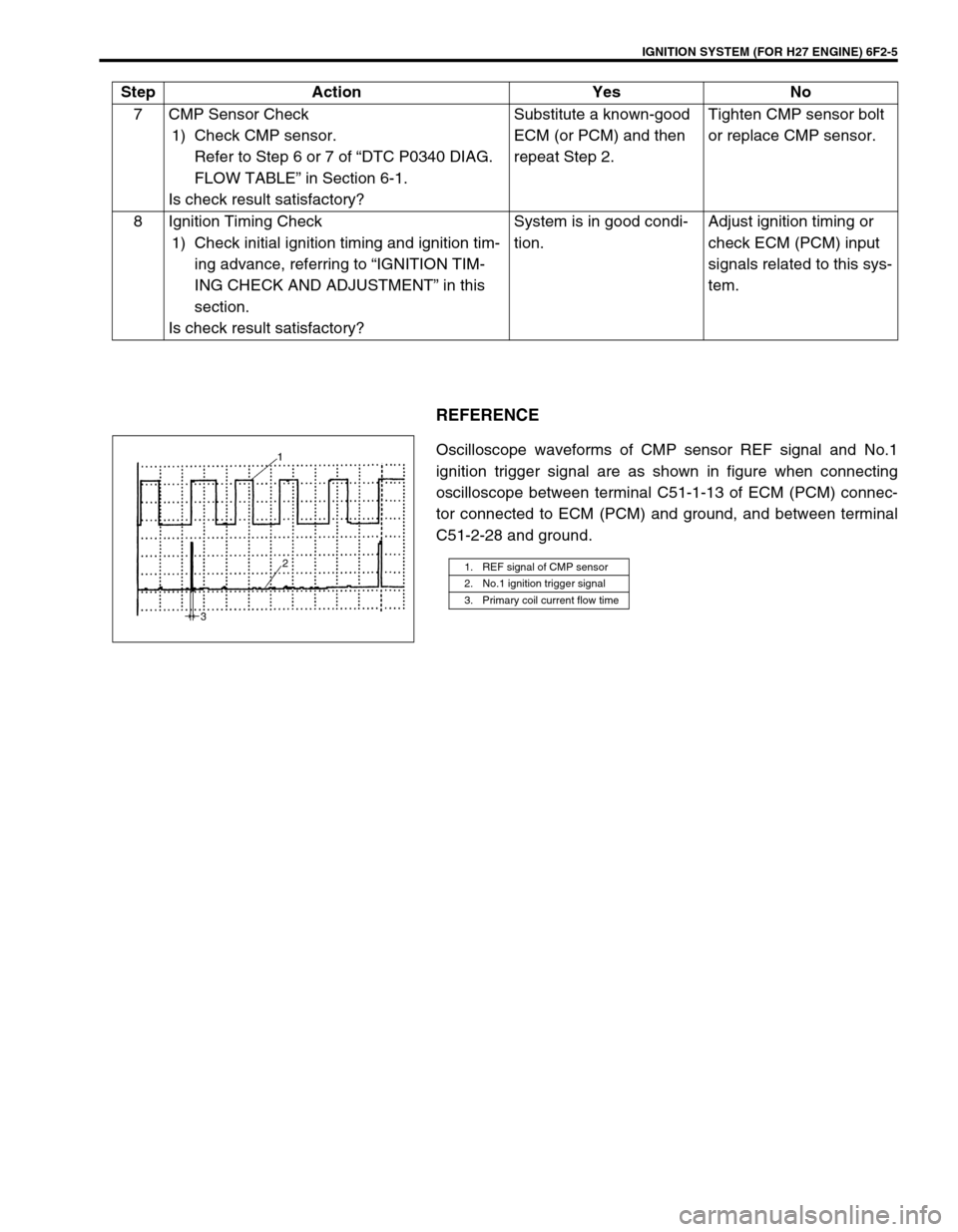
REFERENCE
Oscilloscope waveforms of CMP sensor REF signal and No.1
ignition trigger signal are as shown in figure when connecting
oscilloscope between terminal C51-1-13 of ECM (PCM) connec-
tor connected to ECM (PCM) and ground, and between terminal
C51-2-28 and ground. 7 CMP Sensor Check
1) Check CMP sensor.
Refer to Step 6 or 7 of “DTC P0340 DIAG.
FLOW TABLE” in Section 6-1.
Is check result satisfactory?Substitute a known-good
ECM (or PCM) and then
repeat Step 2.Tighten CMP sensor bolt
or replace CMP sensor.
8 Ignition Timing Check
1) Check initial ignition timing and ignition tim-
ing advance, referring to “IGNITION TIM-
ING CHECK AND ADJUSTMENT” in this
section.
Is check result satisfactory?System is in good condi-
tion.Adjust ignition timing or
check ECM (PCM) input
signals related to this sys-
tem. Step Action Yes No
1. REF signal of CMP sensor
2. No.1 ignition trigger signal
3. Primary coil current flow time
Page 413 of 656

7B1-4 AUTOMATIC TRANSMISSION (4 A/T)
Electronic Shift Control System
1. PCM (ECM) 9. Transmission range sensor 17. MIL (“SERVICE ENGINE SOON” lamp)
2. VSS 10. Shift solenoid-A 18. O/D off switch
3. CMP sensor 11. Shift solenoid-B 19. P/N change switch
4. TP sensor 12. TCC solenoid 20. 4WD low switch
5. ECT sensor 13. Data link connector 21. Main relay
6. Stop lamp switch 14. Cruise control module 22. Ignition switch
7. Input shaft speed sensor 15.“POWER” lamp 23. Battery
8. Output shaft speed sensor 16.“O/D OFF” lamp 24. PCM (ECM) connector terminal (viewed from harness side)
5V
5V5V
5V5V
5V
5V 5V C51-1-14
C51-1-12
C51-1-13
C51-3-26
C51-3-12
C51-3-13
C51-3-9
C51-3-2
C51-3-24
C51-1-11
C51-1-10
C51-1-20 C51-1-21
C51-1-23
C51-1-22
C51-1-7
C51-1-6
C51-1-19
C51-1-18
C51-1-28
C51-1-27
C51-1-2
C51-1-1
C51-1-8
E61-13
E61-35
E61-4C51-1-26 E61-31 E61-33 E61-21 E61-20 E61-7
C51-3-20
E61-2
E61-9
C51-3-4
C51-3-15
C51-3-6
C51-3-17
C51-2-7
12V
12V 12V 12V
12V
12V
12V
12V
5V
12V
BLU/YEL
YEL/GRN
YEL/BLU
GRY/YEL
GRY/YEL
GRY/RED
RED/GRN
ORN/BLU
GRY/YEL
BLU/YEL
BLU/GRN
WHT
ORN
ORN/GRN
RED P
R
N
D
2
LORN/BLU
YEL/GRN
GRN/ORN
GRN/BLU
GRN
GRN/RED
GRN/YEL
PPL/RED
PNK/BLU
GRY
PPL/YEL
WHT/BLK
GRY/BLU
YEL/RED
ORN/BLU
WHT
BLU
BLU/BLK
BLU/BLK
BLK/GRN
BLK/ORN
BLK/GRNBLK/WHT ORN/WHT
8
7
23 22
35 346
20 21
335
19
3218
3117
3016 15
2914
284
13
273
12
26112
10
256
5
17 16
26 252
1
98
21 202
1
98
22 21 1
9
247
20
306
19
2918
27 17
2816 15
2614
25 5
13 4
12
24113
10
23 7
19
28654 3
18
2717 16
2615 14
2513
2412
2311
2210 4
15 14
2413
2312
2211 10 9 8 7
213
202
191
18
24
E61 C51-3 C51-1 C51-2 14
13
B+
B+
17
16
15
18
19
20
22
21
23
BB+
IG1
B+
IG2
1 2
3
4
5
7 6
8
IG1
9
10
11
12
BB+
E61-34 GRN/WHT
BB+
Page 416 of 656

AUTOMATIC TRANSMISSION (4 A/T) 7B1-7
Diagnosis
This vehicle is equipped with an electronic transmission control system, which control the automatic shift up and
shift down timing, TCC operation, etc. suitably to vehicle driving conditions.
PCM (ECM) has an On-Board Diagnosis system which detects a malfunction in this system and abnormality of
those parts that influence the engine exhaust emission.
When diagnosing a trouble in the transmission including this system, be sure to have full understanding of the
outline of “ON-BOARD DIAGNOSTIC SYSTEM” and each item in “PRECAUTION IN DIAGNOSING TROUBLE”
and execute diagnosis according to “AUTOMATIC TRANSMISSION DIAGNOSTIC FLOW TABLE” to obtain
correct result smoothly.
On-Board Diagnostic System (Vehicle without
monitor connector)
For automatic transmission control system, PCM (ECM) has fol-
lowing functions. Refer to Section 6-1 for details.
•When the ignition switch is turned ON with the engine at a
stop, malfunction indicator lamp (MIL) (1) turns ON to check
the bulb of the MIL.
•When PCM detects a malfunction in A/T control system
(and/or a malfunction which gives an adverse effect to vehi-
cle emission) while the engine is running, it makes the mal-
function indicator lamp in the meter cluster of the instrument
panel turn ON and stores the malfunction area.
(If it detects that continuously 3 driving cycles are normal
after detecting a malfunction, however, it makes MIL (1) turn
OFF although DTC stored in its memory will remain.)
•It is possible to communicate through DLC (3) by using not
only SUZUKI scan tool (2). (Diagnostic information can be
accessed by using a scan tool (2).)
2 DRIVING CYCLE DETECTION LOGIC
Refer to Section 6-1 for details.
PENDING DTC
Refer to Section 6-1 for details.
FREEZE FRAME DATA
Refer to Section 6-1 for details.