Page 276 of 656

ENGINE GENERAL INFORMATION AND DIAGNOSIS (H27 ENGINE) 6-1-115
DTC P1510 Ecm Back-Up Power Supply Malfunction
WIRING DIAGRAM
CIRCUIT DESCRIPTION
Battery voltage is supplied to keep DTC memory, values that ECM has learned to control engine, etc. in ECM
even when ignition switch is turned OFF.
DTC DETECTING CONDITION AND TROUBLE AREA
DTC CONFIRMATION PROCEDURE
1) Connect scan tool to DLC with ignition switch OFF.
2) Turn ON ignition switch and clear DTC, pending DTC and freeze frame data by using scan tool and run
engine at idle speed for 1min.
3) Check DTC by using scan tool.
TROUBLESHOOTING
1. Main fuse box 3. ECM (PCM)
2. To DLC
DTC DETECTING CONDITION TROUBLE AREA
Back-up circuit voltage lower than specification is detected
while engine is running.•ECM (PCM) back-up circuit
•ECM (PCM)
NOTE:
Check to make sure that following condition is satisfied when using this “DTC CONFIRMATION PRO-
CEDURE”.
Intake air temp. : – 8°C (18°F) or higher
Engine coolant temp. : – 8 – 110°C (18 – 230°F)
Altitude (barometric pressure) : 2400 m, 8000 ft or less (560 mmHg (75 kPa) or more)
Step Action Yes No
1Was “ENGINE DIAG. FLOW TABLE” performed? Go to Step 2. Go to “ENGINE DIAG. FLOW
TABLE” in this section.
2 Battery voltage supply circuit check :
1) Remove ECM (PCM) cover.
2) While engine running, check voltage between E61-
2 and ground.
Is voltage 10 – 14 V?Poor E61-2 connection or
intermittent trouble.
Check for intermittent referring
to “INTERMITTENT AND
POOR CONNECTION” in
Section 0A.
If wire and connections are
OK, substitute a known-good
ECM (PCM) and recheck.“WHT” circuit open or short.
Page 277 of 656
6-1-116 ENGINE GENERAL INFORMATION AND DIAGNOSIS (H27 ENGINE)
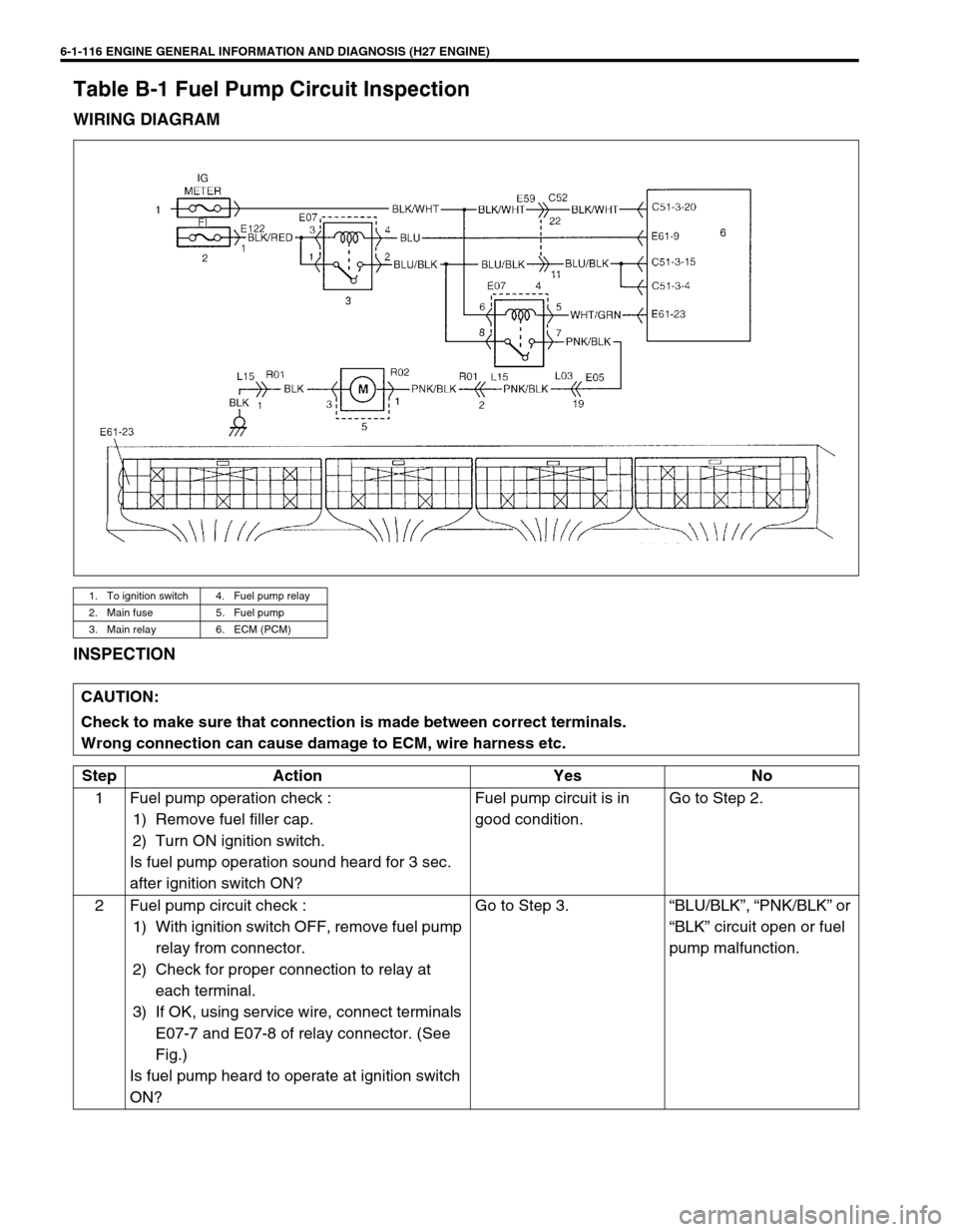
Table B-1 Fuel Pump Circuit Inspection
WIRING DIAGRAM
INSPECTION
1. To ignition switch 4. Fuel pump relay
2. Main fuse 5. Fuel pump
3. Main relay 6. ECM (PCM)
CAUTION:
Check to make sure that connection is made between correct terminals.
Wrong connection can cause damage to ECM, wire harness etc.
Step Action Yes No
1 Fuel pump operation check :
1) Remove fuel filler cap.
2) Turn ON ignition switch.
Is fuel pump operation sound heard for 3 sec.
after ignition switch ON?Fuel pump circuit is in
good condition.Go to Step 2.
2 Fuel pump circuit check :
1) With ignition switch OFF, remove fuel pump
relay from connector.
2) Check for proper connection to relay at
each terminal.
3) If OK, using service wire, connect terminals
E07-7 and E07-8 of relay connector. (See
Fig.)
Is fuel pump heard to operate at ignition switch
ON?Go to Step 3.“BLU/BLK”, “PNK/BLK” or
“BLK” circuit open or fuel
pump malfunction.
Page 278 of 656
ENGINE GENERAL INFORMATION AND DIAGNOSIS (H27 ENGINE) 6-1-117
Fig. for Step 2
Table B-2 Fuel Injectors and Circuit Inspection
WIRING DIAGRAM
3 Fuel pump relay check :
1) Check fuel pump relay referring to “FUEL
PUMP RELAY INSPECTION” in Section
6E2.
Is it in good condition?“BLK/WHT” or “WHT/
GRN” circuit open or poor
E61-23 connection.
If wire and connection are
OK, substitute a known-
good ECM (PCM) and
recheck.Replace fuel pump relay. Step Action Yes No
1. Fuel pump relay connector
1. To ignition switch 4. Injector No.1 7. Injector No.4 10. ECM (PCM)
2. Main fuse 5. Injector No.2 8. Injector No.5
3. Main relay 6. Injector No.3 9. Injector No.6
Page 279 of 656

6-1-118 ENGINE GENERAL INFORMATION AND DIAGNOSIS (H27 ENGINE)
INSPECTION
Step Action Yes No
1 Check injector for operating sound :
Using sound scope, check each injector for
operating sound at engine cranking.
Do all 6 injectors make operating sound?Go to Step 2. Go to Step 3.
2 Wire harness check :
1) Remove ECM (PCM) cover and disconnect
connectors from ECM (PCM).
2) Check for resistance between following ter-
minals of ECM (PCM) connector discon-
nected.
Fuel injector and its circuit resistance (C51-
2-1 – C51-3-4, C51-2-2 – C51-3-4, C51-2-8 –
C51-3-4, C51-2-9 – C51-3-4, C51-2-21 – C51-
3-4 and C51-2-22 – C51-3-4) :
14.2 – 14.8
Ω
ΩΩ Ω at 20°C (68°F)
Is check result as specified?Fuel injector circuit is in
good condition.“PNK”, “PNK/BLK”, “PNK/
GRN”, “PNK/BLU”, “GRY/
GRN” and “GRY/BLK”
shorted each other.
3 Does none of 6 injectors make operating sound
at Step 1?Go to Step 4. Check coupler connec-
tion and wire harness of
injector not making oper-
ating sound and injector
itself (Refer to “FUEL
INJECTOR INSPEC-
TION” in Section 6E2).
4 Check power circuit of injectors for open and
short.
Is it normal?Check all 6 injectors for
resistance respectively.
It resistance is OK, substi-
tute a known-good ECM
(PCM) and recheck.Power circuit open or
short.
Page 282 of 656
ENGINE GENERAL INFORMATION AND DIAGNOSIS (H27 ENGINE) 6-1-121
Table B-4 Idle Air Control System Inspection
WIRING DIAGRAM
INSPECTION
1. Throttle body 3. ECM (PCM) 5. Main fuse
2. Idle air control valve 4. Sensed information 6. Main relay
Step Action Yes No
1 Check engine idle speed and IAC duty
referring to “IDLE SPEED/IAC DUTY
INSPECTION” in Section 6E2.
Is idle speed/IAC duty within specifica-
tion?Go to Step 2. Go to Step 3.
2 Is engine idle speed kept specified speed
even with headlights turned ON?System is in good condition. Go to Step 3.
Page 283 of 656

6-1-122 ENGINE GENERAL INFORMATION AND DIAGNOSIS (H27 ENGINE)
3 Check IAC valve referring to “IAC VALVE
INSPECTION” in Section 6E2.
Is check result as specified?Go to Step 4. IAC valve malfunction, “BLU/
BLK”, “LT GRN/BLK”, “PPL/
BLK”, “GRY/BLU” or “PPL/
YEL” wire open or short or
poor coupler connection.
If all above are OK, substi-
tute a known-good ECM
(PCM) and recheck.
4 Was idle speed within specification in
Step 1?Check for following :
FIA valve, Vacuum leaks, air inhal-
ing, EVAP canister purge control
system, accessory engine load,
stuck of PCV valve, clog of idle air
passage, MAF sensor, TP sensor,
ECT sensor, EGR valve malfunc-
tion (leakage from valve seat), A/C
signal, transmission range switch
signal and power steering switch
signal.Go to Step 5.
5 Was idle speed higher than specification
in Step 1?Go to Step 6. Go to Step 8.
6 Check A/C (input) signal circuit referring
to Step 1 of “Table B-5”. (A/C signal can
be also checked by using SUZUKI scan
tool.)
Is it in good condition?Go to Step 7. A/C signal circuit open or
short, or A/C system mal-
function.
7 Was IAC duty less than about 2% in Step
1 of this table?
Check FIA valve.
Check abnormal air inhaling from
intake manifold, throttle body, PCV
valve and EVAP canister purge
control system.Check TP sensor (closed
throttle position) and ECT
sensor for performance.
If sensors are OK, substitute
a known-good ECM (PCM)
and recheck.
8 Check transmission range switch signal
referring to “INSPECTION OF ECM
(PCM) AND ITS CIRCUIT” in this section.
Is check result satisfactory?Go to Step 9. Transmission range switch
malfunction or its circuits
open or short.
9 Was IAC duty more than about 30% in
Step 1 of this table?Check parts or system which can
cause engine low idle.
Check FIA valve.
Air inhaling from between throttle
body and MAF sensor, EGR valve
malfunction (leakage from valve
seat), accessory engine load, clog
of idle air passage and etc.Substitute a known-good
ECM (PCM) and recheck. Step Action Yes No
Page 284 of 656

ENGINE GENERAL INFORMATION AND DIAGNOSIS (H27 ENGINE) 6-1-123
Table B-5 A/C Signal Circuits Inspection (If Equipped)
WIRING DIAGRAM
INSPECTION
1. A/C control module (amplifier)
2. ECM (PCM)
Step Action Yes No
1 Check A/C Signal Circuit.
1) Check voltage at terminal E61-17 with ignition
switch ON.
A/C signal circuit specification :
A/C switch and/or heater blower switch OFF (A/
C is not operating) : 10 – 14 V
Both A/C switch and heater blower switch ON :
0 – 1.5 V
Are check result as specified?Go to Step 2.“YEL/BLK” circuit open or
short, Evaporative tem-
perature is below 1°C
(34°F) or faulty A/C sys-
tem.
2 Check A/C Cut Signal Circuit.
1) Check voltage at terminal E61-8.
A/C cut signal specification :
While engine running and A/C switch and/or
heater blower switch OFF
(A/C is not operating) : 0 – 1.5 V
While engine running at idle speed and both A/
C switch and heater blower switch ON
(A/C is operating) : 10 – 14 V
Are check result as specified?A/C control signal cir-
cuits are in good con-
dition.“GRY/WHT” circuit open
or short, Poor perfor-
mance of ECT sensor, TP
sensor, Engine start sig-
nal inputted or A/C ampli-
fier malfunction.
If none of the above
exists, substitute a
known-good ECM (PCM)
and recheck.
Page 285 of 656

6-1-124 ENGINE GENERAL INFORMATION AND DIAGNOSIS (H27 ENGINE)
Table B-6 A/C Condenser Fan Motor Relay Control System Inspection (If
Equipped)
WIRING DIAGRAM
INSPECTION
1. To ignition switch 3. A/C fuse 5. A/C condenser fan motor
2. Main fuse 4. A/C condenser fan motor relay 6. ECM (PCM)
WARNING:
Keep hands, tools, and clothing away from A/C condenser fan to help prevent personal injury. This
fan is electric and can come on whether or not the engine is running. The fan can start automatically
in response to the ECT sensor with the ignition switch in the “ON” position.
Step Action Yes No
1 1) Check DTC referring to “DTC CHECK” in this sec-
tion.
Is there any malfunction DTC?Go to applicable DTC
Diag. Flow Table.Go to Step 2.
2 1) Check A/C condenser fan for operation.
A/C condenser fan should be operated under follow-
ing condition A or B only.
A : When engine is running and A/C is operating.
B : When engine coolant temp. is 113°C (235°F) or
more with ignition switch ON.
Is check result as specified?This system is in
good condition.Go to Step 3.
3 1) Remove ECM (PCM) cover.
2) Check voltage between E61-22 terminal of ECM
(PCM) connected coupler and ground.
Other than conditions A and B in Step 2 :
10 – 14 V
Under condition A or B in Step 2 :
0 – 1 V
Is check result as specified?Fuse blown, “RED”,
“RED/BLK” or “RED/
BLU” circuit open,
malfunction of con-
denser fan motor or
relay.“YEL/GRN” circuit
open, “YEL/BLU” cir-
cuit open or short, or
relay malfunction.
If above are OK, sub-
stitute a known-good
ECM (PCM) and
recheck.