Page 165 of 272

165 Starting and driving
SPORT and WINTER modes
To select Sport mode, press the ”S” button on
the selector lever when the selector lever is in
position N, D, 3, 2 or 1.
In this mode, gear changes will take place at
higher engine speeds than in Normal mode, in
other words, the transmission will change up
later and change down earlier for the same throt-
tle (accelerator) position.
The Sport mode will be deselected if:
The S button is pressed.
The selector lever is moved to position P or R.
The engine is switched off.
The Winter mode is selected.
”Automatic transmission, fault indicator”
appears on main instrument panel, see page
161.
The Winter mode facilitates pulling away and
driving on icy roads. Third gear is selected auto-
matically for pulling away to reduce wheelspin.
Winter mode can be selected when the engine
is running by pressing the ”W” button on the
selector-lever surround. It cannot be selected
when the selector lever is in position 2 or 1.
Note: It is still possible to use kick-down in the
Winter mode, in which case a change-down to
1st or 2nd will take place.
The Winter mode will be deselected if:
The W button is pressed.
The engine is switched off.
The selector lever is moved to position 2 or 1.
Kick-down is activated.
The automatic-transmission fluid overheats.
”Automatic transmission, fault indicator”
appears on main instrument panel, see page
161.
ProCarManuals.com
Page 170 of 272

170 Starting and drivingTurning the TCS off The TCS is switched on automatically when
the engine is started.
The system can be switched off manually by
the TCS button, whereupon TCS OFF on
the main instrument panel will come on. The
TCS system cannot be switched off if the car
is travelling faster than 35 mph (60 km/h).
It may be necessary to switch off the system
if the car has become bogged down, for
instance. Press TCS to switch it on again.
If a fault is detected in the ABS system, the
TCS will be switched off automatically.
The cruise-control system will automatically
be disengaged after one second if it is active
when the TCS starts to operate.
Economical motoringFactors affecting fuel consumption Fuel consumption is greatly affected by the
general driving conditions, the way in which
the car is driven and at what speeds, the
weather, the state of the road, the condition
of the car, etc. Breaking-in Fuel consumption may be somewhat higher
during the break-in period (the first 3,000–
4,000 miles (5,000–7,000 km) than stated
under ”Technical data”. Weather conditions Fuel consumption can be as much as 10 %
lower in summer than in winter. The higher
consumption in cold weather is explained by
the longer time it takes for the engine to
reach normal operating temperature, and
for the transmission and wheel bearings to
warm up. Fuel economy is also affected by
the distance driven: short journeys of
3-5 miles (5-8 km) do not give the engine
enough time to reach normal temperature.
Strong winds can also affect fuel consump-
tion. How to read the graph on the right:
If fuel consumption with the engine at
normal temperature is 28 mpg
(10l/100 km), the actual fuel consumption 3
miles (5 km) after the engine has started
from cold will be:
– 23.5 mpg (12l/100 km) at outside temp.
of 68°F (20°C) (increase of 20%).
– 17.7 mpg (16l/100 km) at outside temp.
of 32°F (0°C) (increase of 60%).
– 14 mpg (20l/100 km)) at outside temp. of
–4°F (–20°C) (increase of 100%).
As can be seen, both the distance travelled
by the car and the outside temperature have
IB478
IB311
Percentage increase in fuel consumption
of engine starting from cold compared to
engine at normal temperature.
ProCarManuals.com
Page 185 of 272
185 Starting and driving
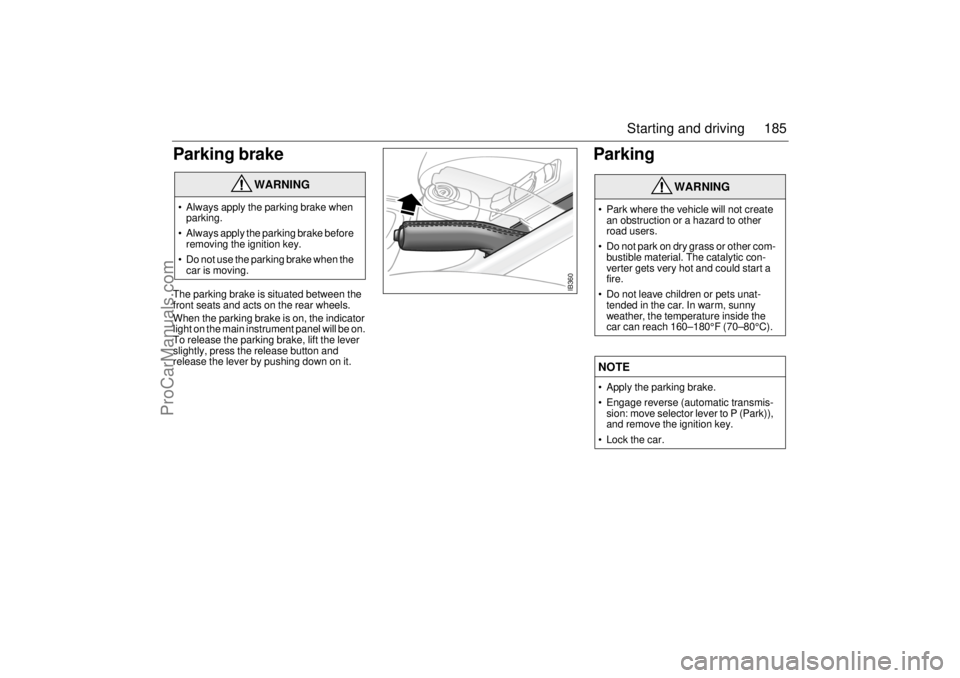
Parking brake The parking brake is situated between the
front seats and acts on the rear wheels.
When the parking brake is on, the indicator
light on the main instrument panel will be on.
To release the parking brake, lift the lever
slightly, press the release button and
release the lever by pushing down on it.
Parking
WARNING
Always apply the parking brake when
parking.
Always apply the parking brake before
removing the ignition key.
Do not use the parking brake when the
car is moving.
WARNING
Park where the vehicle will not create
an obstruction or a hazard to other
road users.
Do not park on dry grass or other com-
bustible material. The catalytic con-
verter gets very hot and could start a
fire.
Do not leave children or pets unat-
tended in the car. In warm, sunny
weather, the temperature inside the
car can reach 160–180°F (70–80°C). NOTE Apply the parking brake.
Engage reverse (automatic transmis-
sion: move selector lever to P (Park)),
and remove the ignition key.
Lock the car.
IB360
ProCarManuals.com
Page 188 of 272
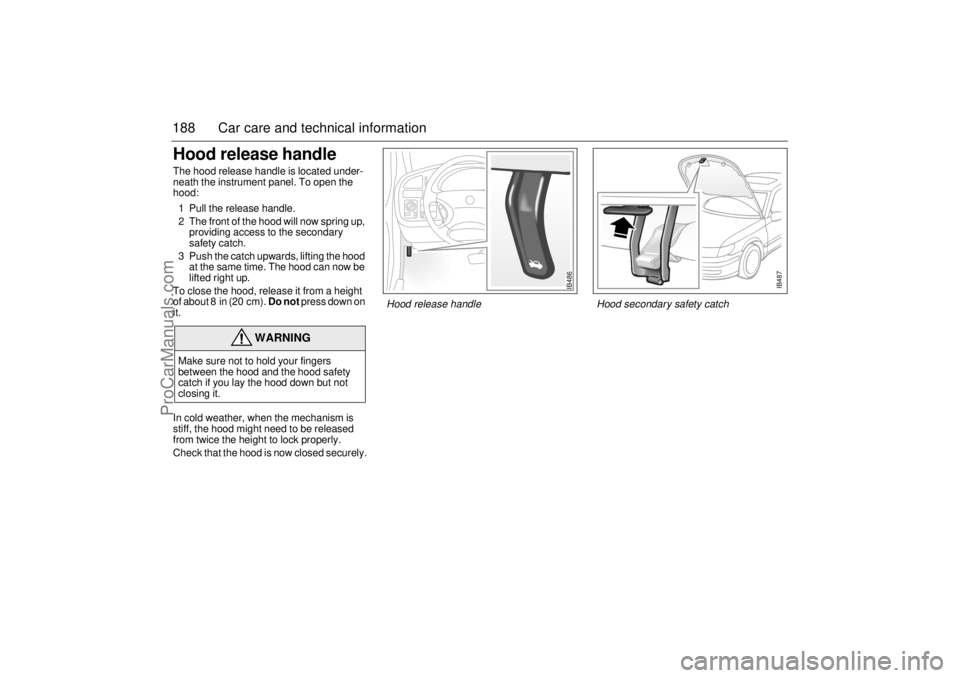
188 Car care and technical informationHood release handleThe hood release handle is located under-
neath the instrument panel. To open the
hood:
1 Pull the release handle.
2 The front of the hood will now spring up,
providing access to the secondary
safety catch.
3 Push the catch upwards, lifting the hood
at the same time. The hood can now be
lifted right up.
To close the hood, release it from a height
of about 8 in (20 cm). Do not press down on
it.
In cold weather, when the mechanism is
stiff, the hood might need to be released
from twice the height to lock properly.
Check that the hood is now closed securely.
WARNING
Make sure not to hold your fingers
between the hood and the hood safety
catch if you lay the hood down but not
closing it.
IB487
IB486
Hood release handle Hood secondary safety catch
ProCarManuals.com
Page 215 of 272

215 Car care and technical information
FusesThe fuses are housed in two fuse panels:
one at the end of the instrument panel on the
driver’s side, and one under the hood.
To check if a fuse has blown, first remove it
from the panel (see below). If the filament is
broken, the fuse has blown.
A special tool for removing fuses is provided
at the bottom of the fuse panel. Simply push
the tool onto the fuse, squeeze and remove
the fuse.
WARNING
To avert the risk of short-circuiting and/or
fire breaking out in the electrical system,
the following advice should be heeded:
Always consult an authorized Saab
dealer before modifying or adding any
electrical equipment. Failure to do so
can result in the electrical system
being damaged.
Never replace a fuse with one having
a higher/lower rating than specified
(see page 217). The color of the fuse
indicates its amperage.
If the same fuse blows repeatedly,
have the electrical system checked by
an authorized Saab dealer.
If a MAXI fuse blows, there is a major
fault in the electrical system. Have the
car checked by an authorized Saab
dealer.
IB527
Fuse panel in instrument panel
IB528
Fuse box under the hood
IB144
Sound fuse / Blown fuse
ProCarManuals.com
Page 216 of 272

216 Car care and technical informationMaxi fusesThe Maxi fuses are housed in the fuse box
under the hood. These fuses can be
checked in the same way as the other fuses.
The Maxi fuses are designed to protect the
car’s electrical system from being dam-
aged. Each Maxi fuse protects a number of
electrical circuits and functions and there-
fore has a higher rating (amperage) than the
standard fuses. No spare Maxi fuses are
supplied with the car.
DICE / TWICEDICE = Dashboard Integrated Central Elec-
tronics
TWICE = Theft-Warning Central Electronics
DICE and TWICE are electronic control
modules that monitor and control a variety
of functions, including:
DICE controls (among other things):
Front lights and interior lighting.
Instrument illumination.
Intermittent wiper operation.
Electric heating of rear window and door
mirrors.
Cooling fans.
TWICE controls (among other things):
Central locking.
Car alarm (Anti-theft system).
Engine immobilizer.
Autochecking of lights.
Electric heating of rear seat.
Safety belt reminder.
Electrically adjustable passenger seat.The DICE and TWICE control modules are
linked to a data bus, which is basically an
information carrier that allows information to
be exchanged between all the control mod-
ules and components connected to the bus.
If a fault occurs in any of these components,
diagnostic faults codes are set in the rele-
vant control module, which facilitates fault
diagnosis at the Saab dealer.
The scan tool connector for fault diagnosis
is located under the instrument panel on the
drivers side.
NOTEIf a Maxi fuse blows, it means that there
is a major fault in the electrical system.
Have the car checked without delay by
an authorized Saab dealer.
IB529
Maxi fuses under the hood
ProCarManuals.com
Page 217 of 272

217 Car care and technical information
Fuse panel in instrument panel
# Amp Function
A 30 Trailer lights
B 10 Automatic transmission
C 7,5 Electric door mirrors; DICE
1 15 Brake lights; shift-lock override
2 15 Reversing lights
3 10 Parking lights, left
4 10 Parking lights, right
5 7,5 DICE / TWICE
6 30 Electric windows, right
6B 5 Stop lights, trailer
7 10 Fuel injection
8 15 Trunk lighting; trunk lock; door lighting; SID; car
phone
9 15 Audio System; diagnostic instrument; CD changer
10 15 Memory function, door mirrors; heating, rear seat
11 30 Central locking; electrically adjusted passenger seat
12 7,5 Automatic transmission
13 20 Audio System, amplifier
14 30 Ignition system, engine
15 15 Preheated oxygen sensor (catalytic converter)
16 20 DICE (direction indicators)
16B – –
17 20 Engine-management system
18 7,5 Door-mirror heating
19 20 Fuel pump
20 15 ACC; interior lighting; rear fog light
21 10 Audio System; rear-view mirror with auto dimming
function; telematics
22 40 Interior fan; air pump (3.0t V6 only)
23 15 Sunroof
24 40 Rear-window heating
25 30 Electrically adjustable driver’s seat; fuel-filler flap
26 7,5 ABS brakes; ACC
27 10 Engine-management system
28 7,5 Airbag (SRS)
29 7,5 Automatic transmission
IB530
BC123456 A
14
121110987
13
6B
1516
2324
222120191817
16B
5425262728293031
3635343332
39383755525356
ProCarManuals.com
Page 218 of 272
218 Car care and technical informationRelay panel under instrument panel Relay panel under instrument panel (cont.)30 7,5 Starter motor
31 7,5 Cruise control; water valve; fog lights, front
32 15 Ventilated front seats
33 7,5 Direction-indicator switch
34 30 Cigarette lighter
35 15 Daytime running light
36 30 Electric windows, left
37 30 Windshield wipers; rain sensor
38 30 Electric heating, front seats
39 20 Limp-home solenoid (automatic transmission)
52-5
6Spare fuses
# Function
A
B Electric heating of rear seat
C
D
E Main relay (engine management system)
F Fuel filler flap
G Fuel pump
H Ignition switch
I Rear-window / door mirrors heating
J Reversing lights
KStarter relay
L Limp-home function
IB531
A
BC
D
GEF
HI
KL J
ProCarManuals.com