2001 SAAB 9-5 seats
[x] Cancel search: seatsPage 26 of 272

26 SafetyAirbag (Supplemental
Restraint System
"SRS") The supplementary restraint system (SRS)
comprises an airbag in the steering wheel,
a front passenger airbag and side airbags in
the front seats.
The system supplements the protection
provided by the safety belts to further
enhance the safety of the occupants.
If a fault is detected in the SRS, the
AIR BAG warning light on the main instru-
ment panel will come on (see pages 50 and
30). When the system is triggered by impact of a
frontal collision, the airbags in the steering
wheel and passenger side of the dash board
are inflated, after which they deflate through
vents in the back of the bags.
The entire process takes less than
0.1 second – literally, faster than the blink-
ing of an eye.
These airbags are triggered only by moder-
ate to severe frontal or near-frontal colli-
sions. They will not be activated by minor
front-end impacts, rear-end or side impacts,
or by the car rolling over.
WARNING
To reduce risk of injury:
Always wear your safety belt.
Always adjust your seat so that you
are as far back as possible but still
able to reach the steering wheel and
controls comfortably.
Children 12 and under or shorter than
140 cm (55 inches) should always
travel in the rear as the vehicle is
equipped with an airbag on the pas-
senger side.
WARNING
Even if the car is equipped with SRS
(airbag), safety belts must still always
be worn by all occupants.
Note that because an airbag inflates
and deflates extremely rapidly, it will
not provide protection against a
second impact occurring in the same
incident. Always use your safety belt.
Always sit with the whole of your back
in contact with the backrest of the seat,
and with your seat as far back as is
practical. This is to reduce the risk of
injury from contact with the backrest of
the seat when the airbag inflates and
also because the airbag needs space
in which to inflate.
Never attach anything to the steering
wheel or passenger side of the instru-
ment panel, as this could result in
injury if the airbag should inflate. The
same applies to anything you might
have in your mouth, such as a pipe, for
instance.
Some components of the airbag will
be hot for a short time. In some circum-
stances the airbag can cause burns or
abrasions to the body when the airbag
inflates/deflates.
Never rest your hands or forearms on
the steering-wheel center padding.
If the AIR BAG warning light remains
on after the car has been started or
comes on while you are driving, have
the car checked immediately by an
authorized Saab dealer. The warning
light could signify that the airbags may
not inflate in a crash, or they could
even inflate without a crash.
ProCarManuals.com
Page 28 of 272

28 SafetyFront passenger seat The airbags are interconnected and have a
common warning light. The passenger
airbag module is housed in the fascia above
the glove compartment and is marked ”SRS
AIRBAG”.
Both airbags will be inflated in the event of a
moderate to severe frontal, or near-frontal
collision, even if the passenger seat is unoc-
cupied.
Side airbags Side airbags are housed inside the back-
rests of the front seats and are designed to
protect the driver and front passenger in the
event of a side impact.
In a side impact, only the airbag on that side
will be activated, and only then if certain pre-
determined conditions are met such as the
force and angle of the impact, the speed of
the car on impact, and at which point on the
car’s side the impact occurs.
The sensors, which are fitted in the front
doors, sense the rise in pressure caused by
the door panel being pressed in during an
impact condition. The side airbag trigger will
be commanded based on the characteris-
tics of this pressure rise.
WARNING
Never secure a rear-facing child seat in
the right front seat of a car equipped with
a passenger airbag. Inflation of the airbag
in the event of an accident could seriously
injure or kill a child.
WARNING Children 12 and
under can be killed by
the airbag
The back seat is the
safest place for children
Never allow a child to stand in front of
the seat or to sit on the lap of a
front-seat passenger. Serious injury or
death could result if the airbag is
inflated in a collision.
Never place anything on the dash or in
front of the seat as, in addition to being
a hazard to passengers, this could
interfere with the function of the airbag
in the event of an accident. The same
applies to the mounting of accessories
on the dash.
Keep feet on the floor - never put feet
up on the fascia, on the seat or out of
the window.
Do not carry anything in your lap.
IB420
Passenger airbag and driver’s airbag both
inflated
ProCarManuals.com
Page 36 of 272
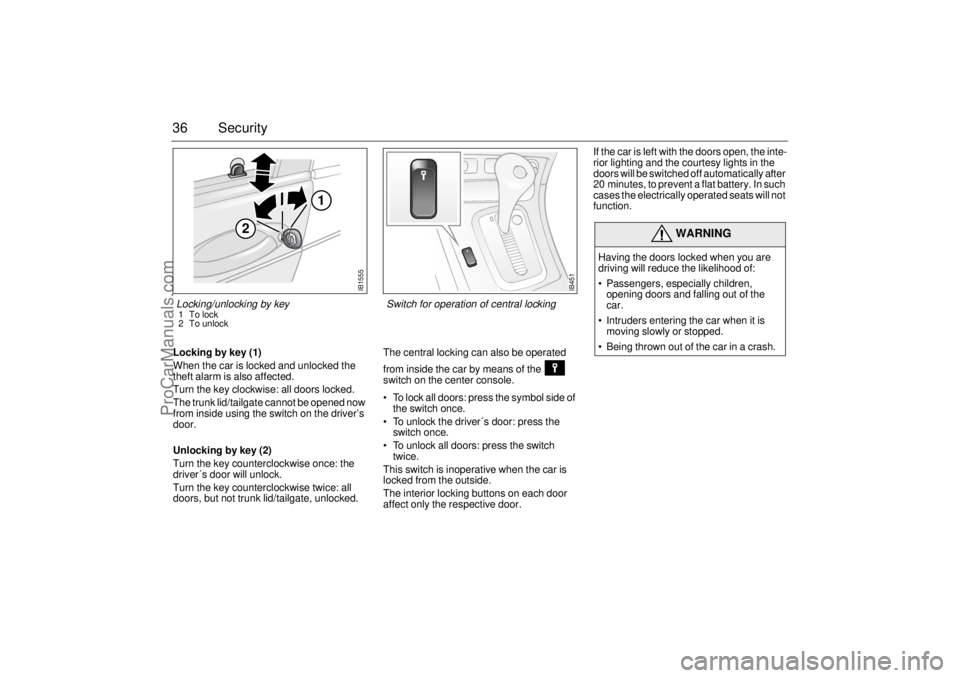
36 SecurityLocking by key (1)
When the car is locked and unlocked the
theft alarm is also affected.
Turn the key clockwise: all doors locked.
The trunk lid/tailgate cannot be opened now
from inside using the switch on the driver’s
door.
Unlocking by key (2)
Turn the key counterclockwise once: the
driver´s door will unlock.
Turn the key counterclockwise twice: all
doors, but not trunk lid/tailgate, unlocked. The central locking can also be operated
from inside the car by means of the
switch on the center console.
To lock all doors: press the symbol side of
the switch once.
To unlock the driver´s door: press the
switch once.
To unlock all doors: press the switch
twice.
This switch is inoperative when the car is
locked from the outside.
The interior locking buttons on each door
affect only the respective door.If the car is left with the doors open, the inte-
rior lighting and the courtesy lights in the
doors will be switched off automatically after
20 minutes, to prevent a flat battery. In such
cases the electrically operated seats will not
function.
WARNING
Having the doors locked when you are
driving will reduce the likelihood of:
Passengers, especially children,
opening doors and falling out of the
car.
Intruders entering the car when it is
moving slowly or stopped.
Being thrown out of the car in a crash.
IB451
Switch for operation of central locking
IB1555
2
1
Locking/unlocking by key1To lock
2 To unlock
ProCarManuals.com
Page 72 of 272

72 Instruments and controls
Temperature control The cabin is divided into two temperature
zones:
The driver’s zone.
The passenger zone (front and rear
seats).
The desired temperature can be set
between 58 and 82°F (15 and 27°C). In
addition, there are also HI and LO settings
(see below). The HI and LO settings for the
passenger zone can only be selected if they
are also selected for the driver’s zone.
The displayed temperature is not the abso-
lute temperature but corresponds to the
comfort level normally experienced at that
temperature after allowance has been
made for the air flow, relative humidity, solar
radiation, etc., currently prevailing inside
the car.
The most usual temperature setting is
64-76°F (18-24°C), depending on per-
sonal preference and what clothing is
worn.
It is recommended that changes in the
temperature setting be made in steps of
2°F (1°C).
Once the desired climate has been
achieved, the rear center vents can be
closed to prevent warm air being distrib-
uted at face height.Settings when HI selected:
Maximum heat.
Air distribution to windshield and floor.
Recirculation OFF (even if manually
selected before).
Fan: high speed.
Settings shown on ACC display.
Settings when LO selected:
Maximum cooling (A/C compressor will
run even if ECON manually selected
before).
Air distribution through panel vents.
Fan: maximum speed.
Recirculation ON.
Settings shown on ACC display.
IB369
Air vent at rear side window
ProCarManuals.com
Page 119 of 272

119 Interior equipment and trunk
Interior equipment
and trunk Seats ................................ 120
Steering-wheel
adjustment ..................... 124
Rear-view mirrors ........... 125
Electric windows ............. 127
Sunroof ............................ 128
Sun visors........................ 130
Ashtrays........................... 130
Glove compartment ........ 131
Cup holders ..................... 133
Trunk ................................ 134
Spare wheel and tools .... 144
Fuel filler flap................... 145
Opening the fuel filler flap
in an emergency............ 145
IB394
ProCarManuals.com
Page 120 of 272

120 Interior equipment and trunkSeats Both front seats are electrically operated.
On certain models the driver´s seat is
equipped with a memory function.
To facilitate getting into the car, both seats
can be adjusted when either of the front
doors is open.
For safety reasons, if the door is closed, the
seat can only be adjusted when the ignition
is ON.
Note, however, that both seats can be
adjusted for 30 seconds after both doors
have been closed. The following seat adjustments can be
made to achieve a comfortable driving
position:
Height.
Legroom.
Backrest rake angle.
Lumbar support.
Head-restraint height.
We recommend that adjustments to the
driver’s seat be performed in the following
order:
1Height.
2 Legroom.
3 Seat tilt angle.
4 Backrest rake angle.
Lastly, adjust the steering wheel (see page
124).
Side airbags (see page 28).Head restraint(see page 18).
Height To raise the seat, lift the lower control
straight up.
To lower the seat, press the lower control
down.
The same control can be used to adjust the
height of the front and rear edges of the seat
independently.
WARNING
The seats are actuated by powerful
motors. Ensure that nothing can be
trapped when adjusting the seat.
Bear in mind that children can be injured
if they play with the electrically-operated
seats
WARNING
Never adjust the driver’s seat except
when the car is stationary.
IB401
ProCarManuals.com
Page 123 of 272

123 Interior equipment and trunk
Ventilated front seats (option)Ventilated front seats, that enhance seating
comfort in hot weather, are available as an
option on cars equipped with leather-uphol-
stered and electrically adjustable seats.
Ventilated seats are equipped with two fans
that extract the moist air from between the
seat and the body.
The fans have three speeds and are OFF
when the switch is set to 0.
Electric heating, front seats (option)Both front seats have adjustable and ther-
mostat-controlled heating of the seat cush-
ion and backrest, available as an option.
Heating is adjustable in three stages. In
position 0 it is turned off.
Electrically heated seat cushions in
the rear seat (option)Electrically heated seat cushions for the two
outer seats in the rear are available as an
option.
The ON/OFF control button for the cushion
heating is located on the back of the center
console.
The warming-up time varies with the tem-
perature outside.
The button has an integral indicator that is
illuminated when the heating is on.
IB406
IB407
IB405
ProCarManuals.com
Page 132 of 272

132 Interior equipment and trunk
IB436
IB437
IB439
IB440
IB441IB438
On the back of the front seats
Center armrest for rear seat At bottom of door pillars adjacent to
front-seat backrests On leading edge of front seats
Console between front seats In the doors
ProCarManuals.com