Page 68 of 346
2-
2-1
Section 2 Features and Controls
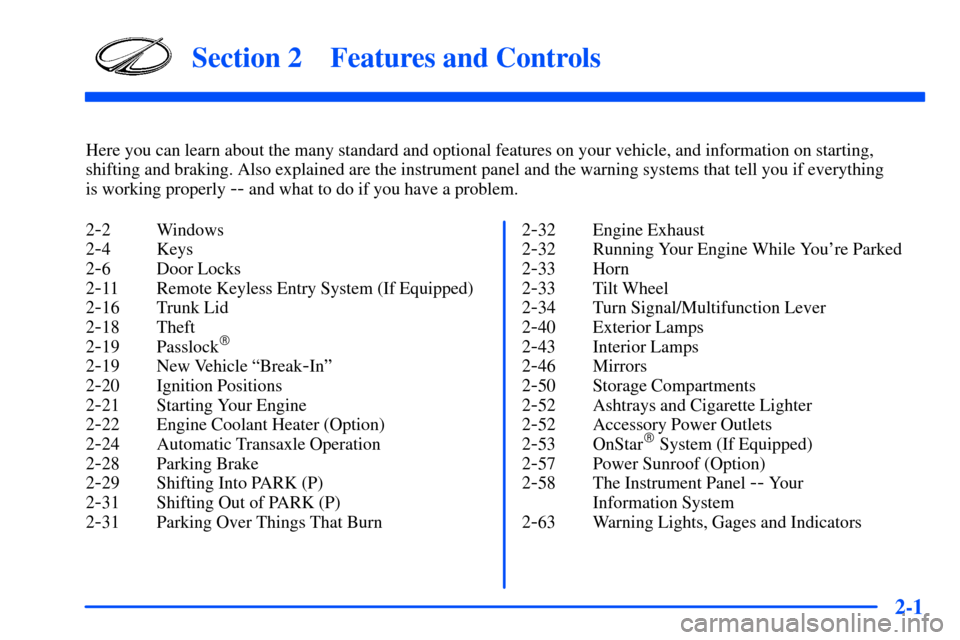
Here you can learn about the many standard and optional features on your vehicle, and information on starting,
shifting and braking. Also explained are the instrument panel and the warning systems that tell you if everything
is working properly
-- and what to do if you have a problem.
2
-2 Windows
2
-4 Keys
2
-6 Door Locks
2
-11 Remote Keyless Entry System (If Equipped)
2
-16 Trunk Lid
2
-18 Theft
2
-19 Passlock�
2-19 New Vehicle ªBreak-Inº
2
-20 Ignition Positions
2
-21 Starting Your Engine
2
-22 Engine Coolant Heater (Option)
2
-24 Automatic Transaxle Operation
2
-28 Parking Brake
2
-29 Shifting Into PARK (P)
2
-31 Shifting Out of PARK (P)
2
-31 Parking Over Things That Burn2
-32 Engine Exhaust
2
-32 Running Your Engine While You're Parked
2
-33 Horn
2
-33 Tilt Wheel
2
-34 Turn Signal/Multifunction Lever
2
-40 Exterior Lamps
2
-43 Interior Lamps
2
-46 Mirrors
2
-50 Storage Compartments
2
-52 Ashtrays and Cigarette Lighter
2
-52 Accessory Power Outlets
2
-53 OnStar� System (If Equipped)
2
-57 Power Sunroof (Option)
2
-58 The Instrument Panel -- Your
Information System
2
-63 Warning Lights, Gages and Indicators
Page 87 of 346

2-20
Ignition Positions
Your ignition switch is located on the instrument panel.
With the ignition key in the switch, you can turn the
switch to four positions.
OFF (A): This position locks your ignition and
transaxle. It's a theft
-deterrent feature. It's also the
only position from which you can remove your key.
NOTICE:
If your key seems stuck in OFF and you can't
turn it, be sure you are using the correct key;
if so, is it all the way in? Turn the key only with
your hand. Using a tool to force it could break
the key or the ignition switch. If none of this
works, then your vehicle needs service.
ACC (B): This position lets you turn off the ignition.
It also lets you use things like the radio and windshield
wipers when the engine is off. Your steering wheel will
unlock. Use ACC if you must have your vehicle pushed
or towed.
ON (C): This position is where the key returns to after
you start the vehicle. With the engine off, you can use
ON to display some of your warning and indicator lights.
START (D): This position starts your engine.
Page 91 of 346

2-24
Automatic Transaxle Operation
Your automatic transaxle
has a shift lever located
on the console between
the seats.
Maximum engine speed is limited when your vehicle
is in PARK (P) or NEUTRAL (N) to protect driveline
components from improper operations.
There are several positions for your shift lever.PARK (P): This position locks your front wheels.
It's the best position to use when you start your engine
because your vehicle can't move easily.
CAUTION:
It is dangerous to get out of your vehicle if the
shift lever is not fully in PARK (P) with the
parking brake firmly set. Your vehicle can roll.
Don't leave your vehicle when the engine is
running unless you have to. If you have left the
engine running, the vehicle can move suddenly.
You or others could be injured. To be sure your
vehicle won't move, even when you're on fairly
level ground, always set your parking brake and
move the shift lever to PARK (P).
See ªShifting Into PARK (P)º in the Index.
If you're pulling a trailer, see ªTowing a Trailerº
in the Index.
Page 92 of 346

2-25
Make sure the shift lever is fully in PARK (P) before
starting the engine. Your vehicle has an automatic
transaxle shift lock control system. You must fully
apply your regular brakes before you can shift from
PARK (P) when the ignition is in ON. If you cannot
shift out of PARK (P), ease pressure on the shift lever
by pushing it all the way into PARK (P) while keeping
the brake pushed down. Then move the shift lever out
of PARK (P), being sure to press the shift lever button.
See ªShifting Out of PARK (P)º in the Index.
REVERSE (R): Use this gear to back up.
NOTICE:
Shifting to REVERSE (R) while your vehicle is
moving forward could damage your transaxle.
Shift to REVERSE (R) only after your vehicle
is stopped.
To rock your vehicle back and forth to get out of
snow, ice or sand without damaging your transaxle,
see ªStuck: In Sand, Mud, Ice or Snowº in the Index.NEUTRAL (N): In this position, your engine
doesn't connect with the wheels. To restart when you're
already moving, use NEUTRAL (N) only. Also, use
NEUTRAL (N) when your vehicle is being towed.
CAUTION:
Shifting out of PARK (P) or NEUTRAL (N) while
your engine is ªracingº (running at high speed)
is dangerous. Unless your foot is firmly on the
brake pedal, your vehicle could move very
rapidly. You could lose control and hit people
or objects. Don't shift out of PARK (P) or
NEUTRAL (N) while your engine is racing.
NOTICE:
Damage to your transaxle caused by shifting out
of PARK (P) or NEUTRAL (N) with the engine
racing isn't covered by your warranty.
Page 94 of 346

2-27
SECOND (2): This position gives you more power, but
lower fuel economy. You can use SECOND (2) on hills.
It can help control your speed as you go down steep
mountain roads, but then you would also want to use
your brakes off and on.
NOTICE:
Don't drive in SECOND (2) for more than 25 miles
(40 km) at speeds over 55 mph (88 km/h), or you
can damage your transaxle. Use AUTOMATIC
OVERDRIVE (D) or THIRD (3) as much
as possible.
Don't shift into SECOND (2) unless you are
going slower than 65 mph (105 km/h), or you
can damage your engine.
FIRST (1): This position gives you even more power
(but lower fuel economy) than SECOND (2). You can
use it on very steep hills, or in deep snow or mud. If the
shift lever is put in FIRST (1), the transaxle won't shift
into first gear until the vehicle is going slowly enough.
NOTICE:
If your front wheels can't turn, don't try to drive.
This might happen if you were stuck in very deep
sand or mud or were up against a solid object.
You could damage your transaxle. Also, if you
stop when going uphill, don't hold your vehicle
there with only the accelerator pedal. This could
overheat and damage the transaxle. Use your
brakes or shift into PARK (P) to hold your
vehicle in position on a hill.
Page 100 of 346

2-33
CAUTION:
It can be dangerous to get out of your vehicle if
the shift lever is not fully in PARK (P) with the
parking brake firmly set. Your vehicle can roll.
Don't leave your vehicle when the engine is
running unless you have to. If you've left the
engine running, the vehicle can move suddenly.
You or others could be injured. To be sure your
vehicle won't move, even when you're on fairly
level ground, always set your parking brake and
move the shift lever to PARK (P).
Follow the proper steps to be sure your vehicle won't
move. See ªShifting Into PARK (P)º in the Index.
If you are parking on a hill and if you're pulling a
trailer, also see ªTowing a Trailerº in the Index.
Horn
Press at or near the horn symbols to sound the horn.
Tilt Wheel
A tilt wheel allows you to adjust the steering wheel
before you drive. You can also raise it to the highest
level to give your legs more room when you exit and
enter the vehicle.
To tilt the wheel, hold the wheel and pull the lever
located on the left side of your steering column. Move
the wheel to a comfortable level, then release the lever
to lock the wheel in place.
Page 102 of 346

2-35
If a bulb is burned out, replace it to help avoid an
accident. If the arrows don't go on at all when you
signal a turn, check for burned
-out bulbs and then check
the fuse (see ªFuses and Circuit Breakersº in the Index).
A chime will sound if you leave your turn signal on for
more than 3/4 mile (1.2 km).
Headlamp High/Low-Beam Changer
To change your headlamps
from low beam to high
beam, push the lever
away from you. To change
back to low beam, pull the
lever toward you.
To flash your high beams, pull the lever toward you and
release. The lever will return to the low
-beam position.
Fog lamps (if equipped) will not be illuminated while
the headlamps are in the high
-beam mode.
Flash-to-Pass
With the lever in the low-beam position, pull the lever
toward you momentarily to switch to high beams
(to signal you are going to pass). If you have the
headlamps on, they will return to low beams when
you release the lever.
Windshield Wipers
You can control the windshield wipers by moving the
lever with the wiper symbol on it up or down. This lever
is located on the right side of the steering wheel.
Page 103 of 346

2-36
For a single wiping cycle, pull down on the lever to
MIST. Hold it there until the wipers start, then let go.
The wipers will stop after one cycle. If you want more
cycles, hold the lever down longer.
You can set the wiper speed for a long delay or
short delay between wipes. This can be very useful
in light rain or snow. Push the lever up one click to
INT (intermittent), then turn the band, located on the
lever, to adjust the delay time. Turn the band down for a
longer delay, up for a shorter delay. The wiper speed can
only be adjusted when the lever is in the INT position,
not in HI or LO.
Be sure to clear the ice and snow from the wiper blades
before using them. If they're frozen to the windshield,
carefully loosen or thaw them. If your blades do become
damaged, get new blades or blade inserts.
Heavy snow or ice can overload your wipers. A circuit
breaker will stop them until the motor cools. Clear away
snow or ice to prevent an overload.Windshield Washer
At the end of the lever on right side of the steering
wheel, there is a wiper symbol. To spray washer fluid on
the windshield, push the button on the end of the lever.
The wipers will run for several sweeps and then either
stop or return to your preset speed.
CAUTION:
In freezing weather, don't use your washer until
the windshield is warmed. Otherwise the washer
fluid can form ice on the windshield, blocking
your vision.