Page 206 of 371

4-40
CAUTION:
Snow can trap exhaust gases under your vehicle.
This can cause deadly CO (carbon monoxide) gas
to get inside. CO could overcome you and kill
you. You can't see it or smell it, so you might not
know it is in your vehicle. Clear away snow from
around the base of your vehicle, especially any
that is blocking your exhaust pipe. And check
around again from time to time to be sure snow
doesn't collect there.
Open a window just a little on the side of the
vehicle that's away from the wind. This will
help keep CO out.
Run your engine only as long as you must. This saves
fuel. When you run the engine, make it go a little faster
than just idle. That is, push the accelerator slightly. This
uses less fuel for the heat that you get and it keeps the
battery charged. You will need a well
-charged battery
to restart the vehicle, and possibly for signaling later
on with your headlamps. Let the heater run for a while.Then, shut the engine off and close the window almost
all the way to preserve the heat. Start the engine again
and repeat this only when you feel really uncomfortable
from the cold. But do it as little as possible. Preserve the
fuel as long as you can. To help keep warm, you can get
out of the vehicle and do some fairly vigorous exercises
every half hour or so until help comes.
Recreational Vehicle Towing
Your vehicle was not designed to be towed with all four
wheels on the ground, nor was it designed to be towed
with only two wheels on the ground. If your vehicle
must be towed, see ªTowing Your Vehicleº in the Index.
NOTICE:
Towing your vehicle with all four wheels on
the ground will damage drivetrain components.
And, since your vehicle has all
-wheel drive,
towing with only two wheels on the ground will
also damage drivetrain components.
ProCarManuals.com
Page 217 of 371

4-51 Maintenance When Trailer Towing
Your vehicle will need service more often when you're
pulling a trailer. See the Maintenance Schedule for
more on this. Things that are especially important
in trailer operation are automatic transmission fluid
(don't overfill), engine oil, axle lubricant, belt, cooling
system and brake system. Each of these is covered
in this manual, and the Index will help you find them
quickly. If you're trailering, it's a good idea to review
these sections before you start your trip.
Check periodically to see that all hitch nuts and
bolts are tight.
Trailer Wiring Harness
The trailer wiring harness is an eight-wire harness
assembly. The harness is stored under the vehicle,
on the driver's side corner frame crossmember.
The harness is fused in the engine compartment fuse
block. See ªFuses and Circuit Breakersº in the
Index. The harness does not have a connector and
should be wired by a qualified electrical technician. The technician can use the following color code chart
when connecting the wiring harness to your trailer.
�Dark Blue: Use for electric trailer brakes or
auxiliary wiring.
�Red: Use for battery charging; it connects to the
starter solenoid.
�Light Green: Back
-up lamps.
�Brown: Taillamps and parking lamps.
�Yellow: Left stoplamp and turn signal.
�Dark Green: Right stoplamp and turn signal.
�White: Ground wire.
�Light Blue: Auxiliary stoplamp.
Securely attach the harness to the trailer, then tape or
strap it to your vehicle's frame rail. Be sure you leave
it loose enough so the wiring doesn't bend or break,
but not so loose that it drags on the ground. Store the
harness in its original place. Wrap the harness together
and tie it neatly so it won't be damaged.
ProCarManuals.com
Page 231 of 371
5-14 How to Add Coolant to the Radiator
1. You can remove the radiator pressure cap when
the cooling system, including the radiator pressure
cap and upper radiator hose, is no longer hot.
Turn the pressure cap slowly counterclockwise
until it first stops. (Don't press down while turning
the pressure cap.)
If you hear a hiss, wait for that to stop. A hiss means
there is still some pressure left.
2. Then keep turning the pressure cap, but now push
down as you turn it. Remove the pressure cap.
ProCarManuals.com
Page 235 of 371
5-18
Changing a Flat Tire
If a tire goes flat, avoid further tire and wheel damage
by driving slowly to a level place. Turn on your hazard
warning flashers.
CAUTION:
Changing a tire can cause an injury. The vehicle
can slip off the jack and roll over you or other
people. You and they could be badly injured.
Find a level place to change your tire. To help
prevent the vehicle from moving:
1. Set the parking brake firmly.
2. Put the shift lever in PARK (P).
3. Turn off the engine.
To be even more certain the vehicle won't move,
you can put blocks at the front and rear of the
tire farthest away from the one being changed.
That would be the tire on the other side of the
vehicle, at the opposite end.
The following steps will tell you how to use the jack and
change a tire.
ProCarManuals.com
Page 236 of 371
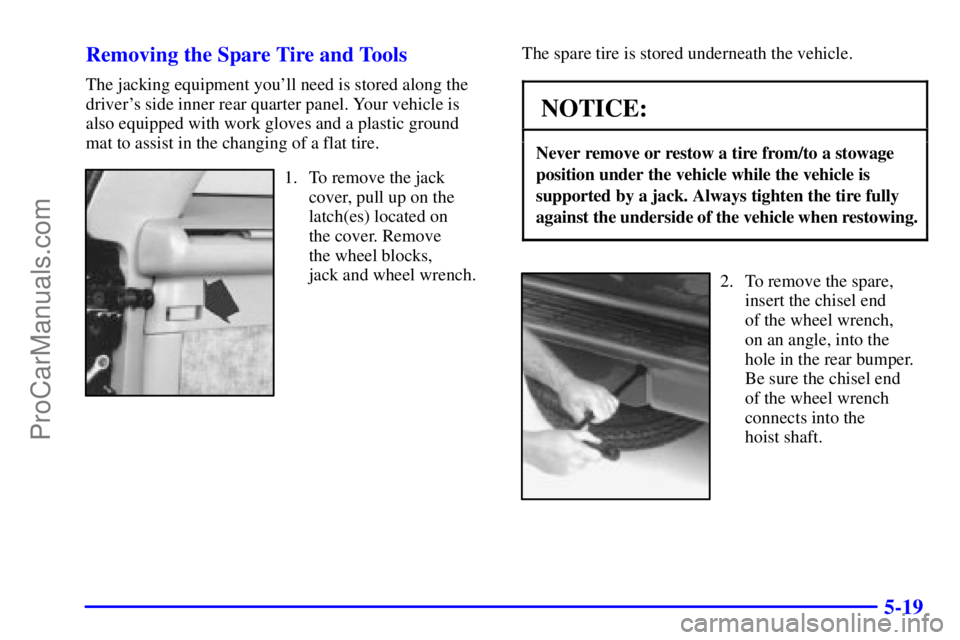
5-19 Removing the Spare Tire and Tools
The jacking equipment you'll need is stored along the
driver's side inner rear quarter panel. Your vehicle is
also equipped with work gloves and a plastic ground
mat to assist in the changing of a flat tire.
1. To remove the jack
cover, pull up on the
latch(es) located on
the cover. Remove
the wheel blocks,
jack and wheel wrench.The spare tire is stored underneath the vehicle.
NOTICE:
Never remove or restow a tire from/to a stowage
position under the vehicle while the vehicle is
supported by a jack. Always tighten the tire fully
against the underside of the vehicle when restowing.
2. To remove the spare,
insert the chisel end
of the wheel wrench,
on an angle, into the
hole in the rear bumper.
Be sure the chisel end
of the wheel wrench
connects into the
hoist shaft.
ProCarManuals.com
Page 237 of 371
5-20
Turn the wheel wrench counterclockwise to lower the
spare tire. Keep turning the wheel wrench until the spare
tire can be pulled out from under the vehicle.
3. When the tire has been completely lowered, tilt the
retainer at the end of the cable and pull it through
the wheel opening. Pull the tire out from under
the vehicle.
NOTICE:
To help avoid vehicle damage, do not drive the
vehicle before the cable is restored.
Put the spare tire near the flat tire.The tools you'll be using include the jack (A), and the
wheel wrench (B).
ProCarManuals.com
Page 238 of 371
5-21
Position the chisel end of your wheel wrench in the
notch of the hub cap and pry off the hub cap.
Removing the Flat Tire and Installing the
Spare Tire
1. Using the wheel wrench, loosen all the wheel nuts.
Don't remove them yet.
2. Turn the jack handle clockwise to raise the jack
lift head.
ProCarManuals.com
Page 240 of 371
5-23
4. Raise the vehicle by turning the jack handle clockwise.
Raise the vehicle far enough off the ground so there is
enough room for the spare tire to fit.
5. Remove all the wheel nuts and take off the flat tire.
6. Remove any rust or dirt
from the wheel bolts,
mounting surfaces and
spare wheel.
CAUTION:
Rust or dirt on the wheel, or on the parts to
which it is fastened, can make the wheel nuts
become loose after a time. The wheel could come
off and cause an accident. When you change a
wheel, remove any rust or dirt from the places
where the wheel attaches to the vehicle. In an
emergency, you can use a cloth or a paper towel
to do this; but be sure to use a scraper or wire
brush later, if you need to, to get all the rust or
dirt off.
ProCarManuals.com