Page 221 of 371

5-4
2. Get the vehicles close enough so the jumper cables
can reach, but be sure the vehicles aren't touching
each other. If they are, it could cause a ground
connection you don't want. You wouldn't be able
to start your vehicle, and the bad grounding could
damage the electrical systems.
To avoid the possibility of the vehicles rolling, set
the parking brake firmly on both vehicles involved in
the procedure. Put an automatic transmission vehicle
in PARK (P) and a manual transmission vehicle
in NEUTRAL.
3. Turn off the ignition on both vehicles. Unplug
unnecessary accessories plugged into the cigarette
lighter, or accessory power outlets, if you have this
option. Turn off all lamps that aren't needed as well
as radios. This will avoid sparks and help to save
both batteries. In addition, it could save your radio!
NOTICE:
If you leave your radio on, it could be badly
damaged. The repair wouldn't be covered by
your warranty.
4. Open both hoods and locate the batteries.
(Your vehicle's battery is located towards the front
of the vehicle, on the passenger side of the engine
compartment. See ªEngine Compartment Overviewº in
the Index for more information on location.) Find the
positive (+) and negative (
-) terminals on each battery.
CAUTION:
Using a match near a battery can cause battery
gas to explode. People have been hurt doing this,
and some have been blinded. Use a flashlight
if you need more light.
Be sure the battery has enough water. You don't
need to add water to the ACDelco� battery
installed in every new GM vehicle. But if a
battery has filler caps, be sure the right amount
of fluid is there. If it is low, add water to take
care of that first. If you don't, explosive gas
could be present.
Battery fluid contains acid that can burn you.
Don't get it on you. If you accidentally get it in
your eyes or on your skin, flush the place with
water and get medical help immediately.
ProCarManuals.com
Page 247 of 371

6-
6-1
Section 6 Service and Appearance Care
Here you will find information about the care of your vehicle. This section begins with service and fuel information,
and then it shows how to check important fluid and lubricant levels. There is also technical information about your
vehicle, and a part devoted to its appearance care.
6
-2 Service
6
-3 Fuel
6
-5 Fuels in Foreign Countries
6
-5 Filling Your Tank
6
-7 Filling a Portable Fuel Container
6
-8 Checking Things Under the Hood
6
-10 Engine Oil
6
-15 Engine Air Cleaner/Filter
6
-16 Automatic Transmission Fluid
6
-19 All-Wheel Drive
6
-21 Rear Axle
6
-21 Engine Coolant
6
-25 Radiator Pressure Cap
6
-25 Power Steering Fluid
6
-26 Windshield Washer Fluid
6
-27 Brakes6
-31 Battery
6
-32 Bulb Replacement
6
-35 Windshield Wiper Blade Replacement
6
-37 Tires
6
-44 Appearance Care
6
-45 Cleaning the Inside of Your Vehicle
6
-47 Care of Safety Belts
6
-48 Cleaning the Outside of Your Vehicle
6
-52 GM Vehicle Care/Appearance Materials
6
-53 Vehicle Identification Number (VIN)
6
-53 Service Parts Identification Label
6
-54 Electrical System
6
-60 Replacement Bulbs
6
-60 Capacities and Specifications
6
-61 Normal Maintenance Replacement Parts
ProCarManuals.com
Page 262 of 371

6-16
Automatic Transmission Fluid
When to Check and Change
A good time to check your automatic transmission fluid
level is when the engine oil is changed.
Change both the fluid and filter every 15,000 miles
(25 000 km) if the vehicle is mainly driven under one or
more of these conditions:
�In heavy city traffic where the outside temperature
regularly reaches 90�F (32�C) or higher.
�In hilly or mountainous terrain.
�When doing frequent trailer towing.
�Uses such as found in taxi, police or delivery service.
If you do not use your vehicle under any of
these conditions, change the fluid and filter
every 50,000 miles (83 000 km).
See ªScheduled Maintenance Servicesº in the Index.
How to Check
Because this operation can be a little difficult, you
may choose to have this done at the dealership
service department.
If you do it yourself, be sure to follow all the instructions
here, or you could get a false reading on the dipstick.
NOTICE:
Too much or too little fluid can damage your
transmission. Too much can mean that some of
the fluid could come out and fall on hot engine
parts or exhaust system parts, starting a fire.
Be sure to get an accurate reading if you check
your transmission fluid.
Wait at least 30 minutes before checking the
transmission fluid level if you have been driving:
�When outside temperatures are above 90�F (32�C).
�At high speed for quite a while.
�In heavy traffic
-- especially in hot weather.
�While pulling a trailer.
ProCarManuals.com
Page 265 of 371

6-19 How to Add Fluid
Refer to the Maintenance Schedule to determine what
kind of transmission fluid to use. See ªRecommended
Fluids and Lubricantsº in the Index.
Add fluid only after checking the transmission fluid
while it is hot. (A cold check is used only as a
reference.) If the fluid level is low, add only enough of
the proper fluid to bring the level up to the HOT area for
a hot check. It doesn't take much fluid, generally less
than one pint (0.5 L). Don't overfill.
NOTICE:
We recommend you use only fluid labeled
DEXRON�-III, because fluid with that label is
made especially for your automatic transmission.
Damage caused by fluid other than DEXRON
�-III
is not covered by your new vehicle warranty.
�After adding fluid, recheck the fluid level as
described under ªHow to Check.º
�When the correct fluid level is obtained, push the
dipstick back in all the way; then flip the handle
down to lock the dipstick in place.
All-Wheel Drive
Transfer Case
When to Check Lubricant
Refer to the Maintenance Schedule to determine how
often to check the lubricant. See ªPeriodic Maintenance
Inspectionsº in the Index.
How to Check Lubricant
If the level is below the bottom of the filler plug hole,
you'll need to add some lubricant. Add enough lubricant
to raise the level to the bottom of the filler plug hole.
ProCarManuals.com
Page 303 of 371
6-57
Fuse/Circuit
Breaker Usage
15 4WD Switch, Engine Controls
(VCM, PCM, Transmission)
16 Supplemental Inflatable Restraint
17 Front Wiper
18 Steering Wheel Radio Controls
19 Radio, Battery
20 Amplifier
21 HVAC I (Automatic),
HVAC Sensors (Automatic)
22 Anti
-Lock Brakes
23 Rear Wiper
24 Radio, Ignition
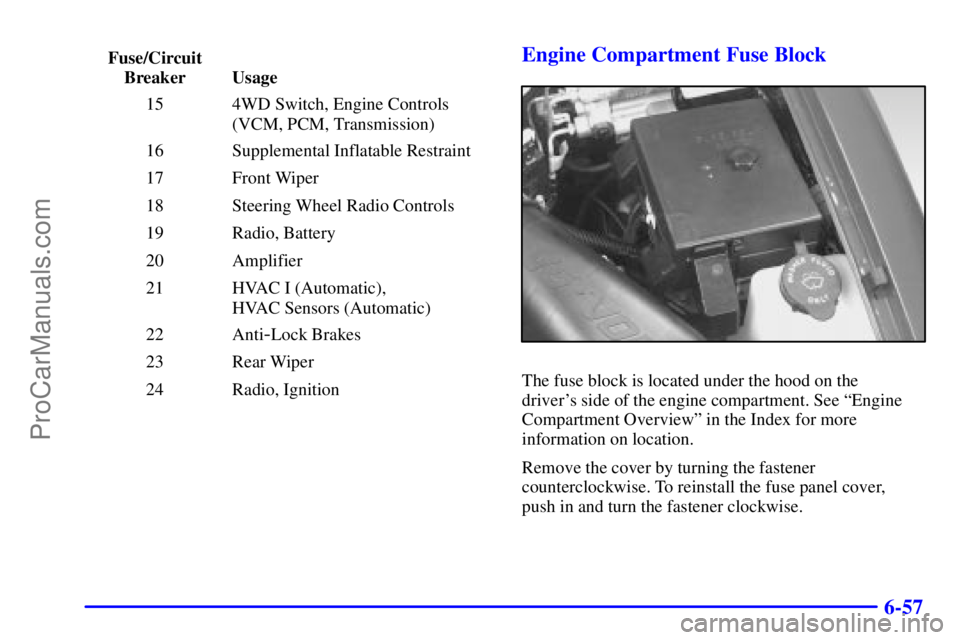
Engine Compartment Fuse Block
The fuse block is located under the hood on the
driver's side of the engine compartment. See ªEngine
Compartment Overviewº in the Index for more
information on location.
Remove the cover by turning the fastener
counterclockwise. To reinstall the fuse panel cover,
push in and turn the fastener clockwise.
ProCarManuals.com
Page 305 of 371
6-59
Name Usage
BTSI Automatic Transmission Shift
Lock Control System
B/U LP Back
-Up Lamps
IGN B Column Feed, IGN 2, 3, 4
RAP Retained Accessory Power
LD LEV Not Used
OXYSEN Oxygen Sensor
IGN E Engine
MIR/LKS Mirrors, Door Locks
FOG LP Fog Lamps
IGN A Starting and Charging IGN 1
STUD #2 Accessory Feeds, Electric Brake
PARKLP Parking Lamps
LR PRK Left Rear Parking Lamps
IGN C Starter Solenoid,
Fuel Pump, PRNDLName Usage
HTDSEAT Heated Seat
HVAC HVAC System
TRCHMSL Trailer Center High-Mounted
Stop Light
RRDFOG Rear Defogger
TBC Truck Body Computer
CRANK Clutch Switch, NSBU Switch
HAZLP Hazard Lamps
VECHMSL Vehicle Center High
Mounted Stoplamp
HTDMIR Heated Mirror
ATC Active Transfer Case
STOPLP Stoplamps
RR W/W Rear Window Wiper
ProCarManuals.com
Page 306 of 371

6-60
Replacement Bulbs
Lamps Quantity Number
Halogen Headlamps,
Composite Low Beam2 9006 HB4
or 9006 LL
Halogen Headlamps,
Composite High Beam2 9005 HB3
Tail and Stoplamps 4 3057
Front Sidemarker Lamps 2 194
Front Turn Signal Lamps 2 3457 A
Capacities and Specifications
Engine Description ªVORTECº 4300 V6. . . . . . . . .
Type V6. . . . . . . . . . . . . . . . . . . . . . . . . . . . . . . . . . . .
VIN Code W. . . . . . . . . . . . . . . . . . . . . . . . . . . . . . . . .
Firing Order 1
-6-5-4-3-2 . . . . . . . . . . . . . . . . . . . . . .
Horsepower 190 at 4,400 rpm. . . . . . . . . . . . . . . . . . .
Thermostat Specification 195�F (91�C) . . . . . . . . . . .
Spark Plug Gap 0.060 inches (1.52 mm). . . . . . . . . .
Wheels and Tires
Wheel Nut Torque 100 lb-ft (140 N´m) . . . . . . . . . . .
Tire Pressure See the Certification/Tire label.. . . . . .
See ªLoading Your Vehicleº in the Index.
Capacities
Please refer to ªRecommended Fluids and Lubricantsº
in the Index for more information.
Cooling System* 11.7 quarts (11.1 L). . . . . . . . . . . . .
Crankcase with Filter* 4.5 quarts (4.3 L). . . . . . . . . .
Automatic Transmission
(Drain and Refill)* 5.0 quarts (4.7 L). . . . . . . . . . . . .
Differential Fluid (Rear) 4.0 pints (1.9 L). . . . . . . . .
Differential Fluid (Front) 2.6 pints (1.2 L). . . . . . . . .
Fuel Tank 18.0 gallons (68.0 L). . . . . . . . . . . . . . . . . .
A/C Refrigerant See refrigerant charge label. . . . . . .
under the hood.
All capacities are approximate, After refill, the level
must be checked.
ProCarManuals.com
Page 307 of 371

6-61
Normal Maintenance
Replacement Parts
Replacement part numbers listed in this section are
based on the latest information available at the time of
printing, and are subject to change. If a part listed in this
manual is not the same as the part used in your vehicle
when it was built, or if you have any questions, please
contact your dealer.
Oil Filter* PF52. . . . . . . . . . . . . . . . . . . . . . . . . . . . . .
Air Cleaner Filter* A1163C. . . . . . . . . . . . . . . . . . . . .
PCV Valve* CV769C. . . . . . . . . . . . . . . . . . . . . . . . .
Automatic Transmission Filter Kit** 24200796. . . .
Spark Plugs* 41
-932 . . . . . . . . . . . . . . . . . . . . . . . . . .
Fuel Filter* GF481. . . . . . . . . . . . . . . . . . . . . . . . . . . .
Windshield Wiper Blade Trico 20 inches (50.8 cm). .
Backglass Wiper Blade Trico 14 inches (35.6 cm). . .
*ACDelco
� Part No.
**GM Part No.
Vehicle Dimensions*
Wheelbase 107.0 inches (271.8 cm). . . . . . . . . . . . . .
Length 180.9 inches (459.5 cm). . . . . . . . . . . . . . . . .
Height 63.2 inches (160.5 cm). . . . . . . . . . . . . . . . . . .
Width 67.6 inches (171.7 cm). . . . . . . . . . . . . . . . . . .
Front Tread 57.3 inches (145.4 cm). . . . . . . . . . . . . . .
Rear Tread 55.1 inches (139.9 cm). . . . . . . . . . . . . . .
*Figures reflect base equipment only.
ProCarManuals.com