Page 56 of 340
1-44
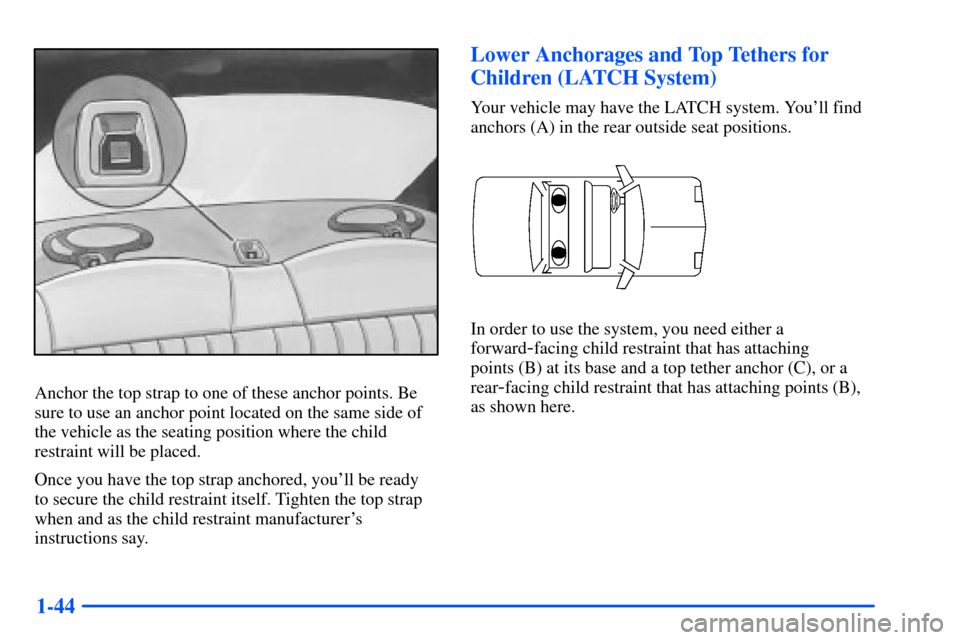
Anchor the top strap to one of these anchor points. Be
sure to use an anchor point located on the same side of
the vehicle as the seating position where the child
restraint will be placed.
Once you have the top strap anchored, you'll be ready
to secure the child restraint itself. Tighten the top strap
when and as the child restraint manufacturer's
instructions say.
Lower Anchorages and Top Tethers for
Children (LATCH System)
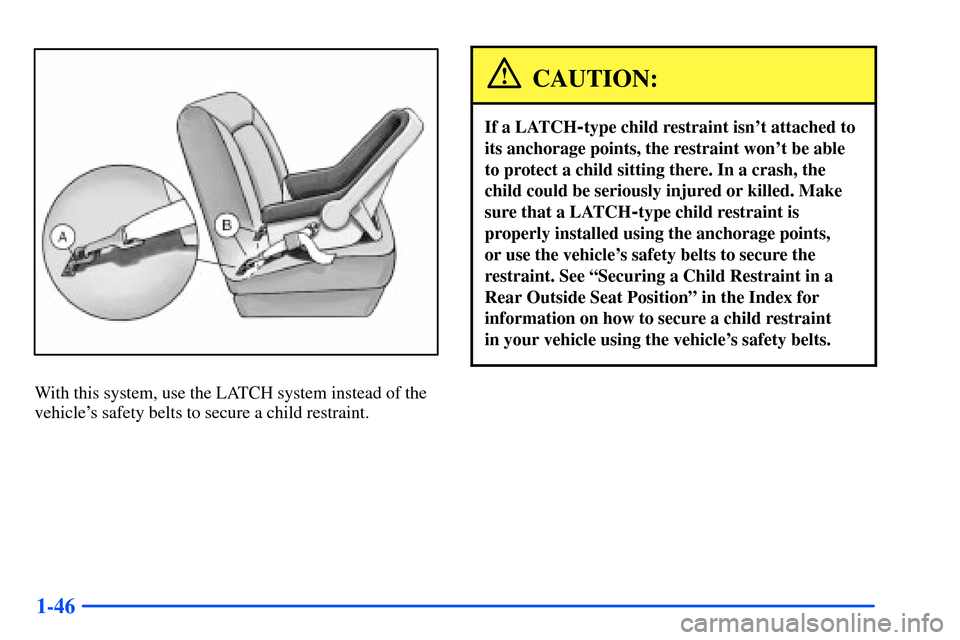
Your vehicle may have the LATCH system. You'll find
anchors (A) in the rear outside seat positions.
In order to use the system, you need either a
forward
-facing child restraint that has attaching
points (B) at its base and a top tether anchor (C), or a
rear
-facing child restraint that has attaching points (B),
as shown here.
Page 58 of 340
1-46
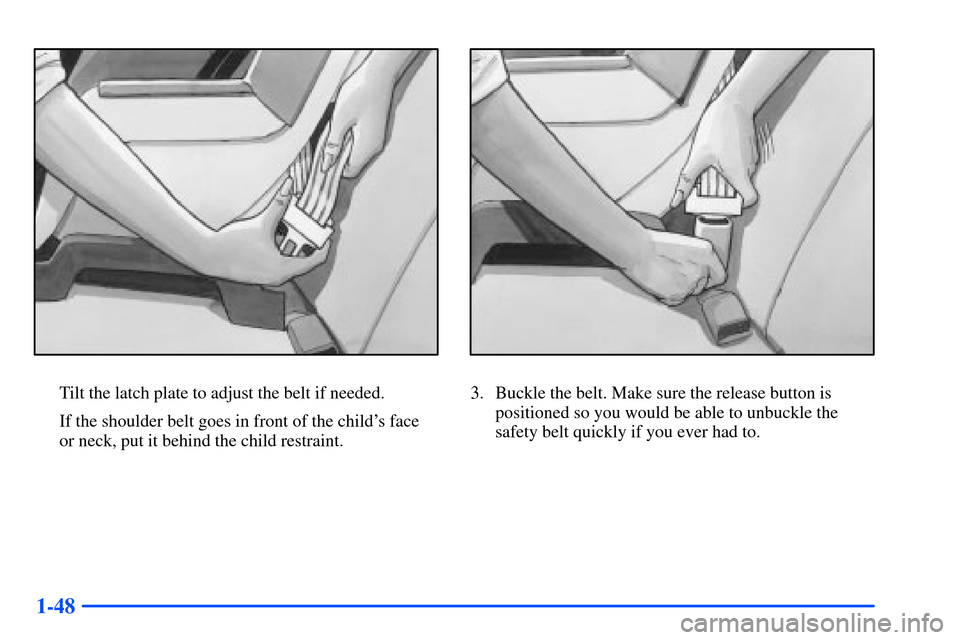
With this system, use the LATCH system instead of the
vehicle's safety belts to secure a child restraint.
CAUTION:
If a LATCH-type child restraint isn't attached to
its anchorage points, the restraint won't be able
to protect a child sitting there. In a crash, the
child could be seriously injured or killed. Make
sure that a LATCH
-type child restraint is
properly installed using the anchorage points,
or use the vehicle's safety belts to secure the
restraint. See ªSecuring a Child Restraint in a
Rear Outside Seat Positionº in the Index for
information on how to secure a child restraint
in your vehicle using the vehicle's safety belts.
Page 59 of 340
1-47
Securing a Child Restraint Designed for the
LATCH System
1. Find the anchors for the seating position you want to
use, where the bottom of the seatback meets the back
of the seat cushion.
2. Put the child restraint on the seat.
3. If the child restraint is forward
-facing, attach the
anchor points on the child restraint to the anchors in
the vehicle. The child restraint instructions will show
you how.
4. Attach the top strap to the top strap anchor. See ªTop
Strapº in the Index. Tighten the top strap according
to the child restraint instructions.
5. Push and pull the child restraint in different
directions to be sure it is secure.
To remove the child restraint, simply unhook the top
strap from the top tether anchor and then disconnect the
anchor points.
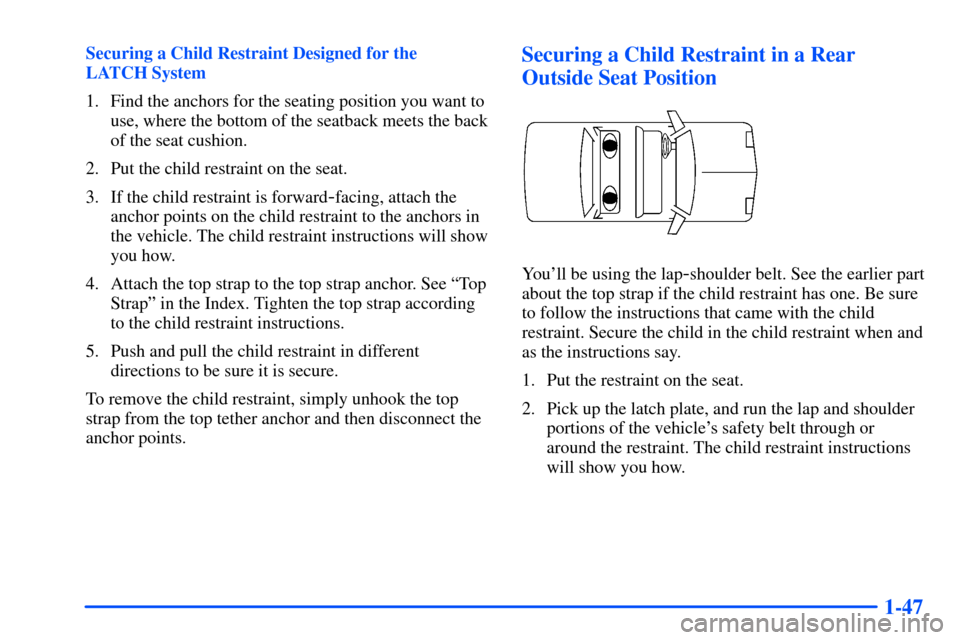
Securing a Child Restraint in a Rear
Outside Seat Position
You'll be using the lap-shoulder belt. See the earlier part
about the top strap if the child restraint has one. Be sure
to follow the instructions that came with the child
restraint. Secure the child in the child restraint when and
as the instructions say.
1. Put the restraint on the seat.
2. Pick up the latch plate, and run the lap and shoulder
portions of the vehicle's safety belt through or
around the restraint. The child restraint instructions
will show you how.
Page 60 of 340
1-48
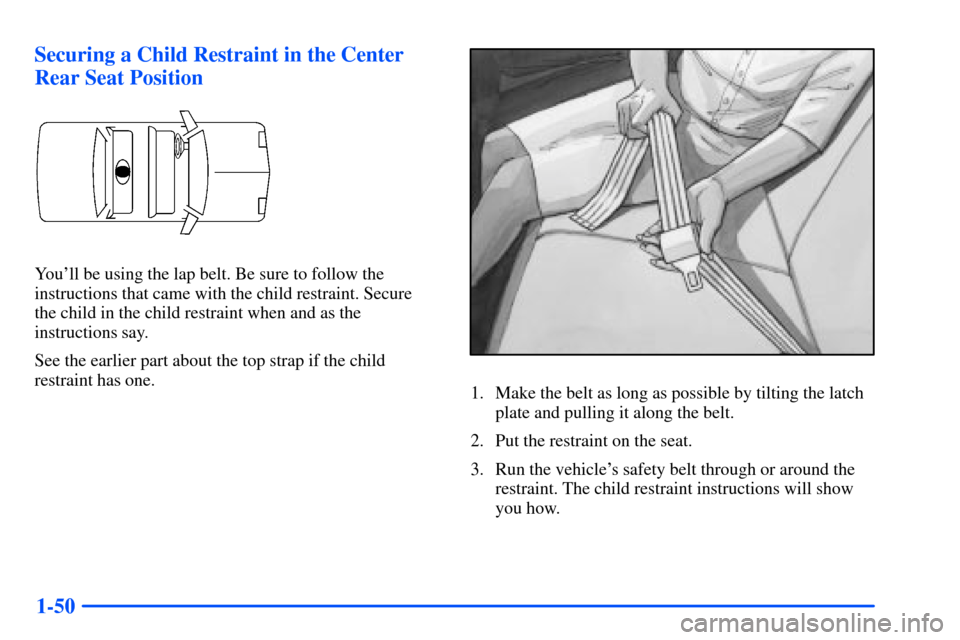
Tilt the latch plate to adjust the belt if needed.
If the shoulder belt goes in front of the child's face
or neck, put it behind the child restraint.3. Buckle the belt. Make sure the release button is
positioned so you would be able to unbuckle the
safety belt quickly if you ever had to.
Page 62 of 340
1-50 Securing a Child Restraint in the Center
Rear Seat Position
You'll be using the lap belt. Be sure to follow the
instructions that came with the child restraint. Secure
the child in the child restraint when and as the
instructions say.
See the earlier part about the top strap if the child
restraint has one.
1. Make the belt as long as possible by tilting the latch
plate and pulling it along the belt.
2. Put the restraint on the seat.
3. Run the vehicle's safety belt through or around the
restraint. The child restraint instructions will show
you how.
Page 64 of 340
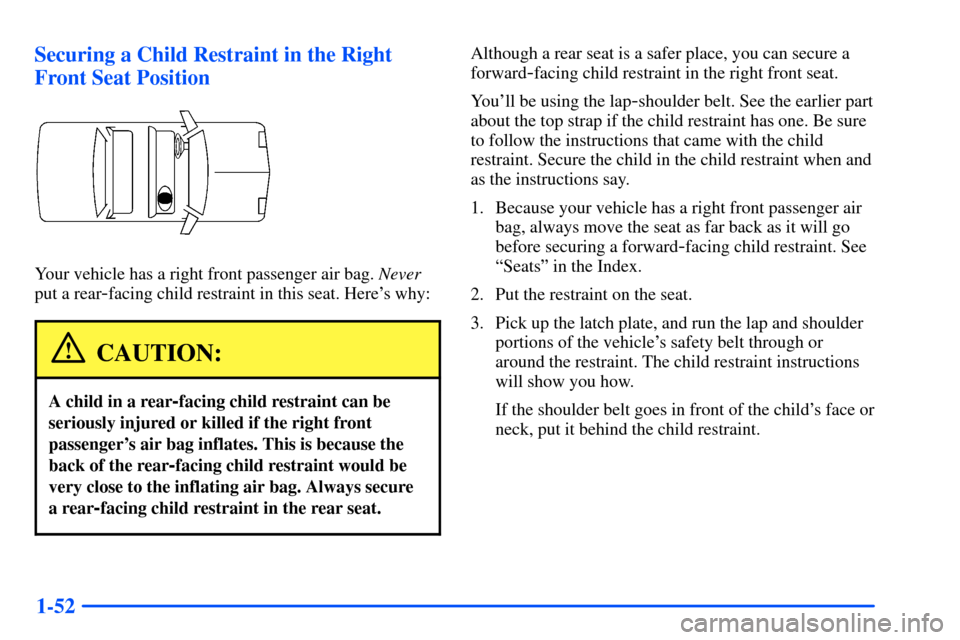
1-52 Securing a Child Restraint in the Right
Front Seat Position
Your vehicle has a right front passenger air bag. Never
put a rear
-facing child restraint in this seat. Here's why:
CAUTION:
A child in a rear-facing child restraint can be
seriously injured or killed if the right front
passenger's air bag inflates. This is because the
back of the rear
-facing child restraint would be
very close to the inflating air bag. Always secure
a rear
-facing child restraint in the rear seat.
Although a rear seat is a safer place, you can secure a
forward
-facing child restraint in the right front seat.
You'll be using the lap
-shoulder belt. See the earlier part
about the top strap if the child restraint has one. Be sure
to follow the instructions that came with the child
restraint. Secure the child in the child restraint when and
as the instructions say.
1. Because your vehicle has a right front passenger air
bag, always move the seat as far back as it will go
before securing a forward
-facing child restraint. See
ªSeatsº in the Index.
2. Put the restraint on the seat.
3. Pick up the latch plate, and run the lap and shoulder
portions of the vehicle's safety belt through or
around the restraint. The child restraint instructions
will show you how.
If the shoulder belt goes in front of the child's face or
neck, put it behind the child restraint.
Page 70 of 340
1-58
Checking Your Restraint Systems
Now and then, make sure the safety belt reminder light
and all your belts, buckles, latch plates, retractors and
anchorages are working properly. Look for any other
loose or damaged safety belt system parts. If you see
anything that might keep a safety belt system from
doing its job, have it repaired.
Torn or frayed safety belts may not protect you in a
crash. They can rip apart under impact forces. If a belt
is torn or frayed, get a new one right away.
Also look for any opened or broken air bag covers, and
have them repaired or replaced. (The air bag system
does not need regular maintenance.)
Replacing Restraint System Parts
After a Crash
If you've had a crash, do you need new belts?
After a very minor collision, nothing may be necessary.
But if the belts were stretched, as they would be if worn
during a more severe crash, then you need new belts.
If belts are cut or damaged, replace them. Collision
damage also may mean you will need to have safety belt
or seat parts repaired or replaced. New parts and repairs
may be necessary even if the belt wasn't being used at
the time of the collision.
If your seat adjuster won't work after a crash, the special
part of the safety belt that goes through the seat to the
adjuster may need to be replaced.
If an air bag inflates, you'll need to replace air bag
system parts. See the part on the air bag system earlier
in this section.
Page 86 of 340
2-16
Trunk
To unlock the trunk from the outside, insert the key and
turn the trunk lock cylinder or use the remote keyless
entry transmitter (if equipped).
When closing the trunk, close from the center to
ensure it fully latches.CAUTION:
It can be dangerous to drive with the trunk lid
open because carbon monoxide (CO) gas can
come into your vehicle. You can't see or smell
CO. It can cause unconsciousness and even death.
If you must drive with the trunk lid open or if
electrical wiring or other cable connections must
pass through the seal between the body and the
trunk lid:
�Make sure all other windows are shut.
�Turn the fan on your heating or cooling
system to its highest speed with the setting
on OUTSIDE AIR. That will force outside
air into your vehicle. See ªComfort
Controlsº in the Index.
�If you have air outlets on or under the
instrument panel, open them all the way.
See ªEngine Exhaustº in the Index.