2001 NISSAN X-TRAIL change wheel
[x] Cancel search: change wheelPage 1049 of 3833
![NISSAN X-TRAIL 2001 Service Repair Manual IVT CONTROL SOLENOID VALVE
EC-699
[QR25(WITHOUT EURO-OBD)]
C
D
E
F
G
H
I
J
K
L
MA
EC
IVT CONTROL SOLENOID VALVEPFP:23796
DescriptionEBS00ND9
SYSTEM DESCRIPTION
This mechanism hydraulically controls](/manual-img/5/57405/w960_57405-1048.png "NISSAN X-TRAIL 2001 Service Repair Manual IVT CONTROL SOLENOID VALVE
EC-699
[QR25(WITHOUT EURO-OBD)]
C
D
E
F
G
H
I
J
K
L
MA
EC
IVT CONTROL SOLENOID VALVEPFP:23796
DescriptionEBS00ND9
SYSTEM DESCRIPTION
This mechanism hydraulically controls")
IVT CONTROL SOLENOID VALVE
EC-699
[QR25(WITHOUT EURO-OBD)]
C
D
E
F
G
H
I
J
K
L
MA
EC
IVT CONTROL SOLENOID VALVEPFP:23796
DescriptionEBS00ND9
SYSTEM DESCRIPTION
This mechanism hydraulically controls cam phases continuously with the fixed operating angle of the intake
valve.
The ECM receives signals such as crankshaft position, camshaft position, engine speed, and engine coolant
temperature. Then, the ECM sends ON/OFF pulse duty signals to the intake valve timing control solenoid
valve depending on driving status. This makes it possible to control the shut/open timing of the intake valve to
increase engine torque in low/mid speed range and output in high-speed range.
COMPONENT DESCRIPTION
Intake valve timing control solenoid valve is activated by ON/OFF
pulse duty (ratio) signals from the ECM.
The intake valve timing control solenoid valve changes the oil
amount and direction of flow through intake valve timing control unit
or stops oil flow.
The longer pulse width advances valve angle.
The shorter pulse width retards valve angle.
When ON and OFF pulse widths become equal, the solenoid valve
stops oil pressure flow to fix the intake valve angle at the control
position.
CONSULT-II Reference Value in Data Monitor ModeEBS00NDA
Specification data are reference values.
Sensor Input signal to ECM function ECM Actuator
Crankshaft position sensor (POS) Engine speed
Intake valve
timing controlIntake valve timing control
solenoid valve Camshaft position sensor (PHASE) Engine speed and piston position
Engine coolant temperature sensor Engine coolant temperature
Wheel sensor Vehicle speed
PBIB0540E
PBIB0195E
MONITOR ITEM CONDITION SPECIFICATION
INT/V SOL (B1)
●Engine: After warming up
●Shift lever: N
●Air conditioner switch: OFF
●No-loadIdle 0% - 2%
When revving engine up to 2,000 rpm
quicklyApprox. 0% - 50%
Page 1188 of 3833
![NISSAN X-TRAIL 2001 Service Repair Manual EC-838
[QR20(WITH EURO-OBD)]
TROUBLE DIAGNOSIS
CONSULT-II Reference Value in Data Monitor
EBS00MT2
Remarks:
● Specification data are reference values.
● Specification data are output/input values](/manual-img/5/57405/w960_57405-1187.png "NISSAN X-TRAIL 2001 Service Repair Manual EC-838
[QR20(WITH EURO-OBD)]
TROUBLE DIAGNOSIS
CONSULT-II Reference Value in Data Monitor
EBS00MT2
Remarks:
● Specification data are reference values.
● Specification data are output/input values")
EC-838
[QR20(WITH EURO-OBD)]
TROUBLE DIAGNOSIS
CONSULT-II Reference Value in Data Monitor
EBS00MT2
Remarks:
● Specification data are reference values.
● Specification data are output/input values which are detected or supplied by the ECM at the connector.
* Specification data may not be directly related to their components signals/values/operations.
i.e. Adjust ignition timing with a timing light before monitoring IGN TIMING, because the monitor may show the specification data in
spite of the ignition timing not being adjusted to the specification data. This IGN TIMING monitors the data calculated by the ECM
according to the signals input from the camshaft position sensor and other ignition timing related sensors.
MONITOR ITEM CONDITION SPECIFICATION
ENG SPEED
●Run engine and compare the CONSULT-II value with tachometer indica-
tion.Almost the same speed as the
tachometer indication.
MAS A/F SE-B1
●Engine: After warming up
●Air conditioner switch: OFF
●Shift lever: N
●No-loadIdle Approx. 1.0 - 1.5V
2,500 rpm Approx. 1.6 - 2.0V
B/FUEL SCHDL
●Engine: After warming up
●Shift lever: N
●Air conditioner switch: OFF
●No-loadIdle 2.5 - 3.5 msec
2,000 rpm 2.5 - 3.5 msec
A/F ALPHA-B1
●Engine: After warming upMaintaining engine speed at 2,000
rpm54% - 155%
COOLAN TEMP/S
●Engine: After warming up More than 70°C (158°F)
HO2S1 (B1)
●Engine: After warming upMaintaining engine speed at 2,000
rpm0 - 0.3V ←→ Approx. 0.6 - 1.0V
HO2S2 (B1)
●Engine: After warming upRevving engine from idle up to 3,000
rpm quickly0 - 0.3V ←→ Approx. 0.6 - 1.0V
HO2S1 MNTR (B1)
●Engine: After warming upMaintaining engine speed at 2,000
rpmLEAN ←→ RICH
Changes more than 5 times dur-
ing 10 seconds.
HO2S2 MNTR (B1)
●Engine: After warming upRevving engine from idle up to 3,000
rpm quicklyLEAN ←→ RICH
VEH SPEED SE
●Turn drive wheels and compare CONSULT-II value with the speedome-
ter indication.Almost the same speed as the
speedometer indication.
BATTERY VOLT
●Ignition switch: ON (Engine stopped) 11 - 14V
ACCEL SEN1
●Ignition switch: ON
(engine stopped)Accelerator pedal: Fully released 0.41 - 0.71V
Accelerator pedal: Fully depressed More than 3.9V
ACCEL SEN2*
2●Ignition switch: ON
(engine stopped)Accelerator pedal: Fully released 0.15 - 0.97V
Accelerator pedal: Fully depressed More than 3.8V
THRTL SEN1
THRTL SEN2*
2
●Ignition switch: ON
(Engine stopped)Accelerator pedal: Fully released More than 0.36V
●Shift lever:
D (A/T model)
1st (M/T model)Accelerator pedal: Fully depressed Less than 4.75V
START SIGNAL
●Ignition switch: ON → START → ON OFF → ON → OFF
CLSD THL POS
●Ignition switch: ON
●Engine stoppedAccelerator pedal: Fully released ON
Accelerator pedal: Slightly depressed OFF
AIR COND SIG
●Engine: After warming up, idle
the engineAir conditioner switch: OFF OFF
Air conditioner switch: ON
(Compressor operates.)ON
P/N POSI SW
●Ignition switch: ONShift lever:
P or N (A/T model)
Neutral (M/T model)ON
Shift lever: Except above OFF
Page 1296 of 3833
![NISSAN X-TRAIL 2001 Service Repair Manual EC-946
[QR20(WITH EURO-OBD)]
DTC P0300 - P0304 MULTIPLE CYLINDER MISFIRE, NO. 1 - 4 CYLINDER MIS-
FIRE
DTC P0300 - P0304 MULTIPLE CYLINDER MISFIRE, NO. 1 - 4 CYLINDER MIS-
FIRE
PFP:00000
On](/manual-img/5/57405/w960_57405-1295.png "NISSAN X-TRAIL 2001 Service Repair Manual EC-946
[QR20(WITH EURO-OBD)]
DTC P0300 - P0304 MULTIPLE CYLINDER MISFIRE, NO. 1 - 4 CYLINDER MIS-
FIRE
DTC P0300 - P0304 MULTIPLE CYLINDER MISFIRE, NO. 1 - 4 CYLINDER MIS-
FIRE
PFP:00000
On")
EC-946
[QR20(WITH EURO-OBD)]
DTC P0300 - P0304 MULTIPLE CYLINDER MISFIRE, NO. 1 - 4 CYLINDER MIS-
FIRE
DTC P0300 - P0304 MULTIPLE CYLINDER MISFIRE, NO. 1 - 4 CYLINDER MIS-
FIRE
PFP:00000
On Board Diagnosis LogicEBS00MWX
When a misfire occurs, engine speed will fluctuate. If the engine speed fluctuates enough to cause the crank-
shaft position (CKP) sensor (POS) signal to vary, ECM can determine that a misfire is occurring.
The misfire detection logic consists of the following two conditions.
1. One Trip Detection Logic (Three Way Catalyst Damage)
On the first trip that a misfire condition occurs that can damage the three way catalyst (TWC) due to over-
heating, the MI will blink.
When a misfire condition occurs, the ECM monitors the CKP sensor (POS) signal every 200 engine revo-
lutions for a change.
When the misfire condition decreases to a level that will not damage the TWC, the MI will turn off.
If another misfire condition occurs that can damage the TWC on a second trip, the MI will blink.
When the misfire condition decreases to a level that will not damage the TWC, the MI will remain on.
If another misfire condition occurs that can damage the TWC, the MI will begin to blink again.
2. Two Trip Detection Logic (Exhaust quality deterioration)
For misfire conditions that will not damage the TWC (but will affect vehicle emissions), the MI will only light
when the misfire is detected on a second trip. During this condition, the ECM monitors the CKP sensor
signal every 1,000 engine revolutions.
A misfire malfunction can be detected on any one cylinder or on multiple cylinders.
DTC Confirmation ProcedureEBS00MWY
CAUTION:
Always drive vehicle at a safe speed.
NOTE:
If “DTC Confirmation Procedure” has been previously conducted, always turn ignition switch “OFF” and wait at
least 10 seconds before conducting the next test.
WITH CONSULT-II
1. Turn ignition switch “ON”, and select “DATA MONITOR” mode with CONSULT-II.
2. Start engine and warm it up to normal operating temperature.
3. Turn ignition switch “OFF” and wait at least 10 seconds.
Sensor Input Signal to ECM ECM function
Crankshaft position sensor (POS) Engine speed On board diagnosis of misfire
DTC No. Trouble diagnosis name DTC detecting condition Possible cause
P0300
0300Multiple cylinder misfire
detectedMultiple cylinder misfire.
●Improper spark plug
●Insufficient compression
●Incorrect fuel pressure
●The injector circuit is open or shorted
●Fuel injectors
●Intake air leak
●The ignition signal circuit is open or
shorted
●Lack of fuel
●Drive plate or flywheel
●Heated oxygen sensor 1 P0301
0301No.1 cylinder misfire
detectedNo. 1 cylinder misfires.
P0302
0302No. 2 cylinder misfire
detectedNo. 2 cylinder misfires.
P0303
0303No. 3 cylinder misfire
detectedNo. 3 cylinder misfires.
P0304
0304No. 4 cylinder misfire
detectedNo. 4 cylinder misfires.
Page 1533 of 3833
![NISSAN X-TRAIL 2001 Service Repair Manual TROUBLE DIAGNOSIS
EC-1183
[QR20(WITHOUT EURO-OBD)]
C
D
E
F
G
H
I
J
K
L
MA
EC
B/FUEL SCHDL
●Engine: After warming up
●Shift lever: N
●Air conditioner switch: OFF
●No-loadIdle 2.5 - 3.5 msec
2,0](/manual-img/5/57405/w960_57405-1532.png "NISSAN X-TRAIL 2001 Service Repair Manual TROUBLE DIAGNOSIS
EC-1183
[QR20(WITHOUT EURO-OBD)]
C
D
E
F
G
H
I
J
K
L
MA
EC
B/FUEL SCHDL
●Engine: After warming up
●Shift lever: N
●Air conditioner switch: OFF
●No-loadIdle 2.5 - 3.5 msec
2,0")
TROUBLE DIAGNOSIS
EC-1183
[QR20(WITHOUT EURO-OBD)]
C
D
E
F
G
H
I
J
K
L
MA
EC
B/FUEL SCHDL
●Engine: After warming up
●Shift lever: N
●Air conditioner switch: OFF
●No-loadIdle 2.5 - 3.5 msec
2,000 rpm 2.5 - 3.5 msec
A/F ALPHA-B1
●Engine: After warming upMaintaining engine speed at 2,000
rpm54% - 155%
COOLAN TEMP/S
●Engine: After warming up More than 70°C (158°F)
HO2S1 (B1)
●Engine: After warming upMaintaining engine speed at 2,000
rpm0 - 0.3V ←→ Approx. 0.6 - 1.0V
HO2S2 (B1)
●Engine: After warming upRevving engine from idle up to 3,000
rpm quickly0 - 0.3V ←→ Approx. 0.6 - 1.0V
HO2S1 MNTR (B1)
●Engine: After warming upMaintaining engine speed at 2,000
rpmLEAN←→ RICH
Changes more than 5 times dur-
ing 10 seconds.
HO2S2 MNTR (B1)
●Engine: After warming upRevving engine from idle up to 3,000
rpm quicklyLEAN←→ RICH
VEH SPEED SE
●Turn drive wheels and compare CONSULT-II value with the speedometer
indication.Almost the same speed as the
speedometer indication
BATTERY VOLT
●Ignition switch: ON (Engine stopped) 11 - 14V
ACCEL SEN1
●Ignition switch: ON
(engine stopped)Accelerator pedal: Fully released 0.41 - 0.71V
Accelerator pedal: Fully depressed More than 3.9V
ACCEL SEN2*
2●Ignition switch: ON
(engine stopped)Accelerator pedal: Fully released 0.15 - 0.97V
Accelerator pedal: Fully depressed More than 3.8V
THRTL SEN1
THRTL SEN2*
2
●Ignition switch: ON
(Engine stopped)Accelerator pedal: Fully released More than 0.36V
●Shift lever:
D (A/T model)
1st (M/T model)Accelerator pedal: Fully depressed Less than 4.75V
START SIGNAL
●Ignition switch: ON → START → ON OFF → ON → OFF
CLSD THL POS
●Ignition switch: ONAccelerator pedal: Fully released ON
Accelerator pedal: Slightly depressed OFF
AIR COND SIG
●Engine: After warming up, idle
the engineAir conditioner switch: OFF OFF
Air conditioner switch: ON
(Compressor operates.)ON
P/N POSI SW
●Ignition switch: ONShift lever:
P or N (A/T model)
Neutral (M/T model)ON
Shift lever: Except above OFF
PW/ST SIGNAL
●Engine: After warming up, idle
the engineSteering wheel is in neutral position.
(Forward direction)OFF
Steering wheel is turned. ON
LOAD SIGNAL
●Ignition switch: ONRear window defogger switch is ON
and/or lighting switch is in 2nd.ON
Rear window defogger switch is OFF
and lighting switch is OFF.OFF
IGNITION SW
●Ignition switch: ON → OFF → ON ON → OFF → ON
HEATER FAN SW
●Engine: After warming up, idle
the engineHeater fan is operating. ON
Heater fan is not operating OFF
BRAKE SW
●Ignition switch: ONBrake pedal: Fully released OFF
Brake pedal: Slightly depressed ON MONITOR ITEM CONDITION SPECIFICATION
Page 1690 of 3833
![NISSAN X-TRAIL 2001 Service Repair Manual EC-1340
[QR20(WITHOUT EURO-OBD)]
EVAP CANISTER PURGE VOLUME CONTROL SOLENOID VALVE
EVAP CANISTER PURGE VOLUME CONTROL SOLENOID VALVE
PFP:14920
DescriptionEBS00N9L
SYSTEM DESCRIPTION
This system con](/manual-img/5/57405/w960_57405-1689.png "NISSAN X-TRAIL 2001 Service Repair Manual EC-1340
[QR20(WITHOUT EURO-OBD)]
EVAP CANISTER PURGE VOLUME CONTROL SOLENOID VALVE
EVAP CANISTER PURGE VOLUME CONTROL SOLENOID VALVE
PFP:14920
DescriptionEBS00N9L
SYSTEM DESCRIPTION
This system con")
EC-1340
[QR20(WITHOUT EURO-OBD)]
EVAP CANISTER PURGE VOLUME CONTROL SOLENOID VALVE
EVAP CANISTER PURGE VOLUME CONTROL SOLENOID VALVE
PFP:14920
DescriptionEBS00N9L
SYSTEM DESCRIPTION
This system controls flow rate of fuel vapor from the EVAP canister. The opening of the vapor by-pass pas-
sage in the EVAP canister purge volume control solenoid valve changes to control the flow rate. The EVAP
canister purge volume control solenoid valve repeats ON/OFF operation according to the signal sent from the
ECM. The opening of the valve varies for optimum engine control. The optimum value stored in the ECM is
determined by considering various engine conditions. When the engine is operating, the flow rate of fuel vapor
from the EVAP canister is regulated as the air flow changes.
COMPONENT DESCRIPTION
The EVAP canister purge volume control solenoid valve uses a ON/
OFF duty to control the flow rate of fuel vapor from the EVAP canis-
ter. The EVAP canister purge volume control solenoid valve is
moved by ON/OFF pulses from the ECM. The longer the ON pulse,
the greater the amount of fuel vapor that will flow through the valve.
CONSULT-II Reference Value in Data Monitor ModeEBS00N9M
Specification data are reference values.
ECM Terminals and Reference ValueEBS00N9N
Specification data are reference values and are measured between each terminal and ground.
Pulse signal is measured by CONSULT-II.
CAUTION:
Do not use ECM ground terminals when measuring input/output voltage. Doing so may result in dam-
age to the ECM's transistor. Use a ground other than ECM terminals, such as the ground.
Sensor Input Signal to ECMECM
functionActuator
Crankshaft position sensor (POS) Engine speed
EVAP can-
ister purge
flow con-
trolEVAP canister purge volume
control solenoid valve Mass air flow sensor Amount of intake air
Engine coolant temperature sensor Engine coolant temperature
Ignition switch Start signal
Throttle position sensor Throttle position
Accelerator pedal position sensor Closed throttle position
Heated oxygen sensors 1Density of oxygen in exhaust gas
(Mixture ratio feedback signal)
Wheel sensor Vehicle speed
SEF337U
MONITOR ITEM CONDITION SPECIFICATION
PURG VOL C/V
●Engine: After warming up
●Shift lever: N
●Air conditioner switch: OFF
●No-loadIdle 0%
2,000 rpm 20 - 30%
Page 1697 of 3833
![NISSAN X-TRAIL 2001 Service Repair Manual IVT CONTROL SOLENOID VALVE
EC-1347
[QR20(WITHOUT EURO-OBD)]
C
D
E
F
G
H
I
J
K
L
MA
EC
IVT CONTROL SOLENOID VALVEPFP:23796
DescriptionEBS00N9S
SYSTEM DESCRIPTION
This mechanism hydraulically control](/manual-img/5/57405/w960_57405-1696.png "NISSAN X-TRAIL 2001 Service Repair Manual IVT CONTROL SOLENOID VALVE
EC-1347
[QR20(WITHOUT EURO-OBD)]
C
D
E
F
G
H
I
J
K
L
MA
EC
IVT CONTROL SOLENOID VALVEPFP:23796
DescriptionEBS00N9S
SYSTEM DESCRIPTION
This mechanism hydraulically control")
IVT CONTROL SOLENOID VALVE
EC-1347
[QR20(WITHOUT EURO-OBD)]
C
D
E
F
G
H
I
J
K
L
MA
EC
IVT CONTROL SOLENOID VALVEPFP:23796
DescriptionEBS00N9S
SYSTEM DESCRIPTION
This mechanism hydraulically controls cam phases continuously with the fixed operating angle of the intake
valve.
The ECM receives signals such as crankshaft position, camshaft position, engine speed, and engine coolant
temperature. Then, the ECM sends ON/OFF pulse duty signals to the intake valve timing control solenoid
valve depending on driving status. This makes it possible to control the shut/open timing of the intake valve to
increase engine torque in low/mid speed range and output in high-speed range.
COMPONENT DESCRIPTION
Intake valve timing control solenoid valve is activated by ON/OFF
pulse duty (ratio) signals from the ECM.
The intake valve timing control solenoid valve changes the oil
amount and direction of flow through intake valve timing control unit
or stops oil flow.
The longer pulse width advances valve angle.
The shorter pulse width retards valve angle.
When ON and OFF pulse widths become equal, the solenoid valve
stops oil pressure flow to fix the intake valve angle at the control
position.
CONSULT-II Reference Value in Data Monitor ModeEBS00N9T
Specification data are reference values.
Sensor Input signal to ECM function ECM Actuator
Crankshaft position sensor (POS) Engine speed
Intake valve
timing controlIntake valve timing control
solenoid valve Camshaft position sensor (PHASE) Engine speed and piston position
Engine coolant temperature sensor Engine coolant temperature
Wheel sensor Vehicle speed
PBIB0540E
PBIB0195E
MONITOR ITEM CONDITION SPECIFICATION
INT/V SOL (B1)
●Engine: After warming up
●Shift lever: N
●Air conditioner switch: OFF
●No-loadIdle 0% - 2%
When revving engine up to 2,000 rpm
quicklyApprox. 0% - 50%
Page 2640 of 3833
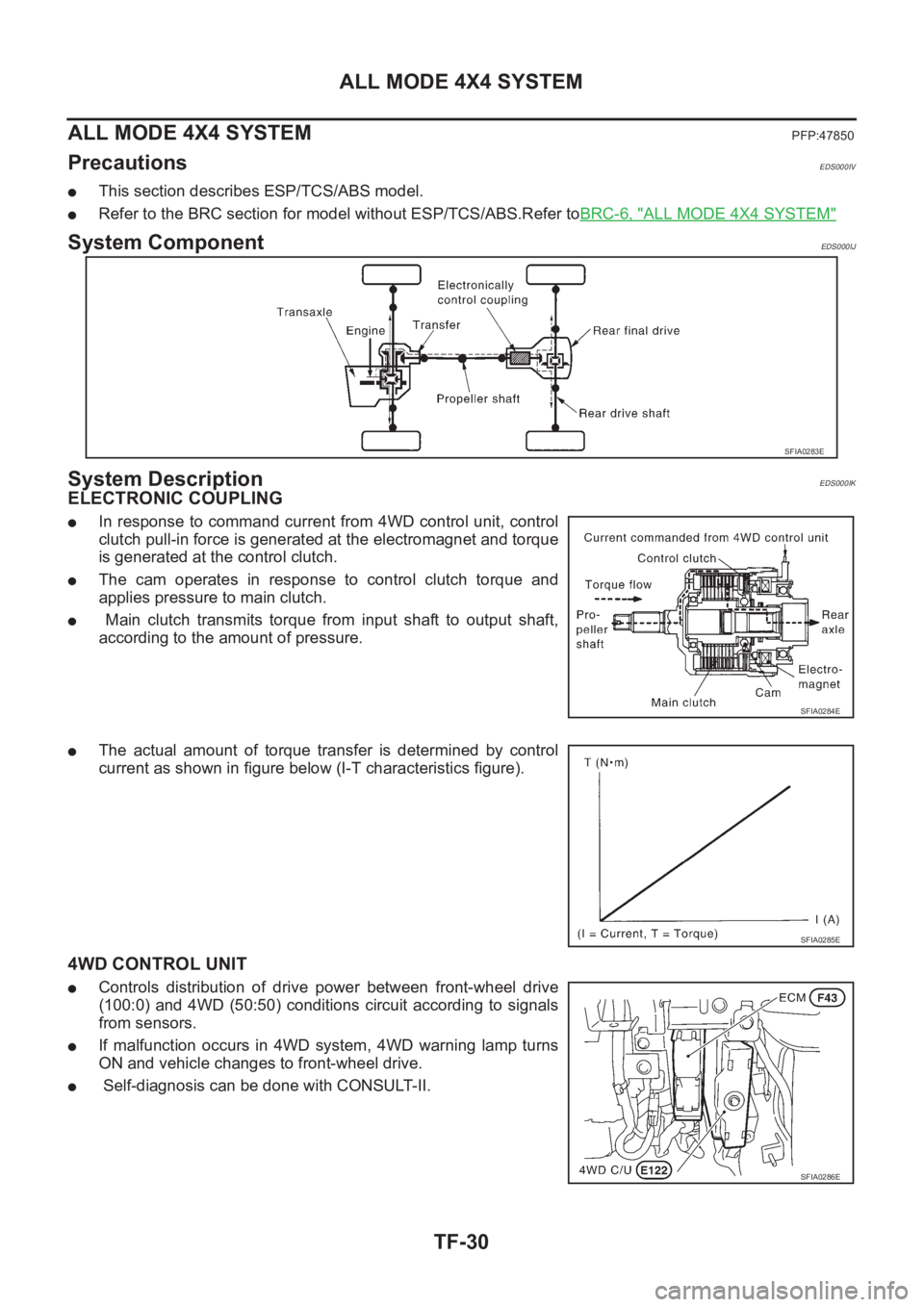
TF-30
ALL MODE 4X4 SYSTEM
ALL MODE 4X4 SYSTEM
PFP:47850
PrecautionsEDS000IV
●This section describes ESP/TCS/ABS model.
●Refer to the BRC section for model without ESP/TCS/ABS.Refer toBRC-6, "ALL MODE 4X4 SYSTEM"
System ComponentEDS000IJ
System DescriptionEDS000IK
ELECTRONIC COUPLING
●In response to command current from 4WD control unit, control
clutch pull-in force is generated at the electromagnet and torque
is generated at the control clutch.
●The cam operates in response to control clutch torque and
applies pressure to main clutch.
● Main clutch transmits torque from input shaft to output shaft,
according to the amount of pressure.
●The actual amount of torque transfer is determined by control
current as shown in figure below (I-T characteristics figure).
4WD CONTROL UNIT
●Controls distribution of drive power between front-wheel drive
(100:0) and 4WD (50:50) conditions circuit according to signals
from sensors.
●If malfunction occurs in 4WD system, 4WD warning lamp turns
ON and vehicle changes to front-wheel drive.
● Self-diagnosis can be done with CONSULT-II.
SFIA0283E
SFIA0284E
SFIA0285E
SFIA0286E
Page 2641 of 3833
ALL MODE 4X4 SYSTEM
TF-31
C
E
F
G
H
I
J
K
L
MA
B
TF
4WD MODE SWITCH
AUTO mode (AUTO indicator lamp ON)
●Electronic control allows optimal distribution of torque to front/rear wheels to match road conditions.
●Makes possible stable driving, with no wheel spin, on snowy roads or other slippery surfaces.
●On roads which do not require 4WD, it contributes to improved fuel economy by driving in conditions close
to front-wheel drive.
●Sensors determine the vehicle's turning condition, and in response tight cornering/braking are controlled
by distributing optimum torque to rear wheels.
NOTE:
●When driving in AUTO mode or LOCK mode, if there is a large difference between front and rear wheel
speed which continues for a long time, oil temperature of drive system parts becomes too high and 4WD
warning lamp flashes rapidly. (When 4WD warning lamp flashes, vehicle changes to front-wheel drive
conditions.)
● When driving in AUTO mode, 4WD warning lamp may flash slowly if there is a significant difference in
pressure or wear between tires. At this time, vehicle performance is not fully available and cautious driving
is required. (Continues until engine is turned OFF.)
●If 4WD warning lamp is flashing rapidly, stop vehicle and allow it to idle for some time. Flashing will stop
and AUTO mode will be restored.
●If the warning lamp flashes slowly during driving but remains OFF after engine is restarted, the system is
normal. If it again flashes slowly after driving for some time, vehicle must be inspected.
●When the difference of revolution speed between the front and rear wheel with AUTO mode the shift
switch occasionally changes to LOCK mode automatically. This is not malfunction.
LOCK mode (LOCK indicator lamp and AUTO indicator lamp ON)
●Front/rear wheel torque distribution is fixed, ensuring stable driving when climbing slopes.
●When LOCK mode is selected, vehicle will switch automatically to AUTO mode if vehicle speed increases.
If vehicle speed then decreases, the vehicle automatically returns to direct 4-wheel driving conditions.
NOTE:
If there is a significant difference in pressure or wear between tires, full vehicle performance is not available.
Tire conditions are detected, and LOCK mode may be prohibited, or else speeds at which LOCK mode is
enabled may be restricted.
2WD mode (indicator lamps OFF)
Vehicle is in front-wheel drive.
NOTE:
● If front wheels are slipping in 2WD mode, do not switch to AUTO or LOCK. This can cause difficulties for
the system.
● The shift switch even if the shift switch is in 2WD mode, the sift switch occasionally automatically change
to 4WD mode depending on the driving condition (For example; Depressing the acceleration firmly). this is
not malfunction. How ever, 4WD mode indicator lamp dose not illuminate.
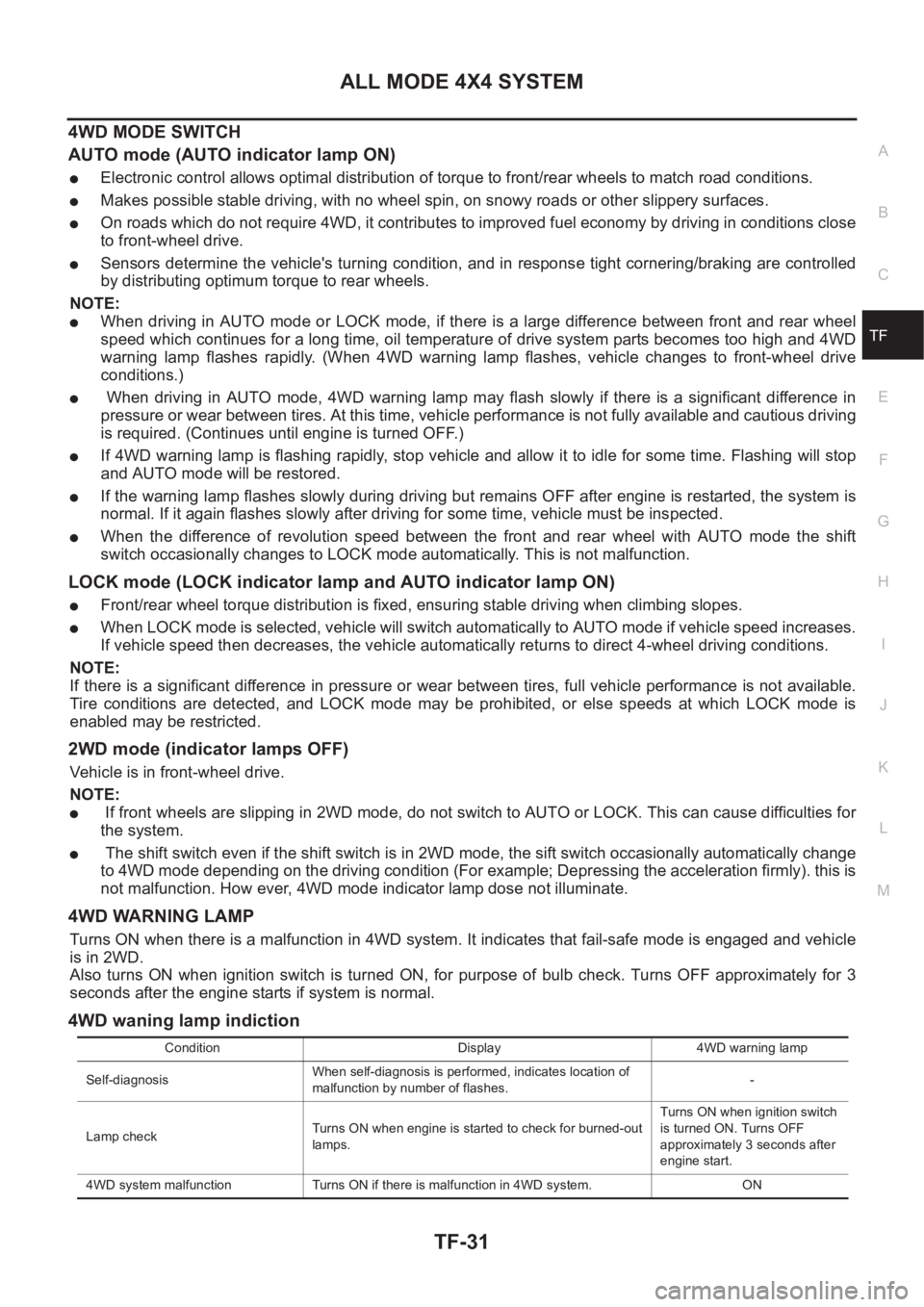
4WD WARNING LAMP
Turns ON when there is a malfunction in 4WD system. It indicates that fail-safe mode is engaged and vehicle
is in 2WD.
Also turns ON when ignition switch is turned ON, for purpose of bulb check. Turns OFF approximately for 3
seconds after the engine starts if system is normal.
4WD waning lamp indiction
Condition Display 4WD warning lamp
Self-diagnosisWhen self-diagnosis is performed, indicates location of
malfunction by number of flashes.-
Lamp checkTurns ON when engine is started to check for burned-out
lamps.Turns ON when ignition switch
is turned ON. Turns OFF
approximately 3 seconds after
engine start.
4WD system malfunction Turns ON if there is malfunction in 4WD system. ON