2001 NISSAN QUEST child seat
[x] Cancel search: child seatPage 48 of 304
child's size. Generally, infants up to about
1 year and less than 20 pounds (9 kg)
should be placed in rear facing child re-
straints. Forward facing child restraints
are available for children who outgrow rear
facing child restraints.
WARNING
Infants and children need special pro-
tection. The vehicle's seat belts may
not fit them properly. The shoulder belt
may come too close to the face or neck.
The lap belt may not fit over their small
hip bones. In an accident, an improp-
erly fitting seat belt could cause seri-
ous or fatal injury. Always use appro-
priate child restraints.
All US States and Canadian provinces re-
quire the use of approved child restraints for
infants and small children. See ``Child re-
straints'' later in this section.
In addition, there are many types of child
restraints available for larger children which
should be used for maximum protection.
NISSAN recommends that all pre-teens
and children be restrained in the rear
seat if possible. According to accidentstatistics, children are safer when prop-
erly restrained in the rear seat than in the
front seat.
This is especially important because your
vehicle has a supplemental restraint sys-
tem (Air bag system) for the front passen-
ger (For precautions, see ``Supplemental
restraint system'' earlier in this section).
Infants and small children
NISSAN recommends that infants and small
children be placed in a child restraint that
complies with the Federal Motor Vehicle
Safety Standards or Canadian Motor Ve-
hicle Safety Standards. You should choose
a child restraint that fits your vehicle and
always follow the manufacturer's instruc-
tions for installation and use.
Larger children
Children who are too large for child re-
straints should be seated and restrained by
the seat belts which are provided.
If the child's seating position has a shoulder
belt that fits close to the face or neck, the use
of a booster seat (commercially available)
may help overcome this. The booster seat
should raise the child so the shoulder belt is
properly positioned across the top, middleportion of the shoulder and the lap belt is low
on the hips. The booster seat should fit the
vehicle seat and have a label certifying that
it complies with Federal Motor Vehicle
Safety Standards or Canadian Motor Ve-
hicle Safety Standards. Once the child has
grown enough so the shoulder belt is no
longer on or near the face and neck, use the
shoulder belt without the booster seat.
WARNING
Never let a child stand or kneel on any
seat and do not allow a child in the
cargo areas while the vehicle is mov-
ing. The child could be seriously in-
jured or killed in an accident or sudden
stop.
PREGNANT WOMEN
NISSAN recommends that pregnant women
use seat belts. The seat belt should be worn
snug, and always position the lap belt as
low as possible around the hips, not the
waist. Place the shoulder belt over your
shoulder and across your chest. Never run
the lap/shoulder belt over your abdominal
area. Contact your doctor for specific rec-
ommendations.
Seats, restraints and supplemental air bag systems
1-41
ZX
Page 50 of 304
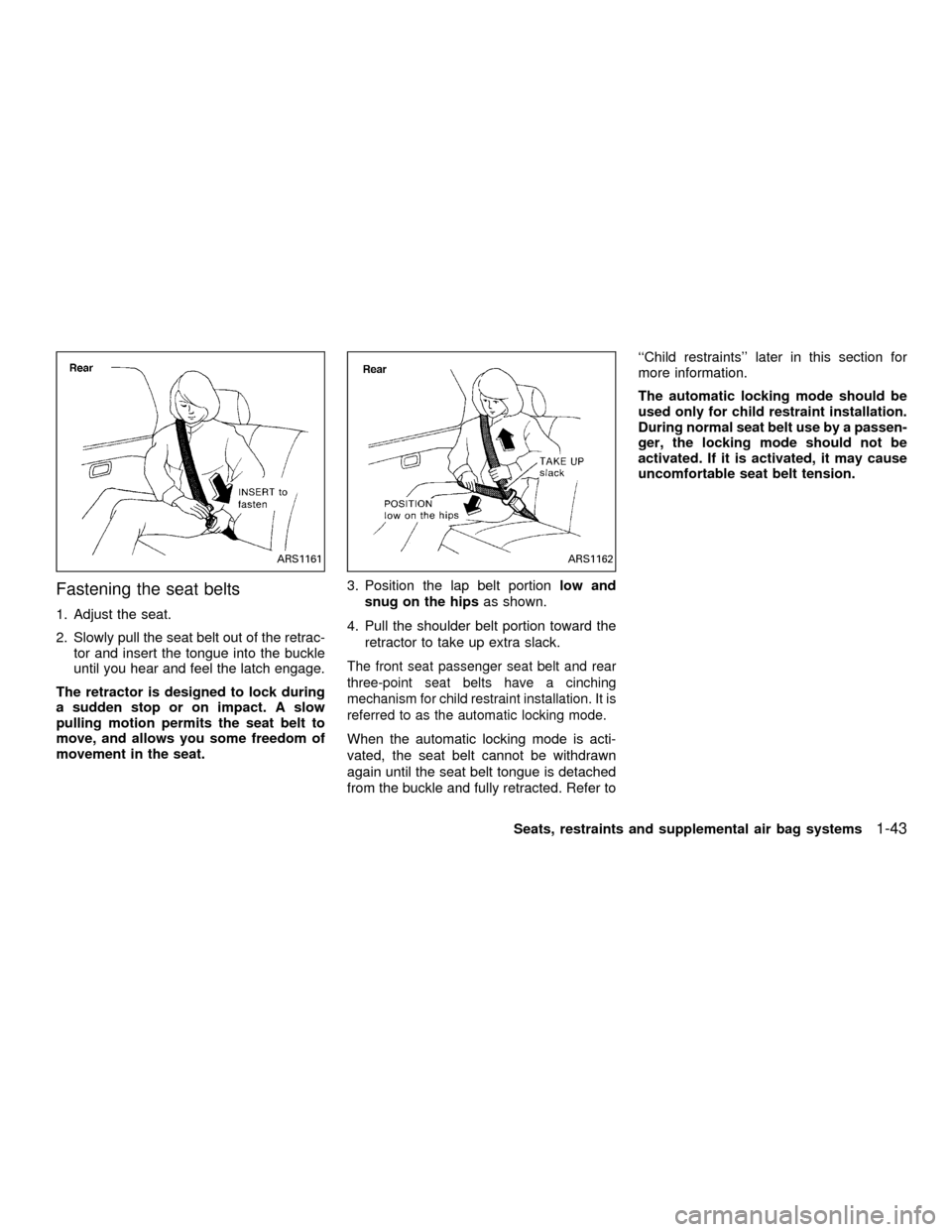
Fastening the seat belts
1. Adjust the seat.
2. Slowly pull the seat belt out of the retrac-
tor and insert the tongue into the buckle
until you hear and feel the latch engage.
The retractor is designed to lock during
a sudden stop or on impact. A slow
pulling motion permits the seat belt to
move, and allows you some freedom of
movement in the seat.3. Position the lap belt portionlow and
snug on the hipsas shown.
4. Pull the shoulder belt portion toward the
retractor to take up extra slack.
The front seat passenger seat belt and rear
three-point seat belts have a cinching
mechanism for child restraint installation. It is
referred to as the automatic locking mode.
When the automatic locking mode is acti-
vated, the seat belt cannot be withdrawn
again until the seat belt tongue is detached
from the buckle and fully retracted. Refer to``Child restraints'' later in this section for
more information.
The automatic locking mode should be
used only for child restraint installation.
During normal seat belt use by a passen-
ger, the locking mode should not be
activated. If it is activated, it may cause
uncomfortable seat belt tension.
ARS1161ARS1162
Seats, restraints and supplemental air bag systems1-43
ZX
Page 54 of 304
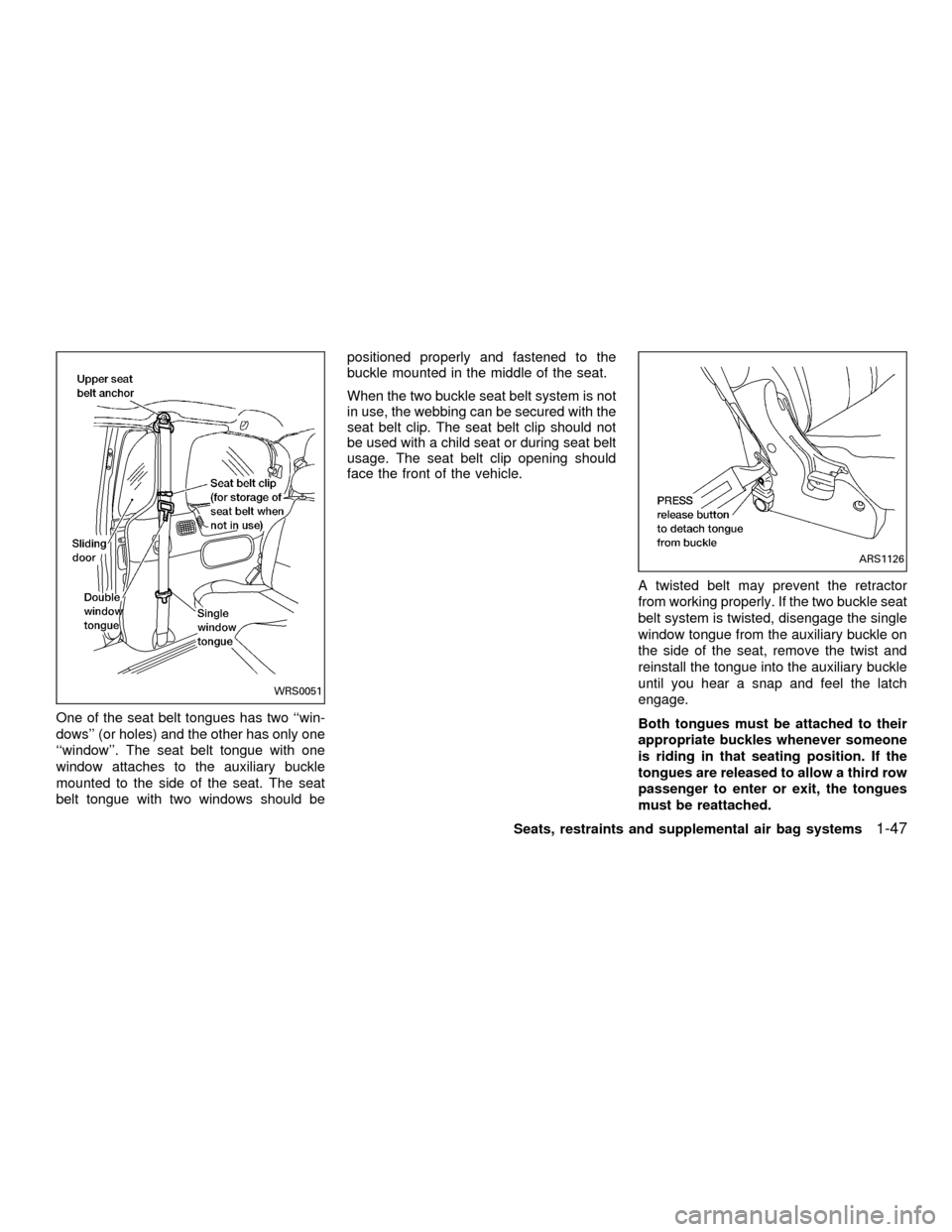
One of the seat belt tongues has two ``win-
dows'' (or holes) and the other has only one
``window''. The seat belt tongue with one
window attaches to the auxiliary buckle
mounted to the side of the seat. The seat
belt tongue with two windows should bepositioned properly and fastened to the
buckle mounted in the middle of the seat.
When the two buckle seat belt system is not
in use, the webbing can be secured with the
seat belt clip. The seat belt clip should not
be used with a child seat or during seat belt
usage. The seat belt clip opening should
face the front of the vehicle.
A twisted belt may prevent the retractor
from working properly. If the two buckle seat
belt system is twisted, disengage the single
window tongue from the auxiliary buckle on
the side of the seat, remove the twist and
reinstall the tongue into the auxiliary buckle
until you hear a snap and feel the latch
engage.
Both tongues must be attached to their
appropriate buckles whenever someone
is riding in that seating position. If the
tongues are released to allow a third row
passenger to enter or exit, the tongues
must be reattached.
WRS0051
ARS1126
Seats, restraints and supplemental air bag systems1-47
ZX
Page 61 of 304
rized NISSAN dealer for assistance if the
extender is required.
WARNING
cOnly NISSAN seat belt extenders,
made by the same company which
made the original equipment belts,
should be used with NISSAN seat
belts.
cPersons who can use the standard
seat belt should not use an extender.
Such unnecessary use could result
in serious personal injury in the
event of an accident.
SEAT BELT MAINTENANCE
cTo clean the seat belt webbings,apply
a mild soap solution or any solution rec-
ommended for cleaning upholstery or
carpet. Then wipe with a cloth and allow
the seat belts to dry in the shade. Do not
allow the seat belts to retract until they
are completely dry.
cIf dirt builds up in the shoulder belt
guideof the seat belt anchors, the seat
belts may retract slowly. Wipe the shoul-
der belt guide with a clean, dry cloth.cPeriodically check to see that the seat
belt and the metal componentssuch
as buckles, tongues, retractors, flexible
wires and anchors work properly. If loose
parts, deterioration, cuts or other dam-
age on the webbing is found, the entire
seat belt assembly should be replaced.
PRECAUTIONS ON CHILD RE-
STRAINTS
WARNING
cInfants and small children should al-
ways be placed in an appropriate child
restraint system while riding in the
vehicle. Failure to use a child restraint
can result in serious injury or death.
cInfants and small children should never
be carried on your lap. It is not possible
for even the strongest adult to resist
the forces of a severe accident. The
child could be crushed between the
adult and parts of the vehicle. Also, do
not put the same seat belt around both
your child and yourself.
cNever install a rear-facing child re-
straint in the front seat. An inflating air
bag could seriously injure or kill your
child. A rear-facing child restraint
must only be used in the rear seat.
cNISSAN recommends that the child
restraint be installed in the rear seat.
,ccording to accident statistics, chil-
dren are safer when properly re-
strained in the rear seat than in a
front seat.
CHILD RESTRAINTS
1-54Seats, restraints and supplemental air bag systems
ZX
Page 62 of 304
cAn improperly installed child re-
straint could lead to serious injury in
an accident.
In general, child restraint systems are de-
signed to be installed with a lap belt or the
lap portion of a three-point type seat belt. In
addition, this vehicle is equipped with a
universal child restraint lower anchor sys-
tem, referred to as the LATCH (Lower An-
chors and Tether for Children) system.
Some child restraints include two rigid or
webbing-mounted attachments that can be
connected to these lower anchors. For de-
tails, see ``LATCH (Lower Anchors and
Tether for Children) system'' later in this
section.
Child restraints for infants and children of
various sizes are offered by several manu-
facturers. When selecting any child re-
straint, keep the following points in mind:
1) Choose only a restraint with a label cer-
tifying that it complies with Federal Motor
Vehicle Safety Standard 213 or Cana-
dian Motor Vehicle Safety Standard 213.
2) Check the child restraint in your vehicle
to be sure it is compatible with the vehi-cle's seat and seat belt system. Choose
a child restraint that meets the guidelines
of the Society of Automotive Engineers
recommended practice J1819 for child
seat installation.
3) If the child restraint is compatible with
your vehicle, place your child in the child
restraint and check the various adjust-
ments to be sure the child restraint is
compatible with your child. Always follow
all recommended procedures.
All U.S. states and some provinces or
territories of Canada require that infants
and small children be restrained in ap-
proved child restraints at all times while
the vehicle is being operated.
WARNING
cImproper use of a child restraint can
result in increased injuries for both
the infant or child and other occu-
pants in the vehicle.cFollow all of the child restraint
manufacturer's instructions for in-
stallation and use. When purchasing
a child restraint, be sure to select
one which will fit your child and
vehicle. It may not be possible to
properly install some types of child
restraints in your vehicle.
cIf the child restraint is not anchored
properly, the risk of a child being
injured in a collision or a sudden
stop greatly increases.
cAdjustable seatbacks should be po-
sitioned to fit the child restraint, but
as upright as possible.
cAfter attaching the child restraint,
test it before you place the child in it.
Tilt it from side to side. Try to tug it
forward and check to see if the belt
holds the restraint in place. If the
restraint is not secure, tighten the
belt as necessary, or put the re-
straint in another seat and test it
again.
Seats, restraints and supplemental air bag systems
1-55
ZX
Page 63 of 304
cFor a front facing child restraint, if
the seat position where it is installed
has a three-point type lap/shoulder
belt, check to make sure the shoul-
der belt does not go in front of the
child's face or neck. If it does, put
the shoulder belt behind the child
restraint. If you must install a front
facing child restraint in the front
seat, see ``Installation on front pas-
senger seat'' later in this section.
cWhen your child restraint is not in
use, keep it secured with a seat belt
to prevent it from being thrown
around in case of a sudden stop or
accident.
CAUTION
Remember that a child restraint left in a
closed vehicle can become very hot.
Check the seating surface and buckles
before placing your child in the child
restraint.
INSTALLATION ON THREE-
PASSENGER BENCH SEAT
CENTER POSITION
Front facing
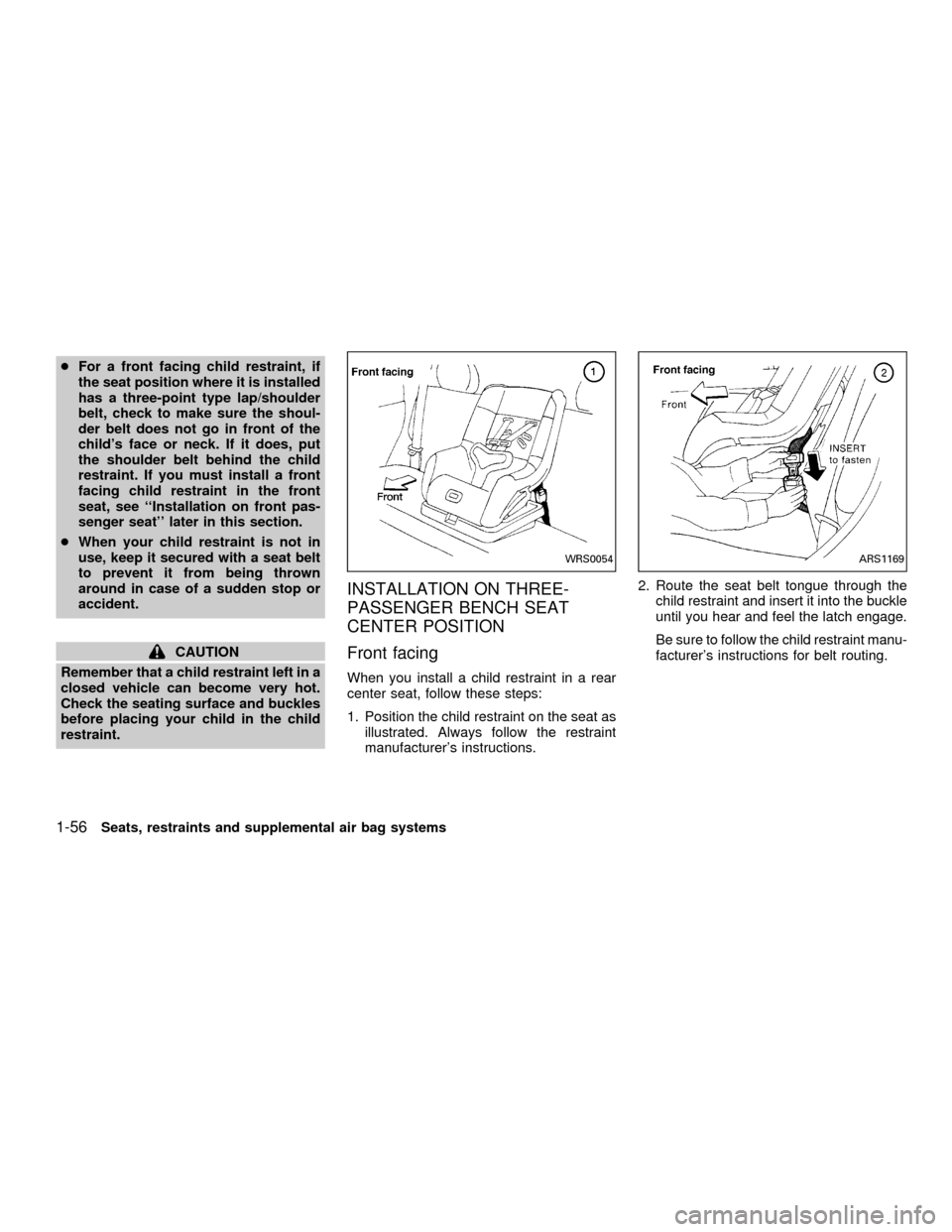
When you install a child restraint in a rear
center seat, follow these steps:
1. Position the child restraint on the seat as
illustrated. Always follow the restraint
manufacturer's instructions.2. Route the seat belt tongue through the
child restraint and insert it into the buckle
until you hear and feel the latch engage.
Be sure to follow the child restraint manu-
facturer's instructions for belt routing.
WRS0054ARS1169
1-56Seats, restraints and supplemental air bag systems
ZX
Page 64 of 304
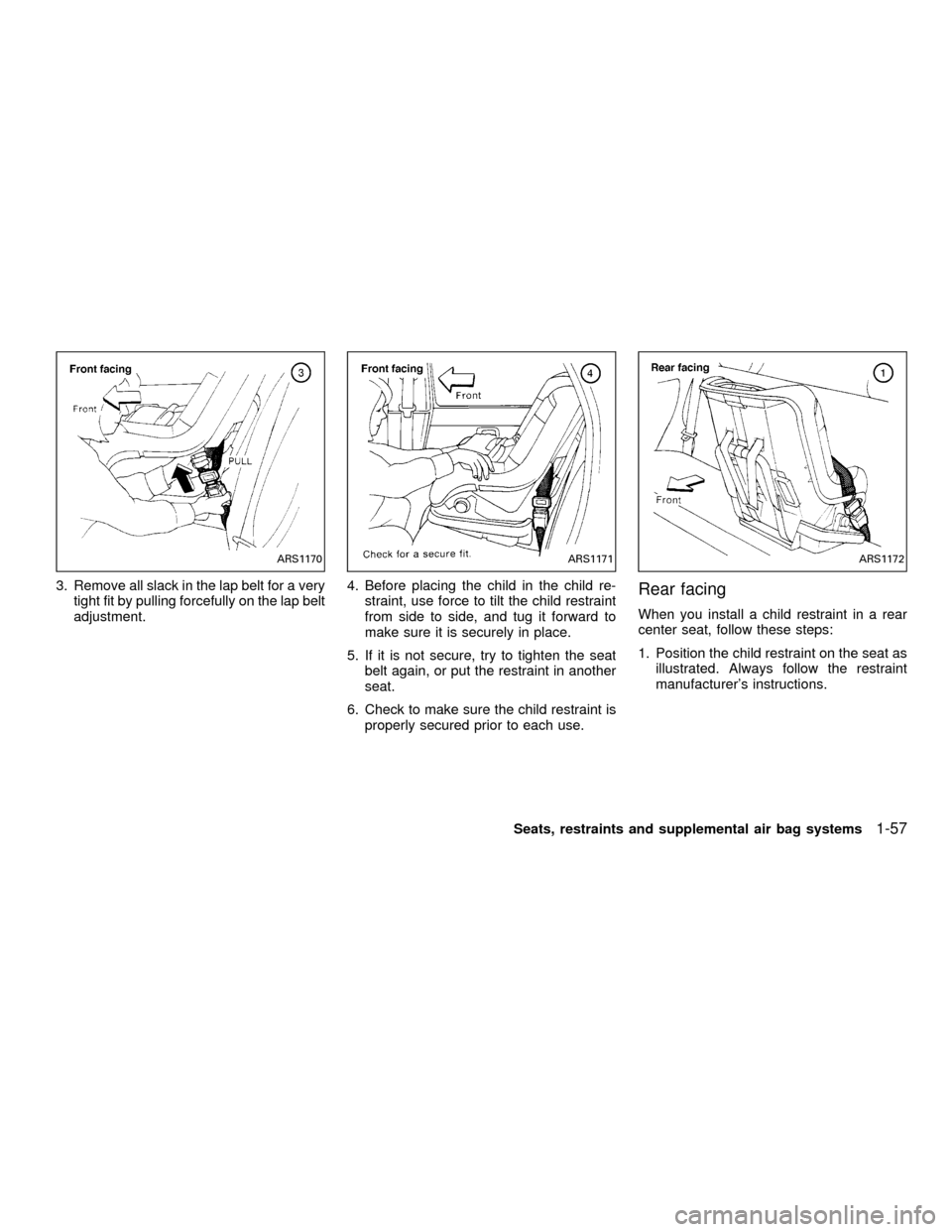
3. Remove all slack in the lap belt for a very
tight fit by pulling forcefully on the lap belt
adjustment.4. Before placing the child in the child re-
straint, use force to tilt the child restraint
from side to side, and tug it forward to
make sure it is securely in place.
5. If it is not secure, try to tighten the seat
belt again, or put the restraint in another
seat.
6. Check to make sure the child restraint is
properly secured prior to each use.Rear facing
When you install a child restraint in a rear
center seat, follow these steps:
1. Position the child restraint on the seat as
illustrated. Always follow the restraint
manufacturer's instructions.
ARS1170ARS1171ARS1172
Seats, restraints and supplemental air bag systems1-57
ZX
Page 65 of 304
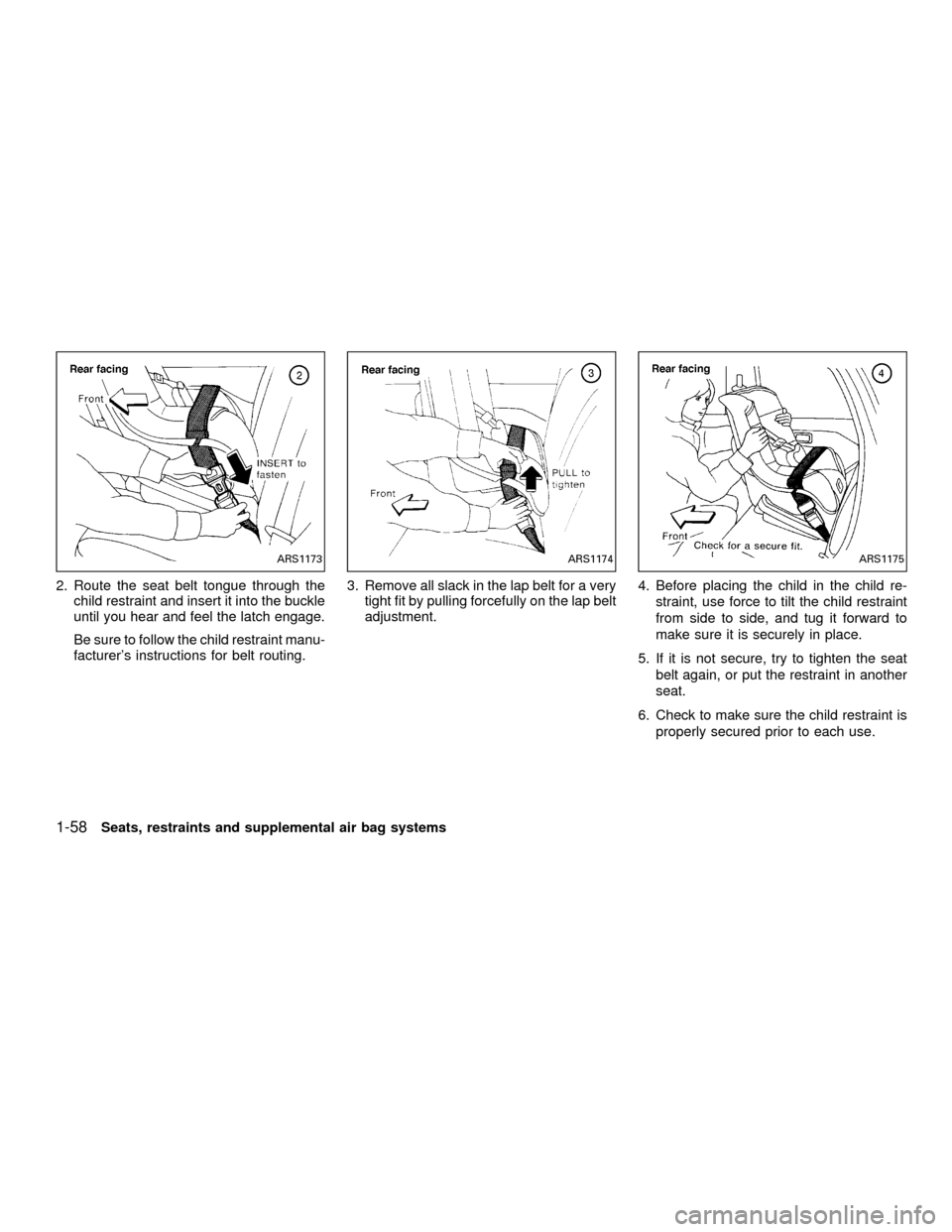
2. Route the seat belt tongue through the
child restraint and insert it into the buckle
until you hear and feel the latch engage.
Be sure to follow the child restraint manu-
facturer's instructions for belt routing.3. Remove all slack in the lap belt for a very
tight fit by pulling forcefully on the lap belt
adjustment.4. Before placing the child in the child re-
straint, use force to tilt the child restraint
from side to side, and tug it forward to
make sure it is securely in place.
5. If it is not secure, try to tighten the seat
belt again, or put the restraint in another
seat.
6. Check to make sure the child restraint is
properly secured prior to each use.
ARS1173ARS1174ARS1175
1-58Seats, restraints and supplemental air bag systems
ZX