2001 NISSAN FRONTIER wheel
[x] Cancel search: wheelPage 1 of 290
Welcome to the growing family of new NIS-
SAN owners. This vehicle has been deliv-
ered to you with confidence. It was pro-
duced using the latest techniques and strict
quality control.
This manual was prepared to help you
understand the operation and maintenance
of your vehicle so that you may enjoy many
miles of driving pleasure. Please read
through this manual before operating your
vehicle.
In the U.S., a separate Warranty Informa-
tion and Maintenance Log Booklet or in
Canada, a Warranty and Roadside Assis-
tance Information Booklet explains de-
tails about the warranties covering your
vehicle and vehicle maintenance sched-
ules. Additionally, a separate Customer
Care/Lemon Law Booklet (U.S. only) will
explain how to resolve any concerns you
may have with your vehicle, as well as
clarify your rights under your state's
lemon law.
Your NISSAN dealership knows your ve-
hicle best. When you require any service or
have any questions, they will be glad to
assist you with the extensive resources
available to them.READ FIRST - THEN DRIVE
SAFELY
Before driving your vehicle please read this
owner's manual carefully. This will ensure
familiarity with controls and maintenance
requirements, assisting you in the safe op-
eration of your vehicle.
WARNING
IMPORTANT SAFETY INFORMATION
REMINDERS FOR SAFETY!
Follow these important driving rules to
help ensure a safe and complete trip for
you and your passengers
²NEVER drive under the influence of
alcohol or drugs.
²ALWAYS observe posted speed lim-
its and never drive too fast for con-
ditions.
²ALWAYS use your seat belts and
appropriate child restraint systems.
Pre-teen children should be seated
in the rear seat.
²ALWAYS provide information about
the proper use of vehicle safety fea-
tures to all occupants of the vehicle.²
ALWAYS review this owner's manual
for important safety information.
For descriptions specified for four-wheel
drive models, amark is placed at
the beginning of the applicable
sections/items.
As with other vehicles with features for
off-road use, failure to operate four-
wheel drive models correctly may result
in loss of control or an accident. Be sure
to read ``Driving safety precautions '' in
the ``Starting and driving'' section of this
manual.
ON-PAVEMENT AND OFF-ROAD DRIVING
This vehicle will handle and maneuver
differently from an ordinary passenger
car because it has a higher center of
gravity for off-road use. As with other
vehicles with features of this type, failure
to operate this vehicle correctly may re-
sult in loss of control or an accident.
Be sure to read ªOn-pavement and off-
road driving precautionsº, and ``Avoiding
collision and rollover'', and ªDriving
safety precautionsº, in the ªStarting and
drivingº section of this manual.
The inside pages of this manual contain
a minimum of 50% recycled fibers,
including 10% post-consumer fibers.
Foreword
ZX
Page 17 of 290
PRECAUTIONS ON
SUPPLEMENTAL RESTRAINT
SYSTEM
This supplemental restraint system section
contains important information concerning
the driver and passenger supplemental air
bags. The supplemental restraint system air
bags can help reduce impact force to the
driver and front passenger in certain frontal
collisions. The supplemental air bags are
designed tosupplementthe crash protec-
tion provided by the driver and front passen-
ger seat belts and arenot a substitutefor
them. Seat belts should always be correctly
worn and the driver and front passenger
seated a suitable distance away from the
steering wheel and instrument panel. See
``Seat belts'' for instructions and precautions
on seat belt usage later in this section.
The supplemental air bags operate only
when the ignition switch is in the ON or
START position.
WARNING
cThe supplemental air bags ordinarily
will not inflate in the event of a side
impact, rear impact, roll over, or
lower severity frontal collision. Al-
ways wear your seat belts to help
reduce the risk or severity of injury
in various kinds of accidents.
SUPPLEMENTAL RESTRAINT
SYSTEM
1-10Seats, restraints and supplemental air bag systems
ZX
Page 18 of 290
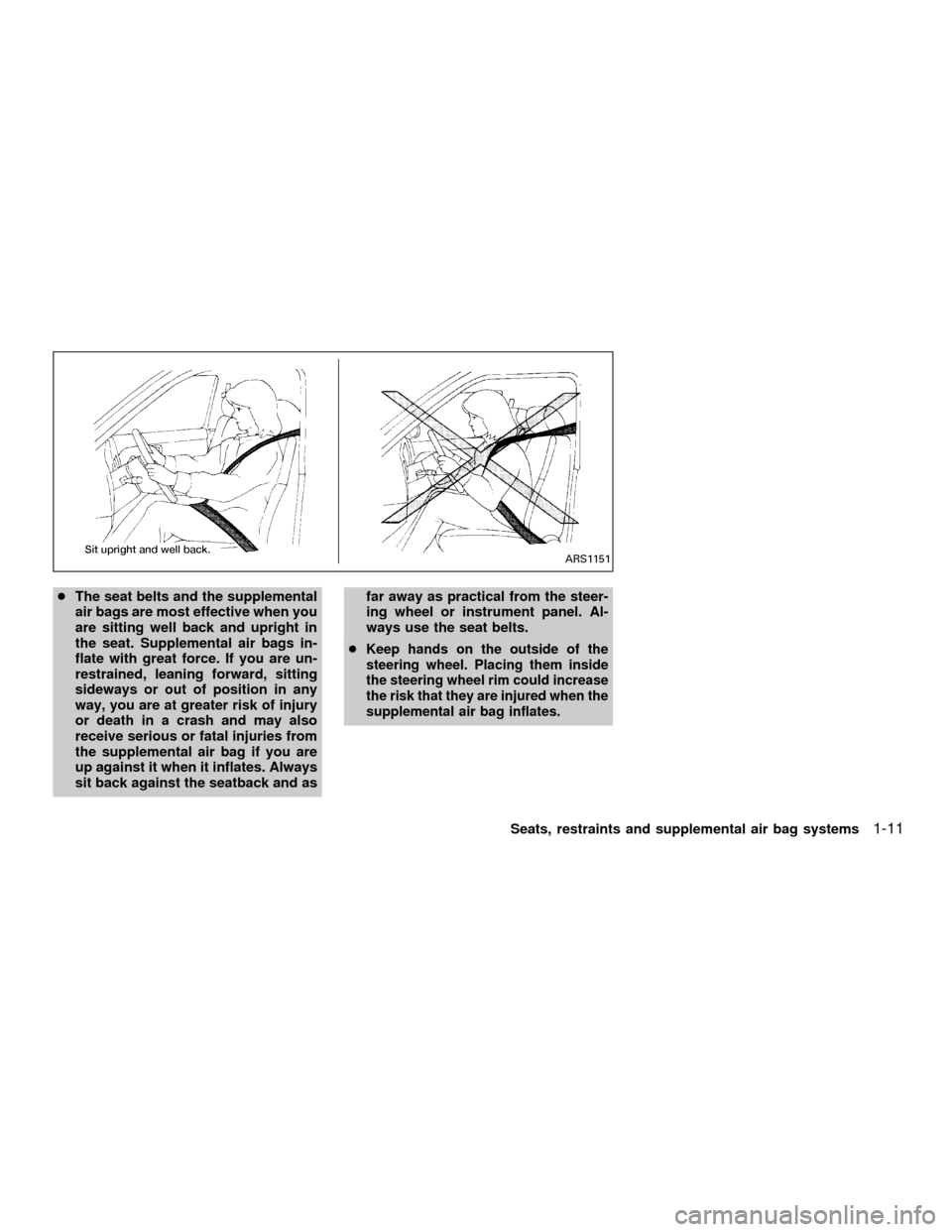
cThe seat belts and the supplemental
air bags are most effective when you
are sitting well back and upright in
the seat. Supplemental air bags in-
flate with great force. If you are un-
restrained, leaning forward, sitting
sideways or out of position in any
way, you are at greater risk of injury
or death in a crash and may also
receive serious or fatal injuries from
the supplemental air bag if you are
up against it when it inflates. Always
sit back against the seatback and asfar away as practical from the steer-
ing wheel or instrument panel. Al-
ways use the seat belts.
c
Keep hands on the outside of the
steering wheel. Placing them inside
the steering wheel rim could increase
the risk that they are injured when the
supplemental air bag inflates.
ARS1151
Seats, restraints and supplemental air bag systems1-11
ZX
Page 21 of 290

Supplemental air bag system
The driver supplemental air bag is located in
the center of the steering wheel. The passen-
ger supplemental air bag is located in the top
right section of the instrument panel.
These systems are designed to meet optional
certification requirements under U.S. regula-
tions. They are also permitted in Canada. The
optional certification allows air bags to be
designed to inflate somewhat less forcefully
than previously.However, all of the infor-mation, cautions and warnings in this
manual still apply and must be followed.
The supplemental air bag system is designed
to inflate in higher severity frontal collisions,
although it may inflate if the forces in another
type of collision are similar to those of a higher
severity frontal impact. It may not inflate in
certain frontal collisions. Vehicle damage (or
lack of it) is not always an indication of proper
supplemental air bag system operation.
The front passenger supplemental air bag is
equipped with an ON/OFF switch (except
crew cab models which have a rear seat for
child restraint installation). Because no rear
seat exists where a rear facing child restraint
can be secured in other models, the switch is
designed to turn OFF the passenger supple-
mental air bag so that a rear facing child
restraint can be used in the front passenger
seat. See ``Passenger supplemental air bag
ON/OFF switch and light'' later in this section
for details.
When the supplemental air bag inflates, a
fairly loud noise may be heard, followed by
the release of smoke. This smoke is not
harmful and does not indicate a fire, but
care should be taken not to intentionally
inhale it, as it may cause irritation and
WRS0059
1-14Seats, restraints and supplemental air bag systems
ZX
Page 22 of 290
choking. Those with a history of a breathing
condition should get fresh air promptly.
The supplemental air bags, along with the use
of the seat belts, helps to cushion the impact
force on the face and chest of the occupant. It
can help save lives and reduce serious inju-
ries. However, an inflating supplemental air
bag may cause facial abrasions or other inju-
ries. Supplemental air bags do not provide
restraint to the lower body.
Seat belts should be correctly worn and the
driver and passenger seated upright as far
as practical away from the steering wheel or
instrument panel. Since the supplemental
air bags inflate quickly in order to help
protect the front occupants, the force of the
supplemental air bags inflating can increase
the risk of injury if the occupant is too close
to or against the supplemental air bag mod-
ule during inflation.
The supplemental air bags deflate quickly
after a collision.
The supplemental air bags operate only
when the ignition switch is in the ON or
START position.
WARNING
cDo not place any objects on the
steering wheel pad or on the instru-
ment panel. Also, do not place any
objects between any occupant and
the steering wheel or on the instru-
ment panel. Such objects may be-
come dangerous projectiles, and
cause injury if the supplemental air
bag inflates.
cRight after inflation, several supple-
mental air bag system components
will be hot. Do not touch them; you
may severely burn yourself.
c
No unauthorized changes should be
made to any components or wiring of
the supplemental air bag system. This
is to prevent accidental inflation of
the supplemental air bag or damage
to the supplemental air bag system.
cDo not make unauthorized changes to
your vehicle's electrical system, sus-
pension system or front end structure.
This could affect proper operation of
the supplemental air bag system.c
Tampering with the supplemental air
bag system may result in serious per-
sonal injury. Tampering includes
changes to the steering wheel and the
instrument panel assembly, by plac-
ing material over the steering wheel
pad and above the instrument panel,
or by installing additional trim mate-
rial around the supplemental air bag
system.
cWork around and on the supplemen-
tal air bag system should be done by
an authorized NISSAN dealer. Instal-
lation of electrical equipment should
also be done by an authorized NIS-
SAN dealer. The yellow Supplemen-
tal Restraint System (SRS) wiring
should not be modified or discon-
nected. Unauthorized electrical test
equipment and probing devices
should not be used on the supple-
mental air bag system.
cSRS wiring harnesses are covered
with yellow insulation either just be-
fore the harness connectors or over
the complete harness for easy iden-
tification.
Seats, restraints and supplemental air bag systems
1-15
ZX
Page 63 of 290
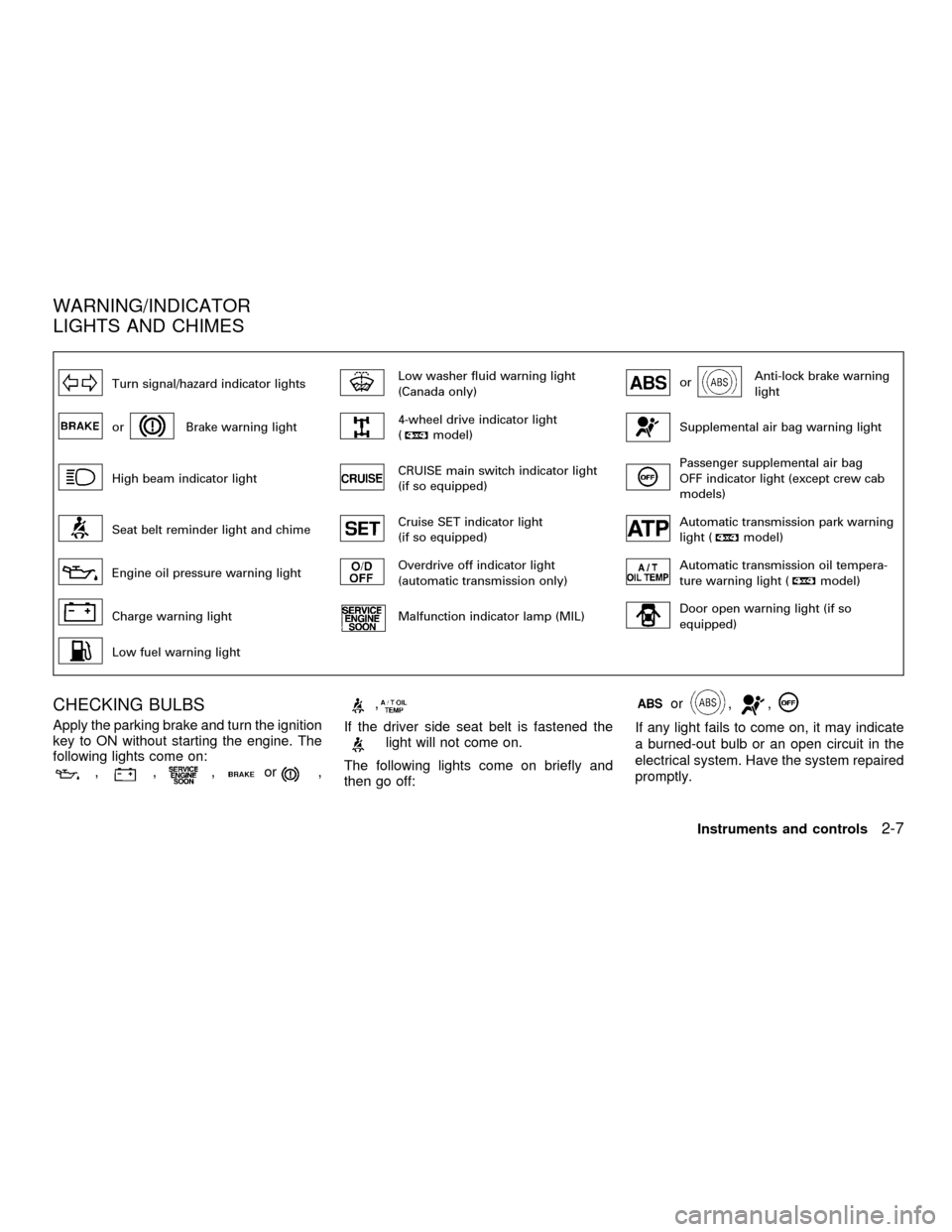
Turn signal/hazard indicator lightsLow washer fluid warning light
(Canada only)orAnti-lock brake warning
light
orBrake warning light4-wheel drive indicator light
(model)Supplemental air bag warning light
High beam indicator lightCRUISE main switch indicator light
(if so equipped)Passenger supplemental air bag
OFF indicator light (except crew cab
models)
Seat belt reminder light and chimeCruise SET indicator light
(if so equipped)Automatic transmission park warning
light (model)
Engine oil pressure warning lightOverdrive off indicator light
(automatic transmission only)Automatic transmission oil tempera-
ture warning light (model)
Charge warning lightMalfunction indicator lamp (MIL)Door open warning light (if so
equipped)
Low fuel warning light
CHECKING BULBS
Apply the parking brake and turn the ignition
key to ON without starting the engine. The
following lights come on:
,,,or,
,
If the driver side seat belt is fastened thelight will not come on.
The following lights come on briefly and
then go off:
or,,
If any light fails to come on, it may indicate
a burned-out bulb or an open circuit in the
electrical system. Have the system repaired
promptly.
WARNING/INDICATOR
LIGHTS AND CHIMES
Instruments and controls2-7
ZX
Page 67 of 290
when the main switch is pushed again.
While the cruise main switch indicator light
comes on, the cruise control system is
operational.
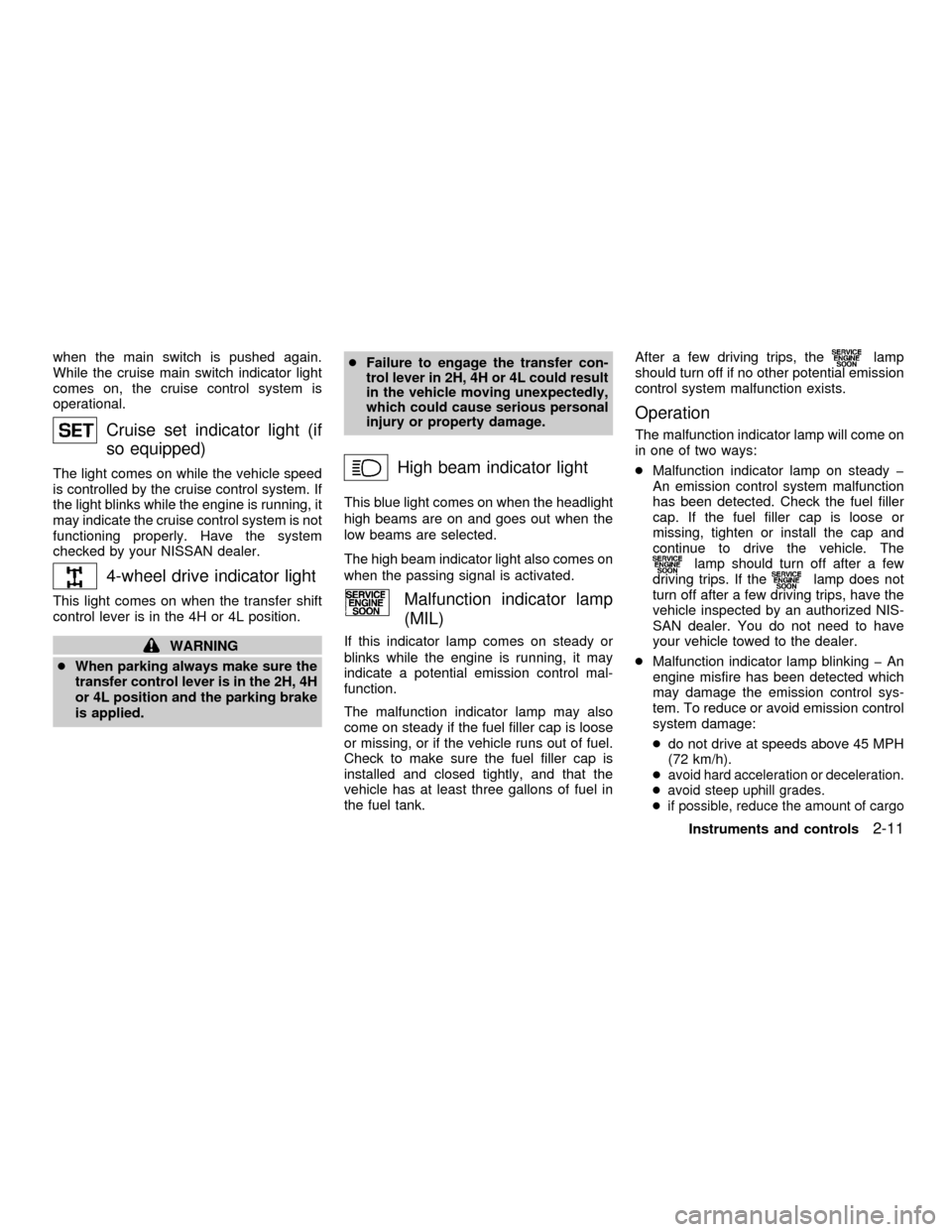
Cruise set indicator light (if
so equipped)
The light comes on while the vehicle speed
is controlled by the cruise control system. If
the light blinks while the engine is running, it
may indicate the cruise control system is not
functioning properly. Have the system
checked by your NISSAN dealer.
4-wheel drive indicator light
This light comes on when the transfer shift
control lever is in the 4H or 4L position.
WARNING
cWhen parking always make sure the
transfer control lever is in the 2H, 4H
or 4L position and the parking brake
is applied.cFailure to engage the transfer con-
trol lever in 2H, 4H or 4L could result
in the vehicle moving unexpectedly,
which could cause serious personal
injury or property damage.
High beam indicator light
This blue light comes on when the headlight
high beams are on and goes out when the
low beams are selected.
The high beam indicator light also comes on
when the passing signal is activated.
Malfunction indicator lamp
(MIL)
If this indicator lamp comes on steady or
blinks while the engine is running, it may
indicate a potential emission control mal-
function.
The malfunction indicator lamp may also
come on steady if the fuel filler cap is loose
or missing, or if the vehicle runs out of fuel.
Check to make sure the fuel filler cap is
installed and closed tightly, and that the
vehicle has at least three gallons of fuel in
the fuel tank.After a few driving trips, the
lamp
should turn off if no other potential emission
control system malfunction exists.
Operation
The malfunction indicator lamp will come on
in one of two ways:
cMalfunction indicator lamp on steady þ
An emission control system malfunction
has been detected. Check the fuel filler
cap. If the fuel filler cap is loose or
missing, tighten or install the cap and
continue to drive the vehicle. The
lamp should turn off after a few
driving trips. If thelamp does not
turn off after a few driving trips, have the
vehicle inspected by an authorized NIS-
SAN dealer. You do not need to have
your vehicle towed to the dealer.
cMalfunction indicator lamp blinking þ An
engine misfire has been detected which
may damage the emission control sys-
tem. To reduce or avoid emission control
system damage:
cdo not drive at speeds above 45 MPH
(72 km/h).
c
avoid hard acceleration or deceleration.
cavoid steep uphill grades.
cif possible, reduce the amount of cargo
Instruments and controls2-11
ZX
Page 75 of 290
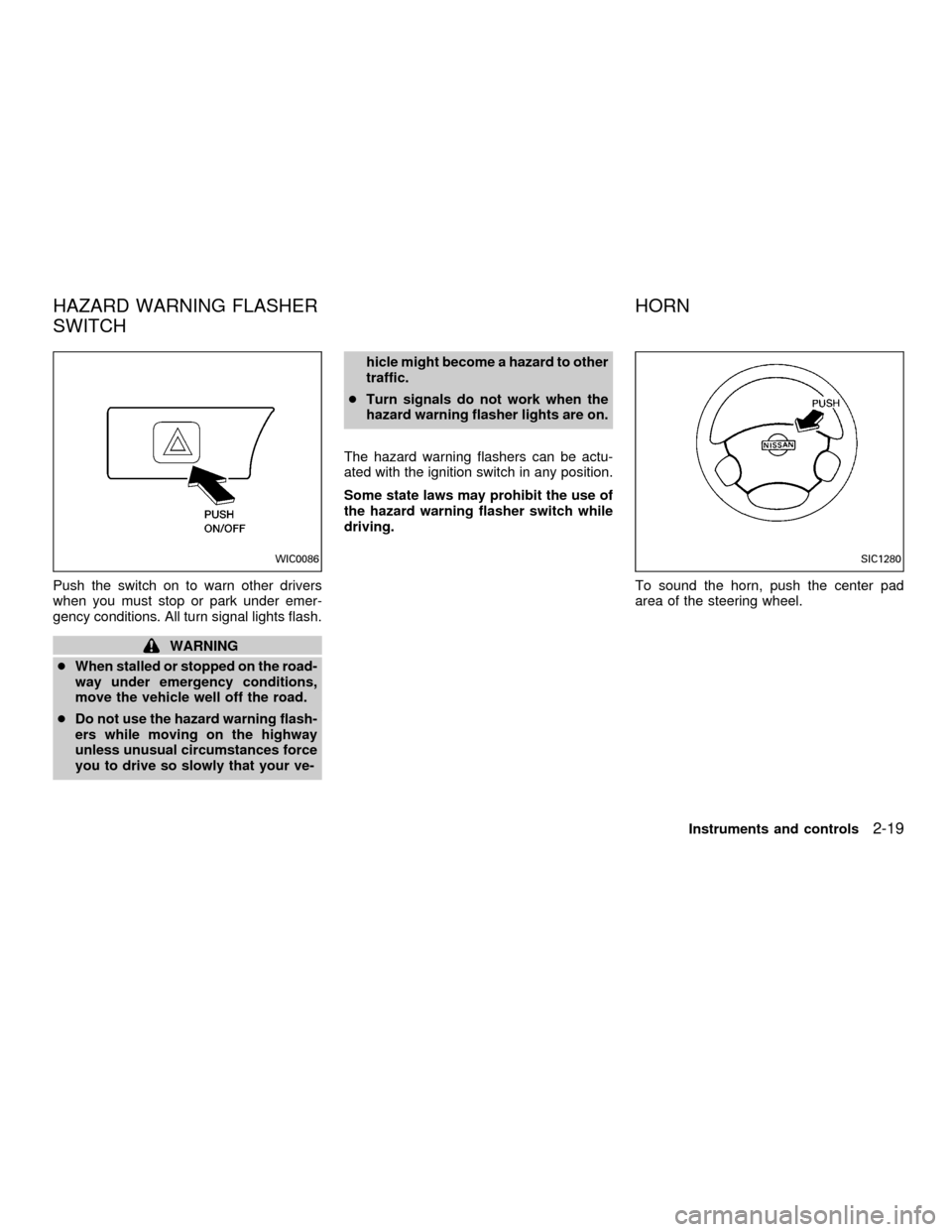
Push the switch on to warn other drivers
when you must stop or park under emer-
gency conditions. All turn signal lights flash.
WARNING
cWhen stalled or stopped on the road-
way under emergency conditions,
move the vehicle well off the road.
cDo not use the hazard warning flash-
ers while moving on the highway
unless unusual circumstances force
you to drive so slowly that your ve-hicle might become a hazard to other
traffic.
cTurn signals do not work when the
hazard warning flasher lights are on.
The hazard warning flashers can be actu-
ated with the ignition switch in any position.
Some state laws may prohibit the use of
the hazard warning flasher switch while
driving.
To sound the horn, push the center pad
area of the steering wheel.
WIC0086SIC1280
HAZARD WARNING FLASHER
SWITCHHORN
Instruments and controls2-19
ZX