Page 31 of 290
supplemental air bag could seri-
ously injure or kill your child. A rear
facing child restraint must only be
used in the rear seat.
cDo not install a child restraint in the
jump seats (King Cab model). These
seats are not suitable for child re-
straint installation.
cDo not install a child restraint in the
center position of the front bench-
seat if the type of restraint used
interferes with operation of the driv-
ing controls.
cInfants and children need special
protection. The vehicle's seat belts
may not fit them properly. The shoul-
der belt may come too close to the-
face or neck. The lap belt may not
fitover their small hip bones. In an
accident, an improperly fitting seat
belt could cause serious or fatal in-
jury. Always use appropriate child
restraints.
All U.S. states and Canadian provinces or
territories require the use of approved child
restraints for infants and small children. See``Child restraints'' later in this section for
more information.
In addition, there are many types of child
restraints available for larger children which
should be used for maximum protection.
NISSAN recommends that all pre-teen
children be restrained in the rear seat if
possible. According to accident statis-
tics, children are safer when properly
restrained in the rear seat than in the
front seat.
This is especially important because
your vehicle has a supplemental re-
straint system (Supplemental air bag
system) for the front passenger (For pre-
cautions, see ``Supplemental restraint
system'' earlier in this section). Also, see
``Passenger air bag ON/OFF switch and
light'' earlier in this section.
Infants and small children
NISSAN recommends that infants and small
children be seated in child restraints that
comply with Federal Motor Vehicle Safety
Standards or Canadian Motor Vehicle
Safety Standards. You should choose a
child restraint which fits your vehicle and
always follow the manufacturer's instruc-
tions for installation and use.
Larger children
Children who are too large for child re-
straints should be seated and restrained by
the seat belts which are provided.
If the child's seating position has a shoulder
belt that fits close to the face or neck, the
use of a booster seat (commercially avail-
able) may help overcome this. The booster
seat should raise the child so the shoulder
belt is properly positioned across the top,
middle portion of the shoulder and the lap
belt is low on the hips. The booster seat
should fit the vehicle seat and have a label
certifying that it complies with Federal Motor
Vehicle Safety Standards or Canadian Mo-
tor Vehicle Safety Standards. Once the
child has grown so the shoulder belt is no
longer on or near the face and neck, use the
shoulder belt without the booster seat.
WARNING
Never let a child stand or kneel on any
seat and do not allow a child in the
cargo areas while the vehicle is mov-
ing. The child could be seriously in-
jured or killed in an accident or sudden
stop.
1-24Seats, restraints and supplemental air bag systems
ZX
Page 32 of 290
PREGNANT WOMEN
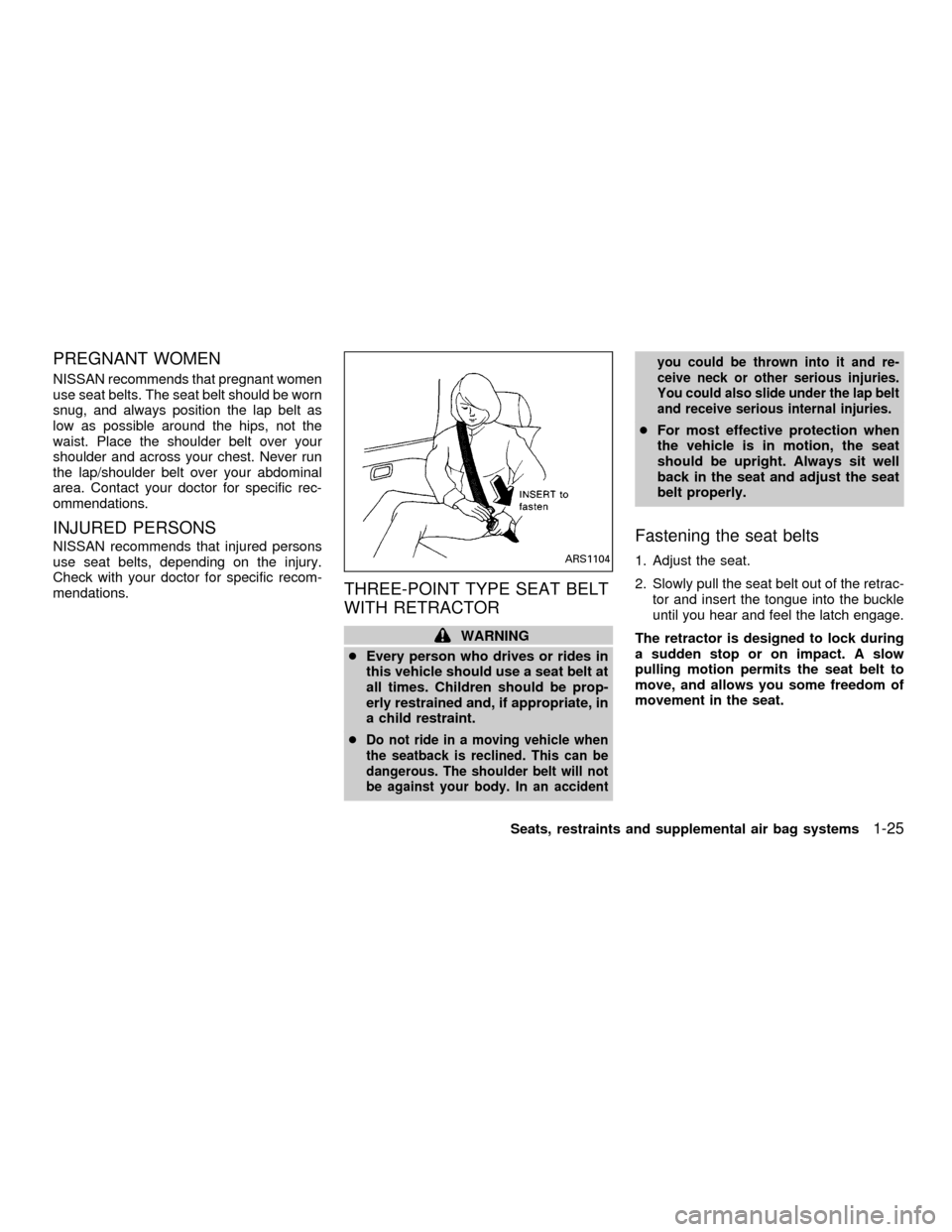
NISSAN recommends that pregnant women
use seat belts. The seat belt should be worn
snug, and always position the lap belt as
low as possible around the hips, not the
waist. Place the shoulder belt over your
shoulder and across your chest. Never run
the lap/shoulder belt over your abdominal
area. Contact your doctor for specific rec-
ommendations.
INJURED PERSONS
NISSAN recommends that injured persons
use seat belts, depending on the injury.
Check with your doctor for specific recom-
mendations.
THREE-POINT TYPE SEAT BELT
WITH RETRACTOR
WARNING
cEvery person who drives or rides in
this vehicle should use a seat belt at
all times. Children should be prop-
erly restrained and, if appropriate, in
a child restraint.
c
Do not ride in a moving vehicle when
the seatback is reclined. This can be
dangerous. The shoulder belt will not
be against your body. In an accidentyou could be thrown into it and re-
ceive neck or other serious injuries.
You could also slide under the lap belt
and receive serious internal injuries.
cFor most effective protection when
the vehicle is in motion, the seat
should be upright. Always sit well
back in the seat and adjust the seat
belt properly.
Fastening the seat belts
1. Adjust the seat.
2. Slowly pull the seat belt out of the retrac-
tor and insert the tongue into the buckle
until you hear and feel the latch engage.
The retractor is designed to lock during
a sudden stop or on impact. A slow
pulling motion permits the seat belt to
move, and allows you some freedom of
movement in the seat.ARS1104
Seats, restraints and supplemental air bag systems1-25
ZX
Page 33 of 290
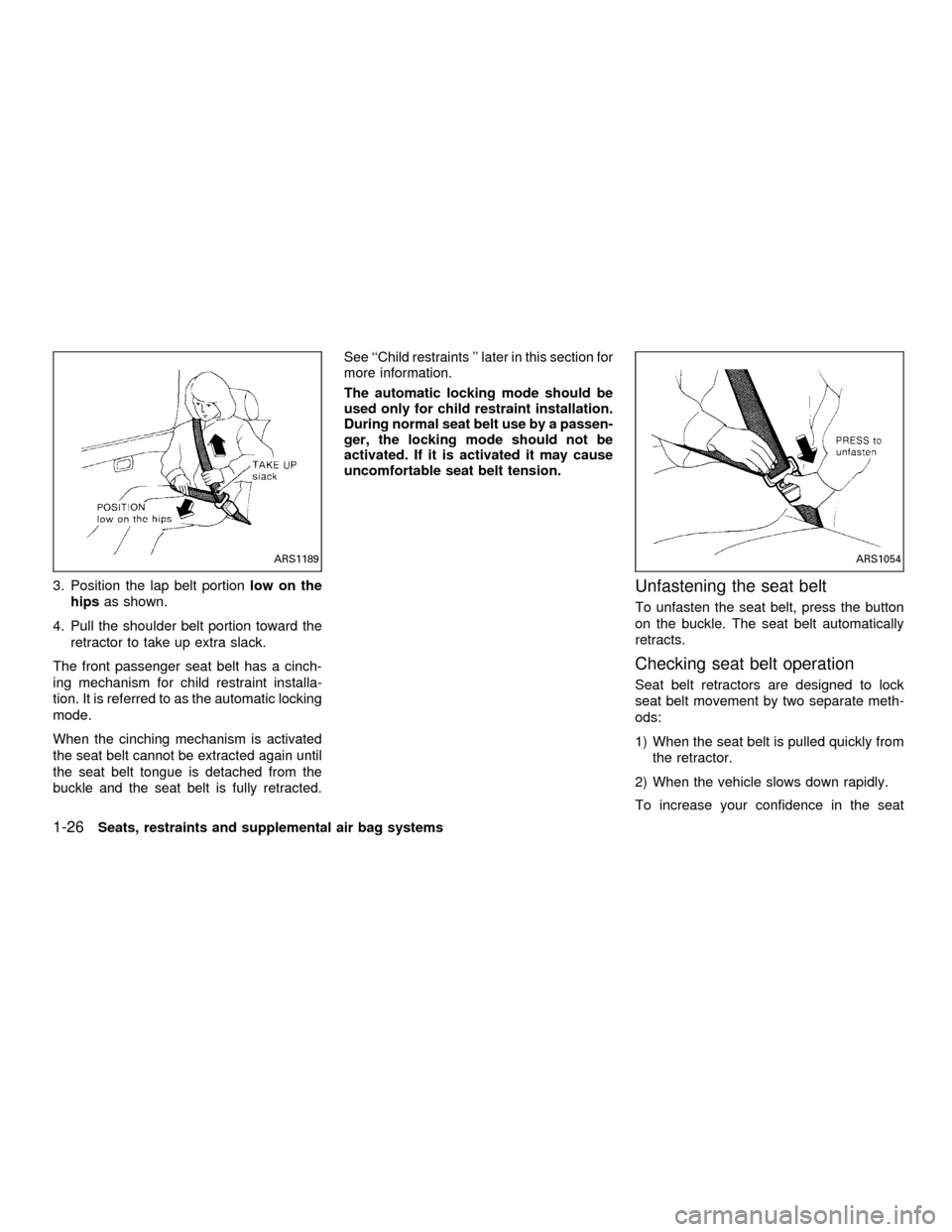
3. Position the lap belt portionlow on the
hipsas shown.
4. Pull the shoulder belt portion toward the
retractor to take up extra slack.
The front passenger seat belt has a cinch-
ing mechanism for child restraint installa-
tion. It is referred to as the automatic locking
mode.
When the cinching mechanism is activated
the seat belt cannot be extracted again until
the seat belt tongue is detached from the
buckle and the seat belt is fully retracted.See ``Child restraints '' later in this section for
more information.
The automatic locking mode should be
used only for child restraint installation.
During normal seat belt use by a passen-
ger, the locking mode should not be
activated. If it is activated it may cause
uncomfortable seat belt tension.
Unfastening the seat belt
To unfasten the seat belt, press the button
on the buckle. The seat belt automatically
retracts.
Checking seat belt operation
Seat belt retractors are designed to lock
seat belt movement by two separate meth-
ods:
1) When the seat belt is pulled quickly from
the retractor.
2) When the vehicle slows down rapidly.
To increase your confidence in the seat
ARS1189ARS1054
1-26Seats, restraints and supplemental air bag systems
ZX
Page 34 of 290
belts, check the operation as follows.
cGrasp the shoulder belt and pull quickly
forward. The retractor should lock and
restrict further belt movement.
If the retractor does not lock during this
check, or if you have any questions about
seat belt operation, see an authorized
NISSAN dealer.
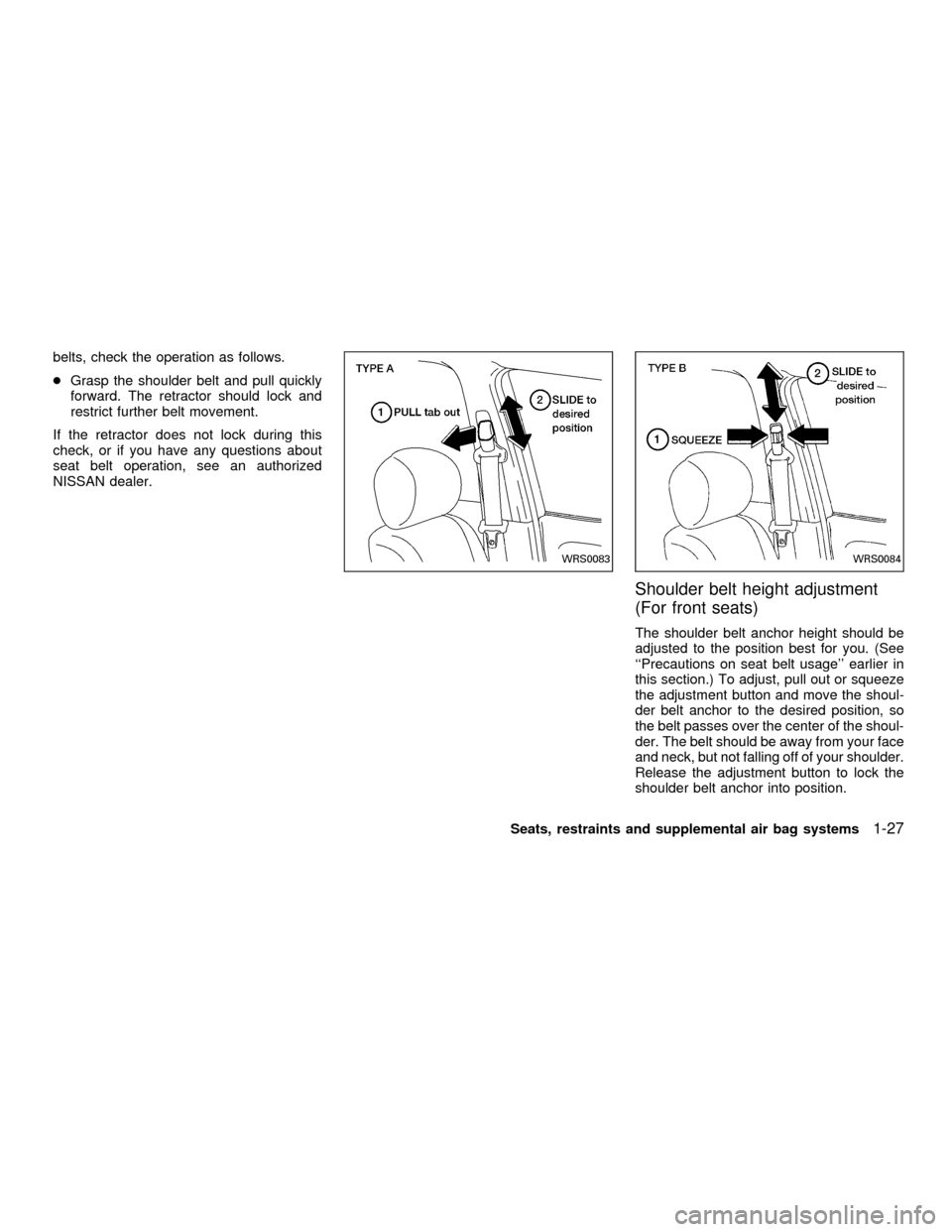
Shoulder belt height adjustment
(For front seats)
The shoulder belt anchor height should be
adjusted to the position best for you. (See
``Precautions on seat belt usage'' earlier in
this section.) To adjust, pull out or squeeze
the adjustment button and move the shoul-
der belt anchor to the desired position, so
the belt passes over the center of the shoul-
der. The belt should be away from your face
and neck, but not falling off of your shoulder.
Release the adjustment button to lock the
shoulder belt anchor into position.
WRS0083WRS0084
Seats, restraints and supplemental air bag systems1-27
ZX
Page 35 of 290
WARNING
cAfter adjustment, release the adjust-
ment button and try to move the
shoulder belt anchor up and down to
make sure it is securely fixed in
position.
cThe shoulder belt anchor height
should be adjusted to the position
best for you. Failure to do so may
reduce the effectiveness of the en-
tire restraint system and increase
the chance or severity of injury in an
accident.
TWO-POINT TYPE SEAT BELT
WITHOUT RETRACTOR (Center
of 60/40 bench seat)
WARNING
cDo not install a child restraint in the
center position of the front seat if the
type of restraint used interferes with
operation of the driving controls.cDo not sit on the armrest. The arm-
rest is not a seating surface. Using
the armrest as a seating surface may
cause serious injury in an accident.
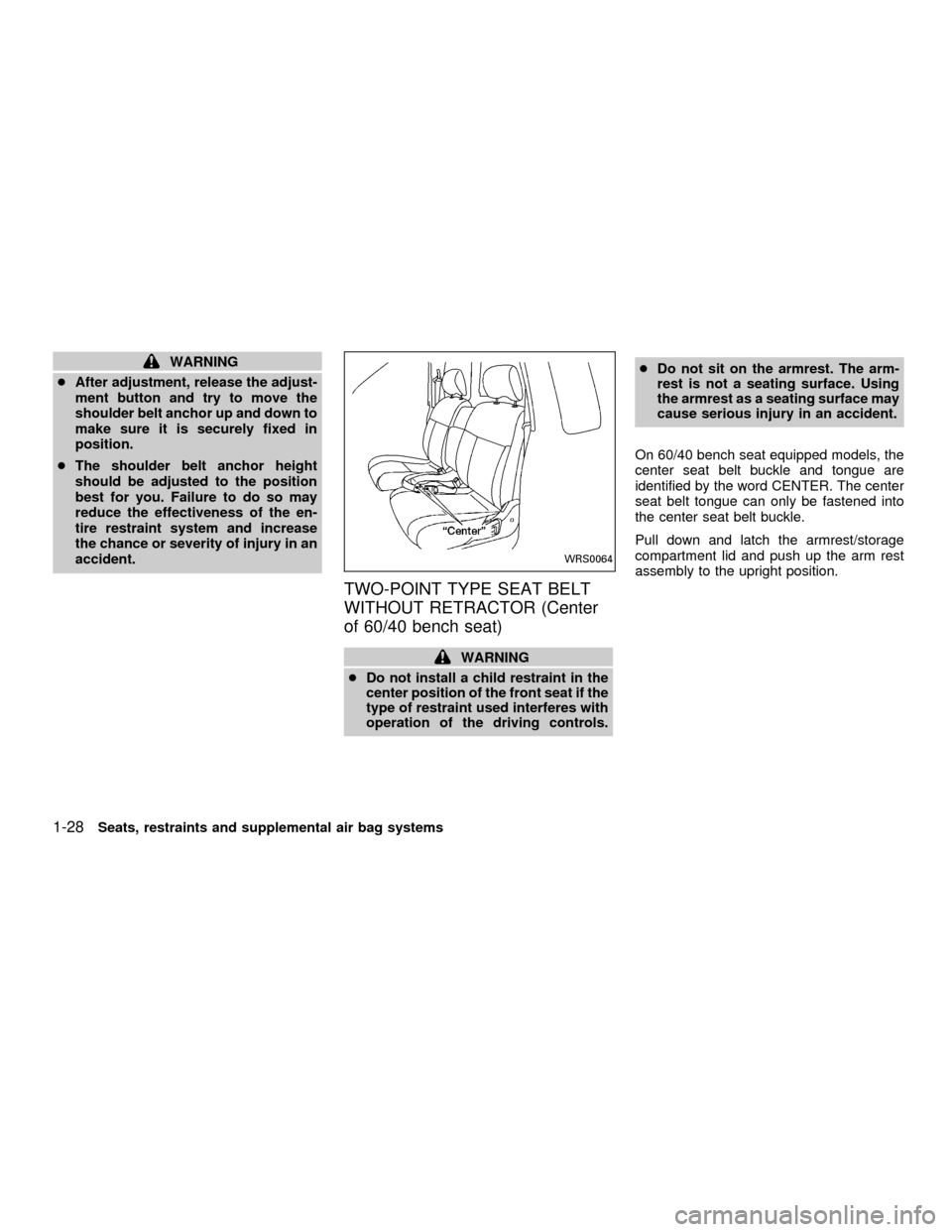
On 60/40 bench seat equipped models, the
center seat belt buckle and tongue are
identified by the word CENTER. The center
seat belt tongue can only be fastened into
the center seat belt buckle.
Pull down and latch the armrest/storage
compartment lid and push up the arm rest
assembly to the upright position.
WRS0064
1-28Seats, restraints and supplemental air bag systems
ZX
Page 36 of 290
TWO-POINT TYPE SEAT BELT
WITHOUT RETRACTOR (Jump
seat and center of bench seat)
WARNING
cDo not install a child restraint in the
jump seats (King Cab model). These
seats are not suitable for child re-
straint installation.cDo not install a child restraint in the
center position of the front bench
seat if the type of restraint used
interferes with operation of the driv-
ing controls.
cSerious or fatal injury could occur.
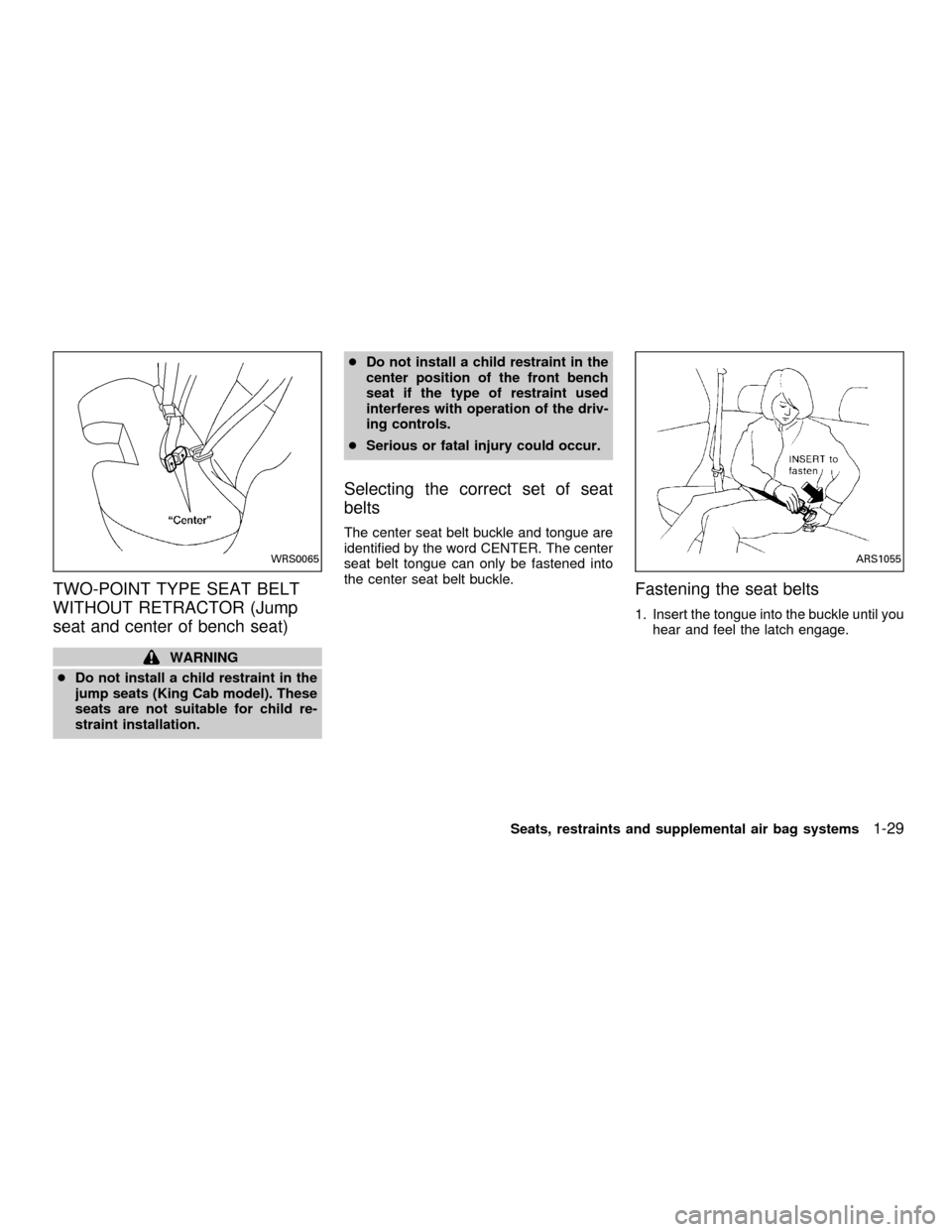
Selecting the correct set of seat
belts
The center seat belt buckle and tongue are
identified by the word CENTER. The center
seat belt tongue can only be fastened into
the center seat belt buckle.
Fastening the seat belts
1. Insert the tongue into the buckle until you
hear and feel the latch engage.
WRS0065ARS1055
Seats, restraints and supplemental air bag systems1-29
ZX
Page 37 of 290
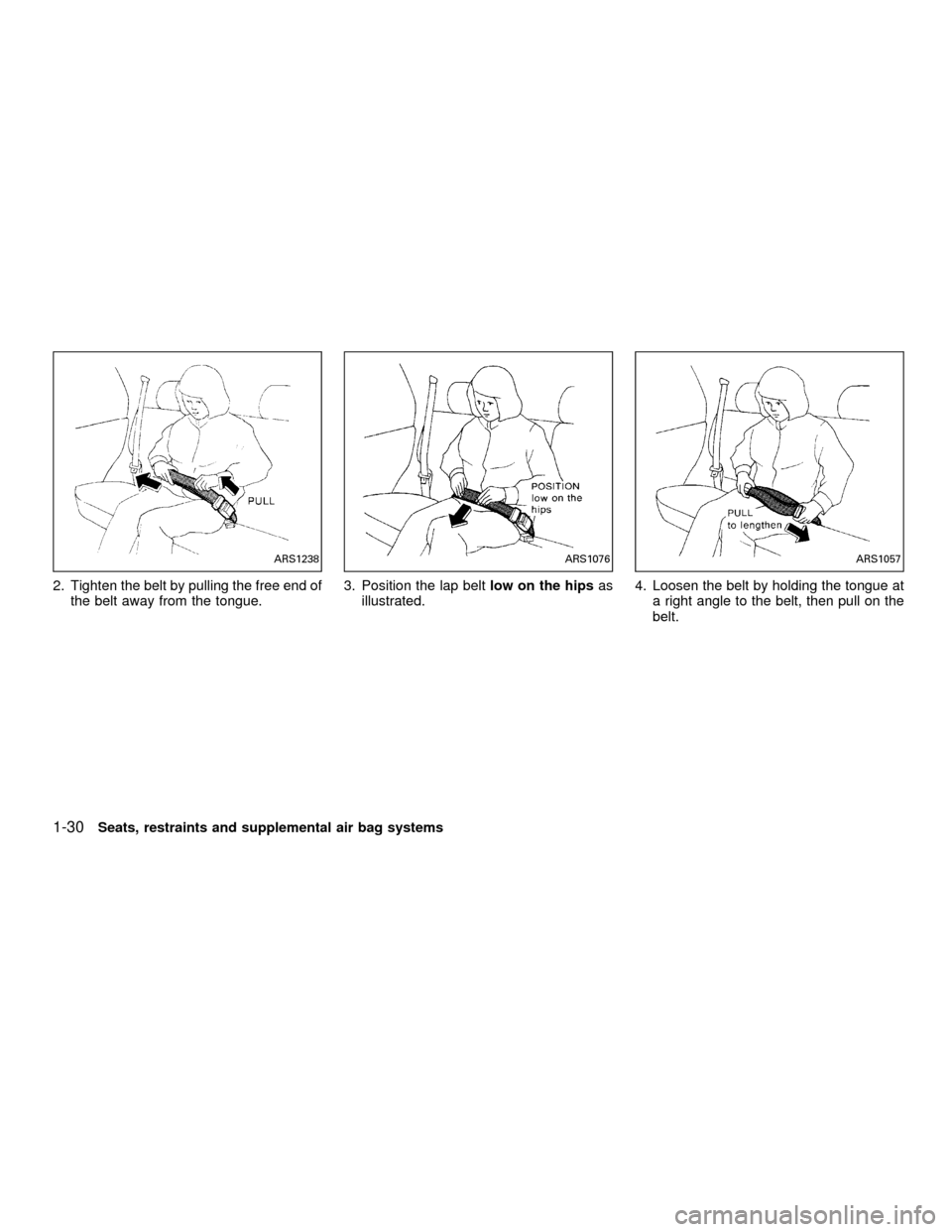
2. Tighten the belt by pulling the free end of
the belt away from the tongue.3. Position the lap beltlow on the hipsas
illustrated.4. Loosen the belt by holding the tongue at
a right angle to the belt, then pull on the
belt.
ARS1238ARS1076ARS1057
1-30Seats, restraints and supplemental air bag systems
ZX
Page 38 of 290
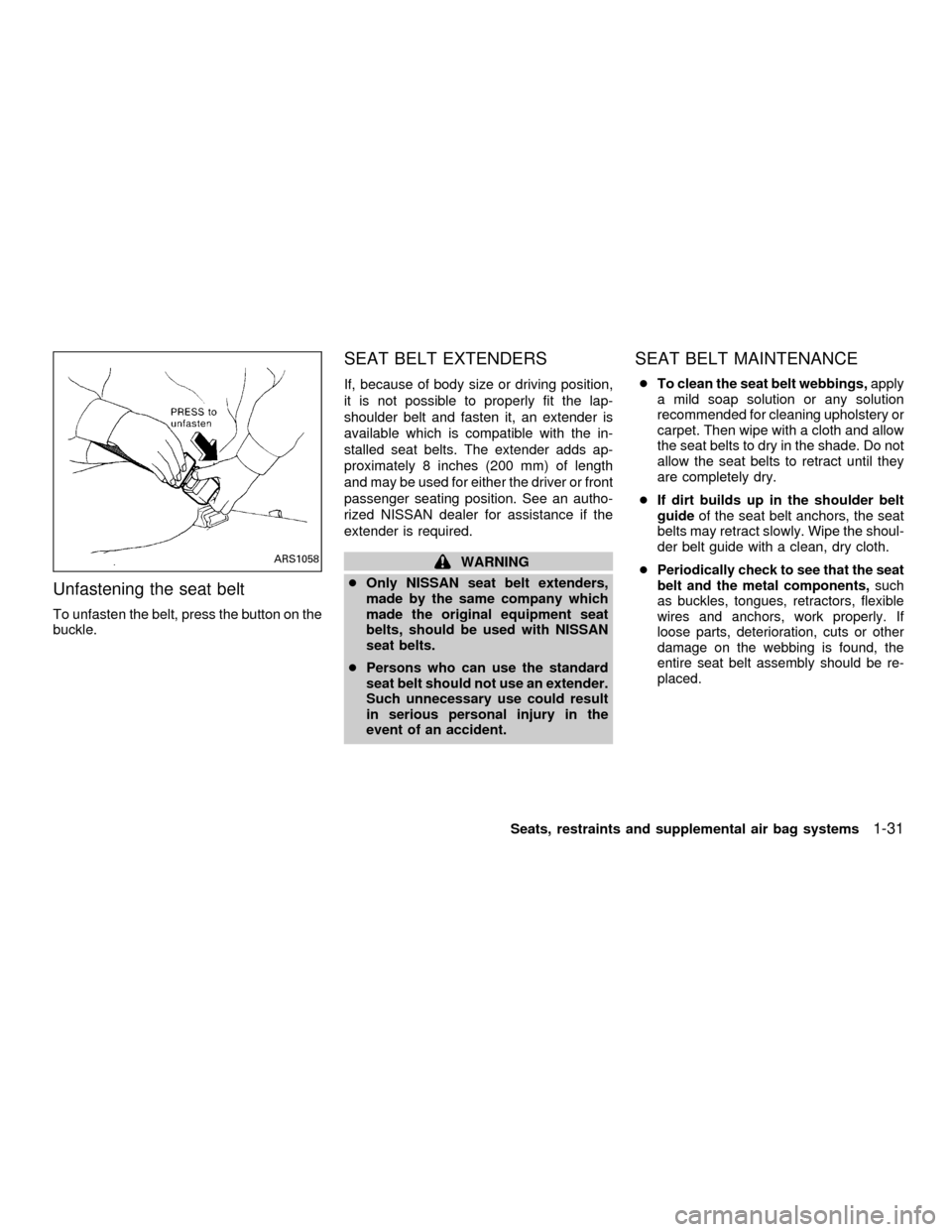
Unfastening the seat belt
To unfasten the belt, press the button on the
buckle.
SEAT BELT EXTENDERS
If, because of body size or driving position,
it is not possible to properly fit the lap-
shoulder belt and fasten it, an extender is
available which is compatible with the in-
stalled seat belts. The extender adds ap-
proximately 8 inches (200 mm) of length
and may be used for either the driver or front
passenger seating position. See an autho-
rized NISSAN dealer for assistance if the
extender is required.
WARNING
cOnly NISSAN seat belt extenders,
made by the same company which
made the original equipment seat
belts, should be used with NISSAN
seat belts.
cPersons who can use the standard
seat belt should not use an extender.
Such unnecessary use could result
in serious personal injury in the
event of an accident.
SEAT BELT MAINTENANCE
cTo clean the seat belt webbings,apply
a mild soap solution or any solution
recommended for cleaning upholstery or
carpet. Then wipe with a cloth and allow
the seat belts to dry in the shade. Do not
allow the seat belts to retract until they
are completely dry.
cIf dirt builds up in the shoulder belt
guideof the seat belt anchors, the seat
belts may retract slowly. Wipe the shoul-
der belt guide with a clean, dry cloth.
c
Periodically check to see that the seat
belt and the metal components,such
as buckles, tongues, retractors, flexible
wires and anchors, work properly. If
loose parts, deterioration, cuts or other
damage on the webbing is found, the
entire seat belt assembly should be re-
placed.ARS1058
Seats, restraints and supplemental air bag systems1-31
ZX