2001 NISSAN ALMERA N16 Code
[x] Cancel search: CodePage 361 of 2493

+The time required for each diagnosis varies with road surface conditions, weather, altitude, individual driv-
ing habits, etc.
Zone A refers to the range where the time required, for the diagnosis under normal conditions*, is the
shortest. Zone B refers to the range where the diagnosis can still be performed if the diagnosis is not
completed within zone A.
*: Normal conditions refer to the following:
þ Sea level
þ Flat road
þ Ambient air temperature: 20 - 30ÉC (68 - 86ÉF)
þ Diagnosis is performed as quickly as possible under normal conditions.
Under different conditions [For example: ambient air temperature other than 20 - 30ÉC (68 - 86ÉF)], diag-
nosis may also be performed.
Pattern 1:
+The engine is started at the engine coolant temperature of þ10 to 35ÉC (14 to 95ÉF) (where the volt-
age between the ECM terminals 70 and 58 is 3.0 - 4.3V).
+The engine must be operated at idle speed until the engine coolant temperature is greater than 70ÉC
(158ÉF) (where the voltage between the ECM terminals 70 and 58 is lower than 1.4V).
+The engine is started at the fuel tank temperature of warmer than 0ÉC (32ÉF) (where the voltage
between the ECM terminal 82 and ground is less than 4.1V).
Pattern 2:
+When steady-state driving is performed again even after it is interrupted, each diagnosis can be conducted.
In this case, the time required for diagnosis may be extended.
*1: Depress the accelerator pedal until vehicle speed is 90 km/h (56 MPH), then release the accelerator pedal
and keep it released for more than 10 seconds. Depress the accelerator pedal until vehicle speed is 90 km/h
(56 MPH) again.
*2: Checking the vehicle speed with CONSULT-II or GST is advised.
Suggested transmission gear position for A/T models
Set the selector lever in the ªDº position with ªODº ON.
Suggested upshift speeds for M/T models
Shown below are suggested vehicle speeds for shifting into a higher gear. These suggestions relate to fuel
economy and vehicle performance. Actual upshift speeds will vary according to road conditions, the weather
and individual driving habits.
Gear changeACCEL shift point
km/h (MPH)
1st to 2nd 15 (9)
2nd to 3rd 35 (22)
3rd to 4th 50 (31)
4th to 5th 70 (43)
Test Value and Test Limit (GST only Ð not applicable to CONSULT-II)NJEC0031S0104The following is the information specified in Mode 6 of ISO 15031-5.
The test value is a parameter used to determine whether a system/circuit diagnostic test is ªOKº or ªNGº while
being monitored by the ECM during self-diagnosis. The test limit is a reference value which is specified as the
maximum or minimum value and is compared with the test value being monitored.
Items for which these data (test value and test limit) are displayed are the same as SRT code items (14 test
items).
These data (test value and test limit) are specified by Test ID (TID) and Component ID (CID) and can be dis-
played on the GST screen.
X: Applicable Ð: Not applicable
SRT item Self-diagnostic test itemTest value (GST display)
Test limit Application
TID CID
CATALYST Three way catalyst function01H 01H Max. X
02H 81H Min. X
ON BOARD DIAGNOSTIC SYSTEM DESCRIPTIONQG
Emission-related Diagnostic Information (Cont'd)
EC-65
Page 362 of 2493

SRT item Self-diagnostic test itemTest value (GST display)
Test limit Application
TID CID
HO2SHeated oxygen sensor 1
(front)09H 04H Max. X
0AH 84H Min. X
0BH 04H Max. X
0CH 04H Max. X
0DH 04H Max. X
Heated oxygen sensor 2
(rear)19H 86H Min. X
1AH 86H Min. X
1BH 06H Max. X
1CH 06H Max. X
HO2S HTRHeated oxygen sensor 1
heater (front)29H 08H Max. X
2AH 88H Min. X
Heated oxygen sensor 2
heater (rear)2DH 0AH Max. X
2EH 8AH Min. X
EGR SYSTEM
(where fitted)EGR function31H 8CH Min. X
32H 8CH Min. X
33H 8CH Min. X
34H 8CH Min. X
35H 0CH Max. X
Emission-related Diagnostic Information ItemsNJEC0031S0105X: Applicable Ð: Not applicable
Items
(CONSULT-II screen terms)DTC*1 SRT codeTest value/Test
limit
(GST only)1st trip DTC*1 Reference page
NO SELF DIAGNOSTIC FAIL-
URE INDICATEDP0000ÐÐÐÐ
MAF SEN/CIRCUIT P0100 Ð Ð X EC-152
AIR TEMP SEN/CIRC P0110 Ð Ð X EC-158
COOLANT T SEN/CIRC P0115 Ð Ð X EC-163
THRTL POS SEN/CIRC P0120 Ð Ð X EC-168
HO2S1 (B1) P0130 X X X*2 EC-176
HO2S1 (B1) P0131 X X X*2 EC-183
HO2S1 (B1) P0132 X X X*2 EC-189
HO2S1 (B1) P0133 X X X*2 EC-195
HO2S1 (B1) P0134 X X X*2 EC-203
HO2S1 HTR (B1) P0135 X X X*2 EC-209
HO2S2 (B1) P0137 X X X*2 EC-214
HO2S2 (B1) P0138 X X X*2 EC-222
HO2S2 (B1) P0139 X X X*2 EC-229
ON BOARD DIAGNOSTIC SYSTEM DESCRIPTIONQG
Emission-related Diagnostic Information (Cont'd)
EC-66
Page 363 of 2493

Items
(CONSULT-II screen terms)DTC*1 SRT codeTest value/Test
limit
(GST only)1st trip DTC*1 Reference page
HO2S2 (B1) P0140 X X X*2 EC-237
HO2S2 HTR (B1) P0141 X X X*2 EC-243
FUEL SYS-LEAN/BK1 P0171 Ð Ð X EC-248
FUEL SYS-RICH/BK1 P0172 Ð Ð X EC-255
MULTI CYL MISFIRE P0300 Ð Ð X EC-262
CYL 1 MISFIRE P0301 Ð Ð X EC-262
CYL 2 MISFIRE P0302 Ð Ð X EC-262
CYL 3 MISFIRE P0303 Ð Ð X EC-262
CYL 4 MISFIRE P0304 Ð Ð X EC-262
KNOCK SEN/CIRC-B1 P0325 Ð Ð Ð EC-268
CKP SEN/CIRCUIT (POS) P0335 Ð Ð X EC-272
CMP SEN/CIRCUIT (PHS) P0340 Ð Ð X EC-278
EGR SYSTEM*3 P0400 X X X*2 EC-285
EGR VOL CONT/V CIRC*3 P0403 Ð Ð X EC-293
TW CATALYST SYS-B1 P0420 X X X*2 EC-299
PURG VOLUME CONT/V P0443 Ð Ð X EC-304
VEH SPEED SEN/CIRC P0500 Ð Ð X EC-309
IACV/AAC VLV/CIRC P0505 Ð Ð X EC-313
CLOSED TP SW/CIRC*3 P0510 Ð Ð X EC-321
ECM P0605 Ð Ð X EC-327
PNP SW/CIRC P0705 Ð Ð XRefer to AT sec-
tion.
ATF TEMP SEN/CIRC P0710 Ð Ð XRefer to AT sec-
tion.
VEH SPD SEN/CIR AT P0720 Ð Ð XRefer to AT sec-
tion.
ENGINE SPEED SIG P0725 Ð Ð XRefer to AT sec-
tion.
A/T 1ST GR FNCTN P0731 Ð Ð XRefer to AT sec-
tion.
A/T 2ND GR FNCTN P0732 Ð Ð XRefer to AT sec-
tion.
A/T 3RD GR FNCTN P0733 Ð Ð XRefer to AT sec-
tion.
A/T 4TH GR FNCTN P0734 Ð Ð XRefer to AT sec-
tion.
TCC SOLENOID/CIRC P0740 Ð Ð XRefer to AT sec-
tion.
L/PRESS SOL/CIRC P0745 Ð Ð XRefer to AT sec-
tion.
ON BOARD DIAGNOSTIC SYSTEM DESCRIPTIONQG
Emission-related Diagnostic Information (Cont'd)
EC-67
Page 364 of 2493
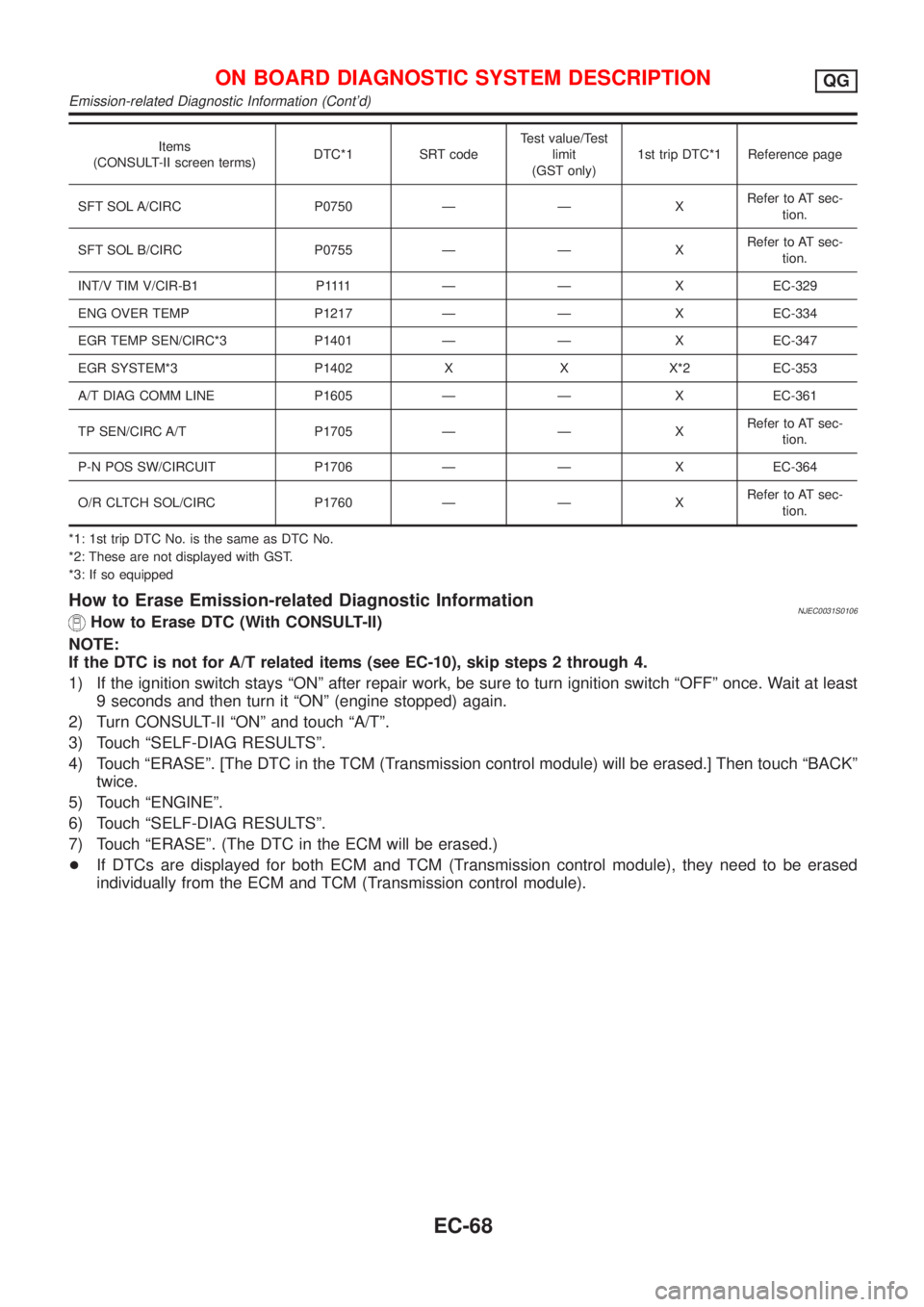
Items
(CONSULT-II screen terms)DTC*1 SRT codeTest value/Test
limit
(GST only)1st trip DTC*1 Reference page
SFT SOL A/CIRC P0750 Ð Ð XRefer to AT sec-
tion.
SFT SOL B/CIRC P0755 Ð Ð XRefer to AT sec-
tion.
INT/V TIM V/CIR-B1 P1111 Ð Ð XEC-329
ENG OVER TEMP P1217 Ð Ð X EC-334
EGR TEMP SEN/CIRC*3 P1401 Ð Ð X EC-347
EGR SYSTEM*3 P1402 X X X*2 EC-353
A/T DIAG COMM LINE P1605 Ð Ð X EC-361
TP SEN/CIRC A/T P1705 Ð Ð XRefer to AT sec-
tion.
P-N POS SW/CIRCUIT P1706 Ð Ð X EC-364
O/R CLTCH SOL/CIRC P1760 Ð Ð XRefer to AT sec-
tion.
*1: 1st trip DTC No. is the same as DTC No.
*2: These are not displayed with GST.
*3: If so equipped
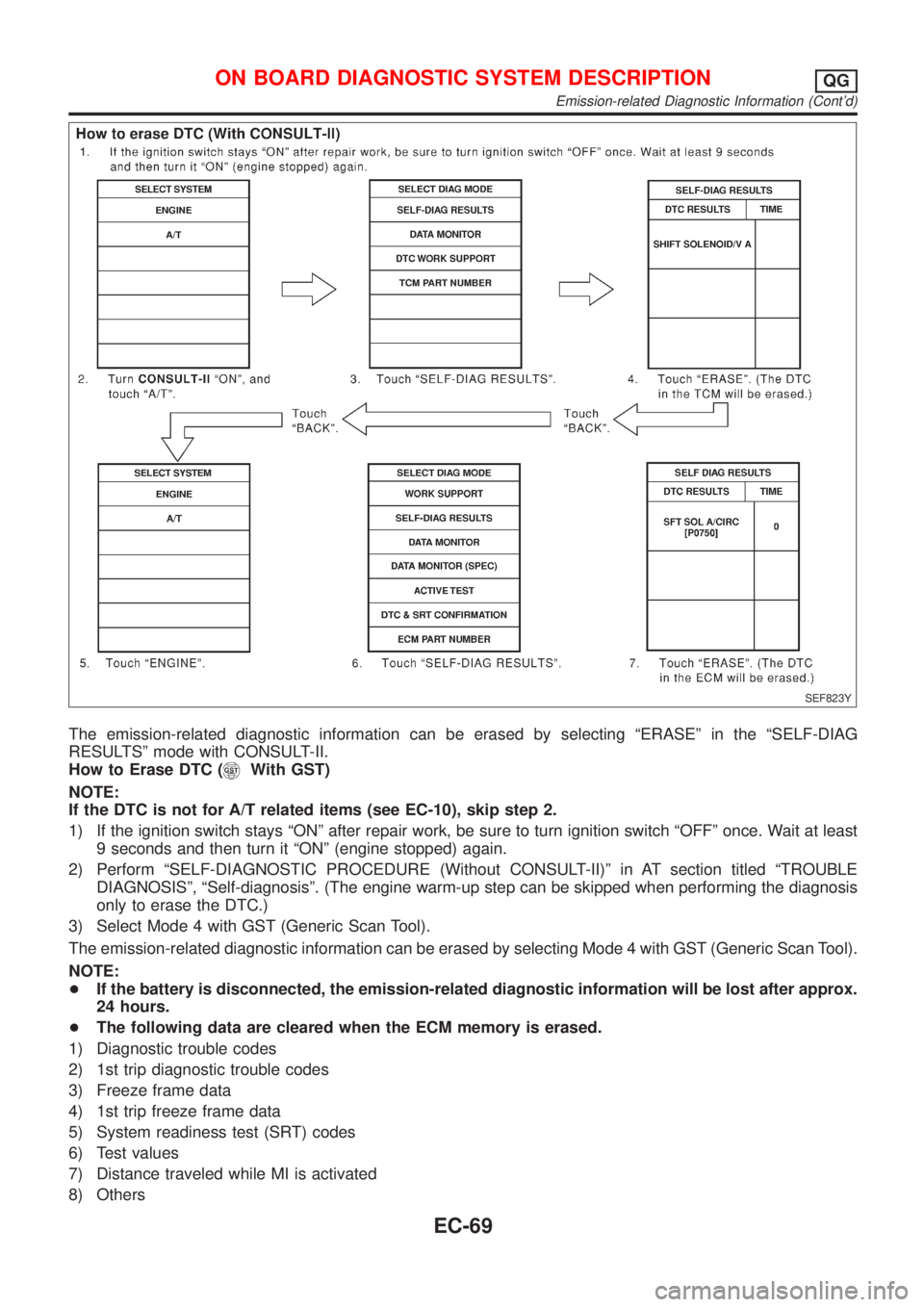
How to Erase Emission-related Diagnostic InformationNJEC0031S0106How to Erase DTC (With CONSULT-II)
NOTE:
If the DTC is not for A/T related items (see EC-10), skip steps 2 through 4.
1) If the ignition switch stays ªONº after repair work, be sure to turn ignition switch ªOFFº once. Wait at least
9 seconds and then turn it ªONº (engine stopped) again.
2) Turn CONSULT-II ªONº and touch ªA/Tº.
3) Touch ªSELF-DIAG RESULTSº.
4) Touch ªERASEº. [The DTC in the TCM (Transmission control module) will be erased.] Then touch ªBACKº
twice.
5) Touch ªENGINEº.
6) Touch ªSELF-DIAG RESULTSº.
7) Touch ªERASEº. (The DTC in the ECM will be erased.)
+If DTCs are displayed for both ECM and TCM (Transmission control module), they need to be erased
individually from the ECM and TCM (Transmission control module).
ON BOARD DIAGNOSTIC SYSTEM DESCRIPTIONQG
Emission-related Diagnostic Information (Cont'd)
EC-68
Page 365 of 2493
SEF823Y
The emission-related diagnostic information can be erased by selecting ªERASEº in the ªSELF-DIAG
RESULTSº mode with CONSULT-II.
How to Erase DTC (
With GST)
NOTE:
If the DTC is not for A/T related items (see EC-10), skip step 2.
1) If the ignition switch stays ªONº after repair work, be sure to turn ignition switch ªOFFº once. Wait at least
9 seconds and then turn it ªONº (engine stopped) again.
2) Perform ªSELF-DIAGNOSTIC PROCEDURE (Without CONSULT-II)º in AT section titled ªTROUBLE
DIAGNOSISº, ªSelf-diagnosisº. (The engine warm-up step can be skipped when performing the diagnosis
only to erase the DTC.)
3) Select Mode 4 with GST (Generic Scan Tool).
The emission-related diagnostic information can be erased by selecting Mode 4 with GST (Generic Scan Tool).
NOTE:
+If the battery is disconnected, the emission-related diagnostic information will be lost after approx.
24 hours.
+The following data are cleared when the ECM memory is erased.
1) Diagnostic trouble codes
2) 1st trip diagnostic trouble codes
3) Freeze frame data
4) 1st trip freeze frame data
5) System readiness test (SRT) codes
6) Test values
7) Distance traveled while MI is activated
8) Others
ON BOARD DIAGNOSTIC SYSTEM DESCRIPTIONQG
Emission-related Diagnostic Information (Cont'd)
EC-69
Page 367 of 2493

Only one set of freeze frame data (either 1st trip freeze frame data or freeze frame data) can be stored in the
ECM. 1st trip freeze frame data is stored in the ECM memory along with the 1st trip DTC. There is no prior-
ity for 1st trip freeze frame data and it is updated each time a different 1st trip DTC is detected. However, once
freeze frame data is stored in the ECM memory, 1st trip freeze frame data is no longer stored. Remember,
only one set of freeze frame data can be stored in the ECM.
If freeze frame data is stored in the ECM memory and another freeze frame data occurs later, the first (origi-
nal) freeze frame data remains unchanged in the ECM memory.
Both 1st trip freeze frame data and freeze frame data (along with the DTCs) are cleared when the ECM
memory is erased. Procedures for clearing the ECM memory are described in ªHow to Erase Emission-related
Diagnostic Informationº, EC-71.
How to Erase Emission-related Diagnostic InformationNJEC0031S0706How to Erase DTC (With CONSULT-II)
1) If the ignition switch stays ªONº after repair work, be sure to turn ignition switch ªOFFº once. Wait at least
10 seconds and then turn it ªONº (engine stopped) again.
2) Touch ªENGINEº.
3) Touch ªSELF-DIAG RESULTSº.
4) Touch ªERASEº. (The DTC in the ECM will be erased.)
SEF993XA
The emission related diagnostic information in the ECM can be erased by selecting ªERASEº in the ªSELF-
DIAG RESULTSº mode with CONSULT-II.
How to Erase DTC (
Without CONSULT-II)
1) If the ignition switch stays ªONº after repair work, be sure to turn ignition switch ªOFFº once. Wait at least
10 seconds and then turn it ªONº (engine stopped) again.
2) Change the diagnostic test mode from Mode II to Mode I by using the data link connector. (See EC-74.)
The emission related diagnostic information in the ECM can be erased by changing the diagnostic test mode.
+If the battery is disconnected, the emission-related diagnostic information will be lost after approx.
24 hours.
+The following data are cleared when the ECM memory is erased.
1) Diagnostic trouble codes
2) 1st trip diagnostic trouble codes
3) Freeze frame data
4) 1st trip freeze frame data
5) Others
Actual work procedures are explained using a DTC as an example. Be careful so that not only the DTC, but
all of the data listed above, are cleared from the ECM memory during work procedures.
ON BOARD DIAGNOSTIC SYSTEM DESCRIPTIONQG
Emission-related Diagnostic Information (Cont'd)
EC-71
Page 369 of 2493

3. SELF-DIAGNOSTIC RESULTS:
This function allows DTCs and 1st trip DTCs to be read.
4. HEATED OXYGEN SENSOR 1 MONITOR (FRONT):
This function allows the fuel mixture condition (lean or rich), monitored by heated oxygen sensor 1 (front),
to be read.
MI Flashing without DTC
NJEC0032S0101If the ECM is in Diagnostic Test Mode II, MI may flash when engine is running. In this case, check ECM test
mode following ªHow to Switch Diagnostic Test Modesº.
How to switch the diagnostic test (function) modes, and details of the above functions are described later.
(Refer to EC-74.)
Condition Diagnostic Test Mode I Diagnostic Test Mode II
Ignition switch in ªONº position
Engine stopped
BULB CHECK SELF-DIAGNOSTIC RESULTS
Engine running
MALFUNCTION WARNINGHEATED OXYGEN SENSOR 1
MONITOR (FRONT)
The following emission-related diagnostic information is cleared when the ECM memory is erased.
1) Diagnostic trouble codes
2) 1st trip diagnostic trouble codes
3) Freeze frame data
4) 1st trip freeze frame data
5) System readiness test (SRT) codes
6) Test values
7) Distance traveled while MI is activated
8) Others
ON BOARD DIAGNOSTIC SYSTEM DESCRIPTIONQG
Malfunction Indicator (MI) (Cont'd)
EC-73
Page 371 of 2493

Diagnostic Test Mode I Ð Bulb CheckNJEC0032S03In this mode, the MI on the instrument panel should stay ON. If it remains OFF, check the MI bulb. Refer to
EL-107, ªWARNING LAMPSº or see EC-488.
Diagnostic Test Mode I Ð Malfunction WarningNJEC0032S04
MI Condition
ON When the malfunction is detected or the ECM's CPU is malfunctioning.
OFF No malfunction.
+These DTC numbers are clarified in Diagnostic Test Mode II (SELF-DIAGNOSTIC RESULTS).
Diagnostic Test Mode II Ð Self-diagnostic Results (If so equipped)NJEC0032S05In this mode, the DTC and 1st trip DTC are indicated by the number of blinks of the MI as shown below.
The DTC and 1st trip DTC are displayed at the same time. If the MI does not illuminate in diagnostic test mode
I (Malfunction warning), all displayed items are 1st trip DTCs. If only one code is displayed when the MI illu-
minates in diagnostic test mode II (SELF-DIAGNOSTIC RESULTS), it is a DTC; if two or more codes are
displayed, they may be either DTCs or 1st trip DTCs. DTC No. is same as that of 1st trip DTC. These uni-
dentified codes can be identified by using the CONSULT-II or GST. A DTC will be used as an example for how
to read a code.
SEF952W
A particular trouble code can be identified by the number of four-digit numeral flashes. The ªzeroº is indicated
by the number of ten flashes. The length of time the 1000th-digit numeral flashes on and off is 1.2 seconds
consisting of an ON (0.6-second)-OFF (0.6-second) cycle.
The 100th-digit numeral and lower digit numerals consist of a 0.3-second ON and 0.3-second OFF cycle.
A change from one digit numeral to another occurs at an interval of 1.0 second OFF. In other words, the lat-
ter numeral appears on the display 1.3 seconds after the former numeral has disappeared.
A change from one trouble code to another occurs at an interval of 1.8 second off.
In this way, all the detected malfunctions are classified by their DTC numbers. The DTC ª0000º refers to no
malfunction. (See TROUBLE DIAGNOSIS Ð INDEX, EC-10.)
How to Erase Diagnostic Test Mode II (Self-diagnostic results)
NJEC0032S0501The DTC can be erased from the backup memory in the ECM when the diagnostic test mode is changed from
Diagnostic Test Mode II to Diagnostic Test Mode I. (Refer to ªHow To Switch Diagnostic Test Modesº, EC-74.)
+If the battery is disconnected, the DTC will be lost from the backup memory after approx. 24 hours.
+Be careful not to erase the stored memory before starting trouble diagnoses.
Diagnostic Test Mode II Ð Heated Oxygen Sensor 1 Monitor (Front) (If so equipped)NJEC0032S06In this mode, the MI displays the condition of the fuel mixture (lean or rich) which is monitored by the heated
oxygen sensor 1 (front).
ON BOARD DIAGNOSTIC SYSTEM DESCRIPTIONQG
Malfunction Indicator (MI) (Cont'd)
EC-75