2001 LAND ROVER FREELANDER belt
[x] Cancel search: beltPage 53 of 1007

GENERAL INFORMATION
03-22
SRS component testing
The SRS components are triggered using relatively
low operating currents, always adhere to the
following precautions:
WARNING: Do not use a multimeter or other
general purpose test equipment on SRS system
components or accidental deployment may
occur. Use only Testbook to diagnose system
faults.
WARNING: Do not use electrical test equipment
on the SRS harness while it is connected to any
of the SRS system components. It may cause
accidental deployment and personal injury.
Never apply electrical power to an SRS component
unless instructed to do so as part of an approved test
procedure.
The SRS Diagnostic Control Unit is a non-
serviceable component and no attempt should be
made to repair or modify the unit.Component handling
The SRS components are sensitive and potentially
hazardous if not handled correctly; always comply
with the following handling precautions:
WARNING: The SRS components are sensitive
and potentially hazardous if not handled
correctly; always comply with the following
handling precautions:
lNever drop an SRS component. The airbag
diagnostic control unit is a particularly
shock sensitive device and must be handled
with extreme care. Airbag modules and seat
belt pre-tensioner units could deploy if
subjected to a strong shock.
lNever wrap your arms around an airbag
module. If an airbag module has to be
carried, hold it by the cover, with the cover
uppermost and the base away from your
body.
lNever transport airbag modules or seat belt
pre-tensioners in the cabin of a vehicle.
Always use the luggage compartment of the
vehicle for carrying airbag modules and seat
belt pre-tensioner units.
WARNING: Never attach anything to an airbag
cover or any trim component covering an airbag
module. Do not allow anything to rest on top of
an airbag module.
WARNING: Always keep components cool, dry
and free from contamination.
Page 54 of 1007

GENERAL INFORMATION
03-23
WARNING: For front seat buckle type pre-
tensioners, hold by the piston tube, with the open
end of the piston tube pointing towards the
ground and the buckle facing away from your
body. Do not cover the end of the piston tube.
DO NOT hold buckle pre-tensioners by the
bracket assembly or steel cable. NEVER point
the piston tube towards your body or other
people.
CAUTION: Do not apply grease or cleaning
solvents to seatbelt pre-tensioner units,
component failure could result.Storage
There are regulations for the safe storage of SRS
components which must be observed, consult your
local authority for details.
WARNING: Airbag modules and seat belt pre-
tensioners are classed as explosive devices. For
overnight and longer term storage, they must be
stored in a secure steel cabinet which has been
approved as suitable for the purpose and has
been registered by the local authority.
WARNING: Store the airbag module with the
deployment side uppermost. If it is stored
deployment side down, accidental deployment
will propel the airbag module with enough force
to cause serious injury.
CAUTION: Improper handling or storage can
internally damage the airbag module, making it
inoperative. If you suspect the airbag module has
been damaged, install a new module and refer to
the Deployment/Disposal Procedures for
disposal of the damaged module.
Always observe the following precautions when
temporarily storing an airbag module:
lEnsure the cover is facing upwards and the
luggage compartment is secured.
lAlways keep components cool, dry and free
from contamination.
lDo not allow anything to rest on the airbag
module.
lStore any removed airbag assembly on a
secure flat surface away from electrical
equipment and heat sources (exceeding 85° C
(185° F).
Page 57 of 1007
GENERAL INFORMATION
03-26
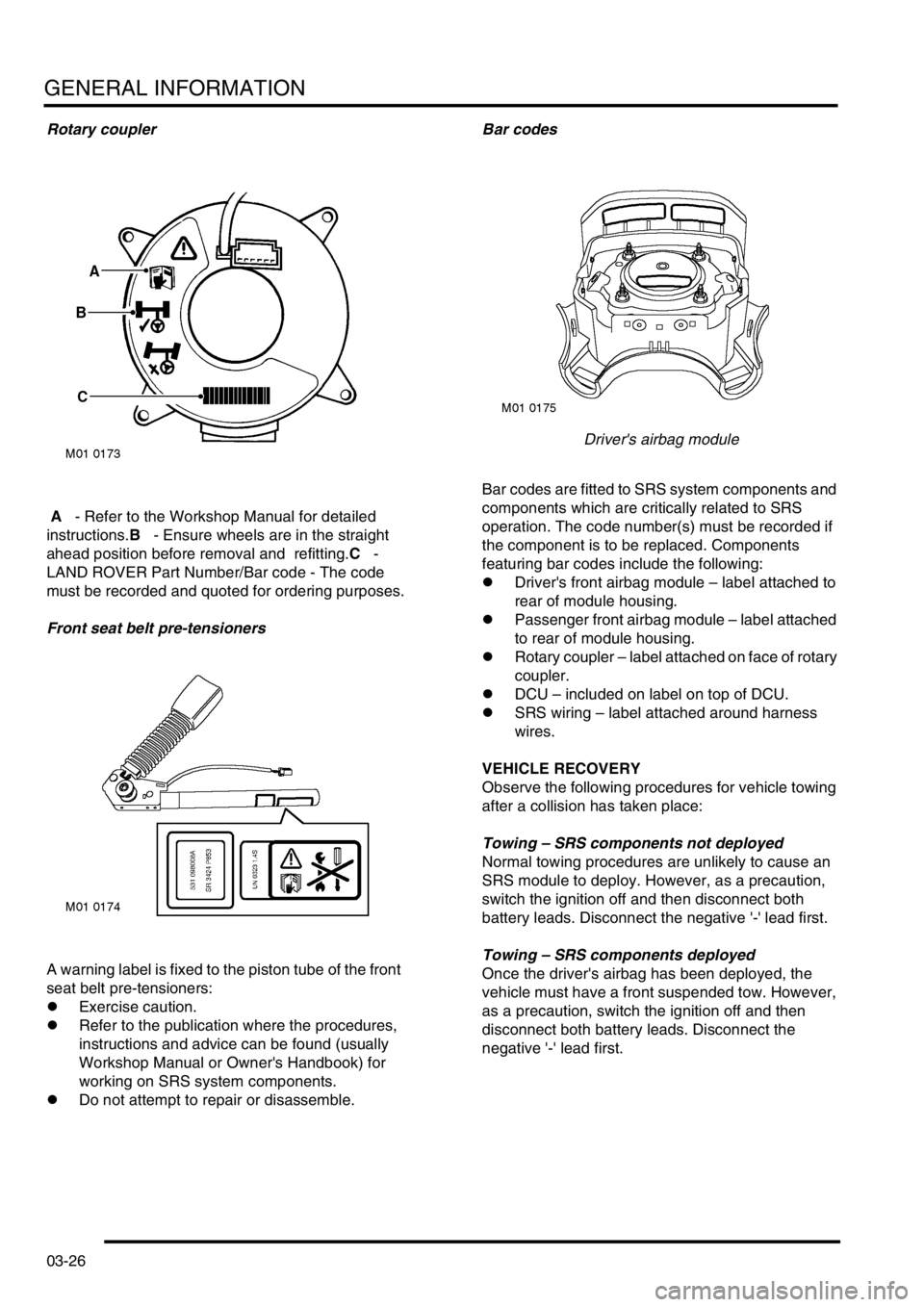
Rotary coupler
A - Refer to the Workshop Manual for detailed
instructions.B - Ensure wheels are in the straight
ahead position before removal and refitting.C -
LAND ROVER Part Number/Bar code - The code
must be recorded and quoted for ordering purposes.
Front seat belt pre-tensioners
A warning label is fixed to the piston tube of the front
seat belt pre-tensioners:
lExercise caution.
lRefer to the publication where the procedures,
instructions and advice can be found (usually
Workshop Manual or Owner's Handbook) for
working on SRS system components.
lDo not attempt to repair or disassemble.Bar codes
Driver's airbag module
Bar codes are fitted to SRS system components and
components which are critically related to SRS
operation. The code number(s) must be recorded if
the component is to be replaced. Components
featuring bar codes include the following:
lDriver's front airbag module – label attached to
rear of module housing.
lPassenger front airbag module – label attached
to rear of module housing.
lRotary coupler – label attached on face of rotary
coupler.
lDCU – included on label on top of DCU.
lSRS wiring – label attached around harness
wires.
VEHICLE RECOVERY
Observe the following procedures for vehicle towing
after a collision has taken place:
Towing – SRS components not deployed
Normal towing procedures are unlikely to cause an
SRS module to deploy. However, as a precaution,
switch the ignition off and then disconnect both
battery leads. Disconnect the negative '-' lead first.
Towing – SRS components deployed
Once the driver's airbag has been deployed, the
vehicle must have a front suspended tow. However,
as a precaution, switch the ignition off and then
disconnect both battery leads. Disconnect the
negative '-' lead first.
Page 58 of 1007
GENERAL INFORMATION
03-27
SRS component manual deployment
If a vehicle is to be scrapped and contains an
undeployed airbag module, the module must be
manually deployed. Always observe the following
precautions:
WARNING: Only personnel who have undergone
the appropriate training should undertake
deployment of airbag and seat belt pre-tensioner
modules.
WARNING: A deployed airbag or seatbelt pre-
tensioner is very hot, DO NOT return to a
deployed airbag module until at least 30 minutes
have elapsed since deployment.
WARNING: Only use approved deployment
equipment, and only deploy SRS components in
a well ventilated designated area. Ensure SRS
components are not damaged or ruptured before
deployment. Notify the relevant authorities.
WARNING: If a vehicle is to be scrapped,
undeployed airbag modules and pre-tensioner
units must be deployed in accordance with the
instructions in this manual.
WARNING: Contact with chemicals from
deployed and damaged SRS components could
present a health hazard, wear protective clothing
when handling. DO NOT eat, drink or smoke
when handling SRS components.
WARNING: Deployment of airbag modules and
seatbelt pre-tensioners can cause injury to
personnel in the close vicinity of the deploying
unit. In case of injury seek urgent medical advice.
Possible sources of injury include:
limpact - due to inflating airbag or pre-
tensioner operation causing component
'kick'.
l hearing - due to noise produced by
deploying airbags and seatbelt pre-
tensioner units.
l burns - hot component parts and gases.
l irritation to eyes and lungs - from deploying
gases or combustion residue.
WARNING: Ensure the SRS component to be
deployed is securely fastened to its mounting.WARNING: Deployment procedures detailed in
this manual should be strictly adhered to.
Compliance with the following precautions
MUST be ensured:
lOnly use deployment equipment approved
for the intended purpose.
lBefore commencing deployment procedure,
ensure the deployment tool functions
properly by performing the self test
procedure detailed in the SRS Repairs
section of this manual.
lDeployment of airbag/pre-tensioner
modules should be performed in a well
ventilated area which has been designated
for the purpose.
lEnsure airbag/pre-tensioner modules are
not damaged or ruptured before attempting
to deploy.
lNotify the relevant authorities of intention to
deploy airbag and pre-tensioner units.
lWhen deploying airbag and seatbelt pre-
tensioner units, ensure that all personnel are
at least 15 metres away from the deployment
zone.
lEnsure deployment tool is connected
correctly, in compliance with the
instructions detailed in this manual. In
particular, ensure deployment tool is NOT
connected to battery supply before
connecting to the airbag or seatbelt pre-
tensioner module connector.
lWhen deploying seatbelt pre-tensioners in
the vehicle, ensure the pre-tensioner unit is
fully secured to its fixing point.
lWhen removing deployed airbag and
seatbelt pre-tensioner modules, wear
protective clothing. Use gloves and seal
deployed units in a plastic bag.
lFollowing deployment of any component of
the SRS system within the vehicle, all SRS
components must be replaced. DO NOT re-
use or salvage any parts of the SRS system.
lDo not lean over airbag modules or seatbelt
pre-tensioner units when connecting
deployment equipment.
WARNING: During deployment parts of the
airbag module become hot enough to burn you.
Wait 30 minutes after deployment before
touching the airbag module.
Page 59 of 1007

GENERAL INFORMATION
03-28
SRS component replacement policy
The following information details the policy for
replacement of SRS components; either as a result
of a vehicle accident or as a result of vehicle age.
Impacts which do not deploy the airbags or seat
belt pre-tensioners
Check for structural damage in the area of the
impact, paying particular attention to bumper
armatures, longitudinals, crash cans and bracketry.
Impacts which deploy the airbags and/or seat
belt pre-tensioners
The inspection and replacement policy is dependent
on the type and severity of the crash condition. The
following guidelines are the minimum that should be
exercised as a result of the deployment of specific
SRS components.
Front airbag/ seat belt pre-tensioner deployment
(driver and passenger)
If the front airbags and/or seat belt pre-tensioners are
deployed as a result of a front, front angled or side
impact, the following parts must be replaced:
lDriver airbag module
lPassenger airbag module (where fitted)
lSRS flyleads
lSRS DCU
lRotary coupler
lFront seat belt pre-tensioners
In addition, the following should be inspected for
damage and replaced as necessary:
lFront seat belt and buckle tongue (anchorage
points, webbing etc.)
lFascia moulding adjacent to passenger airbag
module (where fitted)
lSteering wheel (if damage is evident)
lFront seat frames and head restraints (if there is
evidence of damage to the seat frame or
cushion pan)
lSteering column (if adjustment is lost or there
are signs of collapse)
lFront seat belt height adjusters on 'BC' posts (5
door models only)
lRear seat belts and seat belt buckles (webbing,
buckle covers, body anchorage and tongue
latching function)Rear Impact
If the seat belt pre-tensioners are deployed during a
rear impact, the following components must be
replaced:
lSeat belt pre-tensioners
lFront and rear automatic seat belt assemblies
used during an impact.
lSRS DCU
In addition, the following components should be
inspected for damage and replaced as necessary:
lFront seat frames
lFront seat belts and buckle (retractors,
webbing, tongue latching, buckle covers, body
anchorages and 'D' loops)
lSeat belt height adjusters (5 door models only)
lRear seat belts and seat belt buckles (webbing,
buckle covers, body anchorage and tongue
latching function)
Periodic replacement of SRS components
The performance of the propellants within airbags
and seat belt pre-tensioners will deteriorate over a
period of time. As a result, it is essential that the
airbags and seat belt pre-tensioners are periodically
replaced to maintain occupant safety. Airbags, seat
belt pre-tensioners and the rotary coupler should be
replaced at the recommended intervals.
Page 71 of 1007

GENERAL DATA
04-8
Pistons
Type Aluminium alloy, tin plated, thermal expansion with offset gudgeon pin
Piston diameter:
⇒ Grade A 79.975 - 79.990 mm (3.1486 - 3.1492 in.)
⇒ Grade B 79.991 - 80.005 mm (3.1492 - 3.1498 in.)
Clearance in bore 0.01 - 0.04 mm (0.0004 - 0.0016 in.)
Maximum ovality 0.30 mm (0.012 in.)
Piston rings:
Type: 2 compression, 1 oil control
⇒ Top compression ring Barrel faced, granulite coated
⇒ 2nd compression ring Tapered, phosphate coated
⇒ Oil control ring Nitrided ring with radii and spring
New ring to groove clearance:
⇒ Top compression ring 0.040 - 0.072 mm (0.0016 - 0.0028 in.)
⇒ 2nd compression ring 0.030 - 0.062 mm (0.0012 - 0.0024 in.)
⇒ Oil control ring 0.010 - 0.180 mm (0.0004 - 0.0071 in.)
Ring fitted gap 20 mm (0.75 in) from top of bore:
⇒ Top compression ring 0.20 - 0.35 mm (0.008 - 0.014 in.)
⇒ 2nd compression ring 0.28 - 0.48 mm (0.011 - 0.019 in.)
⇒ Oil control ring 0.15 - 0.40 mm (0.006 - 0.016 in.)
Piston ring width:
⇒ Top compression ring 0.978 - 0.990 mm (0.0385 - 0.0390 in.)
⇒ 2nd compression ring 1.178 - 1.190 mm (0.0464 - 0.0469 in.)
⇒ Oil control ring 0.33 - 0.38 mm (0.0130 - 0.0150 in.)
Camshaft
Type DOHC acting directly on tappets, incorporates target/reluctor for
camshaft sensor
Bearings 6 per camshaft, direct line bored
Drive Toothed belt driven from crankshaft gear, automatically tensioned
Camshaft end-float 0.06 - 0.19 mm (0.002 - 0.007 in.)
⇒ Service limit 0.30 mm (0.012 in.)
Bearing clearance 0.060 - 0.094 mm (0.0024 - 0.0037 in.)
⇒ Service limit 0.15 mm (0.006 in.)
Tappets
Type Self-adjusting lightweight hydraulic tappets, operated directly from
camshafts
Tappet outside diameter 32.959 - 32.975 mm (1.2976 - 1.2982 in.)
Valve timing:
Inlet valves:
⇒ Opens
⇒ Closes
⇒ Maximum lift12° BTDC
52° ABDC
8.8 mm (0.35 in.)
Exhaust valves:
⇒ Opens
⇒ Closes
⇒ Maximum lift52° BBDC
12° ATDC
8.8 mm (0.35 in.) General
Page 77 of 1007

GENERAL DATA
04-14
Clearance in bore 20 mm (0.75 in.) from bottom of
cylinder bore0.034 - 0.035 mm (0.0013 - 0.0014 in.)
Maximum ovality 0.3 mm (0.012 in.)
Piston rings
Type:
⇒ Top compression ring Chrome plated steel
⇒ 2nd compression ring Chrome plated cast iron
⇒ Oil control ring Stainless steel top and bottom rails with expander ring
New ring to groove clearance:
⇒ Top compression ring 0.05 - 0.08 mm (0.0020 - 0.0031 in.)
⇒ 2nd compression ring 0.04 - 0.07 mm (0.0012 - 0.0024 in.)
⇒ Oil control ring 0.010 - 0.180 mm (0.0004 - 0.0071 in.)
Ring fitted gap 20 mm (0.75 in) from top of bore:
⇒ Top compression ring 0.20 - 0.35 mm (0.008 - 0.014 in.)
⇒ 2nd compression ring 0.28 - 0.45 mm (0.011 - 0.018 in.)
⇒ Oil control ring 0.25 - 1.00 mm (0.010 - 0.039 in.)
Piston ring width:
⇒ Top compression ring 3.1 ± 0.15 mm (0.122 ± 0.006 in.)
⇒ 2nd compression ring 3.15 - 3.45 mm (0.124 - 0.136 in.)
⇒ Oil control ring 2.286 - 2.438 mm (0.090 - 0.096 in.)
Camshaft
Type Twin camshafts on each cylinder bank retained by camshaft carrier,
line bored with cylinder head. Reluctor for camshaft sensor mounted
on left hand inlet camshaft
Camshaft identification:
⇒ Inlet Orange paint mark
⇒ Exhaust Blue paint mark
Bearings 5 per camshaft
Drive Toothed belt driven from crankshaft to front of inlet camshafts, 2 x
short toothed belts from rear of inlet camshafts to exhaust camshafts
Camshaft end-float 0.06 - 0.19 mm (0.002 - 0.007 in.)
⇒ Service limit 0.3 mm (0.012 in.)
Bearing clearance 0.025 - 0.059 mm (0.0010 - 0.0023 in.)
⇒ Service limit 0.1 mm (0.004 in.)
Tappets
Type Hydraulic self-adjusting, directly operated from camshafts
Tappet outside diameter 32.959 - 32.975 mm (1.2976 - 1.2982 in.)
Valve timing
Inlet valves:
⇒ Opens
⇒ Closes2° BTDC
54° ABDC
Exhaust valves:
⇒ Opens
⇒ Closes50° BBDC
14° ATDC
Valve maximum lift:
Inlet valves 8.2 mm (0.32 in.)
Exhaust valves 8.8 mm (0.35 in.) General
Page 105 of 1007

TORQUE WRENCH SETTINGS
06-2
Engine – Td4
TORQUE DESCRIPTION METRIC IMPERIAL
Acoustic cover to engine 8 Nm 6 lbf.ft
Ancillary drive belt jockey pulley Allen bolt
*24 Nm 18 lbf.ft
Ancillary drive belt tensioner arm nut 10 Nm 7.5 lbf.ft
Big end bearing cap bolts:
⇒ Stage 15 Nm 3.5 lbf.ft
⇒ Stage 225 Nm 18 lbf.ft
⇒ Stage 3+70°+70°
Camshaft bearing cap bolts
† 10 Nm 7.5 lbf.ft
Camshaft cover bolts
† 10 Nm 7.5 lbf.ft
Camshaft sprocket retaining screw:
⇒ Stage 120 Nm 15 lbf.ft
⇒ Stage 2+35°+35°
Chain lubrication jet bolt 10 Nm 7.5 lbf.ft
Coolant rail to exhaust manifold bolts 20 Nm 15 lbf.ft
Coolant rail to exhaust manifold bolts 8 Nm 6 lbf.ft
Crankshaft pulley:
⇒ Stage 1100 Nm 74 lbf.ft
⇒ Stage 2+60 °+60 °
⇒ Stage 3+60 °+60 °
⇒ Stage 4+30 °+30 °
Crankshaft rear oil seal housing:
⇒ M6 bolts10 Nm 7.5 lbf.ft
⇒ M8 bolts22 Nm 16 lbf.ft
Cylinder block reinforcing plate 22 Nm 16 lbf.ft
Cylinder head bolts: (Stages 1 to 5 relate to bolts 1 to 11. Stage 6 is for bolt 12 only.)
⇒ Stage 1
†80 Nm 59 lbf.ft
⇒ Stage 2 - loosen all bolts
†-1/2 turn -1/2 turn
⇒ Stage 3
†50 Nm 37 lbf.ft
⇒ Stage 4
†+90°+90°
⇒ Stage 5
†+90°+90°
⇒ Stage 6 – tighten 41 mm bolt in position 12 110 Nm 81 lbf.ft
Cylinder head to timing cover Allen screws 15 Nm 11 lbf.ft
Dipstick tube to oil filter housing bolt 10 Nm 7.5 lbf.ft
Drive plate to crankshaft bolts
† 115 Nm 85 lbf.ft
EGR cooler to cylinder head and lifting bracket bolts 25 Nm 18 lbf.ft
Engine breather pipe to air cleaner housing bolt 10 Nm 7.5 lbf.ft
Engine lifting eye bolts 20 Nm 15 lbf.ft
Engine mounting bracket assembly to engine bolts 100 Nm 74 lbf.ft
Engine mounting bracket to hydramount nut 85 Nm 63 lbf.ft
Engine lower steady bracket bolts:
⇒ M1045 Nm 33 lbf.ft
⇒ M1250 Nm 37 lbf.ft
Engine steady mounting bolt 100 Nm 74 lbf.ft
Exhaust manifold to cylinder head nuts 24 Nm 18 lbf.ft
Flywheel to crankshaft bolts
† 115 Nm 85 lbf.ft
Fuel pipe bracket to oil filter housing bolt 10 Nm 7.5 lbf.ft
Fuel pipe union nuts 30 Nm 22 lbf.ft
Fuel pump drive chain lower guide Allen bolt 24 Nm 18 lbf.ft