2001 HONDA ODYSSEY sensor
[x] Cancel search: sensorPage 51 of 363
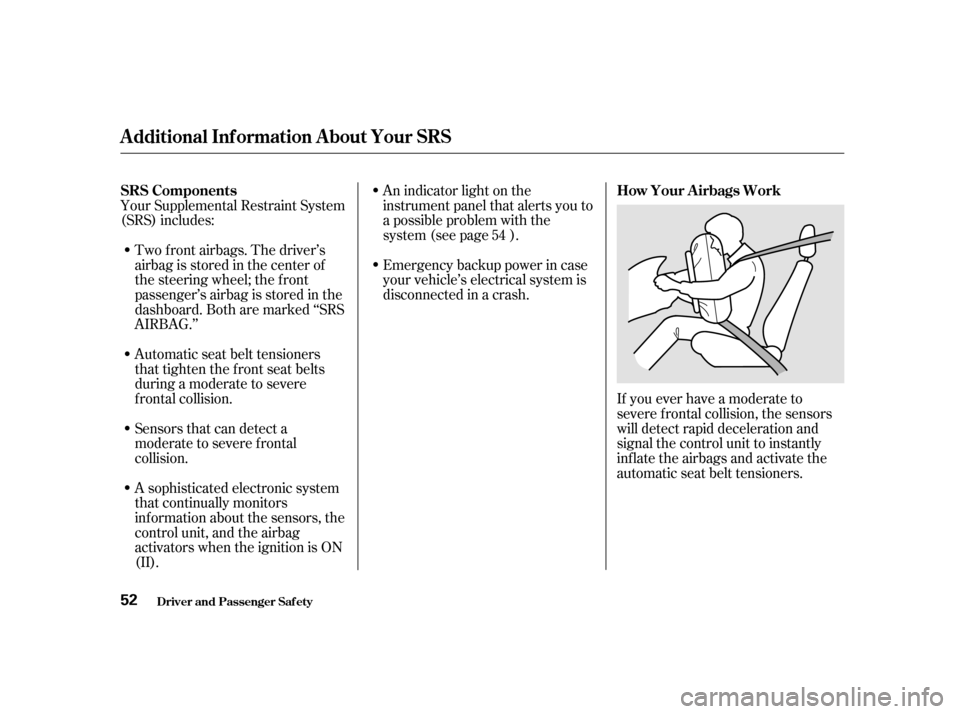
Your Supplemental Restraint System
(SRS) includes:Two f ront airbags. The driver’s
airbag is stored in the center of
the steering wheel; the f ront
passenger’sairbagisstoredinthe
dashboard. Both are marked ‘‘SRS
AIRBAG.’’
If you ever have a moderate to
severe f rontal collision, the sensors
will detect rapid deceleration and
signal the control unit to instantly
inflate the airbags and activate the
automatic seat belt tensioners.
Automatic seat belt tensioners
that tighten the front seat belts
during a moderate to severe
f rontal collision.
Sensors that can detect a
moderate to severe frontal
collision.
A sophisticated electronic system
that continually monitors
inf ormation about the sensors, the
control unit, and the airbag
activators when the ignition is ON
(II). An indicator light on the
instrument panel that alerts you to
a possible problem with the
system (see page ).
Emergency backup power in case
your vehicle’s electrical system is
disconnected in a crash.
54
SRS Components
How Your A irbags Work
Additional Inf ormation About Your SRS
Driver and Passenger Saf ety
52
Page 52 of 363
After a crash, you may see what
looks like smoke. This is actually
powder f rom the airbag’s surf ace.
Although the powder is not harmf ul,
people with respiratory problems
may experience some temporary
discomf ort. If this occurs, get out of
the vehicle as soon as it is saf e to do
so.
For additional information on how
your airbags work, see the booklet
titledthat came with your
owner’s manual.
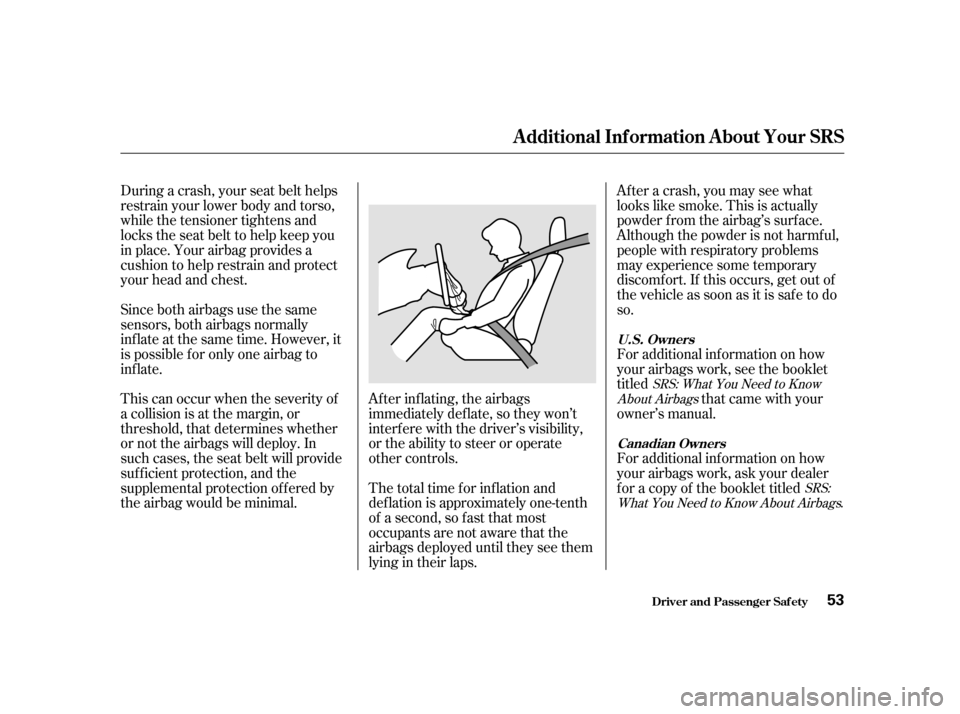
Af ter inf lating, the airbags
immediately def late, so they won’t
interf ere with the driver’s visibility,
or the ability to steer or operate
other controls.
The total time for inflation and
def lation is approximately one-tenth
of a second, so f ast that most
occupants are not aware that the
airbags deployed until they see them
lying in their laps.
During a crash, your seat belt helps
restrain your lower body and torso,
while the tensioner tightens and
locks the seat belt to help keep you
in place. Your airbag provides a
cushion to help restrain and protect
your head and chest.
Since both airbags use the same
sensors, both airbags normally
inf late at the same time. However, it
is possible f or only one airbag to
inf late.
This can occur when the severity of
a collision is at the margin, or
threshold, that determines whether
or not the airbags will deploy. In
such cases, the seat belt will provide
suf f icient protection, and the
supplemental protection of f ered by
the airbag would be minimal.
For additional information on how
your airbags work, ask your dealer
f or a copy of the booklet titled
SRS: What You Need to Know
About Airbags
SRS:
What You Need to Know About Airbags
.
Additional Inf ormation About Your SRS
Driver and Passenger Saf ety
U.S. Owners
Canadian Owners
53
Page 134 of 363

The heating and air conditioning
systems in your Honda provide a
comf ortable driving environment in
all weather conditions.
The standard audio system has
many f eatures. This section de-
scribes those f eatures and how to
use them. (If you selected an
optional audio system, ref er to the
operating instructions that came
with it.)
Your Honda has an anti-thef t audio
system that requires a code number
to enable it......................
Heating and Cooling . 136
.........
What Each Control Does . 136
............
How to Use the System . 139
..........
To Turn Everything Of f . 143
...............
Climate Control System . 144
(EX model without Navigation
System)
.......
Fully-automatic Operation . 146
.......
Semi-automatic Operation . 148
(EX model with Navigation System)
.......
Fully-automatic Operation . 152
.......
Semi-automatic Operation . 153
Sunlight Sensor/
............
Temperature Sensor . 157
...........................
Rear A/C Unit . 158
.......................
Audio System (LX) . 161
AM/FM/Cassette Stereo
........................
Audio System . 161
.................
Operating the Radio . 162
.................
Adjusting the Sound . 165
............
Audio System Lighting . 166
Operating the Cassette
.....................................
Player . 166
............
Tape Search Functions . 166 Operating the Optional CD
....................
Player/Changer . 169
CD Changer Error
.............................
Indications . 172
.......................
Audio System (EX) . 173
....
AM/FM/CD Audio System . 173
.................
Operating the Radio . 174
.................
Adjusting the Sound . 178
............
Audio System Lighting . 179
....................
Radio Frequencies . 179
........................
Radio Reception . 179
.........
Operating the CD Player . 181
.....
Operating the CD Changer . 183
.......
Protecting Compact Discs . 184
....
CD Player Error Indications . 185
CD Changer Error
.............................
Indications . 186
Operating the Cassette
.....................................
Player . 187
............
Tape Search Functions . 188
Caring f or the Cassette
.....................................
Player . 190
...........
Remote Audio Controls . 191
.......................
Thef t Protection . 192
........................
Security System . 193
On EX model
Comf ort and Convenience Features
Comf ort and Convenience Feat ures 135
Page 156 of 363
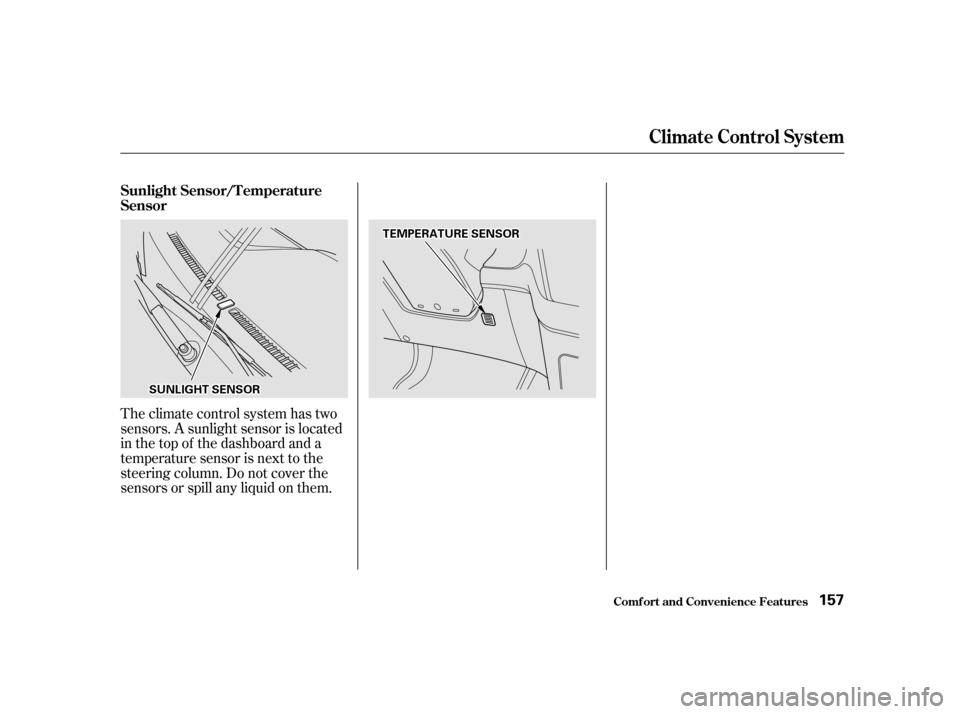
Theclimatecontrolsystemhastwo
sensors. A sunlight sensor is located
in the top of the dashboard and a
temperature sensor is next to the
steering column. Do not cover the
sensors or spill any liquid on them.
Sunlight Sensor/T emperature
Sensor
Climat e Cont rol Syst em
Comf ort and Convenience Feat ures
157
TTEEMMPPEERRAATTUURREESSEENNSSOORR
SSUUNNLLIIGGHHTTSSEENNSSOORR
Page 298 of 363

Two f actors normally contribute to
causing corrosion in your vehicle:Moisture trapped in body cavities.
Dirtandroadsaltthatcollectsin
hollows on the underside of the
vehicle stays damp, promoting
corrosion in that area.
Removal of paint and protective
coatings f rom the exterior and
underside of the vehicle. Repair chips and scratches in the
paint as soon as you discover them.
Many corrosion-preventive measures
are built into your Honda. You can
help keep your vehicle f rom
corroding by perf orming some
simple periodic maintenance:
Inspect and clean out the drain
holes in the bottom of the doors
and body.
Check the floor coverings for
dampness. Carpeting and f loor
mats may remain damp f or a long
time, especially in winter. This
dampness can eventually cause
the f loor panels to corrode. Use a high-pressure spray to clean
the underside of your vehicle. This
is especially important in areas
that use road salt in winter. It is
also a good idea in humid climates
and areas subject to salt air. Be
caref ul of the ABS wheel sensors
and wiring at each wheel.
Have the corrosion-preventive
coatings on the underside of your
vehicle inspected and repaired
periodically.
1. 2.
Corrosion Prot ect ion
Appearance Care
299
Page 338 of 363

If you are planning to take your
Honda outside the U.S. or Canada,
contact the tourist bureaus in the
areas you will be traveling in to f ind
out about the availability of unleaded
gasoline with the proper octane
rating.
If unleaded gasoline is not available,
be aware that using leaded gasoline
in your Honda will af f ect perf or-
mance and fuel mileage, and damage
its emissions controls. It will no
longer comply with U.S. and
Canadian emissions regulations, and
will be illegal to operate in North
America. To bring your vehicle back
into compliance will require the re-
placement of several components,
such as the oxygen sensors and the
three way catalytic converter. These
replacements are not covered under
warranty.T echnical Inf ormation
Driving in Foreign Countries
339
Page 340 of 363

The exhaust emissions controls
include f our systems: PGM-FI,
Ignition Timing Control, Exhaust
Gas Recirculation and Three Way
Catalytic Converter. These four
systems work together to control the
engine’s combustion and minimize
the amount of HC, CO, and NOx that
comes out the tailpipe. The exhaust
emissions control systems are
separate f rom the crankcase and
evaporative emissions control
systems.The emissions control systems are
designed and certif ied to work to-
gether in reducing emissions to
levels that comply with the Clean Air
Act. To make sure the emissions
remain low, you should use only new
genuine Honda replacement parts or
their equivalent f or repairs. Using
lower quality parts may increase the
emissions f rom your vehicle.
The emissions control systems are
covered by warranties separate f rom
the rest of your vehicle. Read your
warranty manual f or more inf orma-
tion.
The PGM-FI System uses sequential
multiport f uel injection.
It has three subsystems: Air Intake,
Engine Control, and Fuel Control.
The Powertrain Control Module
(PCM) uses various sensors to
determine how much air is going
into the engine. It then controls how
much f uel to inject under all operat-
ing conditions. This system constantly adjusts the
ignition timing, reducing the amount
of HC, CO and NOx produced.
The Exhaust Gas Recirculation
(EGR) system takes some of the
exhaust gas and routes it back into
the intake manif old. Adding exhaust
gas to the air/f uel mixture reduces
the amount of NOx produced when
the f uel is burned.
The three way catalytic converter is
in the exhaust system. Through
chemical reactions, it converts HC,
CO, and NOx in the engine’s exhaust
to carbon dioxide (CO ), dinitrogen
(N ), and water vapor.
2
2
Exhaust Emissions Controls
Replacement Parts
PGM-FI Syst emIgnit ion T iming Cont rol Syst em
Exhaust Gas Recirculat ion (EGR)Syst em
Three Way Catalytic Converter
T echnical Inf ormation
Emissions Cont rols
341