Page 81 of 363
�µ
If the f ront wheels are turned, the
anti-thef t lock may sometimes make
it difficult to turn the key from
LOCK to ACCESSORY. Firmly turn
the steering wheel to the lef t or to
the right as you turn the key. You can insert or
remove the key only in this position.
To switch f rom ACCESSORY to
LOCK, you must push the key in
slightly as you turn it. The shif t lever
must also be in Park. The anti-thef t
lock will lock the steering column
when you remove the key.
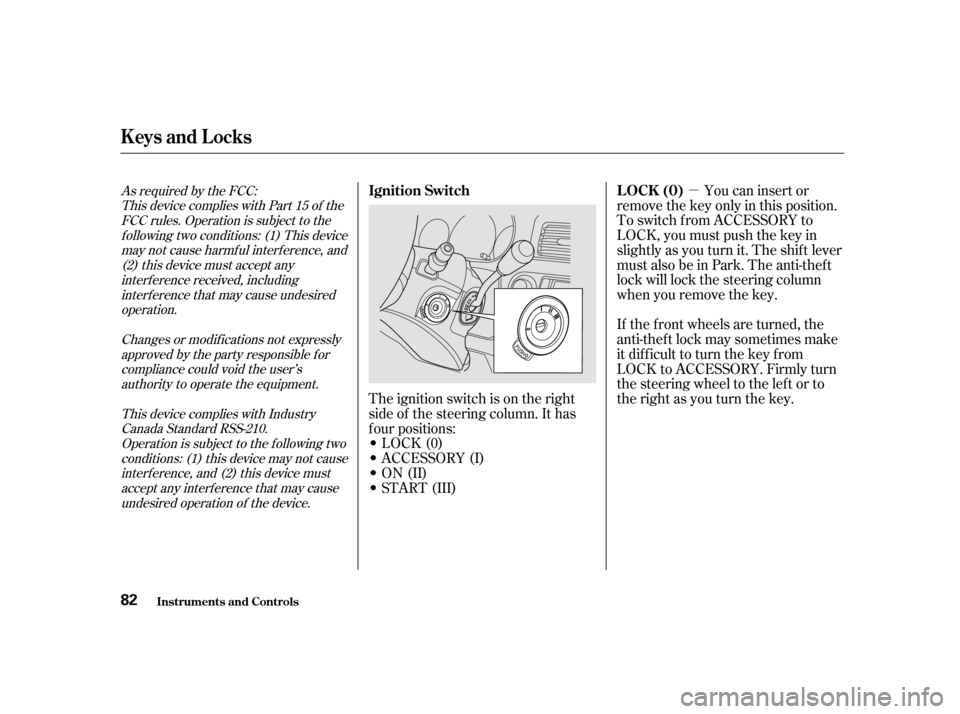
The ignition switch is on the right
side of the steering column. It has
f our positions:
LOCK(0)
ACCESSORY (I)
ON (II)
START (III)As required by the FCC: This device complies with Part 15 of theFCC rules. Operation is subject to thef ollowing two conditions: (1) This devicemay not cause harmf ul interf erence, and(2) this device must accept anyinterf erence received, includinginterf erence that may cause undesired
operation.
Changes or modif ications not expresslyapproved by the party responsible f orcompliance could void the user’sauthority to operate the equipment.
This device complies with IndustryCanada Standard RSS-210.Operation is subject to the f ollowing twoconditions: (1) this device may not causeinterf erence, and (2) this device mustaccept any interf erence that may causeundesired operation of the device.LOCK (0)
Ignition Switch
Inst rument s and Cont rols
Keys and Locks
82
Page 93 of 363
If you shif t out of Park while a door
is opening, you will hear a
continuous tone and the door will
stop moving. If you keep driving with
the door open, the tone continues
until you stop and close the door.
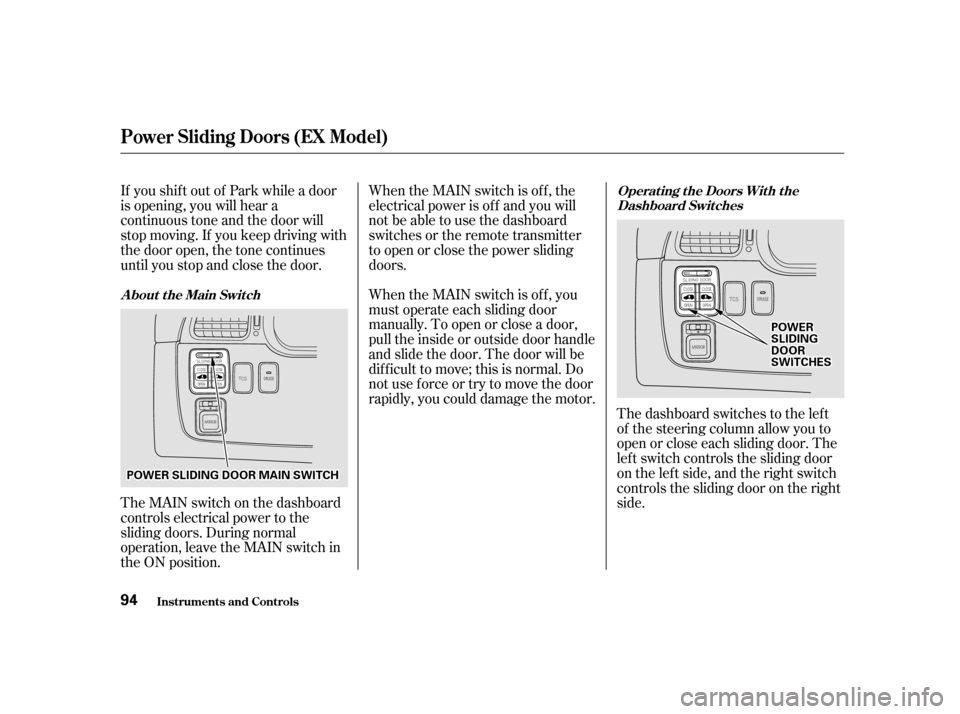
The MAIN switch on the dashboard
controls electrical power to the
sliding doors. During normal
operation, leave the MAIN switch in
the ON position.When the MAIN switch is off, the
electrical power is of f and you will
notbeabletousethedashboard
switches or the remote transmitter
to open or close the power sliding
doors.
When the MAIN switch is of f , you
must operate each sliding door
manually. To open or close a door,
pull the inside or outside door handle
and slide the door. The door will be
difficulttomove;thisisnormal.Do
not use f orce or try to move the door
rapidly, you could damage the motor.
The dashboard switches to the lef t
of the steering column allow you to
open or close each sliding door. The
lef t switch controls the sliding door
on the lef t side, and the right switch
controls the sliding door on the right
side.
Inst rument s and Cont rols
Power Sliding Doors (EX Model)
A bout t he Main Swit ch Operat ing t he Doors Wit h t he
Dashboard Switches
94
PPOOWWEERRSSLLIIDDIINNGGDDOOOORRSSWWIITTCCHHEESS
PPOOWWEERRSSLLIIDDIINNGGDDOOOORRMMAAIINNSSWWIITTCCHH
Page 156 of 363
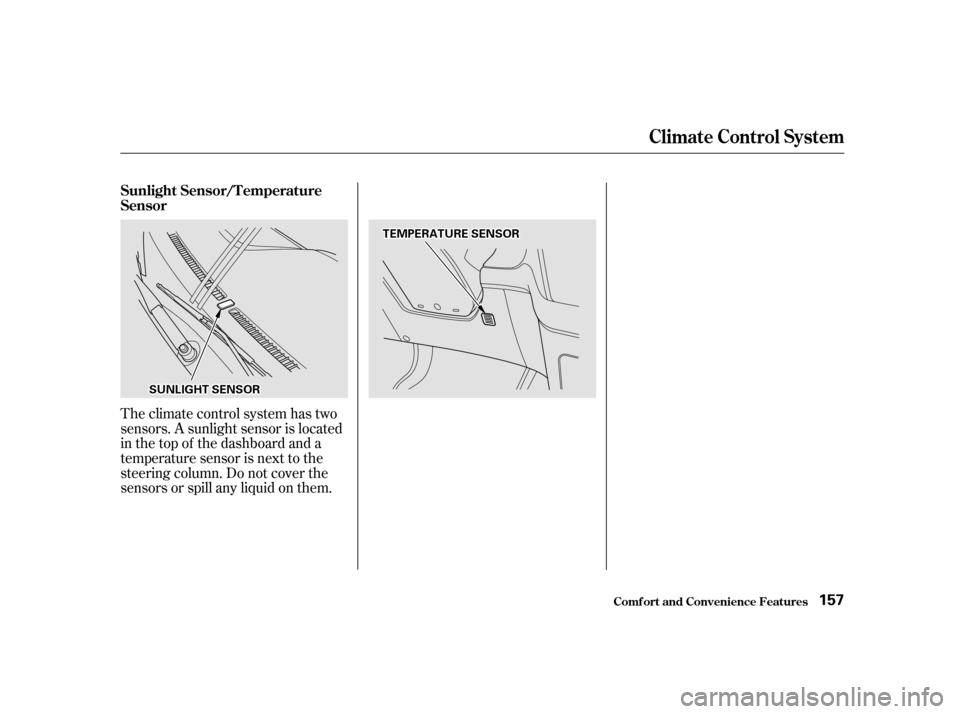
Theclimatecontrolsystemhastwo
sensors. A sunlight sensor is located
in the top of the dashboard and a
temperature sensor is next to the
steering column. Do not cover the
sensors or spill any liquid on them.
Sunlight Sensor/T emperature
Sensor
Climat e Cont rol Syst em
Comf ort and Convenience Feat ures
157
TTEEMMPPEERRAATTUURREESSEENNSSOORR
SSUUNNLLIIGGHHTTSSEENNSSOORR
Page 190 of 363
�Û�Ý
The top and bottom buttons adjust
thevolumeup( )ordown( ).
Press the proper button and hold it
until the desired volume is reached,
then release it.
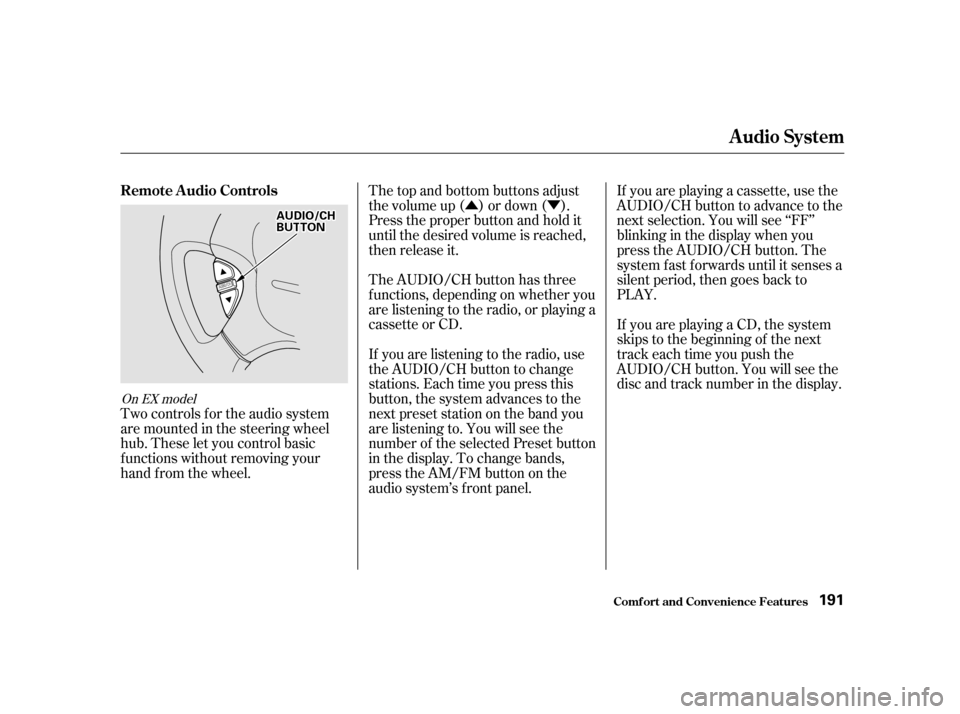
Two controls f or the audio system
are mounted in the steering wheel
hub. These let you control basic
f unctions without removing your
hand f rom the wheel. The AUDIO/CH button has three
f unctions, depending on whether you
are listening to the radio, or playing a
cassette or CD.
If you are playing a cassette, use the
AUDIO/CH button to advance to the
next selection. You will see ‘‘FF’’
blinking in the display when you
press the AUDIO/CH button. The
system f ast f orwards until it senses a
silent period, then goes back to
PLAY.
If youareplayingaCD,thesystem
skips to the beginning of the next
track each time you push the
AUDIO/CH button. You will see the
disc and track number in the display.
If you are listening to the radio, use
the AUDIO/CH button to change
stations. Each time you press this
button, the system advances to the
next preset station on the band you
are listening to. You will see the
number of the selected Preset button
in the display. To change bands,
press the AM/FM button on the
audio system’s f ront panel.
On EX model
Remote Audio Controls
Audio System
Comf ort and Convenience Feat ures
191
AAUUDDIIOO//CCHHBBUUTTTTOONN
Page 203 of 363

Do not remove any original
equipment or modif y your vehicle in
any way that would alter its design or
operation. This could make your
vehicle unsaf e and illegal to drive.
Such modif ications can adversely
af f ect handling, and interf ere with
the operation of the vehicle’s anti-
lock brakes and other systems.In addition, any modif ications that
decrease ground clearance increase
the chance of undercarriage parts
striking a curb, speed bump, or other
raised object, which could cause
your airbags to deploy.
Do not modif y your steering wheel
or any other part of your
Supplemental Restraint System.
Modif ications could make the
system inef f ective.
Any object attached to
or placed on the covers marked ‘‘SRS
AIRBAG,’’ in the center of the
steering wheel and on top of the
dashboard, could interf ere with the
proper operation of the airbags. Or,
if the airbags inf late, the objects
could be propelled inside the vehicle
and hurt someone.
For example, do not make any
modif ications that would change the
ride height of your vehicle, or install
wheels and tires with a dif f erent
overall diameter.
Modif ications
Additional Saf ety PrecautionDo not at t ach or place object s on t he
airbag covers.
A ccessories and Modif ications
Bef ore Driving
204
Page 209 of 363

Youshoulddothefollowingchecks
and adjustments every day bef ore
you drive your vehicle.Make sure all windows, mirrors,
and outside lights are clean and
unobstructed. Remove f rost, snow,
or ice. Check the adjustment of the seat
(see page ).
Check the adjustment of the
inside and outside mirrors (see
page ).
Check the adjustment of the
steering wheel (see page ).
Fasten your seat belt. Check that
your passengers have f astened
their seat belts (see page ).Turn the ignition switch ON (II).
Check the indicator lights in the
instrument panel.
Start the engine (see page ).
Check the gauges and indicator
lights in the instrument panel (see
page ).
Check that any items you may be
carrying with you inside are stored
properly or f astened down
securely.
Visually check the tires. If a tire
looks low, use a gauge to check its
pressure.
Check that the hood and tailgate
arefullyclosed. Makesurethedoorsandtailgate
are securely closed and locked.
3. 2.
1.
4. 5.
6. 7. 8. 9. 11.
12. 10.
15
105
121 76 211
61
Preparing to Drive
Driving
210
Page 214 of 363

�µ
�µ To shif t to Second,
pull the shif t lever towards you, then
shif t to the lower gear. This position
locks the transmission in second
gear. It does not downshif t to f irst
gear when you come to a stop.
Second gives you more power when
climbing, and increased engine
braking when going down steep hills.
Usesecondgearwhenstartingout
on a slippery surf ace or in deep snow.
It will help reduce wheelspin.
When driving down hill with a trailer,
use the Second position.
To shif t f rom Second to
First, pull the shift lever towards you,
then shift to the lower gear. With the
lever in this position, the transmis-
sion locks in First gear. By upshif t-
ing and downshif ting through 1, 2,
D and D , you can operate this
transmission much like a manual
transmission without a clutch pedal. If you exceed the maximum speed
f or the gear you are in, the engine
speed will enter into the tachometer’s
red zone. If this occurs, you may f eel
the engine cut in and out. This is
caused by a limiter in the engine’s
computer controls. The engine will
run normally when you reduce the
RPM below the red zone.
This allows you to move the shif t
lever out of Park if the normal
method of pushing on the brake
pedal and pulling the shif t lever does
not work.
Set the Parking brake.
Remove the key from the ignition
switch.
Place a cloth on the edge of the
shif t lock release slot cover on the
steering column. Remove the
cover by caref ully prying on the
edge with a small f lat-tipped
screwdriver (not included in the
tool kit).
1. 2. 3.
34
CONT INUED
Automatic Transmission
Driving
Second (2)
First (1)
Engine Speed Limiter Shift Lock Release
215
Page 217 of 363

The f ront disc brakes on all vehicles
have audible brake wear indicators.
When the brake pads need replacing,
you will hear a distinctive metallic
‘‘screeching’’ sound when you apply
the brakes. If you do not have the
brake pads replaced, they will begin
screeching all the time.
Your brakes may sometimes squeal
or squeak when you apply them
lightly. Do not conf use this with the
brake wear indicators. They make a
very audible ‘‘screeching.’’
Constant application of the brakes
when going down a long hill builds
up heat and reduces their ef f ective-
ness. Use the engine to assist the
brakes by downshif ting to a lower
gear and taking your f oot of f the
accelerator pedal.
Check your brakes af ter driving
through deep water. Apply the
brakes moderately to see if they f eel
normal. If not, apply them gently and
f requently until they do. Since a
longer distance is needed to stop
with wet brakes, be extra cautious
and alert in your driving.
Your Honda is equipped with f ront
disc brakes. The brakes on the rear
wheels are drum. A power assist
helps reduce the ef f ort needed on
thebrakepedal.TheABShelpsyou
retain steering control when braking
very hard.
Put your f oot on the brake pedal only
when you intend to brake. Resting
your f oot on the pedal keeps the
brakes applied lightly, causing them
to build up heat. Heat build-up can
reduce how well your brakes work. It
also keeps your brake lights on all
the time, conf using drivers behind
you. Brake Wear Indicators
Driving
The Braking System
218