Page 156 of 363
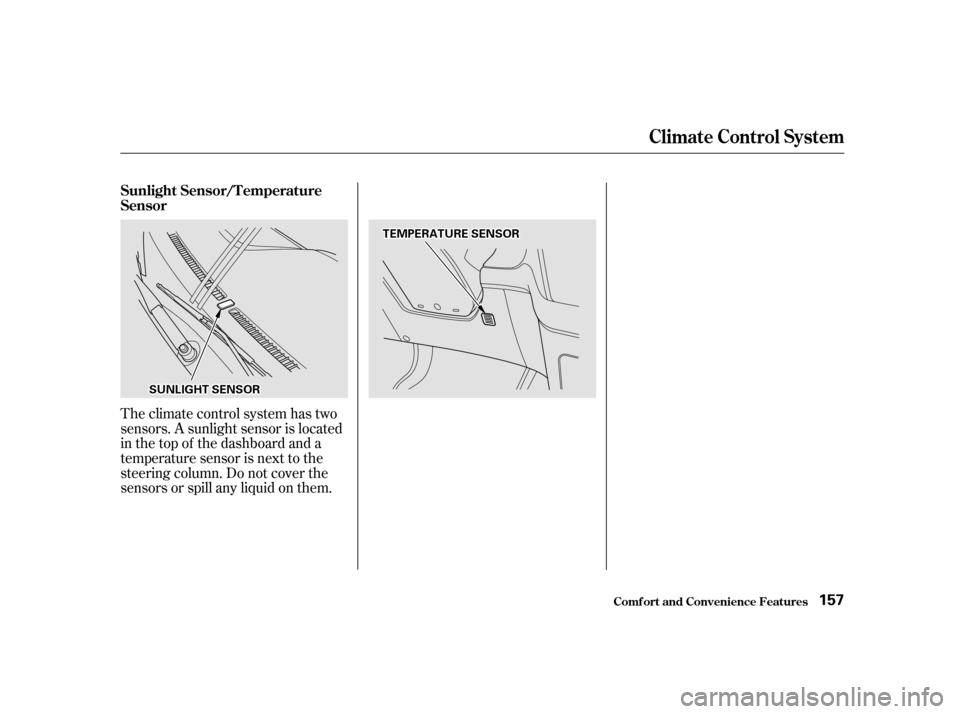
Theclimatecontrolsystemhastwo
sensors. A sunlight sensor is located
in the top of the dashboard and a
temperature sensor is next to the
steering column. Do not cover the
sensors or spill any liquid on them.
Sunlight Sensor/T emperature
Sensor
Climat e Cont rol Syst em
Comf ort and Convenience Feat ures
157
TTEEMMPPEERRAATTUURREESSEENNSSOORR
SSUUNNLLIIGGHHTTSSEENNSSOORR
Page 157 of 363
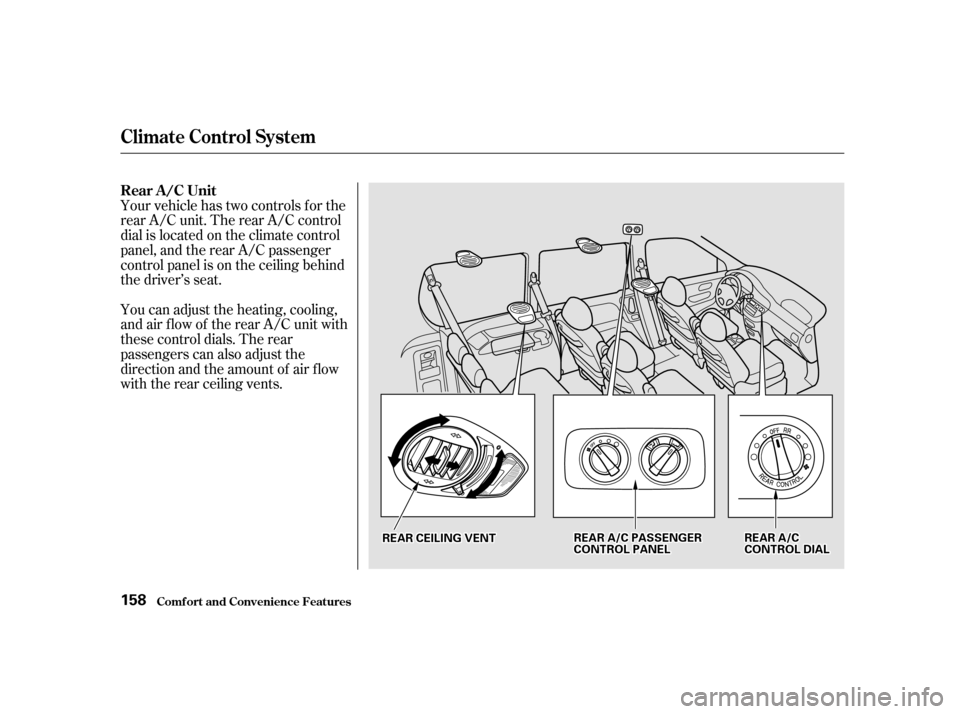
Your vehicle has two controls f or the
rear A/C unit. The rear A/C control
dial is located on the climate control
panel, and the rear A/C passenger
control panel is on the ceiling behind
the driver’s seat.
You can adjust the heating, cooling,
and air f low of the rear A/C unit with
these control dials. The rear
passengers can also adjust the
direction and the amount of air f low
with the rear ceiling vents.
Rear A/C Unit
Comf ort and Convenience Feat ures
Climat e Cont rol Syst em
158
RREEAARRAA//CCPPAASSSSEENNGGEERRCCOONNTTRROOLLPPAANNEELLRREEAARRCCEEIILLIINNGGVVEENNTTRREEAARRAA//CCCCOONNTTRROOLLDDIIAALL
Page 271 of 363
�µ�µ
The air conditioning f ilter removes
pollen and dust that is brought in
f rom the outside through the heating
and cooling system/climate control
system.
This f ilter should be replaced every
30,000 miles (48,000 km) under
normal conditions. It should be
replaced every 15,000 miles (24,000
km) if you drive primarily in urban
areas that have high concentrations
of soot in the air f rom industry and
diesel-powered vehicles. Replace it
more of ten if air f low f rom the
heating and cooling system/climate
control system becomes less than
usual. Have the air conditioning f ilter
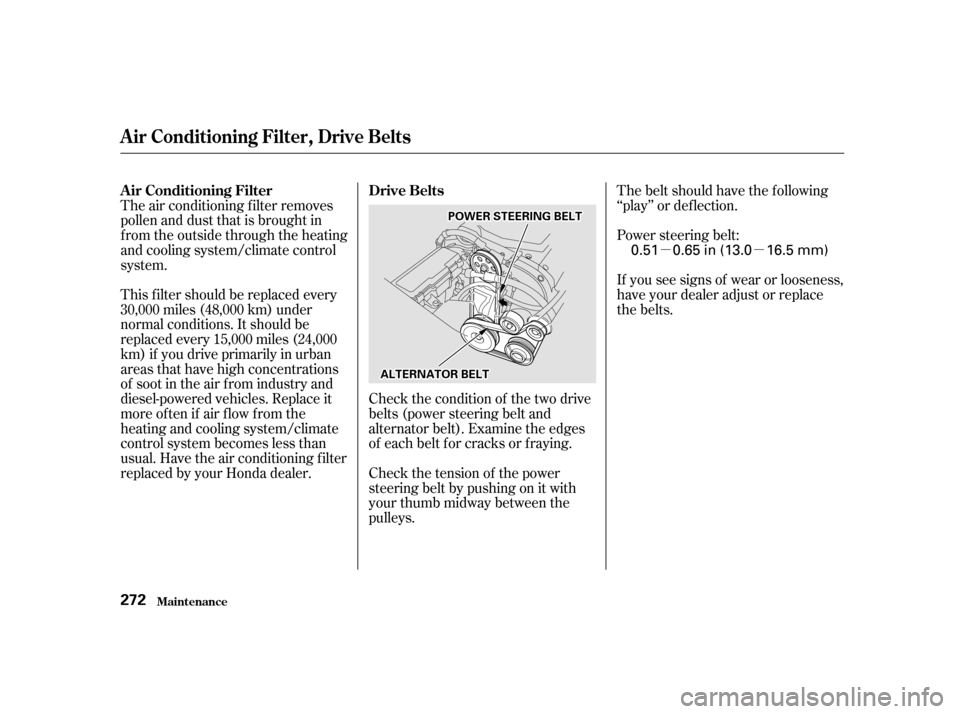
replaced by your Honda dealer. Check the condition of the two drive
belts (power steering belt and
alternator belt). Examine the edges
of each belt f or cracks or f raying.If you see signs of wear or looseness,
have your dealer adjust or replace
the belts.
Power steering belt:
Thebeltshouldhavethefollowing
‘‘play’’ or def lection.
Check the tension of the power
steering belt by pushing on it with
your thumb midway between the
pulleys.
Drive Belts
A ir Conditioning Filter
A ir Conditioning Filter, Drive Belts
Maint enance
272
PPOOWWEERRSSTTEEEERRIINNGGBBEELLTT
AALLTTEERRNNAATTOORRBBEELLTT 0.51 0.65 in (13.0 16.5 mm)
Page 312 of 363

To jump start your vehicle, f ollow
these directions closely:
If your vehicle’s battery has run
down, you may be able to start the
engine by using a booster battery.
Although this seems like a simple
procedure, you should take several
precautions.
Put the transmission in Neutral or
Park and set the parking brake.
In this case, the starter motor’s
speed sounds normal, or even f aster
than normal, when you turn the
ignition switch to START (III), but
the engine does not run.
Open the hood and check the
physical condition of the battery
(see page ). In very cold
weather, check the condition of
the electrolyte. If it seems slushy
or like ice, do not try jump starting
until it thaws.
You cannot start a Honda by pushing
or pulling it.
Are you using the proper starting
procedure? Ref er to
on page .
Do you have f uel? Turn the
ignition switch to ON (II) for a
minute and watch the f uel gauge.
The low f uel level warning light
may not be working, so you were
not reminded to f ill the tank.
There may be an electrical
problem, such as no power to the
f uel pump. Check all the f uses
(see page ). Turn of f all the electrical acces-
sories: heater, A/C, climate
control, stereo system, lights, etc.
If youfindnothingwrong,youwill
need a qualif ied technician to f ind
the problem. See on page . 1. 2.
211
323 329 267
CONT INUED
T he Starter Operates Normally Jump Starting
Starting the
Engine
Emergency
Towing
If Your Engine Won’t Start, Jump Starting
T aking Care of t he Unexpect ed 313
A battery can explode if you do
not follow the correct procedure,
seriously injuring anyonenearby.
Keep all sparks, open flames,
and smoking materials away
from the battery.
If a battery sits in extreme cold, the
electrolyte inside can f reeze.
Attempting to jump start with a f rozen
battery can cause it to rupture.
Page 315 of 363

Saf ely pull to the side of the road.
Put the transmission in Neutral or
Park and set the parking brake.
Turn of f the heating and cooling/
climate control system and all
otheraccessories.Turnonthe
hazard warning indicators.
If you see steam and/or spray
coming f rom under the hood, turn
of f the engine.If you do not see steam or spray,
leave the engine running and
watch the temperature gauge. If
the high heat is due to overloading
(climbing a long, steep hill on a
hot day with the A/C running, f or
example), the engine should start
to cool down almost immediately.
If it does, wait until the tempera-
ture gauge comes down to the mid-
point then continue driving.
If the temperature gauge stays at
the red mark, turn of f the engine.
Wait until you see no more signs
of steam or spray, then open thehood.Look f or any obvious coolant leaks,
such as a split radiator hose.
Everything is still extremely hot,
so use caution. If you f ind a leak, it
must be repaired bef ore you
continue driving (see
on page ).
If you don’t f ind an obvious leak,
check the coolant level in the
radiator reserve tank (see page ). If the level is below the
MIN mark, add coolant to halfway
between the MIN and MAX marks.
1. 2.
3.
7.
6.
5.
4. 329
201
If Your Engine Overheats
T aking Care of t he Unexpect ed Emergency
Towing
316
Page 316 of 363

If there was no coolant in the
reserve tank, you may also have to
add coolant to the radiator. Let the
engine cool down until the pointer
reaches the middle of the tempera-
ture gauge, or lower, bef ore check-
ing the radiator.Using gloves or a large heavy
cloth, turn the radiator cap
counterclockwise, without pushing
down, to the f irst stop. This
releases any remaining pressure in
the cooling system. After the
pressure releases, push down on
the cap and turn it until it comes
off.
Start the engine and set the
temperature control dial to
maximum (climate control to
FULL AUTO at 90°F/32°C). Add
coolant to the radiator up to the
base of the f iller neck. If you do
not have the proper coolant
mixture available, you can add
plain water. Remember to have
the cooling system drained and
ref illed with the proper mixture as
soon as you can.Put the radiator cap back on
tightly. Run the engine and watch
the temperature gauge. If it goes
back to the red mark, the engine
needs repair. (See
on page .)
If the temperature stays normal,
check the coolant level in the
radiator reserve tank. If it has
gone down, add coolant to the
MAX mark. Put the cap back on
tightly.
8.
9.
10. 12.
11.
329Emergency
Towing
If Your Engine Overheats
T aking Care of t he Unexpect ed 317
Removing the radiator cap
while the engine is hot can
cause the coolant to spray out,
seriously scalding you.
Always let the engine and
radiator cool down before
removing the radiator cap.
Page 318 of 363
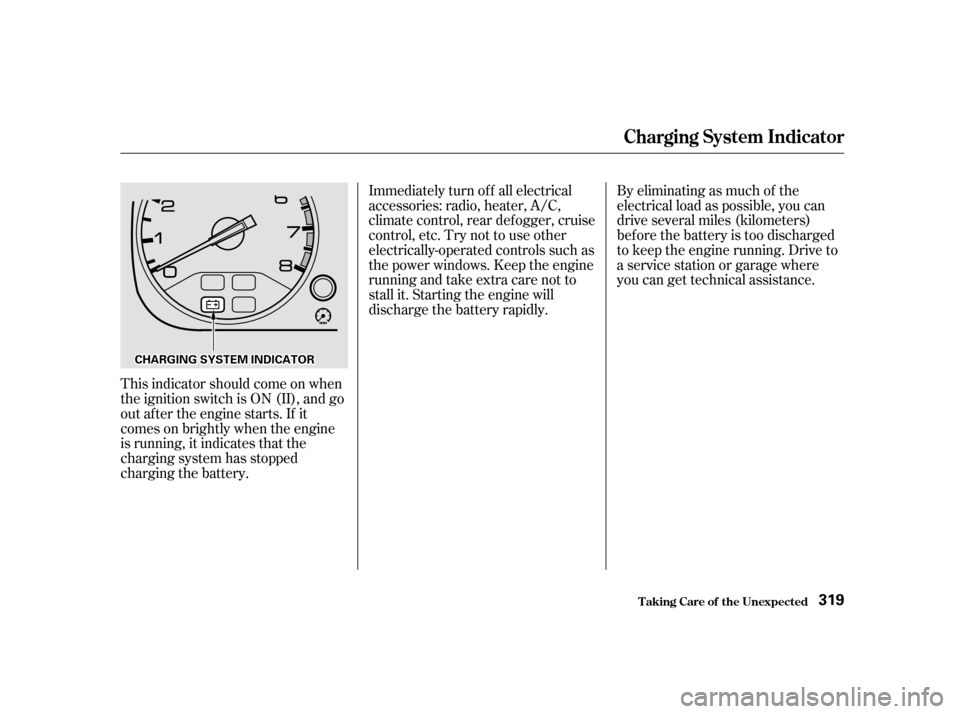
This indicator should come on when
the ignition switch is ON (II), and go
out af ter the engine starts. If it
comes on brightly when the engine
is running, it indicates that the
charging system has stopped
charging the battery.By eliminating as much of the
electrical load as possible, you can
drive several miles (kilometers)
before the battery is too discharged
to keep the engine running. Drive to
a service station or garage where
you can get technical assistance.
Immediately turn of f all electrical
accessories:radio,heater,A/C,
climate control, rear def ogger, cruise
control, etc. Try not to use other
electrically-operated controls such as
the power windows. Keep the engine
running and take extra care not to
stall it. Starting the engine will
discharge the battery rapidly.
Charging System Indicator
T aking Care of t he Unexpect ed
319
CCHHAARRGGIINNGGSSYYSSTTEEMMIINNDDIICCAATTOORR
Page 335 of 363

�µ
The treadwear grade is a compara-
tive rating based on the wear rate of
the tire when tested under controlled
conditions on a specif ied government
test course. For example, a tire
graded 150 would wear one and one-
half (1 1/2) times as well on the
government course as a tire graded
100. The relative perf ormance of
tires depends upon the actual condi-
tions of their use, however, and may
depart signif icantly f rom the norm
due to variations in driving habits,
service practices and dif f erences in
road characteristics and climate. The traction grades, f rom highest to
lowest, are AA, A, B, and C. Those
grades represent the tire’s ability to
stop on wet pavement as measured
under controlled conditions on
specif ied government test surf aces
of asphalt and concrete. A tire
marked C may have poor traction
perf ormance.
Warning: The traction grade
assignedtothistireisbasedon
straight-ahead braking traction tests,
and does not include acceleration,
cornering, hydroplaning, or peak
traction characteristics.
All passenger car tires must conf orm
to Federal Saf ety Requirements in
addition to these grades.
Quality grades can be f ound where
applicable on the tire sidewall
between the tread shoulder and the
maximum section width.
For example:
T echnical Inf ormation
DOT T ire Quality Grading (U.S. Vehicles)
T readwear
Unif orm T ire Quality Grading
DOT Quality Grades Traction AA, A, B, C
T readwear 200
Traction AA
Temperature A
336