Page 5 of 394
iii
Section
3
Comfort Controls and Audio Systems
Section
4
Your Driving and the Road
Section
5
Table of Contents (cont'd)
Your Driving, the Road and Your Vehicle
Defensive Driving
Drunken Driving
Control of a Vehicle
Braking
SteeringDriving Tips for Various Road Conditions
Off-Road Driving
Recreational Vehicle Towing
Loading Your Vehicle
Towing a Trailer Heating and Air Conditioning
Setting the Radio ClockRadio/Cassette Player/CD Player
Radio Theft-Deterrent Feature
Hazard Warning Flashers
Jump Starting
Towing Your VehicleEngine Overheating
Changing a Flat Tire
If You're Stuck
Problems on the Road
Page 157 of 394

2-70 Engine Coolant Temperature Gage
United States Canada
This gage shows the engine coolant temperature.
It also provides an indicator of how hard your vehicle is
working. During a majority of the operation, the gage
will read 210�F (100�C) or less. If you are pulling a
load or going up hills, it is normal for the temperature to
fluctuate and approach the 250�F (122�C) mark. If the
gage reaches the 260�F (125�C) mark, it indicates that
the cooling system is working beyond its capacity.
The ªProblems on the Road,º section of this manual
shows what to do. See ªEngine Overheatingº in
the Index.
Transmission Temperature Gage
United States Canada
When your ignition is on, the gage shows the temperature
of the transmission fluid. The normal operating range is
from 100�F (38�C) to about 265�F (130�C).
At approximately 265�F (130�C), the message center
will display a TRANS FLUID HOT message and the
transmission will enter a transmission protection mode.
When the transmission enters the protection mode, you
may notice a change in the transmission shifting
patterns. The transmission will return to normal shifting
patterns when the transmission fluid temperature falls
below 260�F (127�C).
See ªMessage Centerº in the Index for further information.
Page 167 of 394
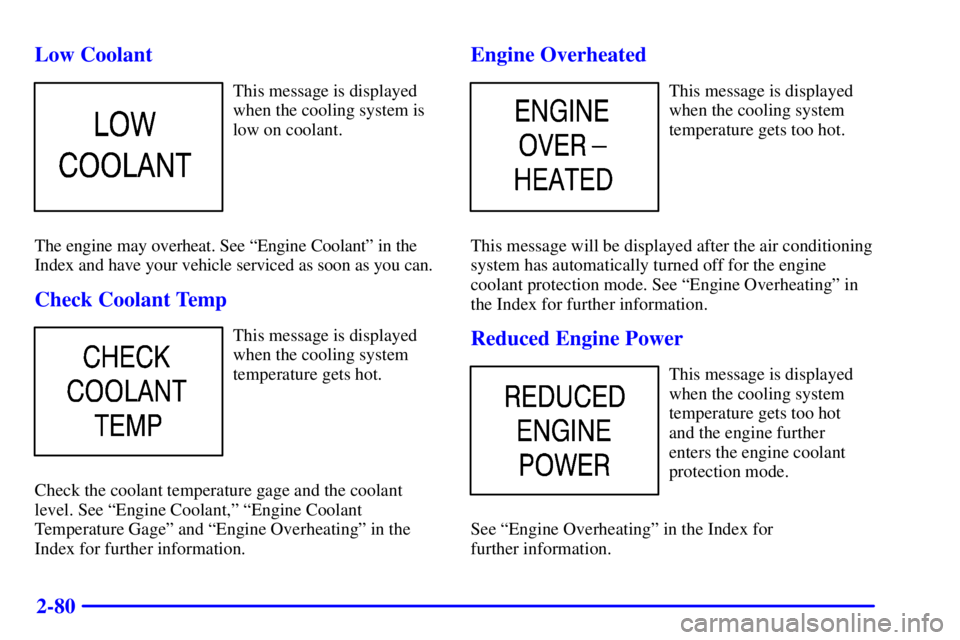
2-80 Low Coolant
This message is displayed
when the cooling system is
low on coolant.
The engine may overheat. See ªEngine Coolantº in the
Index and have your vehicle serviced as soon as you can.
Check Coolant Temp
This message is displayed
when the cooling system
temperature gets hot.
Check the coolant temperature gage and the coolant
level. See ªEngine Coolant,º ªEngine Coolant
Temperature Gageº and ªEngine Overheatingº in the
Index for further information.
Engine Overheated
This message is displayed
when the cooling system
temperature gets too hot.
This message will be displayed after the air conditioning
system has automatically turned off for the engine
coolant protection mode. See ªEngine Overheatingº in
the Index for further information.
Reduced Engine Power
This message is displayed
when the cooling system
temperature gets too hot
and the engine further
enters the engine coolant
protection mode.
See ªEngine Overheatingº in the Index for
further information.
Page 251 of 394
4-50 Making Turns
NOTICE:
Making very sharp turns while trailering could
cause the trailer to come in contact with the
vehicle. Your vehicle could be damaged. Avoid
making very sharp turns while trailering.
When you're turning with a trailer, make wider turns than
normal. Do this so your trailer won't strike soft shoulders,
curbs, road signs, trees or other objects. Avoid jerky or
sudden maneuvers. Signal well in advance.
Turn Signals When Towing a Trailer
The arrows on your instrument panel will flash
whenever you signal a turn or lane change. Properly
hooked up, the trailer lamps will also flash, telling other
drivers you're about to turn, change lanes or stop.
When towing a trailer, the arrows on your instrument
panel will flash for turns even if the bulbs on the trailer
are burned out. Thus, you may think drivers behind
you are seeing your signal when they are not. It's
important to check occasionally to be sure the trailer
bulbs are still working.
Driving On Grades
Reduce speed and shift to a lower gear before you start
down a long or steep downgrade. If you don't shift
down, you might have to use your brakes so much that
they would get hot and no longer work well.
You can tow in DRIVE (D). You may want to shift the
transmission to THIRD (3) or, if necessary, a lower gear
selection if the transmission shifts too often (e.g., under
heavy loads and/or hilly conditions).
You may also want to activate the tow/haul mode if the
transmission shifts too often. See ªTow/Haul Modeº in
the Index.
When towing at high altitude on steep uphill grades,
consider the following: Engine coolant will boil at a
lower temperature than at normal altitudes. If you turn
your engine off immediately after towing at high altitude
on steep uphill grades, your vehicle may show signs
similar to engine overheating. To avoid this, let the
engine run while parked (preferably on level ground)
with the automatic transmission in PARK (P) for a few
minutes before turning the engine off. If you do get
the overheat warning, see ªEngine Overheatingº in
the Index.
Page 255 of 394
5-
5-1
Section 5 Problems on the Road
Here you'll find what to do about some problems that can occur on the road.
5
-2 Hazard Warning Flashers
5
-2 Other Warning Devices
5
-3 Jump Starting
5
-8 Towing Your Vehicle
5
-8 Engine Overheating5
-11 Cooling System
5
-17 Engine Fan Noise
5
-17 If a Tire Goes Flat
5
-18 Changing a Flat Tire
5
-32 If You're Stuck: In Sand, Mud, Ice or Snow
Page 262 of 394
5-8
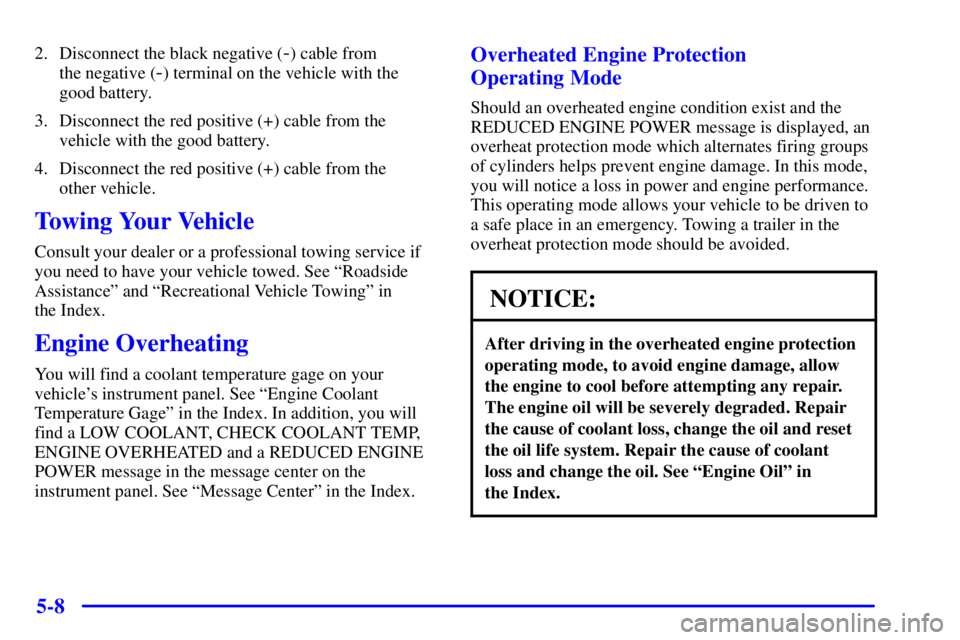
2. Disconnect the black negative (-) cable from
the negative (
-) terminal on the vehicle with the
good battery.
3. Disconnect the red positive (+) cable from the
vehicle with the good battery.
4. Disconnect the red positive (+) cable from the
other vehicle.
Towing Your Vehicle
Consult your dealer or a professional towing service if
you need to have your vehicle towed. See ªRoadside
Assistanceº and ªRecreational Vehicle Towingº in
the Index.
Engine Overheating
You will find a coolant temperature gage on your
vehicle's instrument panel. See ªEngine Coolant
Temperature Gageº in the Index. In addition, you will
find a LOW COOLANT, CHECK COOLANT TEMP,
ENGINE OVERHEATED and a REDUCED ENGINE
POWER message in the message center on the
instrument panel. See ªMessage Centerº in the Index.
Overheated Engine Protection
Operating Mode
Should an overheated engine condition exist and the
REDUCED ENGINE POWER message is displayed, an
overheat protection mode which alternates firing groups
of cylinders helps prevent engine damage. In this mode,
you will notice a loss in power and engine performance.
This operating mode allows your vehicle to be driven to
a safe place in an emergency. Towing a trailer in the
overheat protection mode should be avoided.
NOTICE:
After driving in the overheated engine protection
operating mode, to avoid engine damage, allow
the engine to cool before attempting any repair.
The engine oil will be severely degraded. Repair
the cause of coolant loss, change the oil and reset
the oil life system. Repair the cause of coolant
loss and change the oil. See ªEngine Oilº in
the Index.
Page 312 of 394
6-24
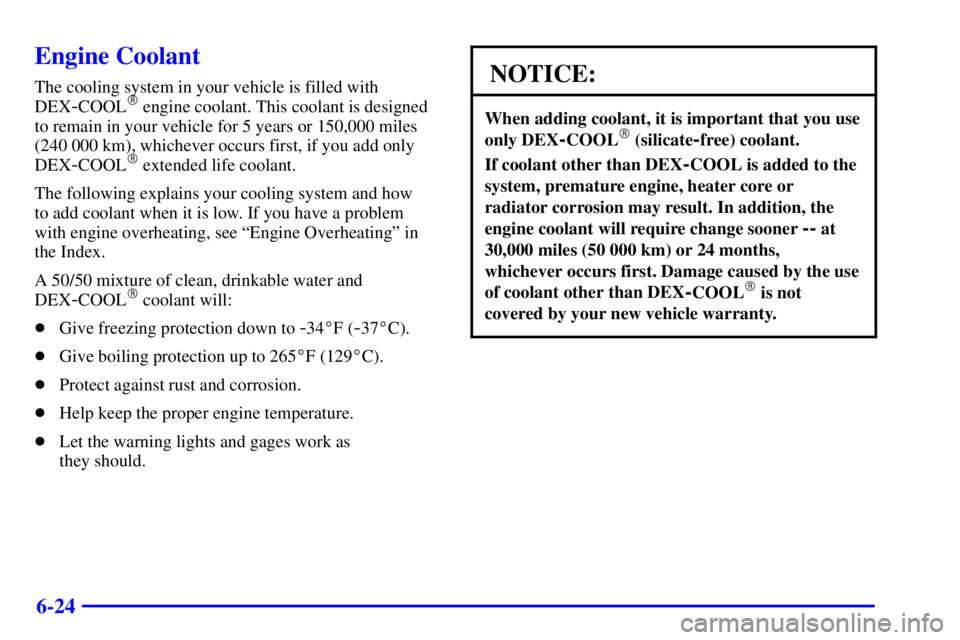
Engine Coolant
The cooling system in your vehicle is filled with
DEX
-COOL� engine coolant. This coolant is designed
to remain in your vehicle for 5 years or 150,000 miles
(240 000 km), whichever occurs first, if you add only
DEX
-COOL� extended life coolant.
The following explains your cooling system and how
to add coolant when it is low. If you have a problem
with engine overheating, see ªEngine Overheatingº in
the Index.
A 50/50 mixture of clean, drinkable water and
DEX
-COOL� coolant will:
�Give freezing protection down to
-34�F (-37�C).
�Give boiling protection up to 265�F (129�C).
�Protect against rust and corrosion.
�Help keep the proper engine temperature.
�Let the warning lights and gages work as
they should.
NOTICE:
When adding coolant, it is important that you use
only DEX
-COOL� (silicate-free) coolant.
If coolant other than DEX-COOL is added to the
system, premature engine, heater core or
radiator corrosion may result. In addition, the
engine coolant will require change sooner
-- at
30,000 miles (50 000 km) or 24 months,
whichever occurs first. Damage caused by the use
of coolant other than DEX
-COOL� is not
covered by your new vehicle warranty.
Page 315 of 394
6-27
Adding Coolant
If you need more coolant, add the proper DEX
-COOL�
coolant mixture at the surge tank, but only when the
engine is cool.
CAUTION:
You can be burned if you spill coolant on hot
engine parts. Coolant contains ethylene glycol,
and it will burn if the engine parts are hot
enough. Don't spill coolant on a hot engine.
When replacing the pressure cap, make sure it
is hand
-tight.
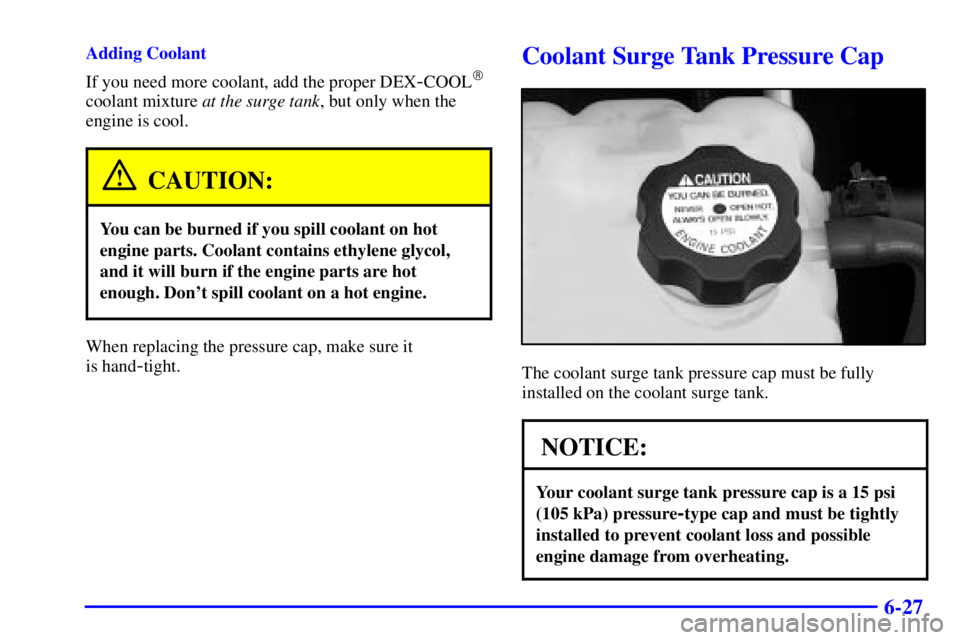
Coolant Surge Tank Pressure Cap
The coolant surge tank pressure cap must be fully
installed on the coolant surge tank.
NOTICE:
Your coolant surge tank pressure cap is a 15 psi
(105 kPa) pressure
-type cap and must be tightly
installed to prevent coolant loss and possible
engine damage from overheating.