Page 4 of 394
ii
Table of Contents
Windows
Keys and Door Locks
Keyless Entry System
Liftgate
Automatic Transmission Operation
All-Wheel Drive
Parking Brake
Tilt Wheel
Turn Signal/Multifunction Lever
Windshield WipersCruise Control
Exterior and Interior Lamps
Mirrors
Storage Compartments
Convenience Net/Luggage Carrier
Accessory Power Outlets
OnStar® System (If Equipped)
Sunroof (If Equipped)
HomeLink® Transmitter
Instrument Panel, Warning Lights and Gages Seats and Seat Controls
Safety BeltsAir Bag Systems
Restraint Systems for Children
Section
1
Section
2
Seats and Restraint Systems
Features and Controls
Page 49 of 394

1-36
The best way to protect the fetus is to protect the
mother. When a safety belt is worn properly, it's more
likely that the fetus won't be hurt in a crash. For
pregnant women, as for anyone, the key to making
safety belts effective is wearing them properly.
Right Front Passenger Position
To learn how to wear the right front passenger's
safety belt properly, see ªDriver Positionº earlier
in this section.
The right front passenger's safety belt works the same
way as the driver's safety belt
-- except for one thing.
If you ever pull the shoulder portion of the belt out all
the way, you will engage the child restraint locking
feature. If this happens, just let the belt go back all the
way and start again.
Air Bag Systems
This part explains the frontal and side impact air
bag systems.
Your vehicle has four air bags
-- a frontal air bag for
the driver, another frontal air bag for the right front
passenger, a side impact air bag for the driver, and
another side impact air bag for the right front passenger.Frontal air bags are designed to help reduce the risk of
injury from the force of an inflating frontal air bag. But
these air bags must inflate very quickly to do their job
and comply with federal regulations.
Here are the most important things to know about the
air bag systems:
CAUTION:
You can be severely injured or killed in a crash if
you aren't wearing your safety belt
-- even if you
have air bags. Wearing your safety belt during a
crash helps reduce your chance of hitting things
inside the vehicle or being ejected from it. Air
bags are designed to work with safety belts but
don't replace them.
CAUTION: (Continued)
Page 57 of 394

1-44 Servicing Your Air Bag-Equipped Vehicle
Air bags affect how your vehicle should be serviced.
There are parts of the air bag systems in several places
around your vehicle. Your dealer and the service manual
have information about servicing your vehicle and the
air bag systems. To purchase a service manual, see
ªService and Owner Publicationsº in the Index.
CAUTION:
For up to 10 minutes after the ignition key is
turned off and the battery is disconnected, an air
bag can still inflate during improper service. You
can be injured if you are close to an air bag when
it inflates. Avoid yellow connectors. They are
probably part of the air bag systems. Be sure to
follow proper service procedures, and make sure
the person performing work for you is qualified
to do so.
The air bag systems do not need regular maintenance.
Adding Equipment to Your Air
Bag-Equipped Vehicle
Q:If I add a push bumper or bicycle rack to the
front of my vehicle, will it keep the air bags
from working properly?
A:As long as the push bumper or bicycle rack is
attached to your vehicle so that the vehicle's basic
structure isn't changed, it's not likely to keep the
air bags from working properly in a crash.
Q:Is there anything I might add to the front or
sides of the vehicle that could keep the air bags
from working properly?
A:Yes. If you add things that change your vehicle's
frame, bumper system, front end or side sheet
metal or height, they may keep the air bag system
from working properly. Also, the air bag system
may not work properly if you relocate any of the
air bag sensors. If you have any questions about
this, you should contact Customer Assistance
before you modify your vehicle. The phone
numbers and addresses for Customer Assistance
are in Step Two of the Customer Satisfaction
Procedure in this manual. See ªCustomer
Satisfaction Procedureº in the Index.
Page 88 of 394

2-
2-1
Section 2 Features and Controls
Here you can learn about the many standard and optional features on your vehicle, and information on starting,
shifting and braking. Also explained are the instrument panel and the warning systems that tell you if everything is
working properly
-- and what to do if you have a problem.
2
-2 Windows
2
-4 Keys
2
-6 Door Locks
2
-8 Keyless Entry System
2
-12 Liftgate/Liftgate Glass
2
-12 Theft
2
-14 Content Theft-Deterrent
2
-15 Passlock�
2-16 New Vehicle ªBreak Inº
2
-16 Ignition Positions
2
-17 Starting Your Engine
2
-19 Engine Coolant Heater (If Equipped)
2
-20 Automatic Transmission Operation
2
-23 Parking Brake
2
-24 Shifting Into PARK (P)
2
-27 Shifting Out of PARK (P)
2
-27 Parking Over Things That Burn
2
-28 Engine Exhaust2
-28 Running Your Engine While You're Parked
2
-30 Locking Rear Axle
2
-30 All-Wheel Drive
2
-30 Tilt Wheel
2
-31 Turn Signal/Multifunction Lever
2
-37 Exterior Lamps
2
-40 Interior Lamps
2
-42 Mirrors
2
-46 Storage Compartments
2
-53 OnStar� System (If Equipped)
2
-57 Sunroof (If Equipped)
2
-58 HomeLink� Transmitter
2
-62 The Instrument Panel - Your
Information System
2
-64 Instrument Panel Cluster
2
-65 Warning Lights, Gages and Indicators
2
-77 Message Center
2
-83 Secondary Information Center (SIC)
Page 91 of 394
2-4
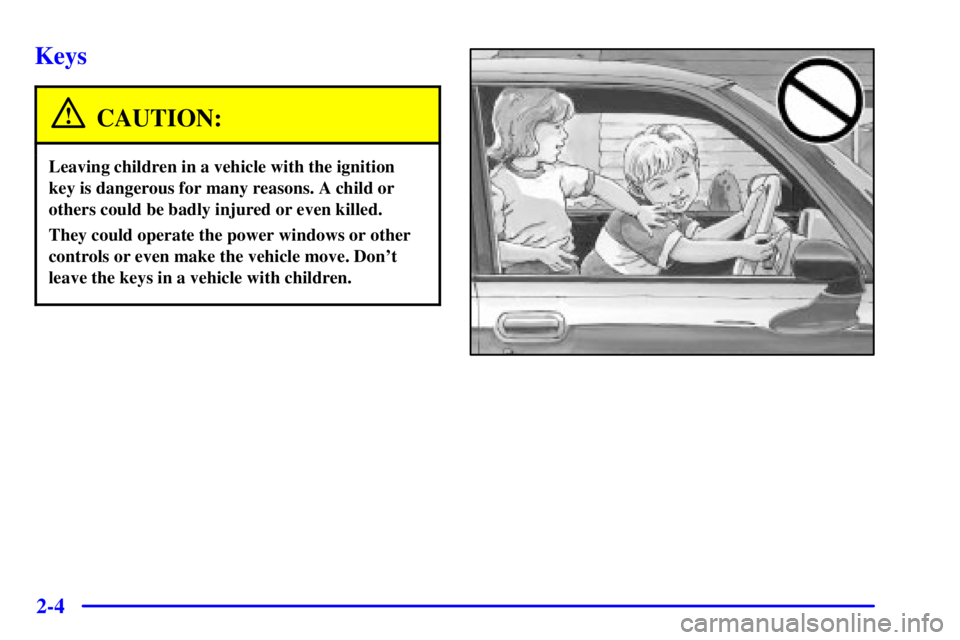
Keys
CAUTION:
Leaving children in a vehicle with the ignition
key is dangerous for many reasons. A child or
others could be badly injured or even killed.
They could operate the power windows or other
controls or even make the vehicle move. Don't
leave the keys in a vehicle with children.
Page 92 of 394
2-5
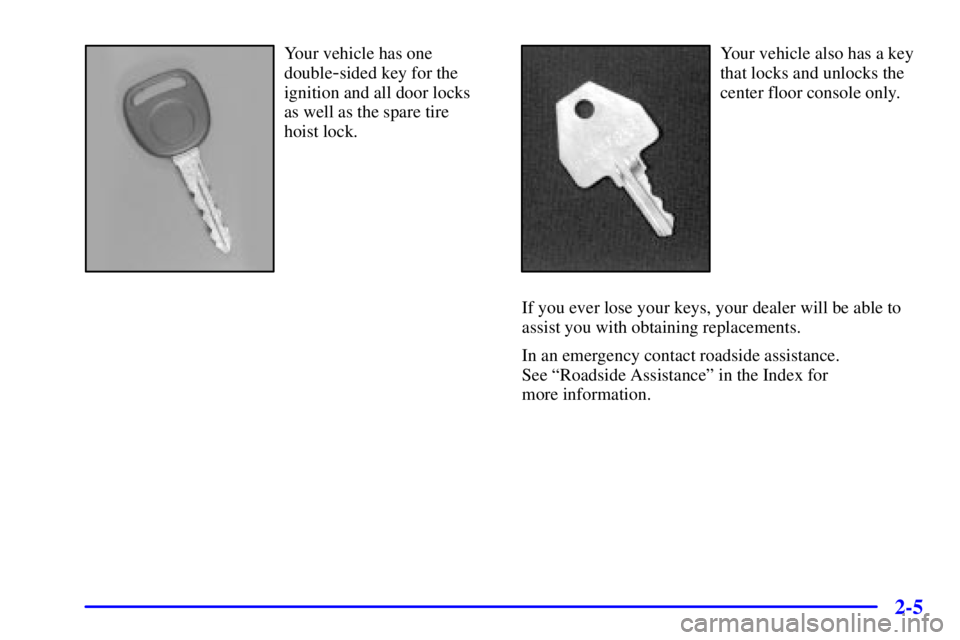
Your vehicle has one
double
-sided key for the
ignition and all door locks
as well as the spare tire
hoist lock.
Your vehicle also has a key
that locks and unlocks the
center floor console only.
If you ever lose your keys, your dealer will be able to
assist you with obtaining replacements.
In an emergency contact roadside assistance.
See ªRoadside Assistanceº in the Index for
more information.
Page 93 of 394
2-6
Door Locks
CAUTION:
Unlocked doors can be dangerous.
�Passengers -- especially children -- can
easily open the doors and fall out of a
moving vehicle. When a door is locked, the
handle won't open it. You increase the
chance of being thrown out of the vehicle in
a crash if the doors aren't locked. So, wear
safety belts properly and lock the doors
whenever you drive.
�Young children who get into unlocked
vehicles may be unable to get out. A child
can be overcome by extreme heat and can
suffer permanent injuries or even death
from heat stroke. Always lock your vehicle
whenever you leave it.
�Outsiders can easily enter through an
unlocked door when you slow down or stop
your vehicle. Locking your doors can help
prevent this from happening.
There are several ways to lock and unlock your vehicle.
Use the keyless entry system.
You can also use your key.
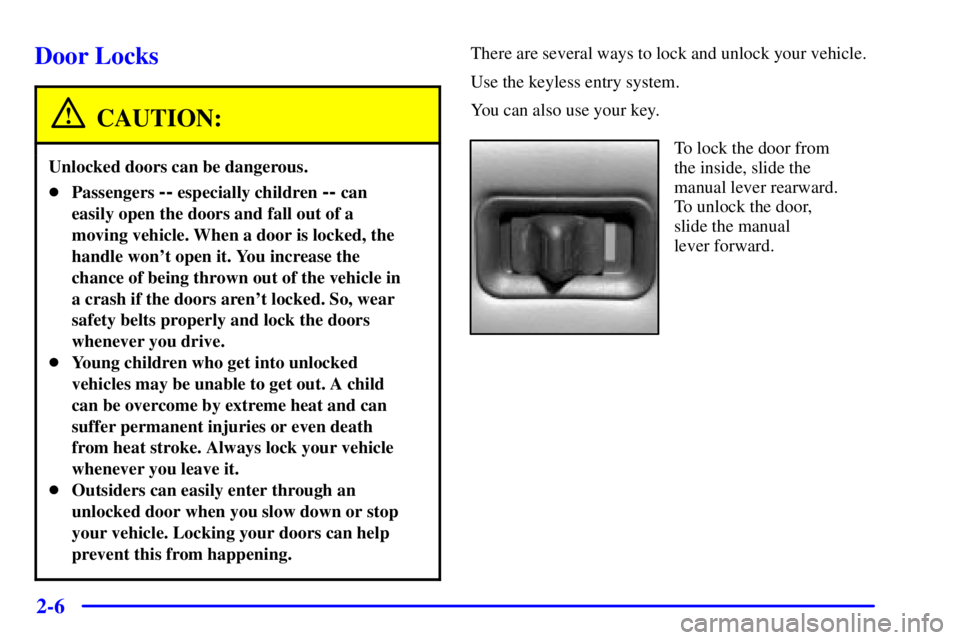
To lock the door from
the inside, slide the
manual lever rearward.
To unlock the door,
slide the manual
lever forward.
Page 94 of 394

2-7 Power Door Locks
Press the raised side of the
switch, marked ªLº on
either front door to lock
all the doors at once.
Press the recessed side of the switch marked ªUº to
unlock all the doors at once.
On the passenger side of the
liftgate opening trim there is
a power lock switch which
can be used to lock or
unlock all of the doors.The power door locks will operate at any time without
the ignition being on.
If the rear lock switch is pressed with the rear doors
open, all of the doors will lock five seconds after the
cargo doors are closed.
The power door locks can be programmed to
automatically lock and unlock depending on the settings
you have chosen in the secondary information center
(SIC). See ªSecondary Information Centerº in the Index
for more information.
Operating the power locks may interact with the
theft
-deterrent system. See ªContent Theft-Deterrentº
in the Index.
Lockout Prevention
This feature protects you from locking your key in
the vehicle when the key is in the ignition and a door
is open.
If the power lock switch is pressed when a door is open
and the key is in the ignition, all of the doors will lock
and then the driver's door will unlock.