2001 FORD F650 engine oil
[x] Cancel search: engine oilPage 161 of 240

Engine oil and filter recommendationsÐCummins B and Caterpillar
3126 B engines
Refer to the appropriate engine operator's manual for information on the
engine oil.
Engine oil and filter recommendationsÐ7.3L Power Stroke engine
To help achieve proper engine performance and durability, it is important
that you:
²Use only engine lubricating oils and oil filters of the proper quality.
²Change the engine oil and filterno laterthan the recommended
service interval. Refer to the Scheduled Maintenance Guide for the
appropriate intervals for changing the engine oil and filter.
²Change your engine oil and filter more frequently if your vehicle
operation includes extended periods of idling or low-speed operation,
driving for a long time in cold temperatures or short driving distances.
Diesel engines require specially formulated oil to resist contamination.
Proper quality oils also provide maximum efficiency of the crankcase
ventilation system which reduces air pollution.
Use Motorcraft motor oil or an equivalent oil meeting Ford specification
WSS-M2C171±C or API service category designation CH-4/SJ. Do not use
oils labeled with only one of the category designations SG, SH, SJ, CE,
CF-4, CH-4 or CG-4, as they could cause engine damage.
Diesel engine oils with improved fuel economy properties (energy
conserving) are currently available. If you use an energy conserving oil,
be sure it meets Ford specification WSS-M2C171±C or API service
category designation CH-4/SJ and is of the proper viscosity grade for the
temperature range in which you expect to operate your vehicle. Some
energy conserving oils do not meet the requirements necessary for your
diesel engine.
Maintenance and care
161
Page 162 of 240
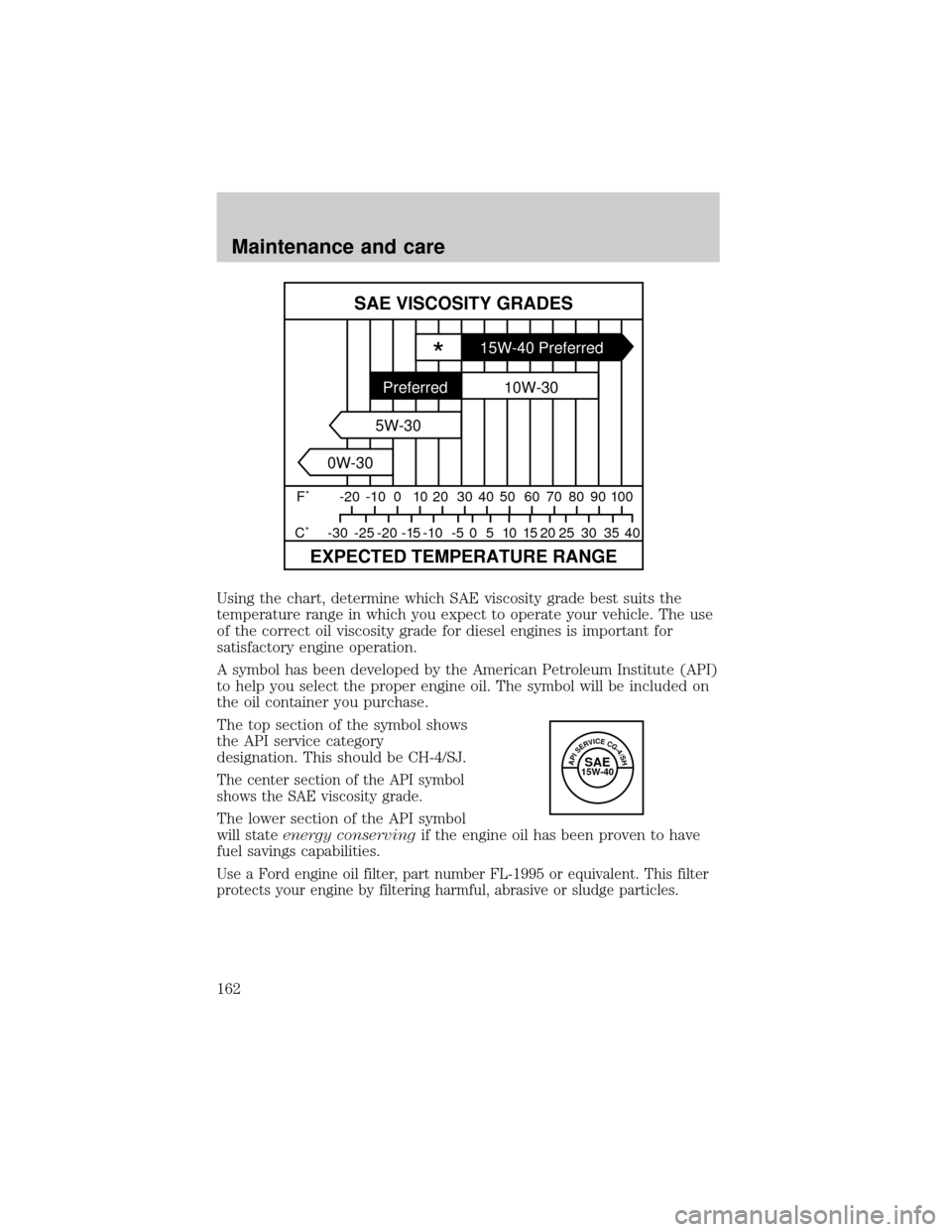
Using the chart, determine which SAE viscosity grade best suits the
temperature range in which you expect to operate your vehicle. The use
of the correct oil viscosity grade for diesel engines is important for
satisfactory engine operation.
A symbol has been developed by the American Petroleum Institute (API)
to help you select the proper engine oil. The symbol will be included on
the oil container you purchase.
The top section of the symbol shows
the API service category
designation. This should be CH-4/SJ.
The center section of the API symbol
shows the SAE viscosity grade.
The lower section of the API symbol
will stateenergy conservingif the engine oil has been proven to have
fuel savings capabilities.
Use a Ford engine oil filter, part number FL-1995 or equivalent. This filter
protects your engine by filtering harmful, abrasive or sludge particles.
SAE VISCOSITY GRADES
EXPECTED TEMPERATURE RANGE
F˚ -20 -10 0 10 20 30 40
40 35 30 25 20 15 10 5 0 -5 -10 -15 -20 -25 -30 C˚50 60 70 80 90 100
*15W-40 Preferred
10W-30
5W-30
0W-30Preferred
APISERVICECG-4/SHSAE15W-40
Maintenance and care
162
Page 167 of 240

Adding and replacing engine coolant-7.3L Power Stroke Cummins
B and Caterpillar 3126 B engines
Refer to the Scheduled Maintenance Guide for service intervals of the
engine cooling system.
Use Ford Premium Engine Coolant E2FZ-19549±AA (in Canada,
MotorcraftCXC-10 ) or a premium engine coolant that meets Ford
specification ESE-M97B44±A. Do not use alcohol or methanol antifreeze.
The use of an improper coolant may cause cooling system and/or engine
damage and may void the warranty of your vehicle's engine cooling
system.
A mixture of 50% engine coolant concentrate and 50% water (50/50
ratio) is recommended to maintain best overall cooling system
performance. A 60/40 antifreeze to water ratio is acceptable for
extremely cold climates, but the coolant and water mixture must be
returned to a 50/50 ratio at the end of the winter season. To avoid
damaging the cooling system and engine, the coolant and water mixture
should never exceed a 60/40 antifreeze to water ratio.
Operating the engine with insufficient coolant can cause severe
cooling system and engine damage.
When refilling the engine cooling system as part of regular maintenance
or due to service, adhere to the following instructions:
1. Drain and flush the cooling system to remove dirt deposits, oil and
rust particles. Always dispose of used automotive fluids following your
community's standards.
2. Fill the coolant reservoir with the specified coolant and water mixture
until the level stabilizes within the cold fill range.
3. Reinstall the coolant reservoir cap.
4. Start and idle the engine until the upper radiator hose is warm
(approximately 10±15 minutes). If the hose does not get warm, repeat
this step at a higher engine speed.
5. Once the hose is warm, shut the engine off.
6. Cautiously remove the coolant reservoir cap as previously described,
and add the specified coolant and water mixture until the level stabilizes
within the cold fill range of the coolant reservoir.
7. Reinstall the engine coolant reservoir cap.
Maintenance and care
167
Page 179 of 240
SERVICING YOUR WHEELS AND TIRES
Wheel assembly
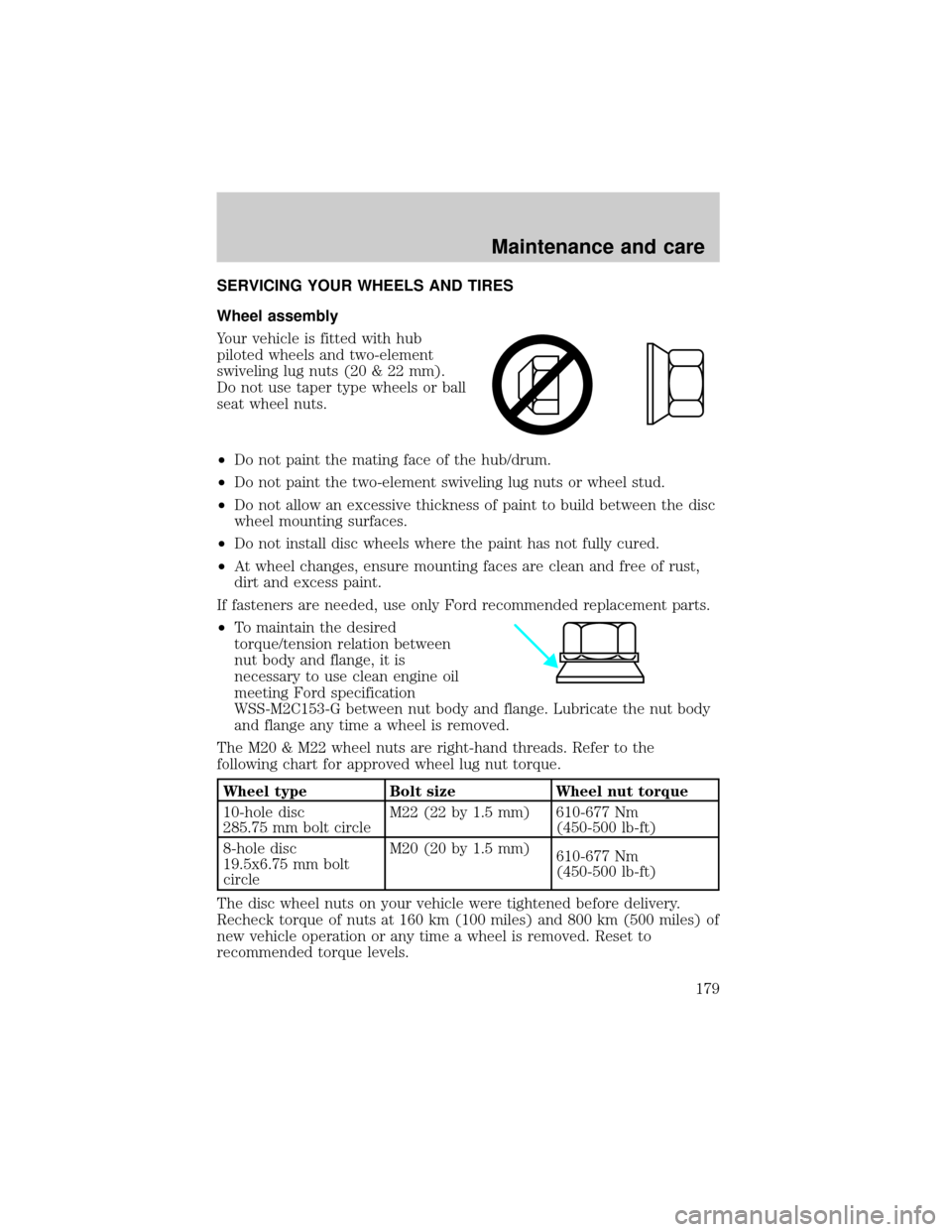
Your vehicle is fitted with hub
piloted wheels and two-element
swiveling lug nuts (20 & 22 mm).
Do not use taper type wheels or ball
seat wheel nuts.
²Do not paint the mating face of the hub/drum.
²Do not paint the two-element swiveling lug nuts or wheel stud.
²Do not allow an excessive thickness of paint to build between the disc
wheel mounting surfaces.
²Do not install disc wheels where the paint has not fully cured.
²At wheel changes, ensure mounting faces are clean and free of rust,
dirt and excess paint.
If fasteners are needed, use only Ford recommended replacement parts.
²To maintain the desired
torque/tension relation between
nut body and flange, it is
necessary to use clean engine oil
meeting Ford specification
WSS-M2C153-G between nut body and flange. Lubricate the nut body
and flange any time a wheel is removed.
The M20 & M22 wheel nuts are right-hand threads. Refer to the
following chart for approved wheel lug nut torque.
Wheel type Bolt size Wheel nut torque
10-hole disc
285.75 mm bolt circleM22 (22 by 1.5 mm) 610-677 Nm
(450-500 lb-ft)
8-hole disc
19.5x6.75 mm bolt
circleM20 (20 by 1.5 mm)
610-677 Nm
(450-500 lb-ft)
The disc wheel nuts on your vehicle were tightened before delivery.
Recheck torque of nuts at 160 km (100 miles) and 800 km (500 miles) of
new vehicle operation or any time a wheel is removed. Reset to
recommended torque levels.
Maintenance and care
179
Page 185 of 240
Choosing the right fuel
At operating temperatures below 0ÉC (32ÉF), use a blend of No. 1D and
No. 2D Diesel fuels, also known as winterized No. 2D.
Do not use diesel fuel blended with waste oil in engines equipped with a
catalytic converter-muffler. Blending waste oil in with the fuel will plug
the catalytic converter-muffler, resulting in a significant loss of engine
power. Your emissions warranty will be voided if blending waste oil with
diesel fuel is practiced.
Use low sulfur (less than 0.05% by weight) fuel as required by the EPA
for emission compliance.
Do not mix diesel fuel with gasoline, gasohol or alcohol. This
could cause an explosion resulting in personal injury.
Do not use starting fluid such as ether or gasoline. Such fluids
can cause immediate explosive damage to the engine and
possible personal injury.
Running out of fuel
Avoid running out of fuel as this will allow air to enter the fuel system,
which will make restarting the vehicle difficult.
If you have run out of fuel:
²If your vehicle is equipped with dual fuel tanks,add at least
15±19 liters (4±5 gallons) of fuel to each tank before attempting to
restart the engine.
²If your vehicle is equipped with the Caterpillar 3126 B engine,
the fuel system must be primed before attempting to restart the
engine. Refer to the engine operator's manual for instructions on
priming the engine.
²Use caution not to overheat and damage the starterby cranking
the engine for an excessive period of time. You may need to crank the
engine for a longer time than normal. If the engine fails to start in 30
seconds, turn the ignition to the OFF position and wait for two
minutes before cranking the engine again.
²Any remaining trapped air will self-purge from the fuel system once
the engine starts running.
²
The engine may run rough and produce white smoke while air is in the
fuel system. This is normal and should stop after a short period of time.
Maintenance and care
185
Page 187 of 240
Draining the fuel filter/water separatorÐCummins B engine
Refer to your engine operator's manual for service procedures.
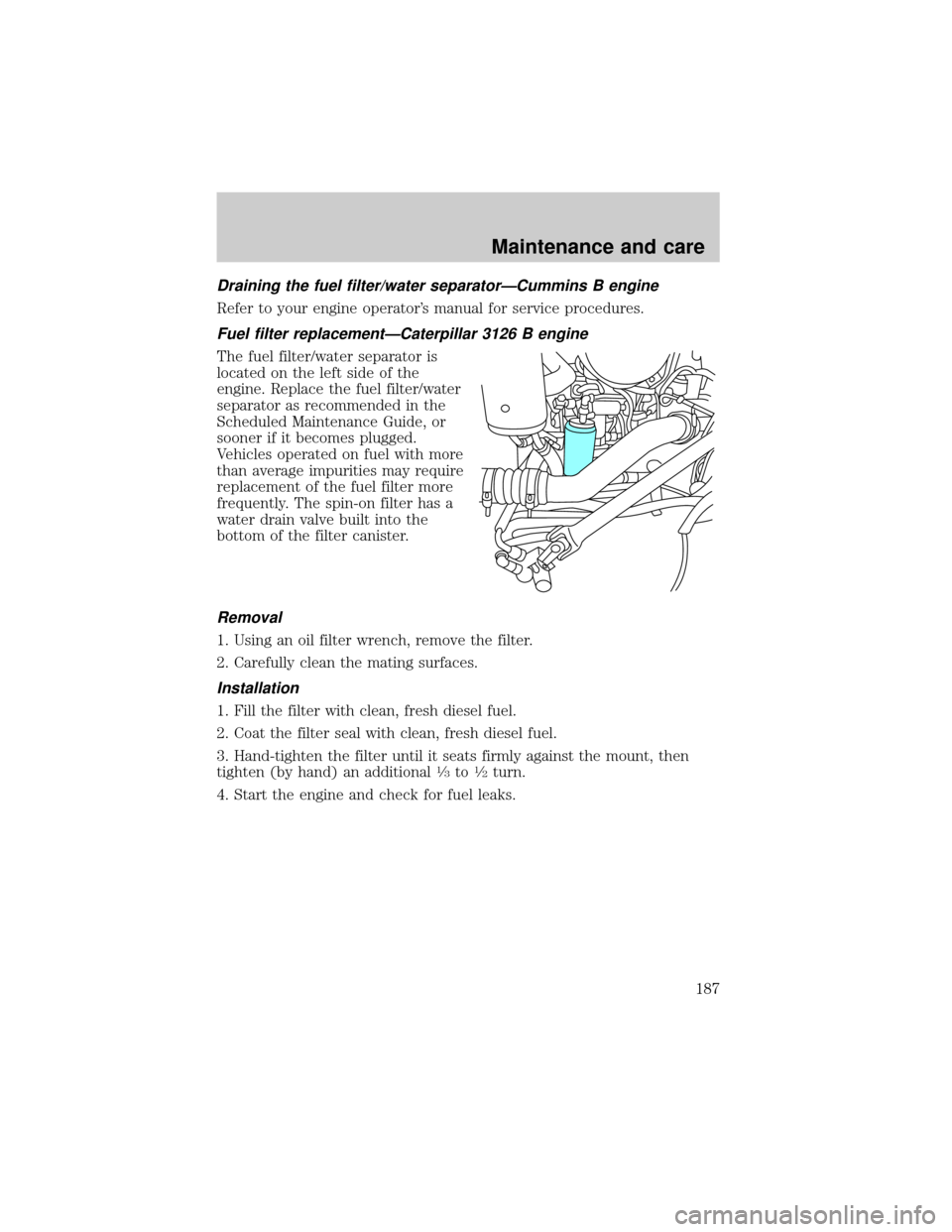
Fuel filter replacementÐCaterpillar 3126 B engine
The fuel filter/water separator is
located on the left side of the
engine. Replace the fuel filter/water
separator as recommended in the
Scheduled Maintenance Guide, or
sooner if it becomes plugged.
Vehicles operated on fuel with more
than average impurities may require
replacement of the fuel filter more
frequently. The spin-on filter has a
water drain valve built into the
bottom of the filter canister.
Removal
1. Using an oil filter wrench, remove the filter.
2. Carefully clean the mating surfaces.
Installation
1. Fill the filter with clean, fresh diesel fuel.
2. Coat the filter seal with clean, fresh diesel fuel.
3. Hand-tighten the filter until it seats firmly against the mount, then
tighten (by hand) an additional
1¤3to1¤2turn.
4. Start the engine and check for fuel leaks.
Maintenance and care
187
Page 198 of 240

Cleaning the wheels
Wash with the same detergent as the body of your vehicle. Do not use
acid-based or alcohol-based wheel cleaners, steel wool, fuel or strong
detergents. Never use abrasives that will damage the finish of special
wheel surfaces. Use a tar remover to remove grease and tar.
The brushes used in some automatic car washes may damage the finish
on your wheels. Before going to a car wash, find out if the brushes are
abrasive.
Cleaning the engine
Cover the underhood electrical connections and terminals of your vehicle
when cleaning the engine compartment. Avoid spraying or splashing
cleaning solvents or detergent solutions on the terminals and
connections. After the cleaning is completed and with the engine not
running, remove the protective cleaning coverings. Exposing electrical
connections and terminals to cleaning solvents and detergent solutions
over a period of time can corrode them and result in electrical system
damage and malfunctions.
Cleaning non-painted plastic exterior parts
Use vinyl cleaner for routine cleaning. Clean with a tar remover if
necessary. Do not clean plastic parts with thinners, solvents or
petroleum-based cleaners.
Cleaning the exterior lamps
Wash with the same detergent as the exterior of your vehicle. If
necessary, use a tar remover such as Ford Extra Strength Tar and Road
Oil Remover (B7A-19520±AA).
To avoid scratching the lamps, do not use a dry paper towel, chemical
solvents or abrasive cleaners.
Cleaning the wiper blades, windshield and rear window
If the wiper blades do not wipe properly, clean the wiper blade rubber
element with undiluted windshield washer solution or a mild detergent.
To avoid damaging the blades, do not use fuel, kerosene, paint thinner or
other solvents.
If the wiper still does not wipe properly, this could be caused by
substances on the windshield or rear window such as tree sap and some
hot wax treatments used by commercial car washes. Clean the outside of
Maintenance and care
198
Page 200 of 240
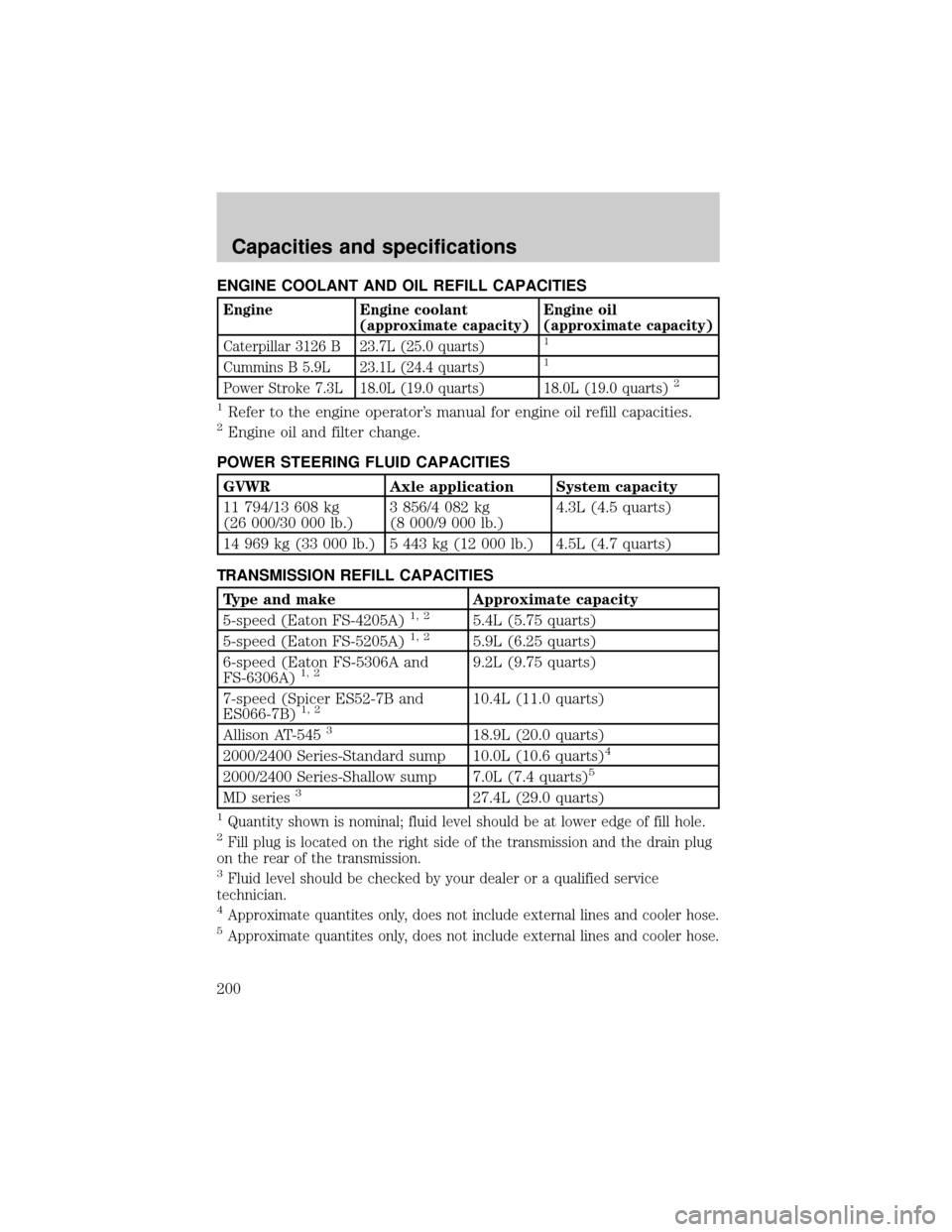
ENGINE COOLANT AND OIL REFILL CAPACITIES
Engine Engine coolant
(approximate capacity)Engine oil
(approximate capacity)
Caterpillar 3126 B 23.7L (25.0 quarts)
1
Cummins B 5.9L 23.1L (24.4 quarts)1
Power Stroke 7.3L 18.0L (19.0 quarts) 18.0L (19.0 quarts)2
1Refer to the engine operator's manual for engine oil refill capacities.2Engine oil and filter change.
POWER STEERING FLUID CAPACITIES
GVWR Axle application System capacity
11 794/13 608 kg
(26 000/30 000 lb.)3 856/4 082 kg
(8 000/9 000 lb.)4.3L (4.5 quarts)
14 969 kg (33 000 lb.) 5 443 kg (12 000 lb.) 4.5L (4.7 quarts)
TRANSMISSION REFILL CAPACITIES
Type and make Approximate capacity
5-speed (Eaton FS-4205A)1, 25.4L (5.75 quarts)
5-speed (Eaton FS-5205A)1, 25.9L (6.25 quarts)
6-speed (Eaton FS-5306A and
FS-6306A)
1, 29.2L (9.75 quarts)
7-speed (Spicer ES52-7B and
ES066-7B)
1, 210.4L (11.0 quarts)
Allison AT-545
318.9L (20.0 quarts)
2000/2400 Series-Standard sump 10.0L (10.6 quarts)4
2000/2400 Series-Shallow sump 7.0L (7.4 quarts)5
MD series327.4L (29.0 quarts)
1Quantity shown is nominal; fluid level should be at lower edge of fill hole.2Fill plug is located on the right side of the transmission and the drain plug
on the rear of the transmission.
3Fluid level should be checked by your dealer or a qualified service
technician.
4Approximate quantites only, does not include external lines and cooler hose.5Approximate quantites only, does not include external lines and cooler hose.
Capacities and specifications
200