2001 FORD CROWN VICTORIA sensor
[x] Cancel search: sensorPage 124 of 248
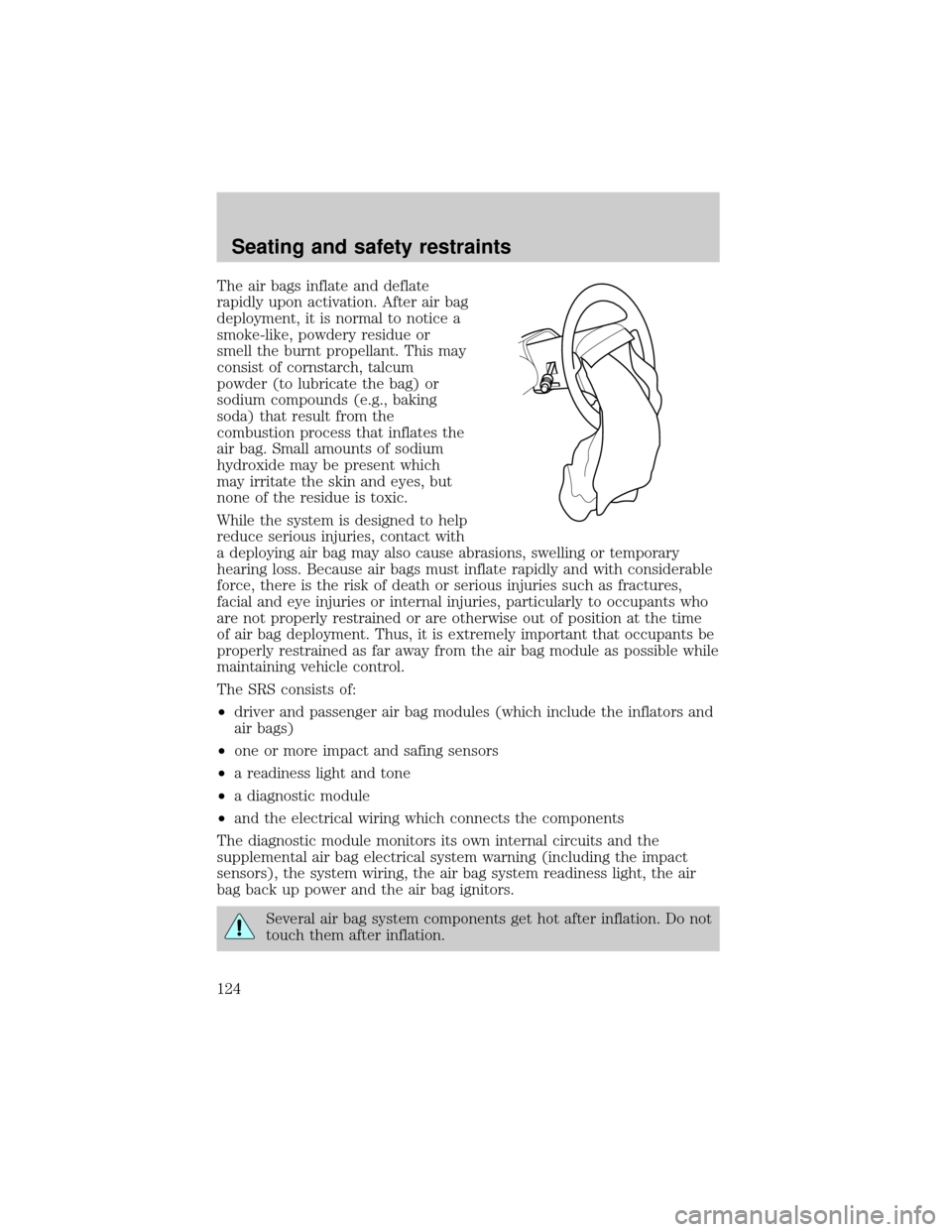
The air bags inflate and deflate
rapidly upon activation. After air bag
deployment, it is normal to notice a
smoke-like, powdery residue or
smell the burnt propellant. This may
consist of cornstarch, talcum
powder (to lubricate the bag) or
sodium compounds (e.g., baking
soda) that result from the
combustion process that inflates the
air bag. Small amounts of sodium
hydroxide may be present which
may irritate the skin and eyes, but
none of the residue is toxic.
While the system is designed to help
reduce serious injuries, contact with
a deploying air bag may also cause abrasions, swelling or temporary
hearing loss. Because air bags must inflate rapidly and with considerable
force, there is the risk of death or serious injuries such as fractures,
facial and eye injuries or internal injuries, particularly to occupants who
are not properly restrained or are otherwise out of position at the time
of air bag deployment. Thus, it is extremely important that occupants be
properly restrained as far away from the air bag module as possible while
maintaining vehicle control.
The SRS consists of:
²driver and passenger air bag modules (which include the inflators and
air bags)
²one or more impact and safing sensors
²a readiness light and tone
²a diagnostic module
²and the electrical wiring which connects the components
The diagnostic module monitors its own internal circuits and the
supplemental air bag electrical system warning (including the impact
sensors), the system wiring, the air bag system readiness light, the air
bag back up power and the air bag ignitors.
Several air bag system components get hot after inflation. Do not
touch them after inflation.
Seating and safety restraints
124
Page 141 of 248

The system operates by detecting and controlling wheel spin. The system
borrows many of the electronic and mechanical elements already present
in the anti-lock braking system (ABS).
Wheel-speed sensors allow excess rear wheel spin to be detected by the
Traction Controlyportion of the ABS computer. Any excessive wheel
spin is controlled by automatically applying and releasing the rear brakes
in conjunction with engine torque reductions. Engine torque reduction is
realized via the fully electronic spark and fuel injection systems. This
process is very sensitive to driving conditions and very fast acting. The
rear wheels ªsearchº for optimum traction several times a second and
adjustments are made accordingly.
The Traction Controlysystem will allow your vehicle to make better use
of available traction on slippery surfaces. The system is a driver aid
which makes your vehicle easier to handle primarily on snow and ice
covered roads.
During Traction Controlyoperation you may hear an electric motor type
of sound coming from the engine compartment and the engine will not
ªrev-upº when you push further on the accelerator. This is normal
system behavior.
If you should become stuck in snow
or ice or on a very slippery road
surface, try switching the Traction
Controlysystem off. This may allow
excess wheel spin to ªdigº the
vehicle out and enable a successful
ªrockingº maneuver.
The traction control indicator
flashes during a Traction Controly
system event.
If the traction control indicator
comes on and stays lit, either:
²the Traction Controlysystem requires service, or
²the customer has disabled the system using the traction control switch
located on the left side of the instrument panel.
The Traction Controlysystem will be on every time you turn the ignition
key from OFF to ON until you deactivate the system using the traction
control switch on the instrument panel left of the steering column.
TRAC
CNTL
Driving
141
Page 159 of 248
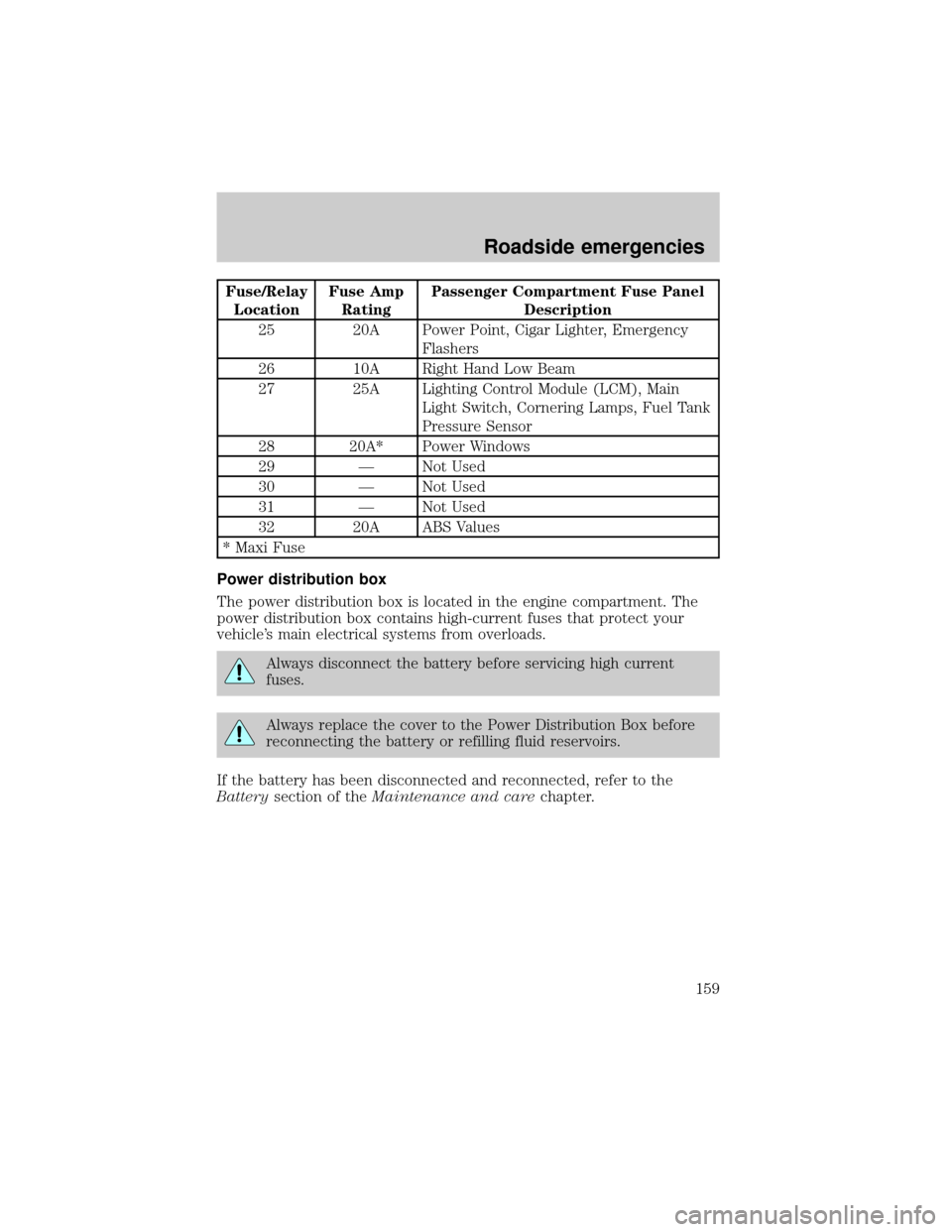
Fuse/Relay
LocationFuse Amp
RatingPassenger Compartment Fuse Panel
Description
25 20A Power Point, Cigar Lighter, Emergency
Flashers
26 10A Right Hand Low Beam
27 25A Lighting Control Module (LCM), Main
Light Switch, Cornering Lamps, Fuel Tank
Pressure Sensor
28 20A* Power Windows
29 Ð Not Used
30 Ð Not Used
31 Ð Not Used
32 20A ABS Values
* Maxi Fuse
Power distribution box
The power distribution box is located in the engine compartment. The
power distribution box contains high-current fuses that protect your
vehicle's main electrical systems from overloads.
Always disconnect the battery before servicing high current
fuses.
Always replace the cover to the Power Distribution Box before
reconnecting the battery or refilling fluid reservoirs.
If the battery has been disconnected and reconnected, refer to the
Batterysection of theMaintenance and carechapter.
Roadside emergencies
159
Page 237 of 248

Vehicle Security
Keyless entry
Wheel locks for styled wheels
Vehicle security systems
Comfort and convenience
Cargo nets
Engine block heaters
Travel equipment
Daytime running lights
HomeLinkt
Rear view mirror with tire pressure sensor
Trunk organizer
Protection and appearance equipment
Air bag anti-theft locks
Carpet floor mats
Electrochromic compass mirror
Electrochromic compass mirror with temperature display
Emergency kit
Door edge guards
First aid kit
Flat splash guards
Front end covers
Locking gas cap
Molded splash guards
Styled hood deflector
Underbody security lighting
Universal floor mats
Customer assistance
237
Page 245 of 248

traction control active ..............14
turn signal indicator .................12
Load limits .................................147
GAWR ......................................147
GVWR ......................................147
trailer towing ..........................147
Locks
autolock .....................................91
childproof ..................................88
doors ..........................................87
Lubricant specifications ...223±224
Lumbar support, seats .............107
M
Message center ...........................22
reset button ..............................23
select button .............................23
Mirrors
automatic dimming rearview
mirror ........................................83
cleaning ...................................216
side view mirrors (power) .......88
Motorcraft parts ................203, 220
O
Octane rating ............................202
Odometer .....................................19
Oil (see Engine oil) ..................175
Overdrive .............................74, 145
P
Panic alarm feature, remote
entry system ................................93
Parking brake ............................139Parts (see Motorcraft parts) ....220
Passenger Occupant
Classification Sensor .................109
Pedals (see Power adjustable
foot pedals) .................................71
Power distribution box
(see Fuses) ...............................159
Power door locks ..................87, 91
Power steering ..........................142
fluid, checking and adding ....187
fluid, refill capacity ................221
fluid, specifications .........223±224
R
Radio ............................................38
Rear window defroster ...............38
Relays ................................156, 161
Remote entry system ...........89, 93
illuminated entry ......................93
locking/unlocking doors ...........90
opening the trunk .....................92
panic alarm ...............................93
replacement/additional
transmitters ...............................94
replacing the batteries .............93
S
Safety belts (see Safety
restraints) ............16, 107, 111±115
Safety defects, reporting ..........240
Safety restraints ........107, 111±115
belt minder .............................117
cleaning the safety belts .......120,
219
extension assembly ................116
for adults .........................112±114
Index
245
Page 246 of 248

for children .....................125±126
lap belt ....................................115
Occupant Classification
Sensor ......................................109
warning light and
chime ...................11, 16, 116±117
Safety seats for children ..........127
Seat belts (see Safety
restraints) ..................................107
Seats ..........................................103
child safety seats ....................127
cleaning ...................................219
SecuriLock passive anti-theft
system ....................................95±97
Servicing your vehicle ..............172
Spark plugs,
specifications .............220, 224±225
Special notice ................................3
Specification chart,
lubricants ...........................223±224
Speed control ..............................75
Speedometer ...............................18
Starting your vehicle ........134, 136
jump starting ..........................165
Steering
speed sensitive .......................142
Steering wheel
tilting .........................................74
T
Tires ...........................161, 194±196
changing ..........................161±162
checking the pressure ............196
replacing ..................................197rotating ....................................196
snow tires and chains ............198
tire grades ...............................195
treadwear ................................195
Towing .......................................149
recreational towing .................151
trailer towing ..........................149
wrecker ....................................171
Traction control ..................72, 140
off light ......................................14
Traction-lok rear axle ...............147
Transmission .............................143
fluid, checking and adding
(automatic) .............................187
fluid, refill capacities ..............221
lubricant specifications ..223±224
Trip odometer .............................20
Trunk .........................................101
remote release ....................86, 92
Turn signal ............................12, 72
V
Vehicle dimensions ...................225
Vehicle Identification Number
(VIN) ..........................................227
Vehicle loading ..........................147
Ventilating your vehicle ...........137
W
Warning chimes ...........................16
Warning lights (see Lights) .........8
Washer fluid ..............................179
Water, Driving through .............152
Index
246