2001 DODGE RAM clock
[x] Cancel search: clockPage 1014 of 2889
8W-80 CONNECTOR PIN-OUTS
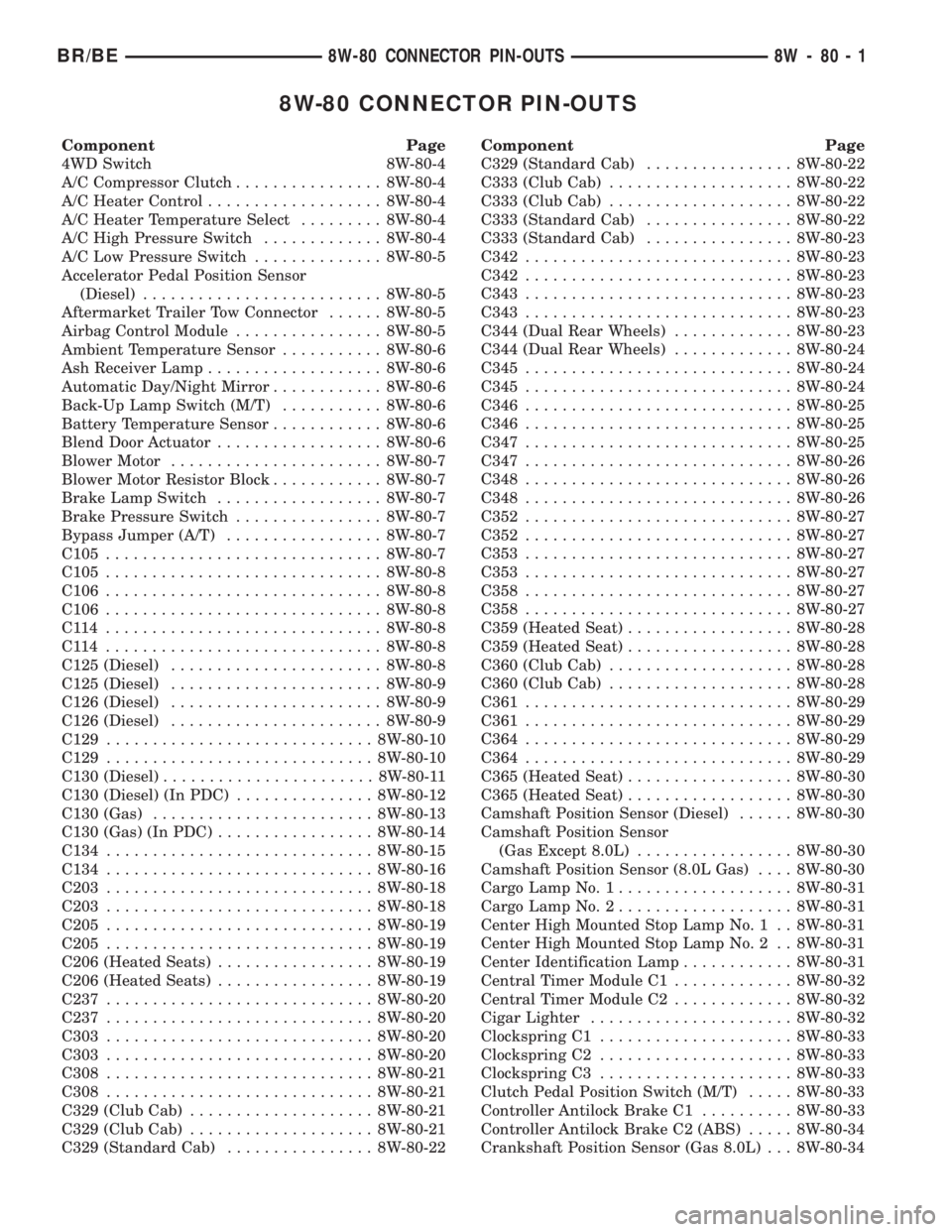
Component Page
4WD Switch 8W-80-4
A/C Compressor Clutch................ 8W-80-4
A/C Heater Control................... 8W-80-4
A/C Heater Temperature Select......... 8W-80-4
A/C High Pressure Switch............. 8W-80-4
A/C Low Pressure Switch.............. 8W-80-5
Accelerator Pedal Position Sensor
(Diesel).......................... 8W-80-5
Aftermarket Trailer Tow Connector...... 8W-80-5
Airbag Control Module................ 8W-80-5
Ambient Temperature Sensor........... 8W-80-6
Ash Receiver Lamp................... 8W-80-6
Automatic Day/Night Mirror............ 8W-80-6
Back-Up Lamp Switch (M/T)........... 8W-80-6
Battery Temperature Sensor............ 8W-80-6
Blend Door Actuator.................. 8W-80-6
Blower Motor....................... 8W-80-7
Blower Motor Resistor Block............ 8W-80-7
Brake Lamp Switch.................. 8W-80-7
Brake Pressure Switch................ 8W-80-7
Bypass Jumper (A/T)................. 8W-80-7
C105.............................. 8W-80-7
C105.............................. 8W-80-8
C106.............................. 8W-80-8
C106.............................. 8W-80-8
C114 .............................. 8W-80-8
C114 .............................. 8W-80-8
C125 (Diesel)....................... 8W-80-8
C125 (Diesel)....................... 8W-80-9
C126 (Diesel)....................... 8W-80-9
C126 (Diesel)....................... 8W-80-9
C129............................. 8W-80-10
C129............................. 8W-80-10
C130 (Diesel)....................... 8W-80-11
C130 (Diesel) (In PDC)............... 8W-80-12
C130 (Gas)........................ 8W-80-13
C130 (Gas) (In PDC)................. 8W-80-14
C134............................. 8W-80-15
C134............................. 8W-80-16
C203............................. 8W-80-18
C203............................. 8W-80-18
C205............................. 8W-80-19
C205............................. 8W-80-19
C206 (Heated Seats)................. 8W-80-19
C206 (Heated Seats)................. 8W-80-19
C237............................. 8W-80-20
C237............................. 8W-80-20
C303............................. 8W-80-20
C303............................. 8W-80-20
C308............................. 8W-80-21
C308............................. 8W-80-21
C329 (Club Cab).................... 8W-80-21
C329 (Club Cab).................... 8W-80-21
C329 (Standard Cab)................ 8W-80-22Component Page
C329 (Standard Cab)................ 8W-80-22
C333 (Club Cab).................... 8W-80-22
C333 (Club Cab).................... 8W-80-22
C333 (Standard Cab)................ 8W-80-22
C333 (Standard Cab)................ 8W-80-23
C342............................. 8W-80-23
C342............................. 8W-80-23
C343............................. 8W-80-23
C343............................. 8W-80-23
C344 (Dual Rear Wheels)............. 8W-80-23
C344 (Dual Rear Wheels)............. 8W-80-24
C345............................. 8W-80-24
C345............................. 8W-80-24
C346............................. 8W-80-25
C346............................. 8W-80-25
C347............................. 8W-80-25
C347............................. 8W-80-26
C348............................. 8W-80-26
C348............................. 8W-80-26
C352............................. 8W-80-27
C352............................. 8W-80-27
C353............................. 8W-80-27
C353............................. 8W-80-27
C358............................. 8W-80-27
C358............................. 8W-80-27
C359 (Heated Seat).................. 8W-80-28
C359 (Heated Seat).................. 8W-80-28
C360 (Club Cab).................... 8W-80-28
C360 (Club Cab).................... 8W-80-28
C361............................. 8W-80-29
C361............................. 8W-80-29
C364............................. 8W-80-29
C364............................. 8W-80-29
C365 (Heated Seat).................. 8W-80-30
C365 (Heated Seat).................. 8W-80-30
Camshaft Position Sensor (Diesel)...... 8W-80-30
Camshaft Position Sensor
(Gas Except 8.0L)................. 8W-80-30
Camshaft Position Sensor (8.0L Gas).... 8W-80-30
Cargo Lamp No. 1................... 8W-80-31
Cargo Lamp No. 2................... 8W-80-31
Center High Mounted Stop Lamp No. 1 . . 8W-80-31
Center High Mounted Stop Lamp No. 2 . . 8W-80-31
Center Identification Lamp............ 8W-80-31
Central Timer Module C1............. 8W-80-32
Central Timer Module C2............. 8W-80-32
Cigar Lighter...................... 8W-80-32
Clockspring C1..................... 8W-80-33
Clockspring C2..................... 8W-80-33
Clockspring C3..................... 8W-80-33
Clutch Pedal Position Switch (M/T)..... 8W-80-33
Controller Antilock Brake C1.......... 8W-80-33
Controller Antilock Brake C2 (ABS)..... 8W-80-34
Crankshaft Position Sensor (Gas 8.0L) . . . 8W-80-34
BR/BE8W-80 CONNECTOR PIN-OUTS 8W - 80 - 1
Page 1046 of 2889
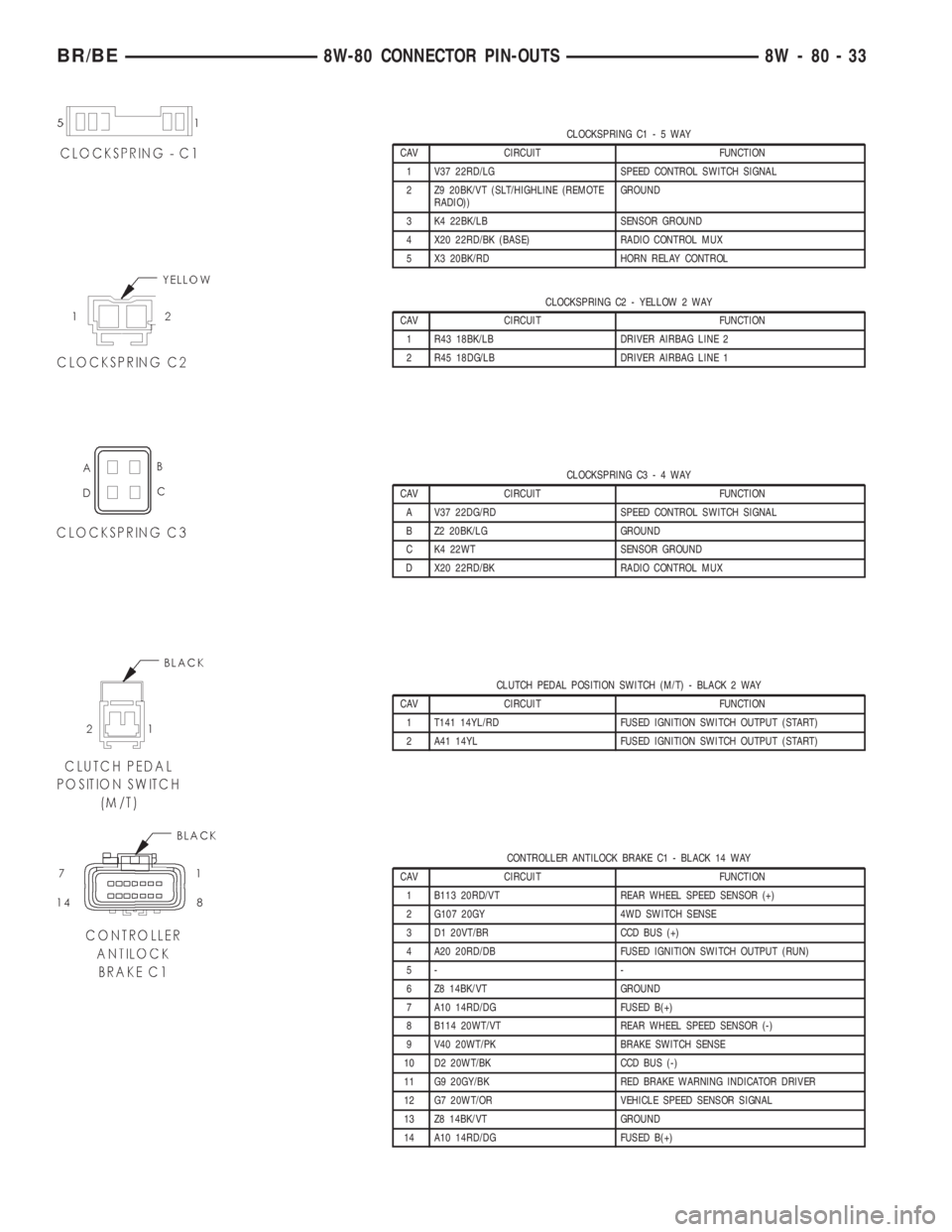
CLOCKSPRING C1-5WAY
CAV CIRCUIT FUNCTION
1 V37 22RD/LG SPEED CONTROL SWITCH SIGNAL
2 Z9 20BK/VT (SLT/HIGHLINE (REMOTE
RADIO))GROUND
3 K4 22BK/LB SENSOR GROUND
4 X20 22RD/BK (BASE) RADIO CONTROL MUX
5 X3 20BK/RD HORN RELAY CONTROL
CLOCKSPRING C2 - YELLOW 2 WAY
CAV CIRCUIT FUNCTION
1 R43 18BK/LB DRIVER AIRBAG LINE 2
2 R45 18DG/LB DRIVER AIRBAG LINE 1
CLOCKSPRING C3-4WAY
CAV CIRCUIT FUNCTION
A V37 22DG/RD SPEED CONTROL SWITCH SIGNAL
B Z2 20BK/LG GROUND
C K4 22WT SENSOR GROUND
D X20 22RD/BK RADIO CONTROL MUX
CLUTCH PEDAL POSITION SWITCH (M/T) - BLACK 2 WAY
CAV CIRCUIT FUNCTION
1 T141 14YL/RD FUSED IGNITION SWITCH OUTPUT (START)
2 A41 14YL FUSED IGNITION SWITCH OUTPUT (START)
CONTROLLER ANTILOCK BRAKE C1 - BLACK 14 WAY
CAV CIRCUIT FUNCTION
1 B113 20RD/VT REAR WHEEL SPEED SENSOR (+)
2 G107 20GY 4WD SWITCH SENSE
3 D1 20VT/BR CCD BUS (+)
4 A20 20RD/DB FUSED IGNITION SWITCH OUTPUT (RUN)
5- -
6 Z8 14BK/VT GROUND
7 A10 14RD/DG FUSED B(+)
8 B114 20WT/VT REAR WHEEL SPEED SENSOR (-)
9 V40 20WT/PK BRAKE SWITCH SENSE
10 D2 20WT/BK CCD BUS (-)
11 G9 20GY/BK RED BRAKE WARNING INDICATOR DRIVER
12 G7 20WT/OR VEHICLE SPEED SENSOR SIGNAL
13 Z8 14BK/VT GROUND
14 A10 14RD/DG FUSED B(+)
BR/BE8W-80 CONNECTOR PIN-OUTS 8W - 80 - 33
Page 1093 of 2889
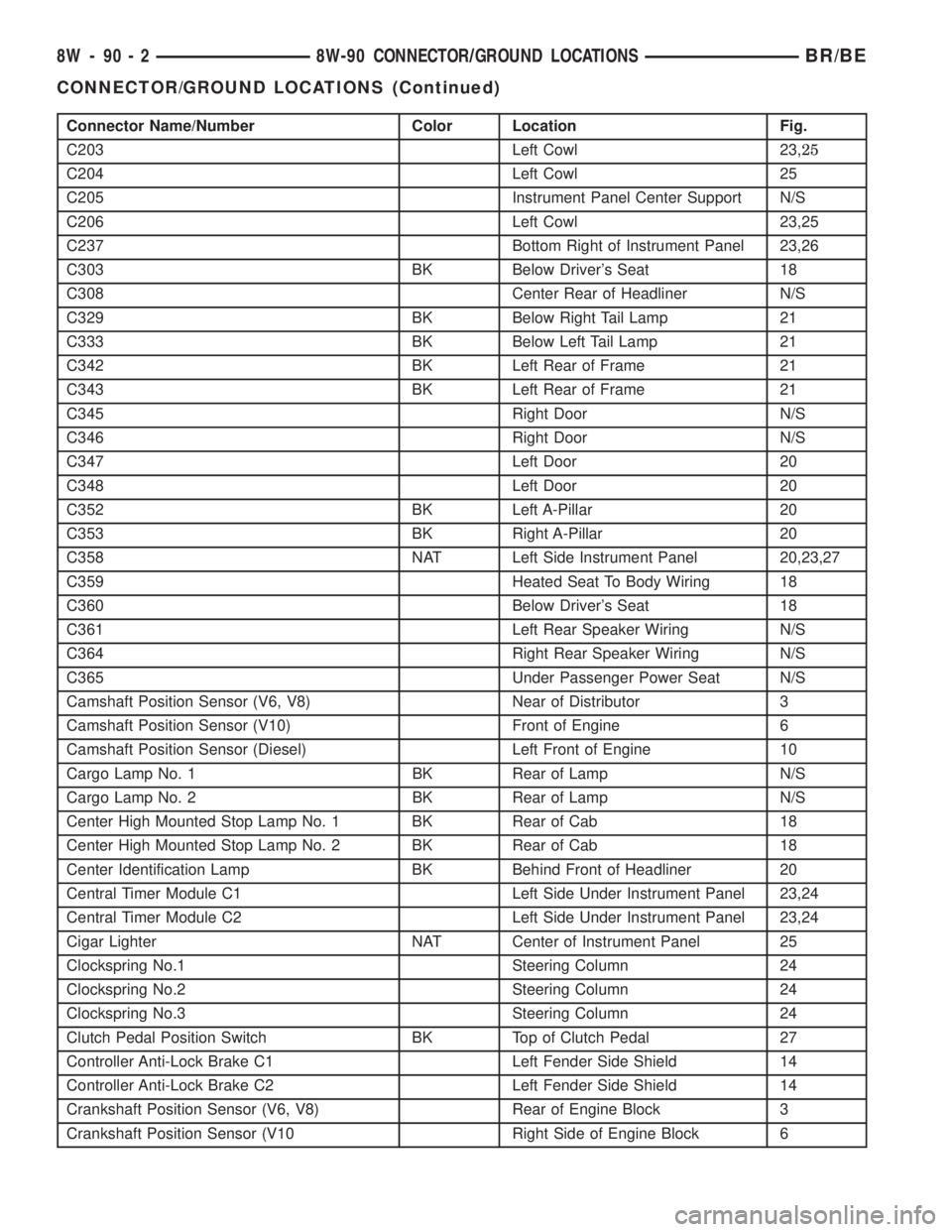
Connector Name/Number Color Location Fig.
C203 Left Cowl 23,25
C204 Left Cowl 25
C205 Instrument Panel Center Support N/S
C206 Left Cowl 23,25
C237 Bottom Right of Instrument Panel 23,26
C303 BK Below Driver's Seat 18
C308 Center Rear of Headliner N/S
C329 BK Below Right Tail Lamp 21
C333 BK Below Left Tail Lamp 21
C342 BK Left Rear of Frame 21
C343 BK Left Rear of Frame 21
C345 Right Door N/S
C346 Right Door N/S
C347 Left Door 20
C348 Left Door 20
C352 BK Left A-Pillar 20
C353 BK Right A-Pillar 20
C358 NAT Left Side Instrument Panel 20,23,27
C359 Heated Seat To Body Wiring 18
C360 Below Driver's Seat 18
C361 Left Rear Speaker Wiring N/S
C364 Right Rear Speaker Wiring N/S
C365 Under Passenger Power Seat N/S
Camshaft Position Sensor (V6, V8) Near of Distributor 3
Camshaft Position Sensor (V10) Front of Engine 6
Camshaft Position Sensor (Diesel) Left Front of Engine 10
Cargo Lamp No. 1 BK Rear of Lamp N/S
Cargo Lamp No. 2 BK Rear of Lamp N/S
Center High Mounted Stop Lamp No. 1 BK Rear of Cab 18
Center High Mounted Stop Lamp No. 2 BK Rear of Cab 18
Center Identification Lamp BK Behind Front of Headliner 20
Central Timer Module C1 Left Side Under Instrument Panel 23,24
Central Timer Module C2 Left Side Under Instrument Panel 23,24
Cigar Lighter NAT Center of Instrument Panel 25
Clockspring No.1 Steering Column 24
Clockspring No.2 Steering Column 24
Clockspring No.3 Steering Column 24
Clutch Pedal Position Switch BK Top of Clutch Pedal 27
Controller Anti-Lock Brake C1 Left Fender Side Shield 14
Controller Anti-Lock Brake C2 Left Fender Side Shield 14
Crankshaft Position Sensor (V6, V8) Rear of Engine Block 3
Crankshaft Position Sensor (V10 Right Side of Engine Block 6
8W - 90 - 2 8W-90 CONNECTOR/GROUND LOCATIONSBR/BE
CONNECTOR/GROUND LOCATIONS (Continued)
Page 1140 of 2889
procedures performed just prior to new vehicle deliv-
ery.
The left end of the instrument panel cover has a
snap-fit fuse access panel that can be removed to pro-
vide service access to the fuses in the JB. A finger
recess is molded into the access panel for easy
removal. An adhesive-backed fuse layout map is
secured to the instrument panel side of the access
panel to ensure proper fuse identification. The IOD
fuse is a 10 ampere mini blade-type fuse. The fuse is
secured within a black molded plastic fuse holder
and puller unit that serves both as a tool for discon-
necting and reconnecting the fuse in its JB cavity,
and as a fuse holder that conveniently stores the fuse
in the same JB cavity after it has been disconnected.
OPERATION
The term ignition-off draw identifies a normal con-
dition where power is being drained from the battery
with the ignition switch in the Off position. The IOD
fuse feeds the memory and sleep mode functions for
some of the electronic modules in the vehicle as well
as various other accessories that require battery cur-
rent when the ignition switch is in the Off position,
including the clock. The only reason the IOD fuse is
disconnected is to reduce the normal IOD of the vehi-
cle electrical system during new vehicle transporta-
tion and pre-delivery storage to reduce battery
depletion, while still allowing vehicle operation sothat the vehicle can be loaded, unloaded and moved
as needed by both vehicle transportation company
and dealer personnel.
The IOD fuse is disconnected from JB fuse cavity
12 when the vehicle is shipped from the assembly
plant. Dealer personnel must reconnect the IOD fuse
when the vehicle is being prepared for delivery in
order to restore full electrical system operation. Once
the vehicle is prepared for delivery, the IOD function
of this fuse becomes transparent and the fuse that
has been assigned the IOD designation becomes only
another Fused B(+) circuit fuse. The IOD fuse serves
no useful purpose to the dealer technician in the ser-
vice or diagnosis of any vehicle system or condition,
other than the same purpose as that of any other
standard circuit protection device.
The IOD fuse can be used by the vehicle owner as
a convenient means of reducing battery depletion
when a vehicle is to be stored for periods not to
exceed about thirty days. However, it must be
remembered that disconnecting the IOD fuse will not
eliminate IOD, but only reduce this normal condition.
If a vehicle will be stored for more than about thirty
days, the battery negative cable should be discon-
nected to eliminate normal IOD; and, the battery
should be tested and recharged at regular intervals
during the vehicle storage period to prevent the bat-
tery from becoming discharged or damaged. Refer to
Batteryin the index of this service manual for the
location of additional service information covering
the battery.
REMOVAL
The Ignition-Off Draw (IOD) fuse is disconnected
from Junction Block (JB) fuse cavity 12 when the
vehicle is shipped from the assembly plant. Dealer
personnel must reconnect the IOD fuse when the
vehicle is being prepared for delivery in order to
restore full electrical system operation.
(1) Turn the ignition switch to the Off position.
(2) Remove the fuse access panel by unsnapping it
from the left outboard end of the instrument panel.
(3) Grasp the upper and lower tabs of the IOD
fuse holder unit in fuse cavity 12 of the JB between
the thumb and forefinger and pull the unit firmly
outward.
(4) Install the fuse access panel by snapping it
onto the left outboard end of the instrument panel.
INSTALLATION
The Ignition-Off Draw (IOD) fuse is disconnected
from Junction Block (JB) fuse cavity 12 (Fig. 4) when
the vehicle is shipped from the assembly plant.
Dealer personnel must reconnect the IOD fuse when
the vehicle is being prepared for delivery in order to
restore full electrical system operation.
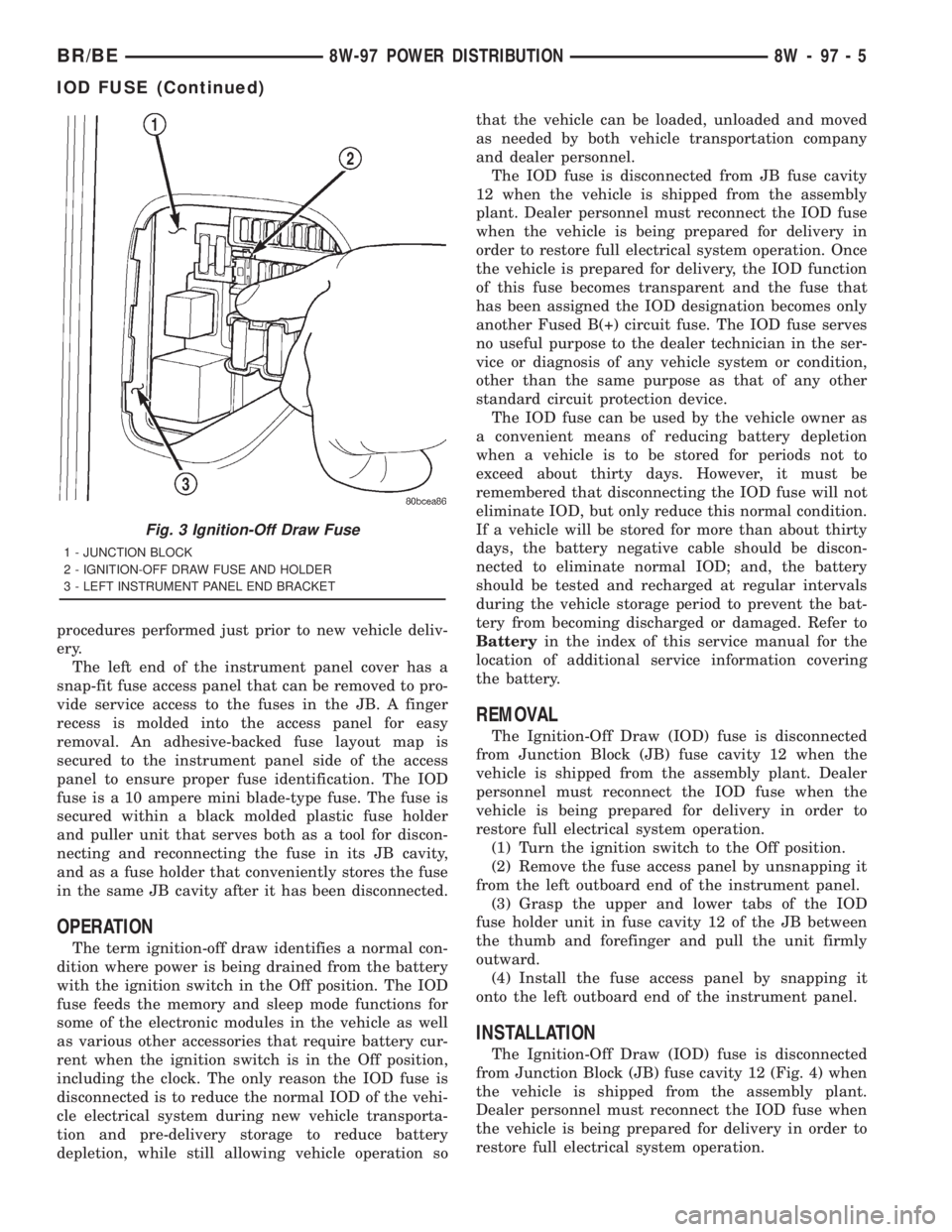
Fig. 3 Ignition-Off Draw Fuse
1 - JUNCTION BLOCK
2 - IGNITION-OFF DRAW FUSE AND HOLDER
3 - LEFT INSTRUMENT PANEL END BRACKET
BR/BE8W-97 POWER DISTRIBUTION 8W - 97 - 5
IOD FUSE (Continued)
Page 1180 of 2889
STANDARD PROCEDUREÐMAIN BEARING
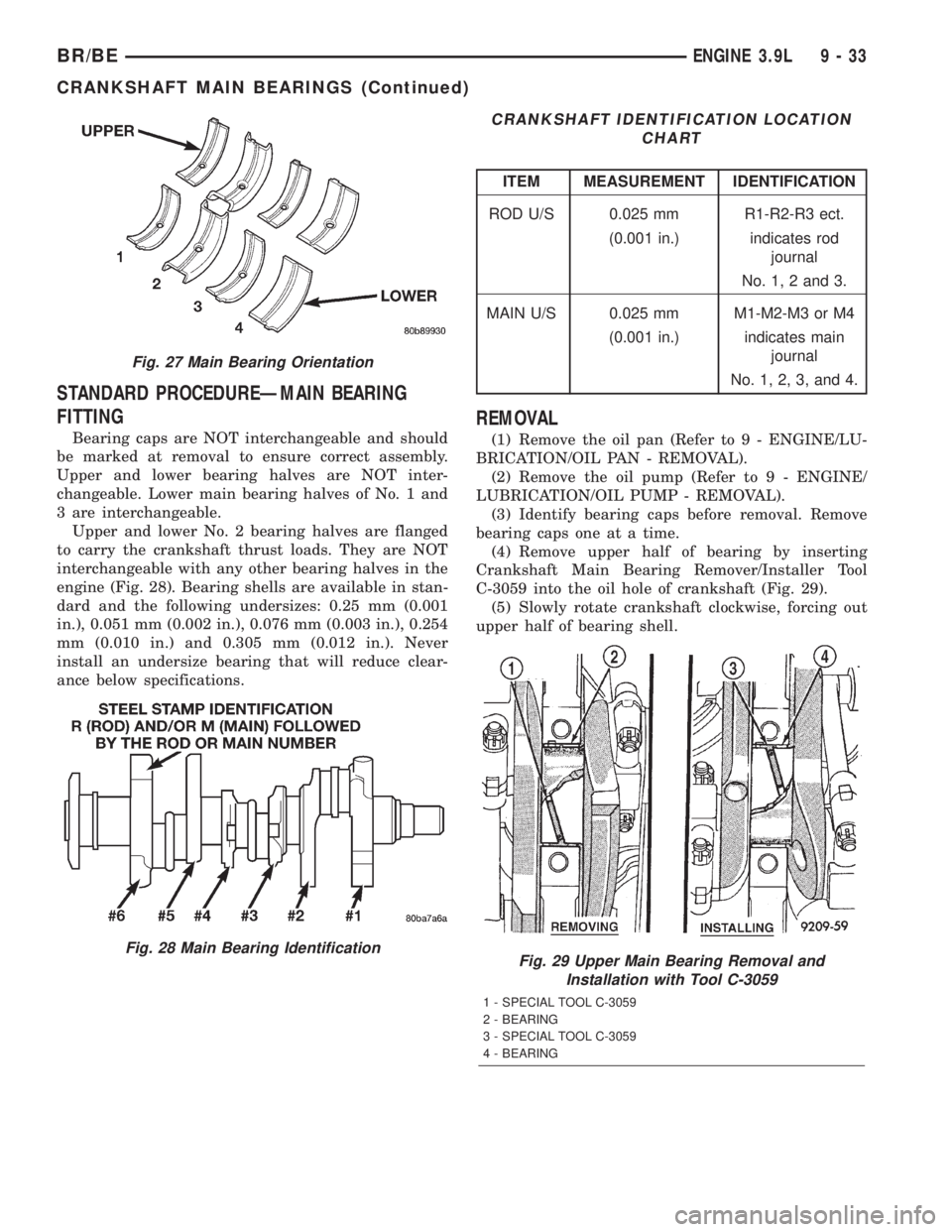
FITTING
Bearing caps are NOT interchangeable and should
be marked at removal to ensure correct assembly.
Upper and lower bearing halves are NOT inter-
changeable. Lower main bearing halves of No. 1 and
3 are interchangeable.
Upper and lower No. 2 bearing halves are flanged
to carry the crankshaft thrust loads. They are NOT
interchangeable with any other bearing halves in the
engine (Fig. 28). Bearing shells are available in stan-
dard and the following undersizes: 0.25 mm (0.001
in.), 0.051 mm (0.002 in.), 0.076 mm (0.003 in.), 0.254
mm (0.010 in.) and 0.305 mm (0.012 in.). Never
install an undersize bearing that will reduce clear-
ance below specifications.
CRANKSHAFT IDENTIFICATION LOCATION
CHART
ITEM MEASUREMENT IDENTIFICATION
ROD U/S 0.025 mm R1-R2-R3 ect.
(0.001 in.) indicates rod
journal
No. 1, 2 and 3.
MAIN U/S 0.025 mm M1-M2-M3 or M4
(0.001 in.) indicates main
journal
No. 1, 2, 3, and 4.
REMOVAL
(1) Remove the oil pan (Refer to 9 - ENGINE/LU-
BRICATION/OIL PAN - REMOVAL).
(2) Remove the oil pump (Refer to 9 - ENGINE/
LUBRICATION/OIL PUMP - REMOVAL).
(3) Identify bearing caps before removal. Remove
bearing caps one at a time.
(4) Remove upper half of bearing by inserting
Crankshaft Main Bearing Remover/Installer Tool
C-3059 into the oil hole of crankshaft (Fig. 29).
(5) Slowly rotate crankshaft clockwise, forcing out
upper half of bearing shell.
Fig. 27 Main Bearing Orientation
Fig. 28 Main Bearing IdentificationFig. 29 Upper Main Bearing Removal and
Installation with Tool C-3059
1 - SPECIAL TOOL C-3059
2 - BEARING
3 - SPECIAL TOOL C-3059
4 - BEARING
BR/BEENGINE 3.9L 9 - 33
CRANKSHAFT MAIN BEARINGS (Continued)
Page 1181 of 2889
INSTALLATION
Only one main bearing should be selectively fitted
while all other main bearing caps are properly tight-
ened. All bearing capbolts removed during service
procedures are to be cleaned and oiled before instal-
lation. DO NOT use a new bearing half with an old
bearing half.
When installing a new upper bearing shell, slightly
chamfer the sharp edges from the plain side.
(1) Start bearing in place, and insert Crankshaft
Main Bearing Remover/Installer Tool C-3059 into oil
hole of crankshaft (Fig. 29).
(2) Slowly rotate crankshaft counterclockwise slid-
ing the bearing into position. Remove Tool C-3059.
(3) Install the bearing caps. Clean and oil the
bolts. Tighten the capbolts to 115 N´m (85 ft. lbs.)
torque.
(4) Install the oil pump (Refer to 9 - ENGINE/LU-
BRICATION/OIL PUMP - INSTALLATION).
(5) Install the oil pan (Refer to 9 - ENGINE/LU-
BRICATION/OIL PAN - INSTALLATION).
CRANKSHAFT OIL SEAL -
FRONT
DESCRIPTION
The crankshaft rear seal is a two piece viton seal.
The crankshaft front seal is a one piece viton seal
with a steel housing. The front seal is located in the
engine front cover. One part of the two piece rear
seal is located in a slot in the number four (4) crank-
shaft main bore, the second part of the two piece seal
is located in the number four (4) main bearing cap.
OPERATION
The crankshaft seals prevent oil from leaking from
around the crankshaft, either from the rear of the
engine or from the engine front cover.
REMOVAL
The oil seal can be replaced without removing the
timing chain cover, provided that the cover is not
misaligned.
(1) Disconnect the negative cable from the battery.
(2) Remove vibration damper (Refer to 9 -
ENGINE/ENGINE BLOCK/VIBRATION DAMPER -
REMOVAL).
(3) If front seal is suspected of leaking, check front
oil seal alignment to crankshaft. The seal installa-
tion/alignment Tool 6635, should fit with minimum
interference. If tool does not fit, the cover must be
removed and installed properly.
(4) Place a suitable tool behind the lips of the oil
seal to pry the oil seal outward. Be careful not to
damage the crankshaft seal bore of cover.
INSTALLATION
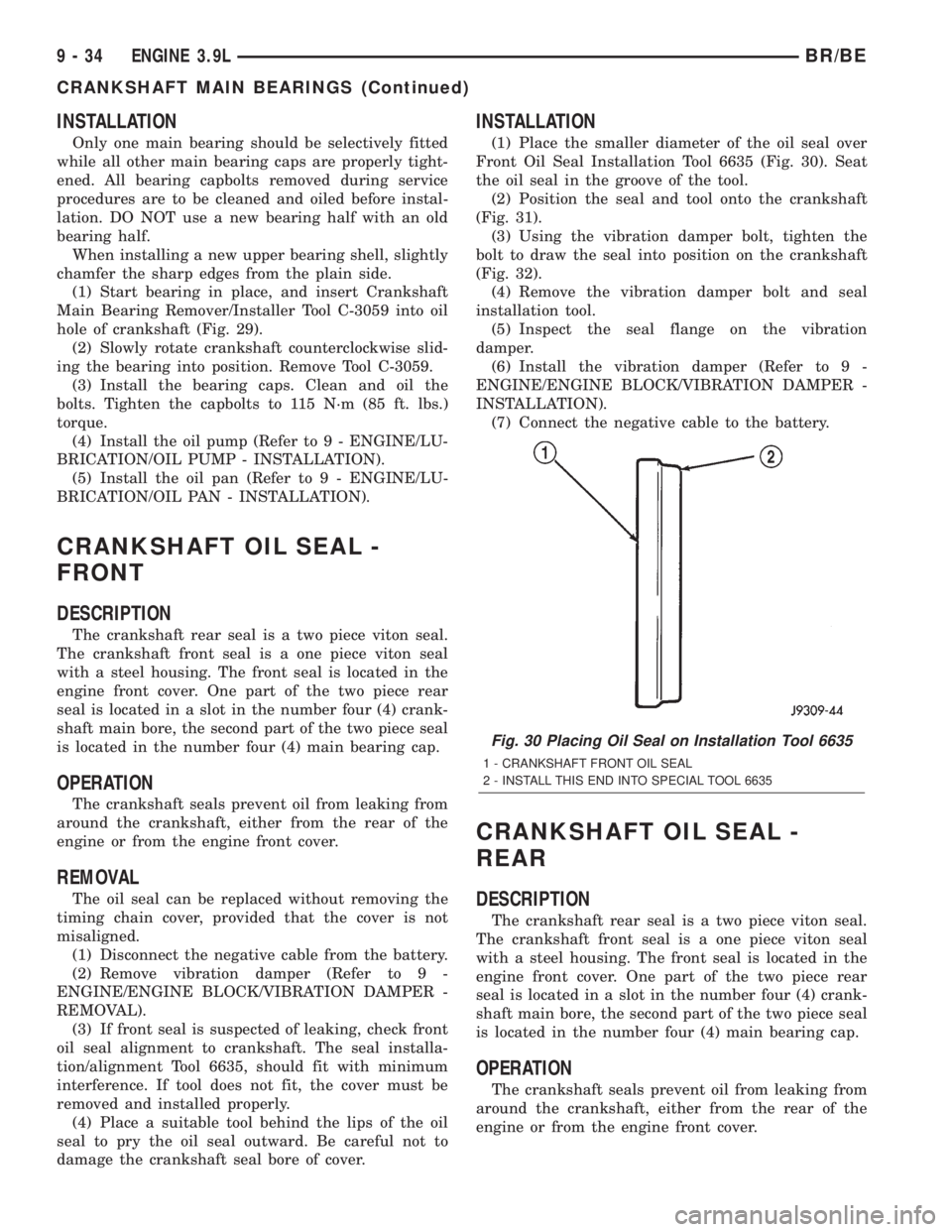
(1) Place the smaller diameter of the oil seal over
Front Oil Seal Installation Tool 6635 (Fig. 30). Seat
the oil seal in the groove of the tool.
(2) Position the seal and tool onto the crankshaft
(Fig. 31).
(3) Using the vibration damper bolt, tighten the
bolt to draw the seal into position on the crankshaft
(Fig. 32).
(4) Remove the vibration damper bolt and seal
installation tool.
(5) Inspect the seal flange on the vibration
damper.
(6) Install the vibration damper (Refer to 9 -
ENGINE/ENGINE BLOCK/VIBRATION DAMPER -
INSTALLATION).
(7) Connect the negative cable to the battery.
CRANKSHAFT OIL SEAL -
REAR
DESCRIPTION
The crankshaft rear seal is a two piece viton seal.
The crankshaft front seal is a one piece viton seal
with a steel housing. The front seal is located in the
engine front cover. One part of the two piece rear
seal is located in a slot in the number four (4) crank-
shaft main bore, the second part of the two piece seal
is located in the number four (4) main bearing cap.
OPERATION
The crankshaft seals prevent oil from leaking from
around the crankshaft, either from the rear of the
engine or from the engine front cover.
Fig. 30 Placing Oil Seal on Installation Tool 6635
1 - CRANKSHAFT FRONT OIL SEAL
2 - INSTALL THIS END INTO SPECIAL TOOL 6635
9 - 34 ENGINE 3.9LBR/BE
CRANKSHAFT MAIN BEARINGS (Continued)
Page 1185 of 2889
HYDRAULIC LIFTERS (CAM IN
BLOCK)
DIAGNOSIS AND TESTINGÐHYDRAULIC
TAPPETS
Before disassembling any part of the engine to cor-
rect tappet noise, check the oil pressure. If vehicle
has no oil pressure gauge, install a reliable gauge at
the pressure sending-unit. The pressure should be
between 207-552 kPa (30-80 psi) at 3,000 RPM.
Check the oil level after the engine reaches normal
operating temperature. Allow 5 minutes to stabilize
oil level, check dipstick. The oil level in the pan
should never be above the FULL mark or below the
ADD OIL mark on dipstick. Either of these two con-
ditions could be responsible for noisy tappets.
OIL LEVEL
HIGH
If oil level is above the FULL mark, it is possible
for the connecting rods to dip into the oil. With the
engine running, this condition could create foam in
the oil pan. Foam in oil pan would be fed to the
hydraulic tappets by the oil pump causing them to
lose length and allow valves to seat noisily.
LOW
Low oil level may allow oil pump to take in air.
When air is fed to the tappets, they lose length,
which allows valves to seat noisily. Any leaks on
intake side of oil pump through which air can be
drawn will create the same tappet action. Check the
lubrication system from the intake strainer to the
pump cover, including the relief valve retainer cap.
When tappet noise is due to aeration, it may be
intermittent or constant, and usually more than one
tappet will be noisy. When oil level and leaks have
been corrected, operate the engine at fast idle. Run
engine for a sufficient time to allow all of the air
inside the tappets to be bled out.
TAPPET NOISE DIAGNOSIS
(1) To determine source of tappet noise, operate
engine at idle with cylinder head covers removed.
(2) Feel each valve spring or rocker arm to detect
noisy tappet. The noisy tappet will cause the affected
spring and/or rocker arm to vibrate or feel rough in
operation.
NOTE: Worn valve guides or cocked springs are
sometimes mistaken for noisy tappets. If such is
the case, noise may be dampened by applying side
thrust on the valve spring. If noise is not apprecia-
bly reduced, it can be assumed the noise is in thetappet. Inspect the rocker arm push rod sockets
and push rod ends for wear.
(3) Valve tappet noise ranges from light noise to a
heavy click. A light noise is usually caused by exces-
sive leak-down around the unit plunger, or by the
plunger partially sticking in the tappet body cylinder.
The tappet should be replaced. A heavy click is
caused by a tappet check valve not seating, or by for-
eign particles wedged between the plunger and the
tappet body. This will cause the plunger to stick in
the down position. This heavy click will be accompa-
nied by excessive clearance between the valve stem
and rocker arm as valve closes. In either case, tappet
assembly should be removed for inspection and clean-
ing.
(4) The valve train generates a noise very much
like a light tappet noise during normal operation.
Care must be taken to ensure that tappets are mak-
ing the noise. If more than one tappet seems to be
noisy, it's probably not the tappets.
LEAK-DOWN TEST
After cleaning and inspection, test each tappet for
specified leak-down rate tolerance to ensure zero-lash
operation (Fig. 38).
Swing the weighted arm of the hydraulic valve tap-
pet tester away from the ram of the Universal Leak-
Down Tester.
(1) Place a 7.925-7.950 mm (0.312-0.313 inch)
diameter ball bearing on the plunger cap of the tap-
pet.
(2) Lift the ram and position the tappet (with the
ball bearing) inside the tester cup.
(3) Lower the ram, then adjust the nose of the ram
until it contacts the ball bearing. DO NOT tighten
the hex nut on the ram.
(4) Fill the tester cup with hydraulic valve tappet
test oil until the tappet is completely submerged.
(5) Swing the weighted arm onto the push rod and
pump the tappet plunger up and down to remove air.
When the air bubbles cease, swing the weighted arm
away and allow the plunger to rise to the normal
position.
(6) Adjust the nose of the ram to align the pointer
with the SET mark on the scale of the tester and
tighten the hex nut.
(7) Slowly swing the weighted arm onto the push
rod.
(8) Rotate the cup by turning the handle at the
base of the tester clockwise one revolution every 2
seconds.
(9) Observe the leak-down time interval from the
instant the pointer aligns with the START mark on
the scale until the pointer aligns with the 0.125
mark. A normally functioning tappet will require
9 - 38 ENGINE 3.9LBR/BE
Page 1189 of 2889
lower rails. Insert oil rail spacer first, then side
rails.
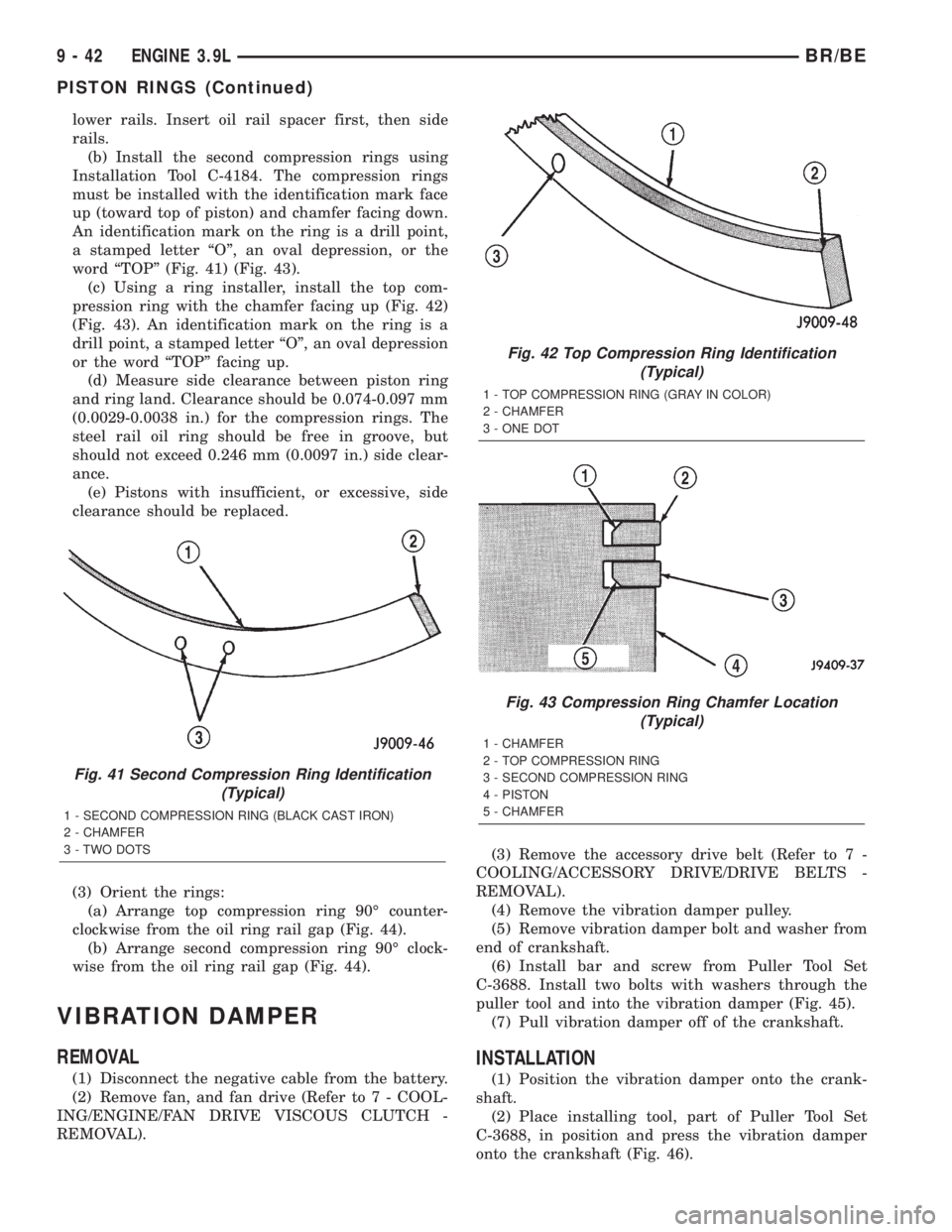
(b) Install the second compression rings using
Installation Tool C-4184. The compression rings
must be installed with the identification mark face
up (toward top of piston) and chamfer facing down.
An identification mark on the ring is a drill point,
a stamped letter ªOº, an oval depression, or the
word ªTOPº (Fig. 41) (Fig. 43).
(c) Using a ring installer, install the top com-
pression ring with the chamfer facing up (Fig. 42)
(Fig. 43). An identification mark on the ring is a
drill point, a stamped letter ªOº, an oval depression
or the word ªTOPº facing up.
(d) Measure side clearance between piston ring
and ring land. Clearance should be 0.074-0.097 mm
(0.0029-0.0038 in.) for the compression rings. The
steel rail oil ring should be free in groove, but
should not exceed 0.246 mm (0.0097 in.) side clear-
ance.
(e) Pistons with insufficient, or excessive, side
clearance should be replaced.
(3) Orient the rings:
(a) Arrange top compression ring 90É counter-
clockwise from the oil ring rail gap (Fig. 44).
(b) Arrange second compression ring 90É clock-
wise from the oil ring rail gap (Fig. 44).
VIBRATION DAMPER
REMOVAL
(1) Disconnect the negative cable from the battery.
(2) Remove fan, and fan drive (Refer to 7 - COOL-
ING/ENGINE/FAN DRIVE VISCOUS CLUTCH -
REMOVAL).(3) Remove the accessory drive belt (Refer to 7 -
COOLING/ACCESSORY DRIVE/DRIVE BELTS -
REMOVAL).
(4) Remove the vibration damper pulley.
(5) Remove vibration damper bolt and washer from
end of crankshaft.
(6) Install bar and screw from Puller Tool Set
C-3688. Install two bolts with washers through the
puller tool and into the vibration damper (Fig. 45).
(7) Pull vibration damper off of the crankshaft.
INSTALLATION
(1) Position the vibration damper onto the crank-
shaft.
(2) Place installing tool, part of Puller Tool Set
C-3688, in position and press the vibration damper
onto the crankshaft (Fig. 46).
Fig. 41 Second Compression Ring Identification
(Typical)
1 - SECOND COMPRESSION RING (BLACK CAST IRON)
2 - CHAMFER
3 - TWO DOTS
Fig. 42 Top Compression Ring Identification
(Typical)
1 - TOP COMPRESSION RING (GRAY IN COLOR)
2 - CHAMFER
3 - ONE DOT
Fig. 43 Compression Ring Chamfer Location
(Typical)
1 - CHAMFER
2 - TOP COMPRESSION RING
3 - SECOND COMPRESSION RING
4 - PISTON
5 - CHAMFER
9 - 42 ENGINE 3.9LBR/BE
PISTON RINGS (Continued)