2001 DODGE RAM mirror
[x] Cancel search: mirrorPage 1095 of 2889
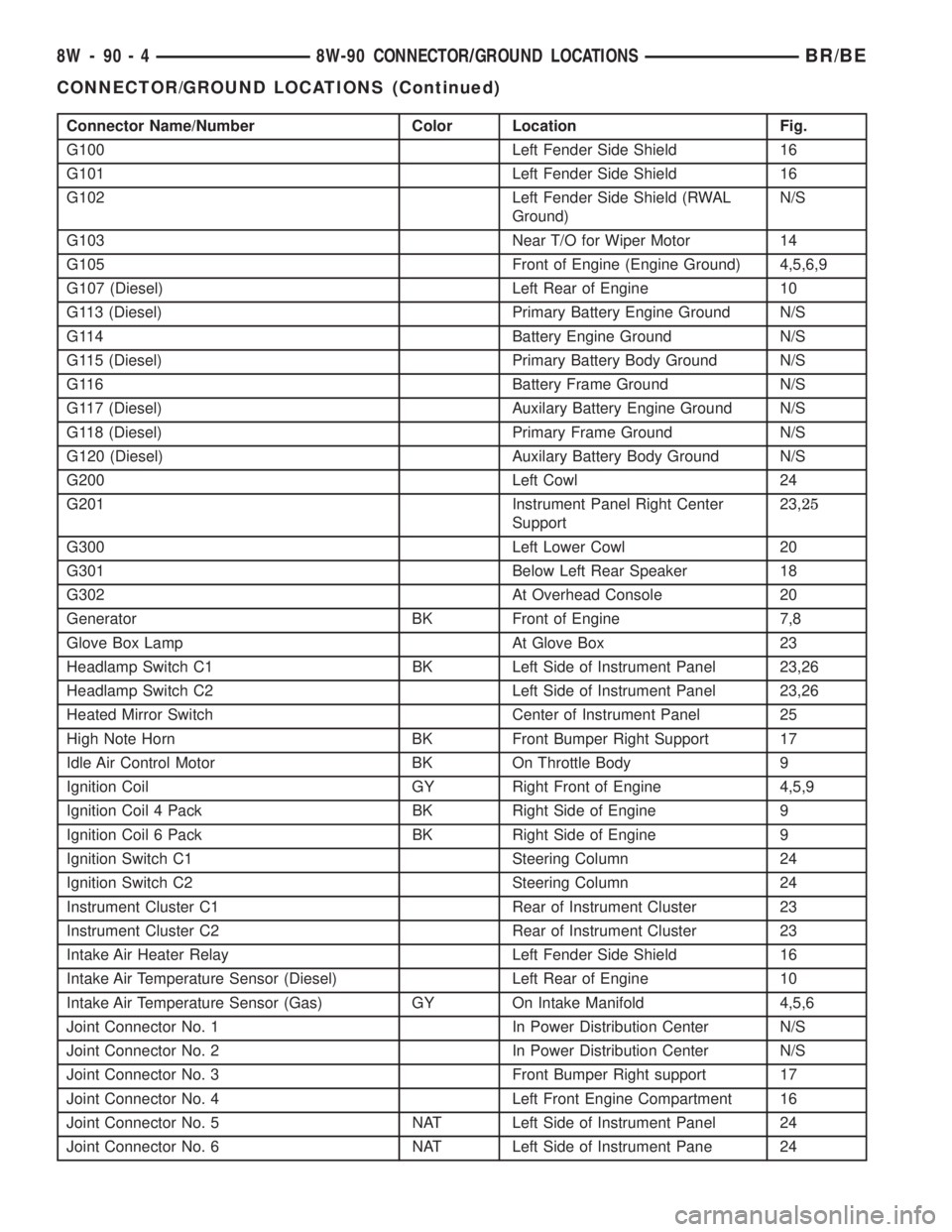
Connector Name/Number Color Location Fig.
G100 Left Fender Side Shield 16
G101 Left Fender Side Shield 16
G102 Left Fender Side Shield (RWAL
Ground)N/S
G103 Near T/O for Wiper Motor 14
G105 Front of Engine (Engine Ground) 4,5,6,9
G107 (Diesel) Left Rear of Engine 10
G113 (Diesel) Primary Battery Engine Ground N/S
G114 Battery Engine Ground N/S
G115 (Diesel) Primary Battery Body Ground N/S
G116 Battery Frame Ground N/S
G117 (Diesel) Auxilary Battery Engine Ground N/S
G118 (Diesel) Primary Frame Ground N/S
G120 (Diesel) Auxilary Battery Body Ground N/S
G200 Left Cowl 24
G201 Instrument Panel Right Center
Support23,25
G300 Left Lower Cowl 20
G301 Below Left Rear Speaker 18
G302 At Overhead Console 20
Generator BK Front of Engine 7,8
Glove Box Lamp At Glove Box 23
Headlamp Switch C1 BK Left Side of Instrument Panel 23,26
Headlamp Switch C2 Left Side of Instrument Panel 23,26
Heated Mirror Switch Center of Instrument Panel 25
High Note Horn BK Front Bumper Right Support 17
Idle Air Control Motor BK On Throttle Body 9
Ignition Coil GY Right Front of Engine 4,5,9
Ignition Coil 4 Pack BK Right Side of Engine 9
Ignition Coil 6 Pack BK Right Side of Engine 9
Ignition Switch C1 Steering Column 24
Ignition Switch C2 Steering Column 24
Instrument Cluster C1 Rear of Instrument Cluster 23
Instrument Cluster C2 Rear of Instrument Cluster 23
Intake Air Heater Relay Left Fender Side Shield 16
Intake Air Temperature Sensor (Diesel) Left Rear of Engine 10
Intake Air Temperature Sensor (Gas) GY On Intake Manifold 4,5,6
Joint Connector No. 1 In Power Distribution Center N/S
Joint Connector No. 2 In Power Distribution Center N/S
Joint Connector No. 3 Front Bumper Right support 17
Joint Connector No. 4 Left Front Engine Compartment 16
Joint Connector No. 5 NAT Left Side of Instrument Panel 24
Joint Connector No. 6 NAT Left Side of Instrument Pane 24
8W - 90 - 4 8W-90 CONNECTOR/GROUND LOCATIONSBR/BE
CONNECTOR/GROUND LOCATIONS (Continued)
Page 1096 of 2889
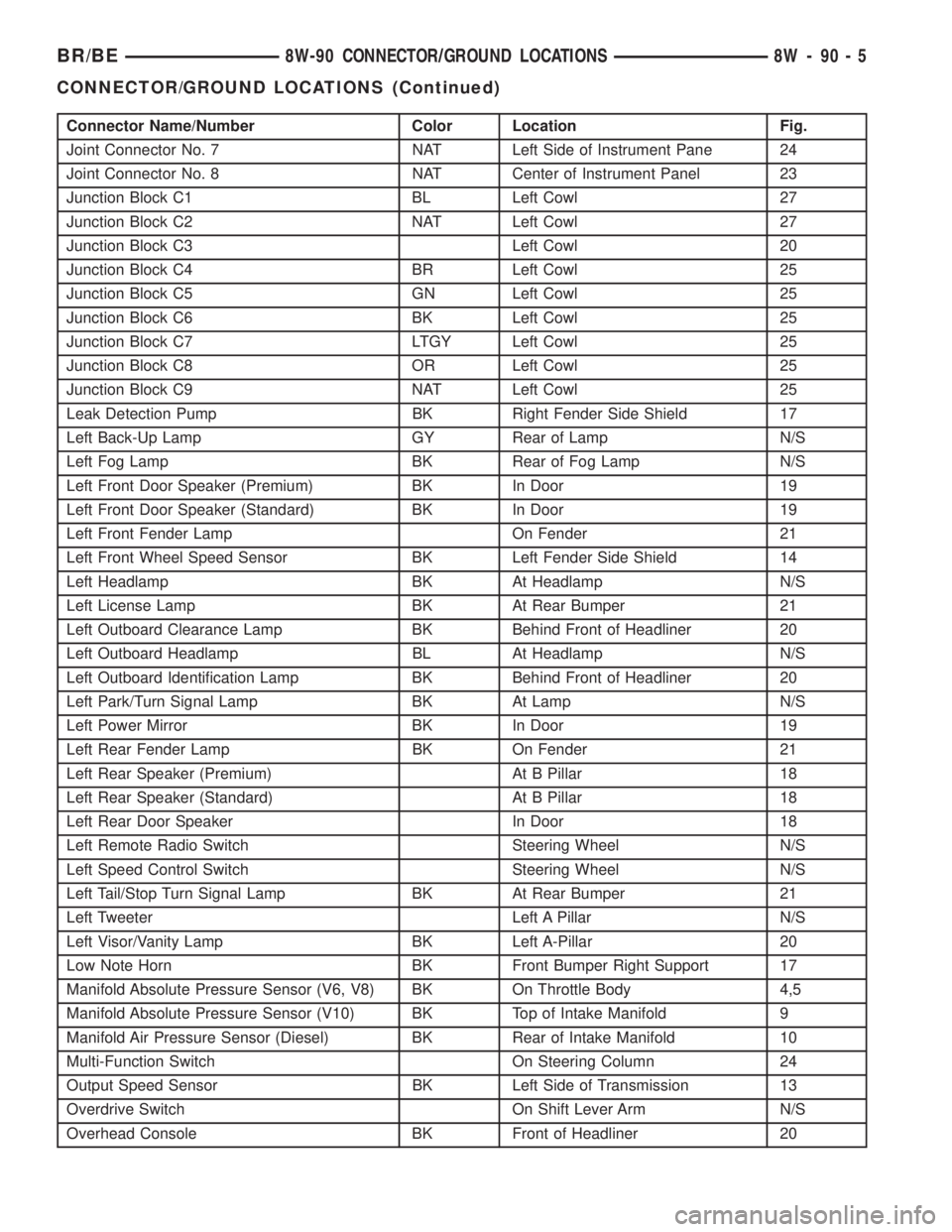
Connector Name/Number Color Location Fig.
Joint Connector No. 7 NAT Left Side of Instrument Pane 24
Joint Connector No. 8 NAT Center of Instrument Panel 23
Junction Block C1 BL Left Cowl 27
Junction Block C2 NAT Left Cowl 27
Junction Block C3 Left Cowl 20
Junction Block C4 BR Left Cowl 25
Junction Block C5 GN Left Cowl 25
Junction Block C6 BK Left Cowl 25
Junction Block C7 LTGY Left Cowl 25
Junction Block C8 OR Left Cowl 25
Junction Block C9 NAT Left Cowl 25
Leak Detection Pump BK Right Fender Side Shield 17
Left Back-Up Lamp GY Rear of Lamp N/S
Left Fog Lamp BK Rear of Fog Lamp N/S
Left Front Door Speaker (Premium) BK In Door 19
Left Front Door Speaker (Standard) BK In Door 19
Left Front Fender Lamp On Fender 21
Left Front Wheel Speed Sensor BK Left Fender Side Shield 14
Left Headlamp BK At Headlamp N/S
Left License Lamp BK At Rear Bumper 21
Left Outboard Clearance Lamp BK Behind Front of Headliner 20
Left Outboard Headlamp BL At Headlamp N/S
Left Outboard Identification Lamp BK Behind Front of Headliner 20
Left Park/Turn Signal Lamp BK At Lamp N/S
Left Power Mirror BK In Door 19
Left Rear Fender Lamp BK On Fender 21
Left Rear Speaker (Premium) At B Pillar 18
Left Rear Speaker (Standard) At B Pillar 18
Left Rear Door Speaker In Door 18
Left Remote Radio Switch Steering Wheel N/S
Left Speed Control Switch Steering Wheel N/S
Left Tail/Stop Turn Signal Lamp BK At Rear Bumper 21
Left Tweeter Left A Pillar N/S
Left Visor/Vanity Lamp BK Left A-Pillar 20
Low Note Horn BK Front Bumper Right Support 17
Manifold Absolute Pressure Sensor (V6, V8) BK On Throttle Body 4,5
Manifold Absolute Pressure Sensor (V10) BK Top of Intake Manifold 9
Manifold Air Pressure Sensor (Diesel) BK Rear of Intake Manifold 10
Multi-Function Switch On Steering Column 24
Output Speed Sensor BK Left Side of Transmission 13
Overdrive Switch On Shift Lever Arm N/S
Overhead Console BK Front of Headliner 20
BR/BE8W-90 CONNECTOR/GROUND LOCATIONS 8W - 90 - 5
CONNECTOR/GROUND LOCATIONS (Continued)
Page 1097 of 2889
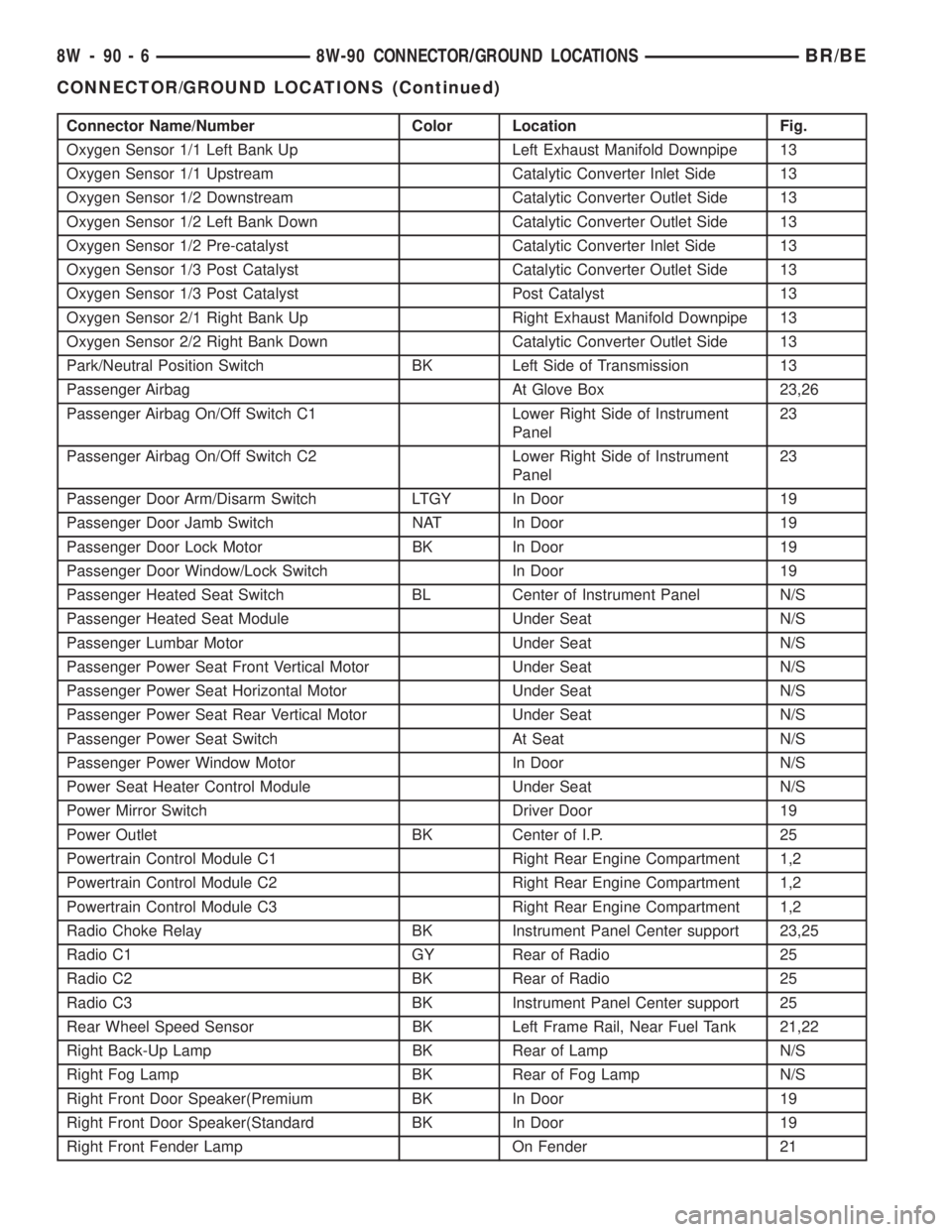
Connector Name/Number Color Location Fig.
Oxygen Sensor 1/1 Left Bank Up Left Exhaust Manifold Downpipe 13
Oxygen Sensor 1/1 Upstream Catalytic Converter Inlet Side 13
Oxygen Sensor 1/2 Downstream Catalytic Converter Outlet Side 13
Oxygen Sensor 1/2 Left Bank Down Catalytic Converter Outlet Side 13
Oxygen Sensor 1/2 Pre-catalyst Catalytic Converter Inlet Side 13
Oxygen Sensor 1/3 Post Catalyst Catalytic Converter Outlet Side 13
Oxygen Sensor 1/3 Post Catalyst Post Catalyst 13
Oxygen Sensor 2/1 Right Bank Up Right Exhaust Manifold Downpipe 13
Oxygen Sensor 2/2 Right Bank Down Catalytic Converter Outlet Side 13
Park/Neutral Position Switch BK Left Side of Transmission 13
Passenger Airbag At Glove Box 23,26
Passenger Airbag On/Off Switch C1 Lower Right Side of Instrument
Panel23
Passenger Airbag On/Off Switch C2 Lower Right Side of Instrument
Panel23
Passenger Door Arm/Disarm Switch LTGY In Door 19
Passenger Door Jamb Switch NAT In Door 19
Passenger Door Lock Motor BK In Door 19
Passenger Door Window/Lock Switch In Door 19
Passenger Heated Seat Switch BL Center of Instrument Panel N/S
Passenger Heated Seat Module Under Seat N/S
Passenger Lumbar Motor Under Seat N/S
Passenger Power Seat Front Vertical Motor Under Seat N/S
Passenger Power Seat Horizontal Motor Under Seat N/S
Passenger Power Seat Rear Vertical Motor Under Seat N/S
Passenger Power Seat Switch At Seat N/S
Passenger Power Window Motor In Door N/S
Power Seat Heater Control Module Under Seat N/S
Power Mirror Switch Driver Door 19
Power Outlet BK Center of I.P. 25
Powertrain Control Module C1 Right Rear Engine Compartment 1,2
Powertrain Control Module C2 Right Rear Engine Compartment 1,2
Powertrain Control Module C3 Right Rear Engine Compartment 1,2
Radio Choke Relay BK Instrument Panel Center support 23,25
Radio C1 GY Rear of Radio 25
Radio C2 BK Rear of Radio 25
Radio C3 BK Instrument Panel Center support 25
Rear Wheel Speed Sensor BK Left Frame Rail, Near Fuel Tank 21,22
Right Back-Up Lamp BK Rear of Lamp N/S
Right Fog Lamp BK Rear of Fog Lamp N/S
Right Front Door Speaker(Premium BK In Door 19
Right Front Door Speaker(Standard BK In Door 19
Right Front Fender Lamp On Fender 21
8W - 90 - 6 8W-90 CONNECTOR/GROUND LOCATIONSBR/BE
CONNECTOR/GROUND LOCATIONS (Continued)
Page 1098 of 2889
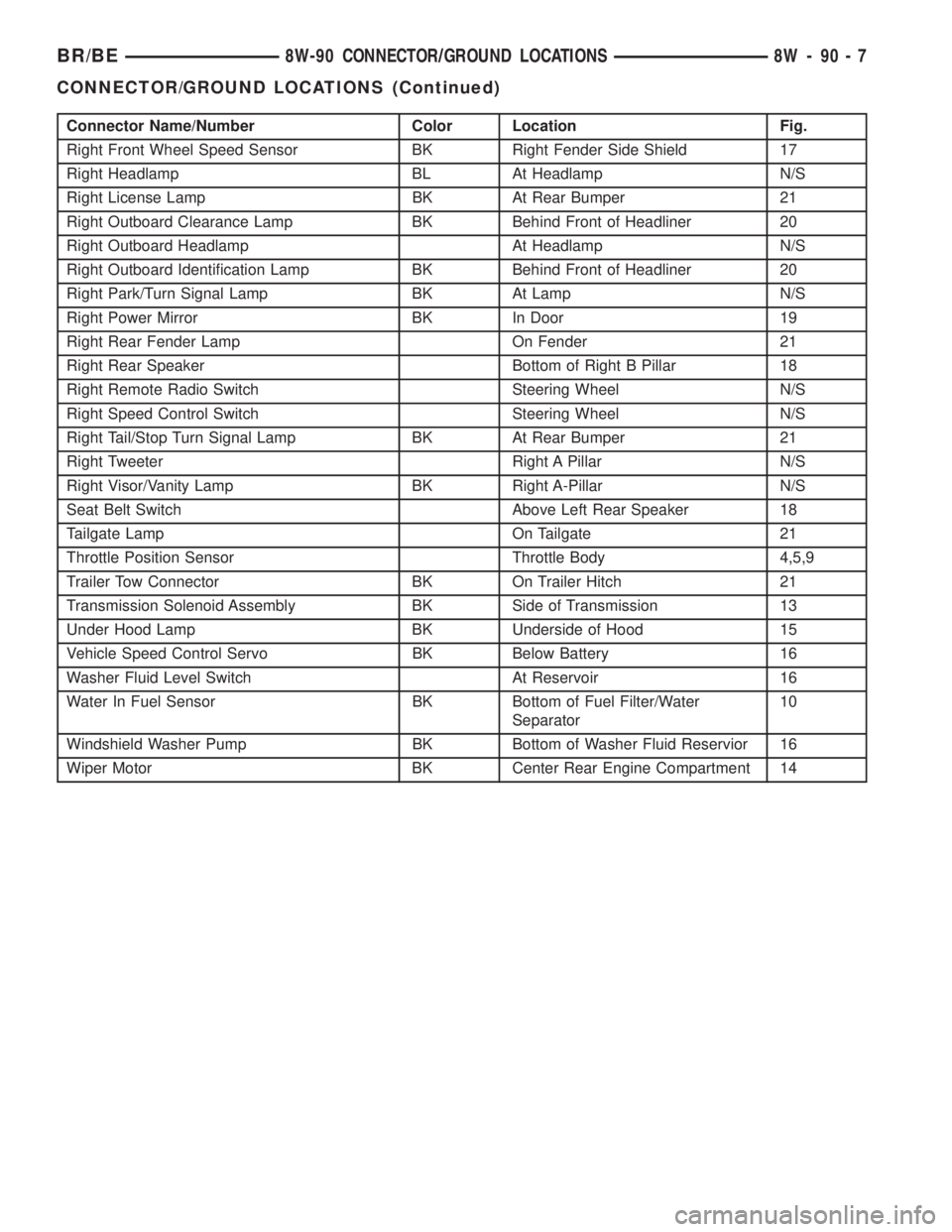
Connector Name/Number Color Location Fig.
Right Front Wheel Speed Sensor BK Right Fender Side Shield 17
Right Headlamp BL At Headlamp N/S
Right License Lamp BK At Rear Bumper 21
Right Outboard Clearance Lamp BK Behind Front of Headliner 20
Right Outboard Headlamp At Headlamp N/S
Right Outboard Identification Lamp BK Behind Front of Headliner 20
Right Park/Turn Signal Lamp BK At Lamp N/S
Right Power Mirror BK In Door 19
Right Rear Fender Lamp On Fender 21
Right Rear Speaker Bottom of Right B Pillar 18
Right Remote Radio Switch Steering Wheel N/S
Right Speed Control Switch Steering Wheel N/S
Right Tail/Stop Turn Signal Lamp BK At Rear Bumper 21
Right Tweeter Right A Pillar N/S
Right Visor/Vanity Lamp BK Right A-Pillar N/S
Seat Belt Switch Above Left Rear Speaker 18
Tailgate Lamp On Tailgate 21
Throttle Position Sensor Throttle Body 4,5,9
Trailer Tow Connector BK On Trailer Hitch 21
Transmission Solenoid Assembly BK Side of Transmission 13
Under Hood Lamp BK Underside of Hood 15
Vehicle Speed Control Servo BK Below Battery 16
Washer Fluid Level Switch At Reservoir 16
Water In Fuel Sensor BK Bottom of Fuel Filter/Water
Separator10
Windshield Washer Pump BK Bottom of Washer Fluid Reservior 16
Wiper Motor BK Center Rear Engine Compartment 14
BR/BE8W-90 CONNECTOR/GROUND LOCATIONS 8W - 90 - 7
CONNECTOR/GROUND LOCATIONS (Continued)
Page 2575 of 2889
DIAGNOSIS AND TESTING ± WATER LEAKS
Water leaks can be caused by poor sealing,
improper body component alignment, body seam
porosity, missing plugs, or blocked drain holes. Cen-
trifugal and gravitational force can cause water to
drip from a location away from the actual leak point,
making leak detection difficult. All body sealing
points should be water tight in normal wet-driving
conditions. Water flowing downward from the front of
the vehicle should not enter the passenger or luggage
compartment. Moving sealing surfaces will not
always seal water tight under all conditions. At
times, side glass or door seals will allow water to
enter the passenger compartment during high pres-
sure washing or hard driving rain (severe) condi-
tions. Overcompensating on door or glass
adjustments to stop a water leak that occurs under
severe conditions can cause premature seal wear and
excessive closing or latching effort. After completing
a repair, water test vehicle to verify leak has stopped
before returning vehicle to use.
VISUAL INSPECTION BEFORE WATER LEAK TESTS
Verify that floor and body plugs are in place, body
drains are clear, and body components are properly
aligned and sealed. If component alignment or seal-
ing is necessary, refer to the appropriate section of
this group for proper procedures.
WATER LEAK TESTS
WARNING: DO NOT USE ELECTRIC SHOP LIGHTS
OR TOOLS IN WATER TEST AREA. PERSONAL
INJURY CAN RESULT.
When the conditions causing a water leak have
been determined, simulate the conditions as closely
as possible.
²If a leak occurs with the vehicle parked in a
steady light rain, flood the leak area with an open-
ended garden hose.
²If a leak occurs while driving at highway speeds
in a steady rain, test the leak area with a reasonable
velocity stream or fan spray of water. Direct the
spray in a direction comparable to actual conditions.
²If a leak occurs when the vehicle is parked on an
incline, hoist the end or side of the vehicle to simu-
late this condition. This method can be used when
the leak occurs when the vehicle accelerates, stops or
turns. If the leak occurs on acceleration, hoist the
front of the vehicle. If the leak occurs when braking,
hoist the back of the vehicle. If the leak occurs on left
turns, hoist the left side of the vehicle. If the leak
occurs on right turns, hoist the right side of the vehi-
cle. For hoisting recommendations refer to Group 0,
Lubrication and Maintenance, General Information
section.
WATER LEAK DETECTION
To detect a water leak point-of-entry, do a water
test and watch for water tracks or droplets forming
on the inside of the vehicle. If necessary, remove inte-
rior trim covers or panels to gain visual access to the
leak area. If the hose cannot be positioned without
being held, have someone help do the water test.
Some water leaks must be tested for a considerable
length of time to become apparent. When a leak
appears, find the highest point of the water track or
drop. The highest point usually will show the point of
entry. After leak point has been found, repair the
leak and water test to verify that the leak has
stopped.
Locating the entry point of water that is leaking
into a cavity between panels can be difficult. The
trapped water may splash or run from the cavity,
often at a distance from the entry point. Most water
leaks of this type become apparent after accelerating,
stopping, turning, or when on an incline.
MIRROR INSPECTION METHOD
When a leak point area is visually obstructed, use
a suitable mirror to gain visual access. A mirror can
also be used to deflect light to a limited-access area
to assist in locating a leak point.
BRIGHT LIGHT LEAK TEST METHOD
Some water leaks in the luggage compartment can
be detected without water testing. Position the vehi-
cle in a brightly lit area. From inside the darkened
luggage compartment inspect around seals and body
seams. If necessary, have a helper direct a drop light
over the suspected leak areas around the luggage
compartment. If light is visible through a normally
sealed location, water could enter through the open-
ing.
PRESSURIZED LEAK TEST METHOD
When a water leak into the passenger compart-
ment cannot be detected by water testing, pressurize
the passenger compartment and soap test exterior of
the vehicle. To pressurize the passenger compart-
ment, close all doors and windows, start engine, and
set heater control to high blower in HEAT position. If
engine can not be started, connect a charger to the
battery to ensure adequate voltage to the blower.
With interior pressurized, apply dish detergent solu-
tion to suspected leak area on the exterior of the
vehicle. Apply detergent solution with spray device or
soft bristle brush. If soap bubbles occur at a body
seam, joint, seal or gasket, the leak entry point could
be at that location.
23 - 2 BODYBR/BE
BODY (Continued)
Page 2640 of 2889
DOOR - FRONT
TABLE OF CONTENTS
page page
APPLIQUE
REMOVAL..............................67
INSTALLATION...........................67
DOOR
REMOVAL..............................68
INSTALLATION...........................68
ADJUSTMENTS..........................68
DOOR GLASS
REMOVAL..............................69
INSTALLATION...........................69
EXTERIOR HANDLE
REMOVAL..............................70
INSTALLATION...........................70
GLASS RUN CHANNEL
REMOVAL..............................70
INSTALLATION...........................70
HINGE
REMOVAL..............................70
INSTALLATION...........................71
INSIDE HANDLE ACTUATOR
REMOVAL..............................71
INSTALLATION...........................71LATCH
REMOVAL..............................72
INSTALLATION...........................72
ADJUSTMENTS..........................72
LATCH STRIKER
REMOVAL..............................73
INSTALLATION...........................73
LOCK CYLINDER
REMOVAL..............................73
INSTALLATION...........................73
SIDE VIEW MIRROR FLAG
REMOVAL..............................74
INSTALLATION...........................74
TRIM PANEL
REMOVAL..............................74
INSTALLATION...........................74
WATERDAM
REMOVAL..............................75
INSTALLATION...........................75
WINDOW REGULATOR
REMOVAL..............................75
INSTALLATION...........................76
APPLIQUE
REMOVAL
(1) Using a heat lamp, warm B-pillar to 38É C
(100É F).
(2) Remove glass run weatherstrip (Refer to 23 -
BODY/WEATHERSTRIP/SEALS/FDR GLASS RUN
WEATHERSTRIP - REMOVAL).
(3) Remove outer belt weatherstrip (Refer to 23 -
BODY/WEATHERSTRIP/SEALS/FDR OUTER BELT
WEATHERSTRIP - REMOVAL).
(4) Using an even pressure pull, peel B-pillar
applique away from the B-pillar.
INSTALLATION
Installation equipment needed:
²Lint free applicator cloth
²six inch applicator squeegee
²Piercing pin
(1) Clean B-pillar using Mopar Super Kleen or
equivalent.
(2) Wipe surface with a lint free cloth.
(3) Using a heat gun, warm surface to 22É C (70É
F).(4) Fold down, up/down locator tab (1a or 1b) (Fig.
1)along crease.
(5) Remove carrier from adhesion strip (2).
(6) Using up/down locator tab (1a or 1b) and fore/
aft locator tab (3a or 3b), position the applique on the
upper portion of the B-pillar.
(7) Using the lower edge locator (4), position the
applique on the lower portion of the B-pillar.
(8) Verify the applique is positioned correctly and
press the adhesion strip (2) to the door to tempo-
rarily secure it in place.
(9) Remove the carrier for the applique.
(10) Holding the applique from the surface, apply
firm downward pressure with a six inch applicator
squeegee. Ensure the lower rear edge (4) is aligned
correctly.
(11) Wrap edges around door to at least a 90É
angle.
(12) Remove premask by pulling in a firm contin-
uous manner from top down at 180É.
(13) Complete wrapping applique around the door
edges.
(14) Inspect for air bubbles. Small bubbles can be
pierced with a sharp pin and smoothed out.
BR/BEDOOR - FRONT 23 - 67
Page 2647 of 2889
SIDE VIEW MIRROR FLAG
REMOVAL
(1) Remove door trim panel.
(2) Remove flag door seal.
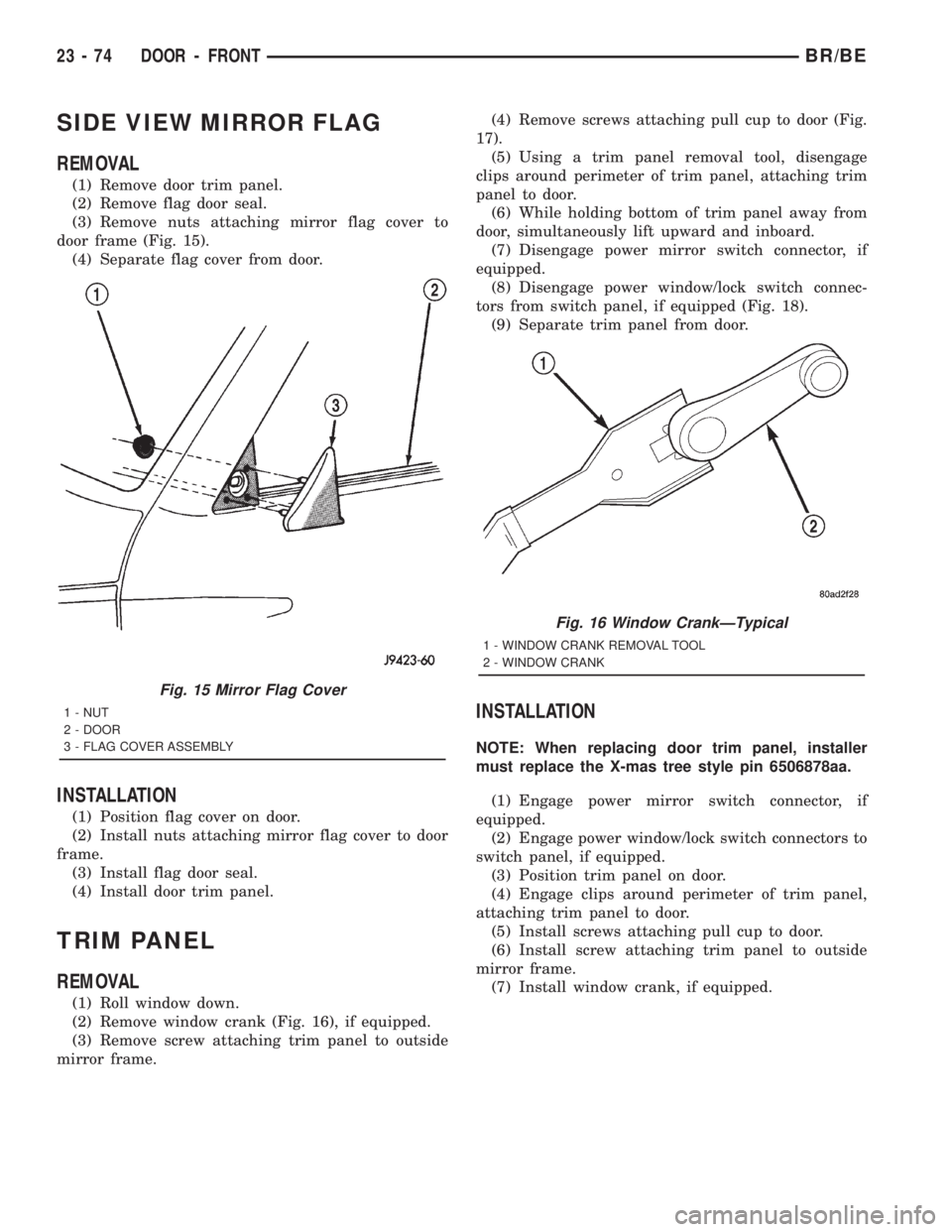
(3) Remove nuts attaching mirror flag cover to
door frame (Fig. 15).
(4) Separate flag cover from door.
INSTALLATION
(1) Position flag cover on door.
(2) Install nuts attaching mirror flag cover to door
frame.
(3) Install flag door seal.
(4) Install door trim panel.
TRIM PANEL
REMOVAL
(1) Roll window down.
(2) Remove window crank (Fig. 16), if equipped.
(3) Remove screw attaching trim panel to outside
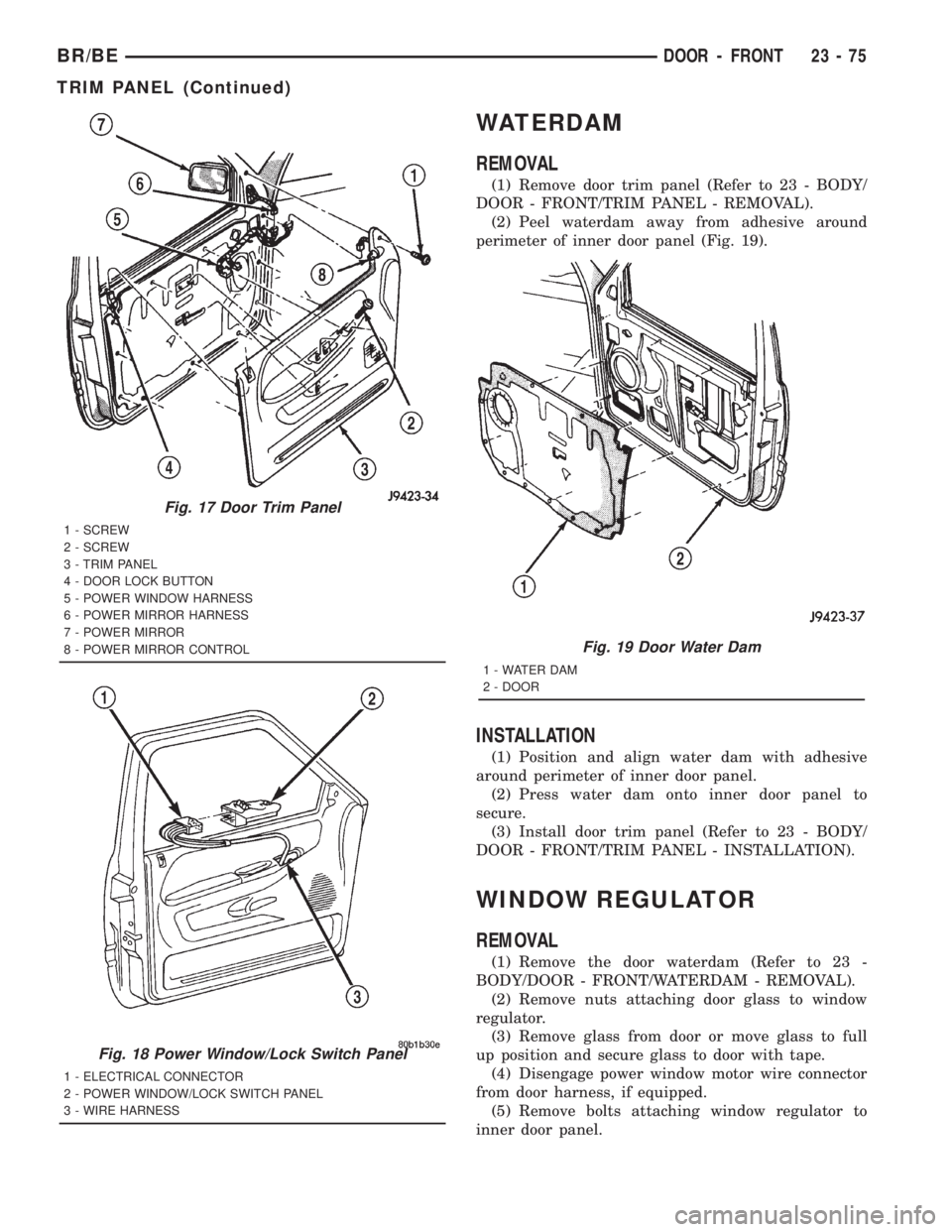
mirror frame.(4) Remove screws attaching pull cup to door (Fig.
17).
(5) Using a trim panel removal tool, disengage
clips around perimeter of trim panel, attaching trim
panel to door.
(6) While holding bottom of trim panel away from
door, simultaneously lift upward and inboard.
(7) Disengage power mirror switch connector, if
equipped.
(8) Disengage power window/lock switch connec-
tors from switch panel, if equipped (Fig. 18).
(9) Separate trim panel from door.
INSTALLATION
NOTE: When replacing door trim panel, installer
must replace the X-mas tree style pin 6506878aa.
(1) Engage power mirror switch connector, if
equipped.
(2) Engage power window/lock switch connectors to
switch panel, if equipped.
(3) Position trim panel on door.
(4) Engage clips around perimeter of trim panel,
attaching trim panel to door.
(5) Install screws attaching pull cup to door.
(6) Install screw attaching trim panel to outside
mirror frame.
(7) Install window crank, if equipped.
Fig. 15 Mirror Flag Cover
1 - NUT
2 - DOOR
3 - FLAG COVER ASSEMBLY
Fig. 16 Window CrankÐTypical
1 - WINDOW CRANK REMOVAL TOOL
2 - WINDOW CRANK
23 - 74 DOOR - FRONTBR/BE
Page 2648 of 2889
WATERDAM
REMOVAL
(1) Remove door trim panel (Refer to 23 - BODY/
DOOR - FRONT/TRIM PANEL - REMOVAL).
(2) Peel waterdam away from adhesive around
perimeter of inner door panel (Fig. 19).
INSTALLATION
(1) Position and align water dam with adhesive
around perimeter of inner door panel.
(2) Press water dam onto inner door panel to
secure.
(3) Install door trim panel (Refer to 23 - BODY/
DOOR - FRONT/TRIM PANEL - INSTALLATION).
WINDOW REGULATOR
REMOVAL
(1) Remove the door waterdam (Refer to 23 -
BODY/DOOR - FRONT/WATERDAM - REMOVAL).
(2) Remove nuts attaching door glass to window
regulator.
(3) Remove glass from door or move glass to full
up position and secure glass to door with tape.
(4) Disengage power window motor wire connector
from door harness, if equipped.
(5) Remove bolts attaching window regulator to
inner door panel.
Fig. 17 Door Trim Panel
1 - SCREW
2 - SCREW
3 - TRIM PANEL
4 - DOOR LOCK BUTTON
5 - POWER WINDOW HARNESS
6 - POWER MIRROR HARNESS
7 - POWER MIRROR
8 - POWER MIRROR CONTROL
Fig. 18 Power Window/Lock Switch Panel
1 - ELECTRICAL CONNECTOR
2 - POWER WINDOW/LOCK SWITCH PANEL
3 - WIRE HARNESS
Fig. 19 Door Water Dam
1 - WATER DAM
2 - DOOR
BR/BEDOOR - FRONT 23 - 75
TRIM PANEL (Continued)