2001 DODGE RAM Heat
[x] Cancel search: HeatPage 2706 of 2889
LUMBAR SUPPORT
REMOVAL
(1) Remove the seat back cover. (Refer to 23 -
BODY/SEATS/SEAT BACK COVER - REMOVAL).
(2) Disengage the heated seat connectors.
(3) Partially separate the seat back foam to access
the lumbar frame clips.
(4) Separate the lumbar assembly from the seat
frame.
INSTALLATION
(1) Position the lumbar assembly on the seat back
frame.
(2) Engage the retaining clips on the seat frame.
(3) Route the lumbar wire harness through seat
assembly.
(4) Engage the heated seat wire connectors.
(5) Install the seat back cover. (Refer to 23 -
BODY/SEATS/SEAT BACK COVER - INSTALLA-
TION).
(6) Perform a function check on the seat opera-
tions.
SEAT - BENCH SEAT
REMOVAL
(1) Move seat track to forward position.
(2) Hinge seat backs forward.
(3) Remove nuts attaching rear of seat tracks to
floor (Fig. 4).
(4) Move seat track to rearward position.
(5) Remove bolts attaching front of seat tracks to
floor.
(6) Separate seat from vehicle.
INSTALLATION
NOTE: Seat adjustment latch must be engaged and
in equal positions prior to seat installation. Verify
inboard and outboard seat latch operation.
(1) Position seat in vehicle.
(2) Install bolts attaching front of seat tracks to
floor. Tighten bolts to 54 N´m (40 ft. lbs.) torque.
(3) Move seat track to forward position.
(4) Hinge seat backs forward.
(5) Install nuts attaching rear of seat tracks to
floor. Tighten inboard nuts to 40 N´m (30 ft. lbs.)
torque. Tighten outboard nuts to 54 N´m (40 ft. lbs.)
torque.
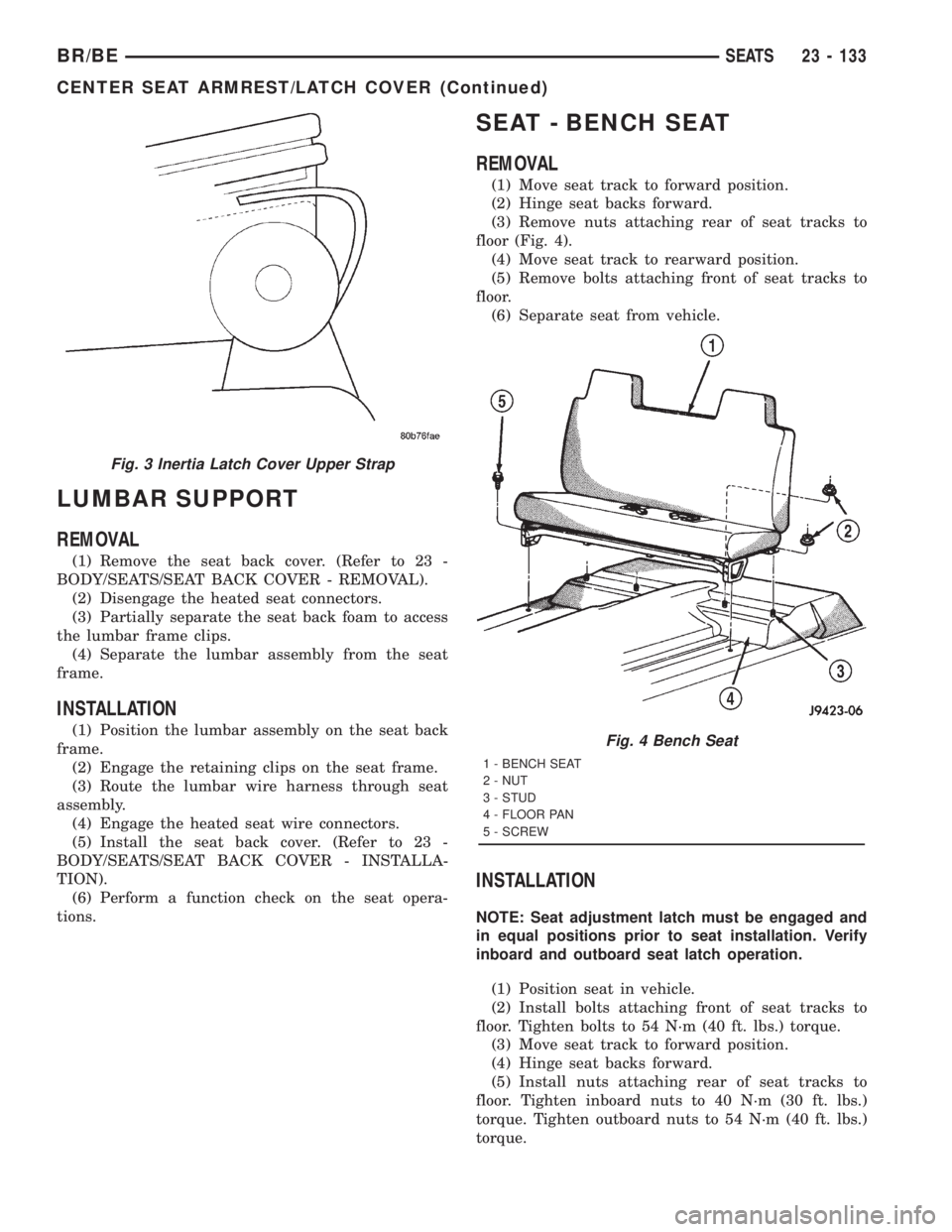
Fig. 3 Inertia Latch Cover Upper Strap
Fig. 4 Bench Seat
1 - BENCH SEAT
2 - NUT
3 - STUD
4 - FLOOR PAN
5 - SCREW
BR/BESEATS 23 - 133
CENTER SEAT ARMREST/LATCH COVER (Continued)
Page 2713 of 2889
QUAD CAB
(1) Remove seat cushion. (Refer to 23 - BODY/
SEATS/SEAT CUSHION - REMOVAL)
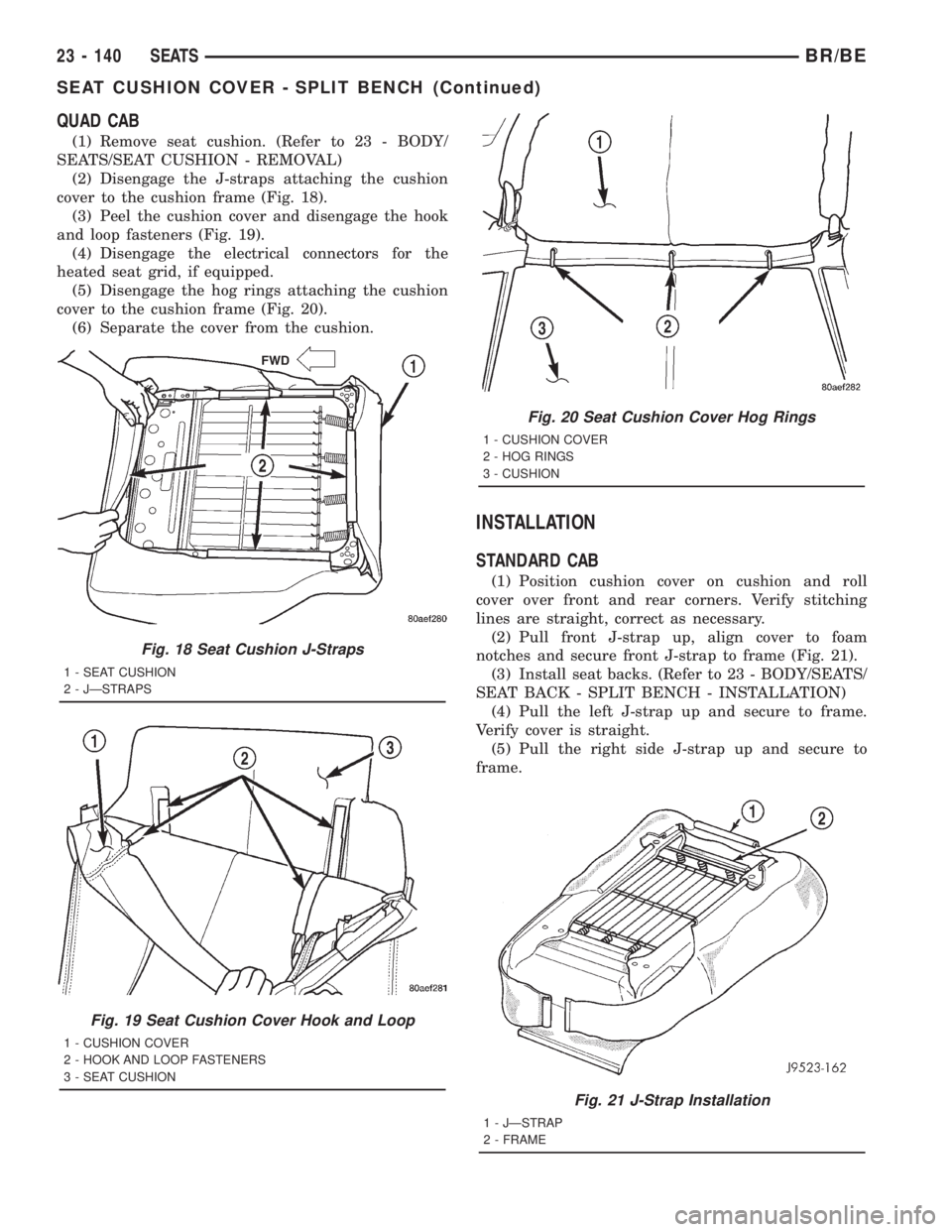
(2) Disengage the J-straps attaching the cushion
cover to the cushion frame (Fig. 18).
(3) Peel the cushion cover and disengage the hook
and loop fasteners (Fig. 19).
(4) Disengage the electrical connectors for the
heated seat grid, if equipped.
(5) Disengage the hog rings attaching the cushion
cover to the cushion frame (Fig. 20).
(6) Separate the cover from the cushion.
INSTALLATION
STANDARD CAB
(1) Position cushion cover on cushion and roll
cover over front and rear corners. Verify stitching
lines are straight, correct as necessary.
(2) Pull front J-strap up, align cover to foam
notches and secure front J-strap to frame (Fig. 21).
(3) Install seat backs. (Refer to 23 - BODY/SEATS/
SEAT BACK - SPLIT BENCH - INSTALLATION)
(4) Pull the left J-strap up and secure to frame.
Verify cover is straight.
(5) Pull the right side J-strap up and secure to
frame.
Fig. 21 J-Strap Installation
1 - JÐSTRAP
2 - FRAME
Fig. 18 Seat Cushion J-Straps
1 - SEAT CUSHION
2 - JÐSTRAPS
Fig. 19 Seat Cushion Cover Hook and Loop
1 - CUSHION COVER
2 - HOOK AND LOOP FASTENERS
3 - SEAT CUSHION
Fig. 20 Seat Cushion Cover Hog Rings
1 - CUSHION COVER
2 - HOG RINGS
3 - CUSHION
23 - 140 SEATSBR/BE
SEAT CUSHION COVER - SPLIT BENCH (Continued)
Page 2714 of 2889
(6) Install seat tracks. (Refer to 23 - BODY/
SEATS/SEAT TRACK - SPLIT BENCH - INSTALLA-
TION)
QUAD CAB
(1) Position the cover on the cushion.
(2) Engage the hog rings attaching the cushion
cover to the cushion frame.
(3) Engage the hook and loop fasteners.
(4) Engage the electrical connectors for the heated
seat grid, if equipped.
(5) Engage the J-straps attaching the cushion
cover to the cushion frame.
(6) Install seat cushion. (Refer to 23 - BODY/
SEATS/SEAT CUSHION - INSTALLATION)
SEAT RISER
REMOVAL
(1) Disconnect seat harness connector.
(2) Remove the seat from the vehicle. (Refer to 23 -
BODY/SEATS/SEAT - BENCH SEAT - REMOVAL) or
(Refer to 23 - BODY/SEATS/SEAT - SPLIT BENCH -
REMOVAL)
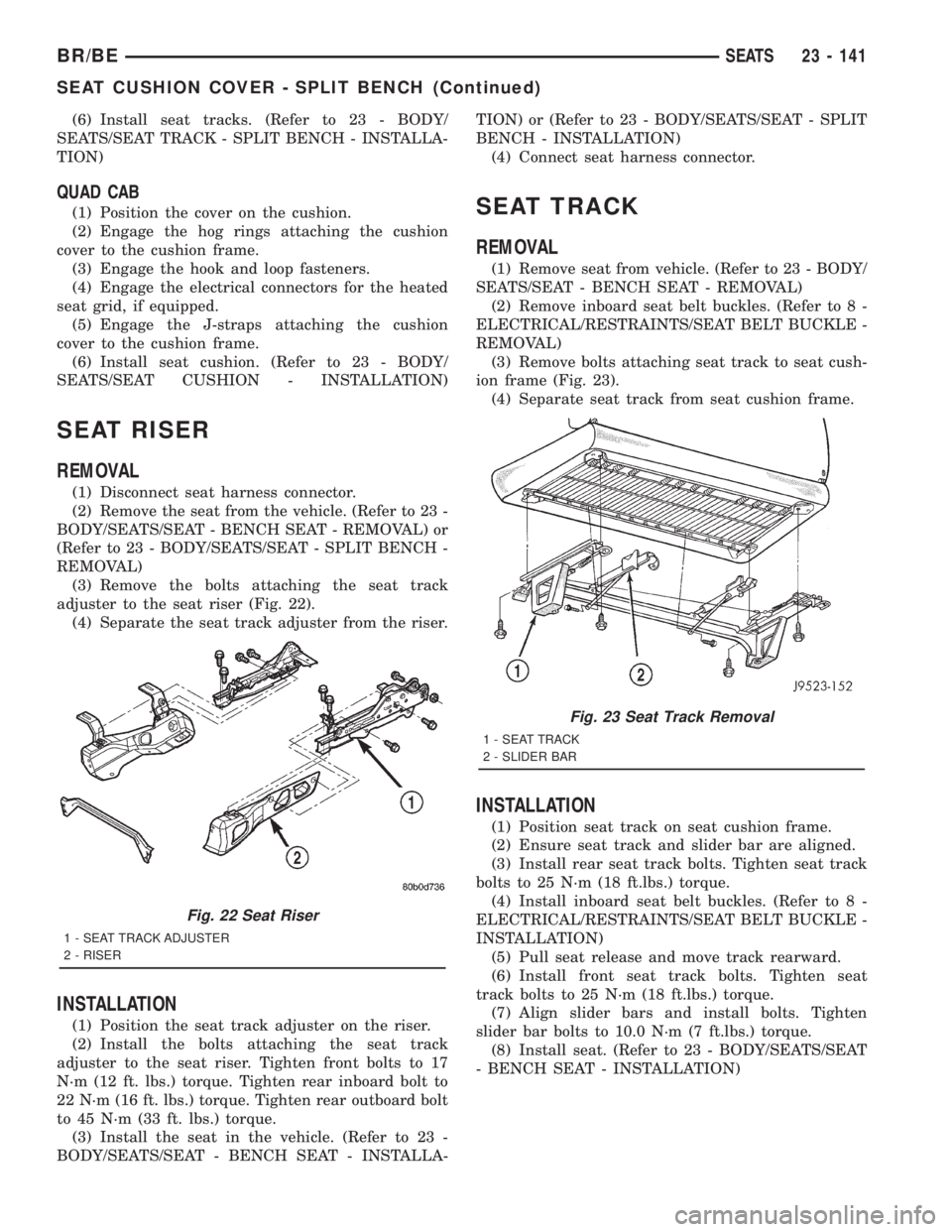
(3) Remove the bolts attaching the seat track
adjuster to the seat riser (Fig. 22).
(4) Separate the seat track adjuster from the riser.
INSTALLATION
(1) Position the seat track adjuster on the riser.
(2) Install the bolts attaching the seat track
adjuster to the seat riser. Tighten front bolts to 17
N´m (12 ft. lbs.) torque. Tighten rear inboard bolt to
22 N´m (16 ft. lbs.) torque. Tighten rear outboard bolt
to 45 N´m (33 ft. lbs.) torque.
(3) Install the seat in the vehicle. (Refer to 23 -
BODY/SEATS/SEAT - BENCH SEAT - INSTALLA-TION) or (Refer to 23 - BODY/SEATS/SEAT - SPLIT
BENCH - INSTALLATION)
(4) Connect seat harness connector.
SEAT TRACK
REMOVAL
(1) Remove seat from vehicle. (Refer to 23 - BODY/
SEATS/SEAT - BENCH SEAT - REMOVAL)
(2) Remove inboard seat belt buckles. (Refer to 8 -
ELECTRICAL/RESTRAINTS/SEAT BELT BUCKLE -
REMOVAL)
(3) Remove bolts attaching seat track to seat cush-
ion frame (Fig. 23).
(4) Separate seat track from seat cushion frame.
INSTALLATION
(1) Position seat track on seat cushion frame.
(2) Ensure seat track and slider bar are aligned.
(3) Install rear seat track bolts. Tighten seat track
bolts to 25 N´m (18 ft.lbs.) torque.
(4) Install inboard seat belt buckles. (Refer to 8 -
ELECTRICAL/RESTRAINTS/SEAT BELT BUCKLE -
INSTALLATION)
(5) Pull seat release and move track rearward.
(6) Install front seat track bolts. Tighten seat
track bolts to 25 N´m (18 ft.lbs.) torque.
(7) Align slider bars and install bolts. Tighten
slider bar bolts to 10.0 N´m (7 ft.lbs.) torque.
(8) Install seat. (Refer to 23 - BODY/SEATS/SEAT
- BENCH SEAT - INSTALLATION)
Fig. 22 Seat Riser
1 - SEAT TRACK ADJUSTER
2 - RISER
Fig. 23 Seat Track Removal
1 - SEAT TRACK
2 - SLIDER BAR
BR/BESEATS 23 - 141
SEAT CUSHION COVER - SPLIT BENCH (Continued)
Page 2725 of 2889
WEATHERSTRIP/SEALS
TABLE OF CONTENTS
page page
B-PILLAR DOOR SEAL
REMOVAL.............................152
INSTALLATION..........................152
COWL WEATHERSTRIP
REMOVAL.............................153
INSTALLATION..........................153
DOOR OPENING SEAL
REMOVAL.............................153
INSTALLATION..........................153
FRONT DOOR GLASS RUN WEATHERSTRIP
REMOVAL.............................153
INSTALLATION..........................154FRONT DOOR INNER BELT WEATHERSTRIP
REMOVAL.............................154
INSTALLATION..........................154
FRONT DOOR OUTER BELT WEATHERSTRIP
REMOVAL.............................154
INSTALLATION..........................154
FRONT DOOR UPPER CORNER SEAL
REMOVAL.............................154
INSTALLATION..........................155
FRONT DOOR SECOND WEATHERSTRIP
REMOVAL.............................155
INSTALLATION..........................155
B-PILLAR DOOR SEAL
REMOVAL
(1) Warm the seal and body metal to approxi-
mately 38ÉC (100ÉF) using a suitable heat lamp or
heat gun.
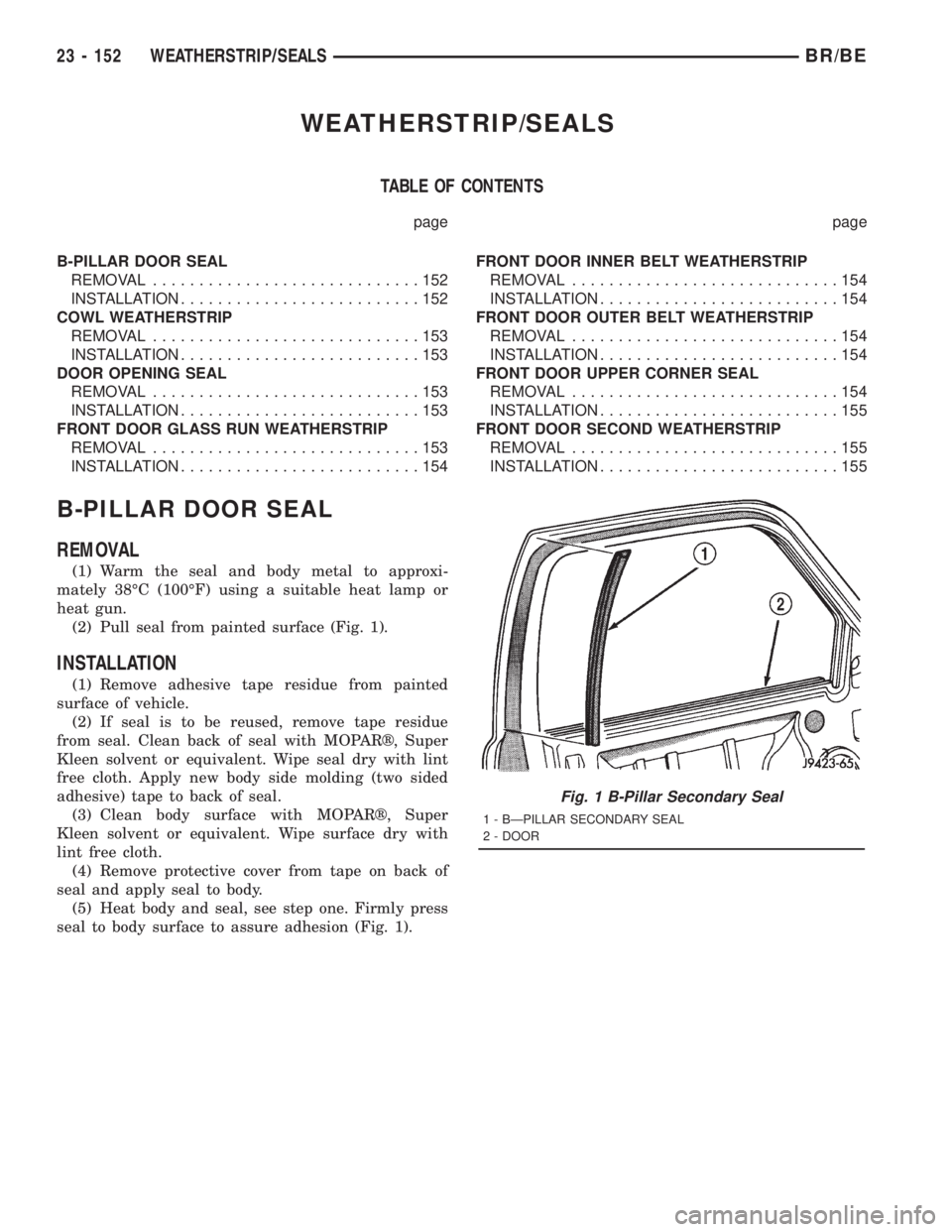
(2) Pull seal from painted surface (Fig. 1).
INSTALLATION
(1) Remove adhesive tape residue from painted
surface of vehicle.
(2) If seal is to be reused, remove tape residue
from seal. Clean back of seal with MOPARž, Super
Kleen solvent or equivalent. Wipe seal dry with lint
free cloth. Apply new body side molding (two sided
adhesive) tape to back of seal.
(3) Clean body surface with MOPARž, Super
Kleen solvent or equivalent. Wipe surface dry with
lint free cloth.
(4) Remove protective cover from tape on back of
seal and apply seal to body.
(5) Heat body and seal, see step one. Firmly press
seal to body surface to assure adhesion (Fig. 1).
Fig. 1 B-Pillar Secondary Seal
1 - BÐPILLAR SECONDARY SEAL
2 - DOOR
23 - 152 WEATHERSTRIP/SEALSBR/BE
Page 2730 of 2889
HEATING & AIR CONDITIONING
TABLE OF CONTENTS
page page
HEATING & AIR CONDITIONING
DESCRIPTION............................1
OPERATION.............................1
DIAGNOSIS AND TESTING..................2
A/C PERFORMANCE.....................2
HEATER PERFORMANCE.................6STANDARD PROCEDURE...................7
DIODE REPLACEMENT...................7
SPECIFICATIONS.........................8
CONTROLS..............................9
DISTRIBUTION..........................31
PLUMBING.............................40
HEATING & AIR
CONDITIONING
DESCRIPTION - HEATER AND AIR
CONDITIONER
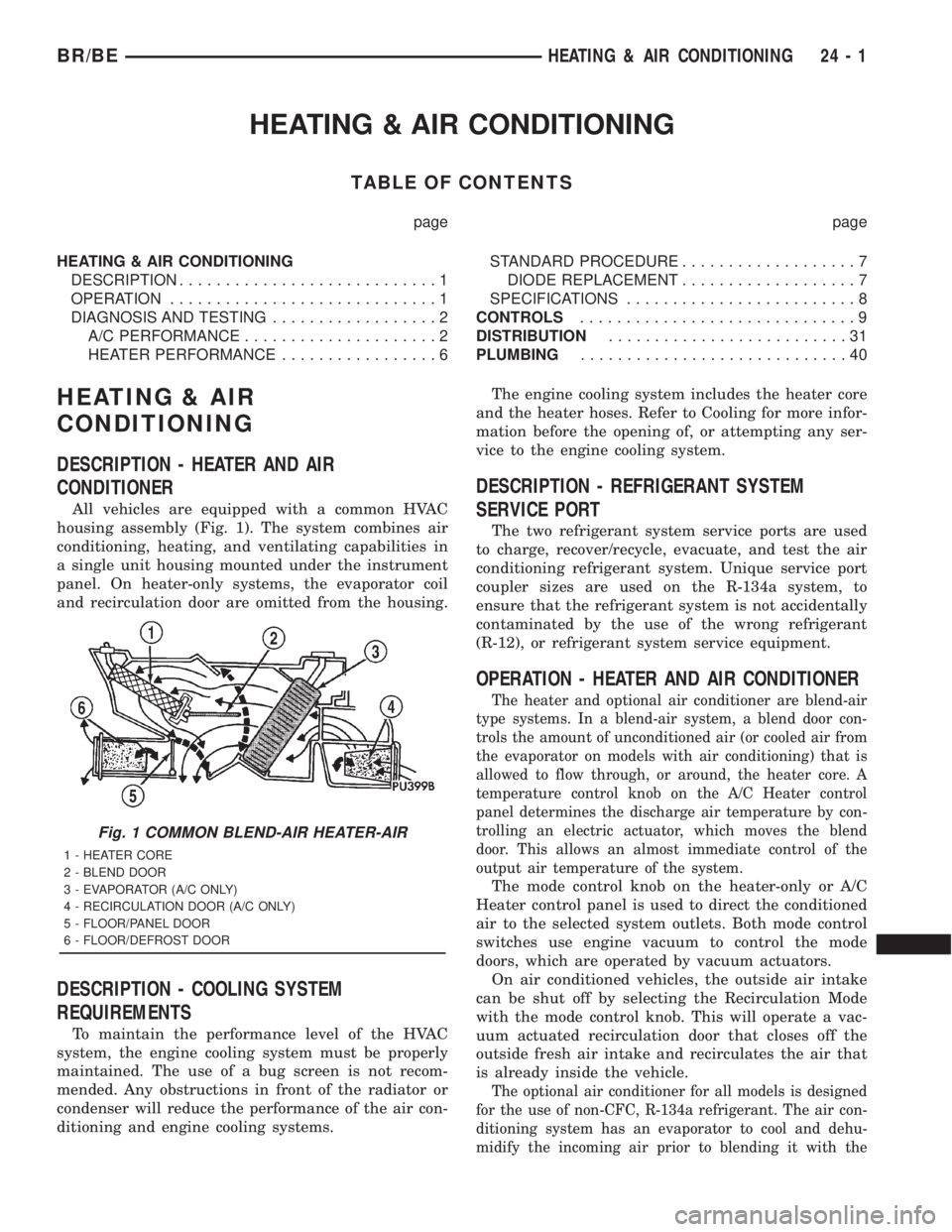
All vehicles are equipped with a common HVAC
housing assembly (Fig. 1). The system combines air
conditioning, heating, and ventilating capabilities in
a single unit housing mounted under the instrument
panel. On heater-only systems, the evaporator coil
and recirculation door are omitted from the housing.
DESCRIPTION - COOLING SYSTEM
REQUIREMENTS
To maintain the performance level of the HVAC
system, the engine cooling system must be properly
maintained. The use of a bug screen is not recom-
mended. Any obstructions in front of the radiator or
condenser will reduce the performance of the air con-
ditioning and engine cooling systems.The engine cooling system includes the heater core
and the heater hoses. Refer to Cooling for more infor-
mation before the opening of, or attempting any ser-
vice to the engine cooling system.
DESCRIPTION - REFRIGERANT SYSTEM
SERVICE PORT
The two refrigerant system service ports are used
to charge, recover/recycle, evacuate, and test the air
conditioning refrigerant system. Unique service port
coupler sizes are used on the R-134a system, to
ensure that the refrigerant system is not accidentally
contaminated by the use of the wrong refrigerant
(R-12), or refrigerant system service equipment.
OPERATION - HEATER AND AIR CONDITIONER
The heater and optional air conditioner are blend-air
type systems. In a blend-air system, a blend door con-
trols the amount of unconditioned air (or cooled air from
the evaporator on models with air conditioning) that is
allowed to flow through, or around, the heater core. A
temperature control knob on the A/C Heater control
panel determines the discharge air temperature by con-
trolling an electric actuator, which moves the blend
door. This allows an almost immediate control of the
output air temperature of the system.
The mode control knob on the heater-only or A/C
Heater control panel is used to direct the conditioned
air to the selected system outlets. Both mode control
switches use engine vacuum to control the mode
doors, which are operated by vacuum actuators.
On air conditioned vehicles, the outside air intake
can be shut off by selecting the Recirculation Mode
with the mode control knob. This will operate a vac-
uum actuated recirculation door that closes off the
outside fresh air intake and recirculates the air that
is already inside the vehicle.
The optional air conditioner for all models is designed
for the use of non-CFC, R-134a refrigerant. The air con-
ditioning system has an evaporator to cool and dehu-
midify the incoming air prior to blending it with the
Fig. 1 COMMON BLEND-AIR HEATER-AIR
1 - HEATER CORE
2 - BLEND DOOR
3 - EVAPORATOR (A/C ONLY)
4 - RECIRCULATION DOOR (A/C ONLY)
5 - FLOOR/PANEL DOOR
6 - FLOOR/DEFROST DOOR
BR/BEHEATING & AIR CONDITIONING 24 - 1
Page 2731 of 2889
heated air. This air conditioning system uses a fixed ori-
fice tube in the middle of the liquid line to meter refrig-
erant flow to the evaporator coil. To maintain minimum
evaporator temperature and prevent evaporator freez-
ing, the a/c low pressure switch on the accumulator
cycles the compressor clutch.
OPERATION - REFRIGERANT SYSTEM SERVICE
PORT
The high pressure service port is located on the liq-
uid line between the condenser and the evaporator,
near the front of the engine compartment. The low
pressure service port is located on the suction line,
near the accumulator outlet.
Each of the service ports has a threaded plastic
protective cap installed over it from the factory. After
servicing the refrigerant system, always reinstall
both of the service port caps.
DIAGNOSIS AND TESTING - A/C
PERFORMANCE
The air conditioning system is designed to provide
the passenger compartment with low temperature
and low humidity air. The evaporator, located in the
HVAC housing on the dash panel below the instru-
ment panel, is cooled to temperatures near the freez-
ing point. As warm damp air passes through the
cooled evaporator, the air transfers its heat to the
refrigerant in the evaporator tubes and the moisture
in the air condenses on the evaporator fins. During
periods of high heat and humidity, an air condition-
ing system will be more effective in the recirculation
mode (Max-A/C). With the system in the recirculation
mode, only air from the passenger compartment
passes through the evaporator. As the passenger com-
partment air dehumidifies, the air conditioning sys-
tem performance levels improve.
Humidity has an important bearing on the temper-
ature of the air delivered to the interior of the vehi-
cle. It is important to understand the effect that
humidity has on the performance of the air condition-
ing system. When humidity is high, the evaporator
has to perform a double duty. It must lower the air
temperature, and it must lower the temperature of
the moisture in the air that condenses on the evapo-
rator fins. Condensing the moisture in the air trans-
fers heat energy into the evaporator fins and tubing.
This reduces the amount of heat the evaporator can
absorb from the air. High humidity greatly reduces
the ability of the evaporator to lower the temperature
of the air.
However, evaporator capacity used to reduce the
amount of moisture in the air is not wasted. Wring-
ing some of the moisture out of the air entering the
vehicle adds to the comfort of the passengers.
Although, an owner may expect too much from theirair conditioning system on humid days. A perfor-
mance test is the best way to determine whether the
system is performing up to standard. This test also
provides valuable clues as to the possible cause of
trouble with the air conditioning system.
Before proceeding, (Refer to 24 - HEATING & AIR
CONDITIONING/PLUMBING - WARNING) and
(Refer to 24 - HEATING & AIR CONDITIONING/
PLUMBING - CAUTION). The air temperature in
the test room and in the vehicle must be a minimum
of 21É C (70É F) for this test.
(1)
Connect a tachometer and a manifold gauge set.
(2) Set the a/c heater mode control switch knob to
the recirculation mode (Max-A/C) position, the tem-
perature control knob to the full cool position, and
the blower motor switch to the highest speed posi-
tion.
(3) Start the engine and hold the idle speed at
1,000 rpm with the compressor clutch engaged. If the
compressor clutch does not engage, (Refer to 24 -
HEATING & AIR CONDITIONING/CONTROLS/A/C
COMPRESSOR CLUTCH COIL - DIAGNOSIS AND
TESTING).
(4) The engine should be at operating temperature.
The doors and windows must be closed and the hood
must be mostly closed.
(5)
Insert a thermometer in the driver side center
A/C (panel) outlet. Operate the engine for five minutes.
(6) The compressor clutch may cycle, depending
upon the ambient temperature and humidity. If the
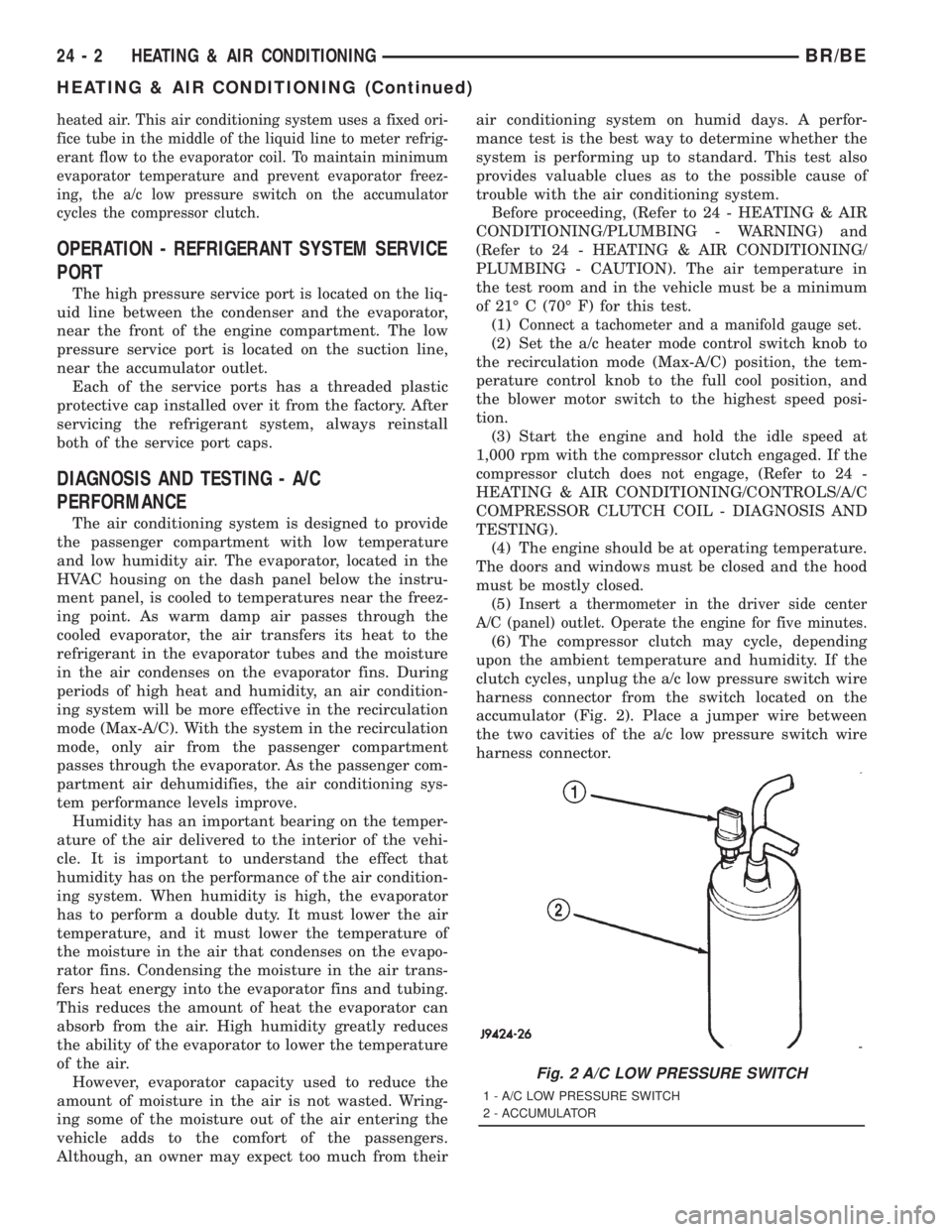
clutch cycles, unplug the a/c low pressure switch wire
harness connector from the switch located on the
accumulator (Fig. 2). Place a jumper wire between
the two cavities of the a/c low pressure switch wire
harness connector.
Fig. 2 A/C LOW PRESSURE SWITCH
1 - A/C LOW PRESSURE SWITCH
2 - ACCUMULATOR
24 - 2 HEATING & AIR CONDITIONINGBR/BE
HEATING & AIR CONDITIONING (Continued)
Page 2732 of 2889
(7)With the compressor clutch engaged, record the
panel outlet discharge air temperature, the discharge
pressure (high side), and the suction pressure (low side).
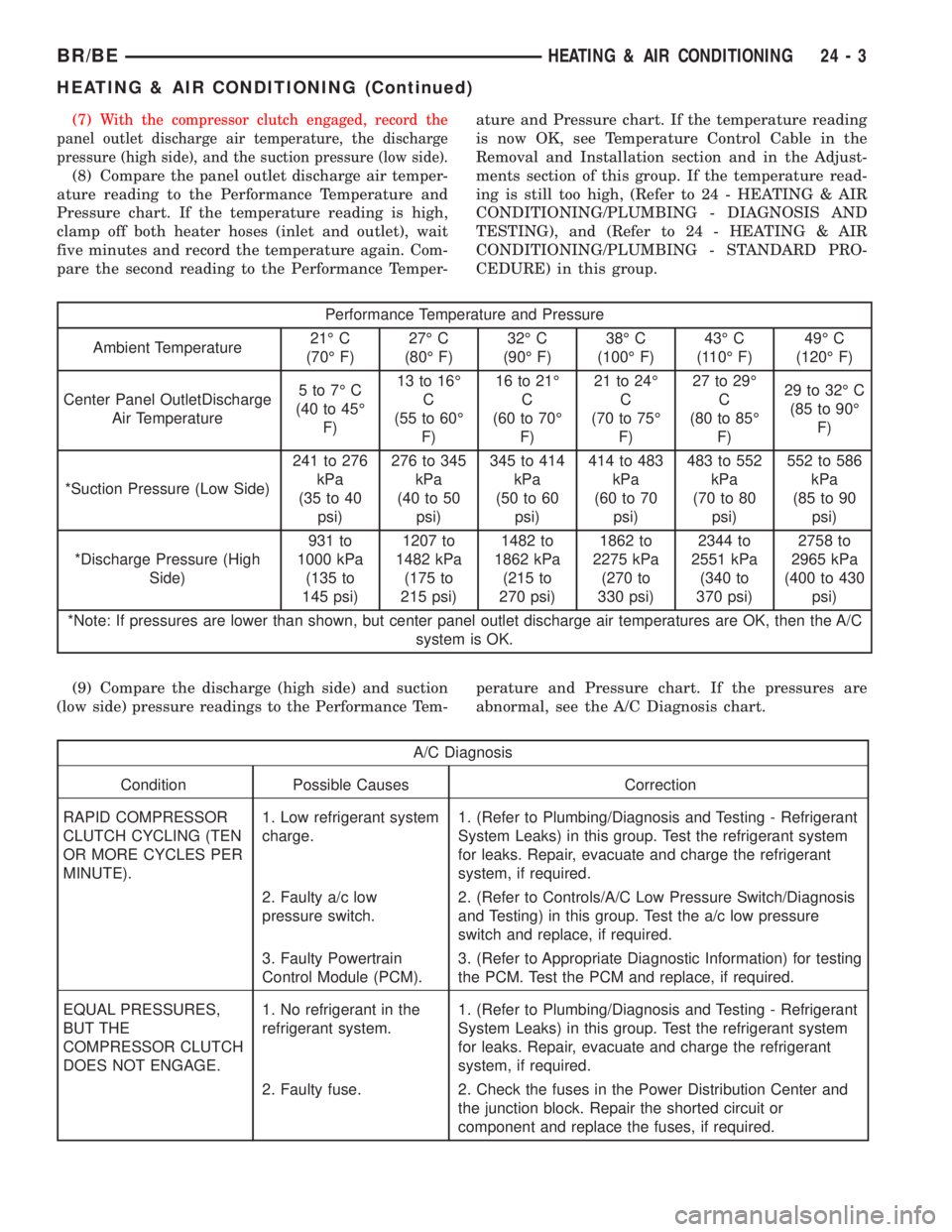
(8) Compare the panel outlet discharge air temper-
ature reading to the Performance Temperature and
Pressure chart. If the temperature reading is high,
clamp off both heater hoses (inlet and outlet), wait
five minutes and record the temperature again. Com-
pare the second reading to the Performance Temper-ature and Pressure chart. If the temperature reading
is now OK, see Temperature Control Cable in the
Removal and Installation section and in the Adjust-
ments section of this group. If the temperature read-
ing is still too high, (Refer to 24 - HEATING & AIR
CONDITIONING/PLUMBING - DIAGNOSIS AND
TESTING), and (Refer to 24 - HEATING & AIR
CONDITIONING/PLUMBING - STANDARD PRO-
CEDURE) in this group.
Performance Temperature and Pressure
Ambient Temperature21É C
(70É F)27É C
(80É F)32É C
(90É F)38É C
(100É F)43É C
(110É F)49É C
(120É F)
Center Panel OutletDischarge
Air Temperature5to7ÉC
(40 to 45É
F)13 to 16É
C
(55 to 60É
F)16 to 21É
C
(60 to 70É
F)21 to 24É
C
(70 to 75É
F)27 to 29É
C
(80 to 85É
F)29 to 32É C
(85 to 90É
F)
*Suction Pressure (Low Side)241 to 276
kPa
(35 to 40
psi)276 to 345
kPa
(40 to 50
psi)345 to 414
kPa
(50 to 60
psi)414 to 483
kPa
(60 to 70
psi)483 to 552
kPa
(70 to 80
psi)552 to 586
kPa
(85 to 90
psi)
*Discharge Pressure (High
Side)931 to
1000 kPa
(135 to
145 psi)1207 to
1482 kPa
(175 to
215 psi)1482 to
1862 kPa
(215 to
270 psi)1862 to
2275 kPa
(270 to
330 psi)2344 to
2551 kPa
(340 to
370 psi)2758 to
2965 kPa
(400 to 430
psi)
*Note: If pressures are lower than shown, but center panel outlet discharge air temperatures are OK, then the A/C
system is OK.
(9) Compare the discharge (high side) and suction
(low side) pressure readings to the Performance Tem-perature and Pressure chart. If the pressures are
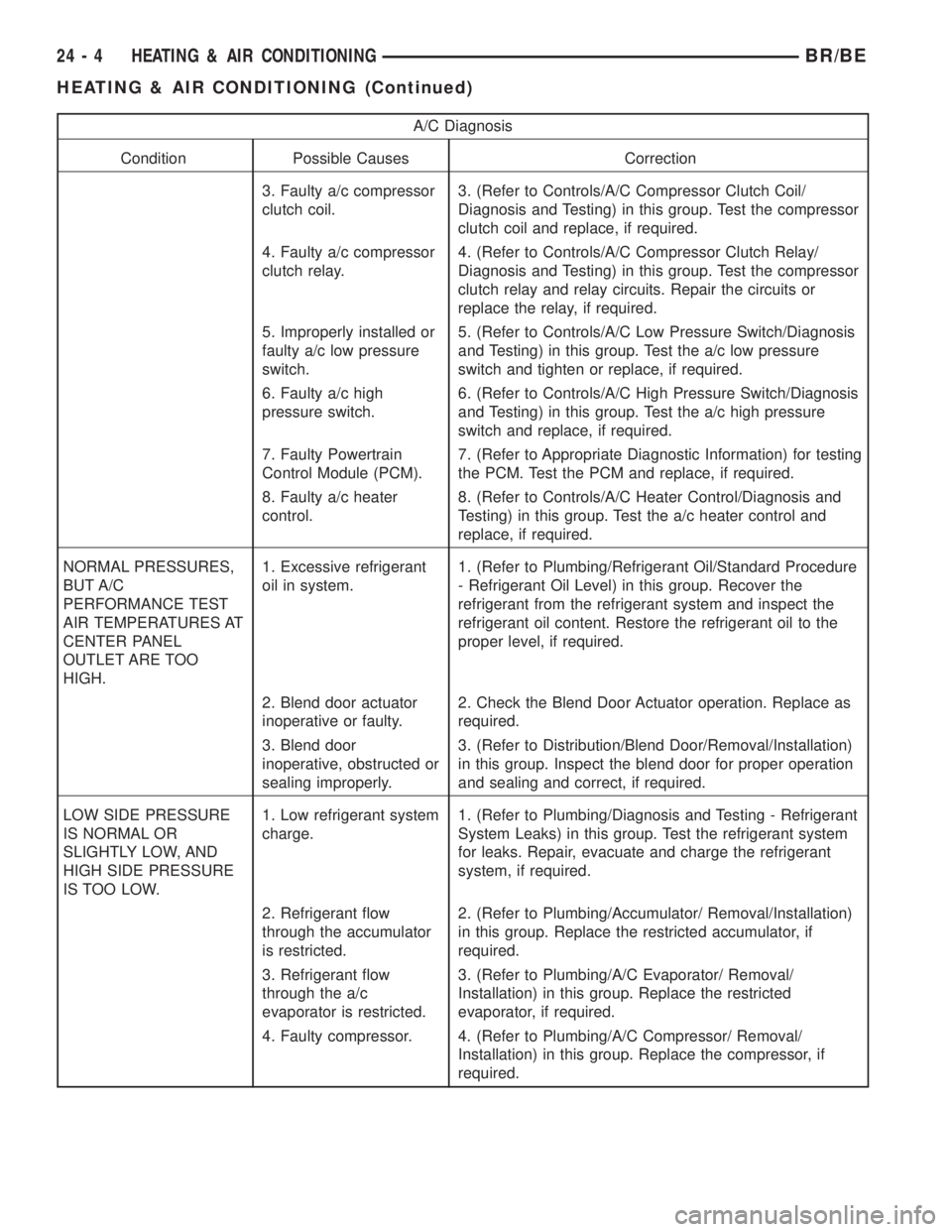
abnormal, see the A/C Diagnosis chart.
A/C Diagnosis
Condition Possible Causes Correction
RAPID COMPRESSOR
CLUTCH CYCLING (TEN
OR MORE CYCLES PER
MINUTE).1. Low refrigerant system
charge.1. (Refer to Plumbing/Diagnosis and Testing - Refrigerant
System Leaks) in this group. Test the refrigerant system
for leaks. Repair, evacuate and charge the refrigerant
system, if required.
2. Faulty a/c low
pressure switch.2. (Refer to Controls/A/C Low Pressure Switch/Diagnosis
and Testing) in this group. Test the a/c low pressure
switch and replace, if required.
3. Faulty Powertrain
Control Module (PCM).3. (Refer to Appropriate Diagnostic Information) for testing
the PCM. Test the PCM and replace, if required.
EQUAL PRESSURES,
BUT THE
COMPRESSOR CLUTCH
DOES NOT ENGAGE.1. No refrigerant in the
refrigerant system.1. (Refer to Plumbing/Diagnosis and Testing - Refrigerant
System Leaks) in this group. Test the refrigerant system
for leaks. Repair, evacuate and charge the refrigerant
system, if required.
2. Faulty fuse. 2. Check the fuses in the Power Distribution Center and
the junction block. Repair the shorted circuit or
component and replace the fuses, if required.
BR/BEHEATING & AIR CONDITIONING 24 - 3
HEATING & AIR CONDITIONING (Continued)
Page 2733 of 2889
A/C Diagnosis
Condition Possible Causes Correction
3. Faulty a/c compressor
clutch coil.3. (Refer to Controls/A/C Compressor Clutch Coil/
Diagnosis and Testing) in this group. Test the compressor
clutch coil and replace, if required.
4. Faulty a/c compressor
clutch relay.4. (Refer to Controls/A/C Compressor Clutch Relay/
Diagnosis and Testing) in this group. Test the compressor
clutch relay and relay circuits. Repair the circuits or
replace the relay, if required.
5. Improperly installed or
faulty a/c low pressure
switch.5. (Refer to Controls/A/C Low Pressure Switch/Diagnosis
and Testing) in this group. Test the a/c low pressure
switch and tighten or replace, if required.
6. Faulty a/c high
pressure switch.6. (Refer to Controls/A/C High Pressure Switch/Diagnosis
and Testing) in this group. Test the a/c high pressure
switch and replace, if required.
7. Faulty Powertrain
Control Module (PCM).7. (Refer to Appropriate Diagnostic Information) for testing
the PCM. Test the PCM and replace, if required.
8. Faulty a/c heater
control.8. (Refer to Controls/A/C Heater Control/Diagnosis and
Testing) in this group. Test the a/c heater control and
replace, if required.
NORMAL PRESSURES,
BUT A/C
PERFORMANCE TEST
AIR TEMPERATURES AT
CENTER PANEL
OUTLET ARE TOO
HIGH.1. Excessive refrigerant
oil in system.1. (Refer to Plumbing/Refrigerant Oil/Standard Procedure
- Refrigerant Oil Level) in this group. Recover the
refrigerant from the refrigerant system and inspect the
refrigerant oil content. Restore the refrigerant oil to the
proper level, if required.
2. Blend door actuator
inoperative or faulty.2. Check the Blend Door Actuator operation. Replace as
required.
3. Blend door
inoperative, obstructed or
sealing improperly.3. (Refer to Distribution/Blend Door/Removal/Installation)
in this group. Inspect the blend door for proper operation
and sealing and correct, if required.
LOW SIDE PRESSURE
IS NORMAL OR
SLIGHTLY LOW, AND
HIGH SIDE PRESSURE
IS TOO LOW.1. Low refrigerant system
charge.1. (Refer to Plumbing/Diagnosis and Testing - Refrigerant
System Leaks) in this group. Test the refrigerant system
for leaks. Repair, evacuate and charge the refrigerant
system, if required.
2. Refrigerant flow
through the accumulator
is restricted.2. (Refer to Plumbing/Accumulator/ Removal/Installation)
in this group. Replace the restricted accumulator, if
required.
3. Refrigerant flow
through the a/c
evaporator is restricted.3. (Refer to Plumbing/A/C Evaporator/ Removal/
Installation) in this group. Replace the restricted
evaporator, if required.
4. Faulty compressor. 4. (Refer to Plumbing/A/C Compressor/ Removal/
Installation) in this group. Replace the compressor, if
required.
24 - 4 HEATING & AIR CONDITIONINGBR/BE
HEATING & AIR CONDITIONING (Continued)