Page 151 of 460
2-38 Parking at Night
Park in a lighted spot, close all windows and lock your
vehicle. Remember to keep your valuables out of sight.
Put them in a storage area, or take them with you.
Parking Lots
Even if you park in a lot where someone will be watching
your vehicle, it's still best to lock it up and take your key.
But what if you have to leave your key? What if you have
to leave something valuable in your vehicle?
�Put your valuables in a storage area, like your
glove box.
�If your vehicle has a remote keyless entry system,
take the transmitter with you.
�Lock all the doors except the driver's.
Content Theft-Deterrent (Option)
If your vehicle has this option, it has a theft-deterrent
alarm system.
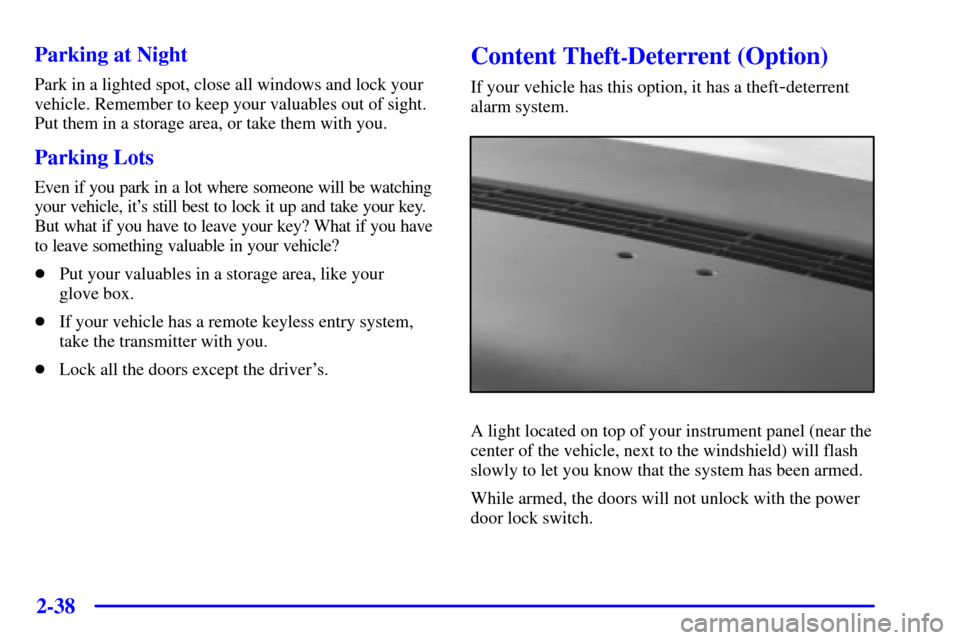
A light located on top of your instrument panel (near the
center of the vehicle, next to the windshield) will flash
slowly to let you know that the system has been armed.
While armed, the doors will not unlock with the power
door lock switch.
Page 152 of 460

2-39
Once armed, the alarm will go off if someone tries to
enter the vehicle (without using the remote keyless entry
transmitter or a key), breaks a window, tries to damage
the vehicle or turns the ignition to ON. The horn will
sound and the parking lamps will flash for up to
two minutes.
When the alarm is armed, the liftgate may be opened
with the remote keyless entry transmitter or with a key.
Arming with the Power Lock Switch
Your alarm system will arm when you use either power
door lock switch to lock the doors while any door or the
liftgate is open and the key is removed from the ignition.
If you would like to turn on power door lock switch
arming, see ªMultifunction Alarm Locks and Lighting
Choicesº in the Index.
The security light flashes quickly to let you know when
the system is ready to arm with the power door lock
switches. The security light will stop flashing and stay
on when you press the rear of the power door lock
switch, to let you know the system is arming. After all
doors and the liftgate are closed and locked, the security
light will begin flashing at a very slow rate to let you
know the system is armed.
Arming with the Remote Keyless
Entry Transmitter
Your alarm system will arm when you use your remote
keyless entry transmitter to lock the doors, if the key is
not in the ignition. The security light will turn on to let
you know the system is arming. After all doors and the
liftgate are closed and locked, the security light will
begin flashing at a very slow rate to let you know the
system is armed.
Arming with Your Key
Your alarm system will arm when you use your key to
lock the doors. The security light will turn on to let you
know the system is arming. After all doors and the
liftgate are closed and locked, the security light will
begin flashing at a very slow rate to let you know the
system is armed. If you would like your key not to arm
the system, see ªMultifunction Alarm Locks and
Lighting Choicesº in the Index.
Arming Confirmation
If remote unlock confirmation is on, your parking lamps
will flash to let you know when your alarm system has
disarmed. If you would not like the parking lamps to
flash, see ªMultifunction Alarm Locks and Lighting
Choicesº in the Index.
Page 153 of 460

2-40 Disarming with the Remote Keyless
Entry Transmitter
Your alarm system will disarm when you use your
remote keyless entry transmitter to unlock the doors.
The security light will stop flashing to let you know the
system is no longer armed.
Disarming with Your Key
Your alarm system will disarm when you use your key
to unlock the doors. The security light will stop flashing
to let you know the system is no longer armed. If you
would like your key not to disarm the alarm system, see
ªMultifunction Alarm Locks and Lighting Choicesº in
the Index.
Nuisance Alarms
If you experience nuisance alarms (alarms which are not
caused by the opening of a door or the liftgate and are
not desirable), you may need to reduce the damage
detection sensitivity. Try programming the content
theft
-deterrent to Mode 1.
If you continue to experience nuisance alarms, you
may want to try turning off damage detection by
programming your content theft
-deterrent to Mode 2.
If you are still having trouble with nuisance alarms, you
can turn off the content theft
-deterrent system by
programming your content theft
-deterrent to Mode 3.
See ªMultifunction Alarm Locks and Lighting Choicesº
in the Index for more information. See your dealer or
qualified technician for service.
Page 155 of 460

2-42
If the engine still does not start, and the key appears to
be undamaged, try another ignition key. At this time,
you may also want to check fuse 12. If the engine still
does not start with the other key, your vehicle needs
service. If your vehicle does start, the first key may
be faulty. See your dealer or a locksmith who can
service the PASS
-Key III to have a new key made.
See ªFuses and Circuit Breakersº in the Index.
It is possible for the Pass
-Key III decoder to learn the
transponder value of a new or replacement key. Up to
10 additional keys may be programmed for the vehicle.
This procedure is for learning additional keys only. If all
the currently programmed keys are lost or do not
operate, you must see your dealer or a locksmith who
can service PASS
-Key III to have keys made and
programmed to the system.
See your dealer or a locksmith who can service
PASS
-Key III to get a new key blank that is cut exactly
as the ignition key that operates the system.To program the new key:
1. Verify the new key has ªPK3º stamped on it.
2. Insert the ignition key in the ignition and start the engine.
If the engine will not start see your dealer for service.
3. After the engine has started, turn the key to OFF and
remove the key.
4. Insert the key to be programmed and turn it to RUN
within 10 seconds of removing the previous key.
5. The security message will turn off once the key has
been programmed. It may not be apparent that the
security message went on due to how quickly the key
is programmed.
6. Repeat Steps 1 through 4 if additional keys are to
be programmed.
If you are ever driving and the security message comes on
and stays on, you will be able to restart your engine if you
turn it off. Your PASS-Key III system, however, is not
working properly and must be serviced by your dealer.
Your vehicle is not protected by the PASS
-Key III system
at this time.
If you lose or damage a PASS
-Key III key, see your
dealer or a locksmith who can service PASS
-Key III to
have a new key made. In an emergency, call Chevrolet
Roadside Assistance. See ªRoadside Assistanceº in the
Index for more information.
Page 156 of 460
2-43
New Vehicle ªBreak-Inº
NOTICE:
Your vehicle doesn't need an elaborate
ªbreak
-in.º But it will perform better in the long
run if you follow these guidelines:
�Don't drive at any one speed -- fast or
slow
-- for the first 500 miles (805 km).
Don't make full
-throttle starts.
�Avoid making hard stops for the first
200 miles (322 km) or so. During this time
your new brake linings aren't yet broken
in. Hard stops with new linings can mean
premature wear and earlier replacement.
Follow this breaking
-in guideline every
time you get new brake linings.
�Don't tow a trailer during break
-in.
See ªTowing a Trailerº in the Index for
more information.
Ignition Positions
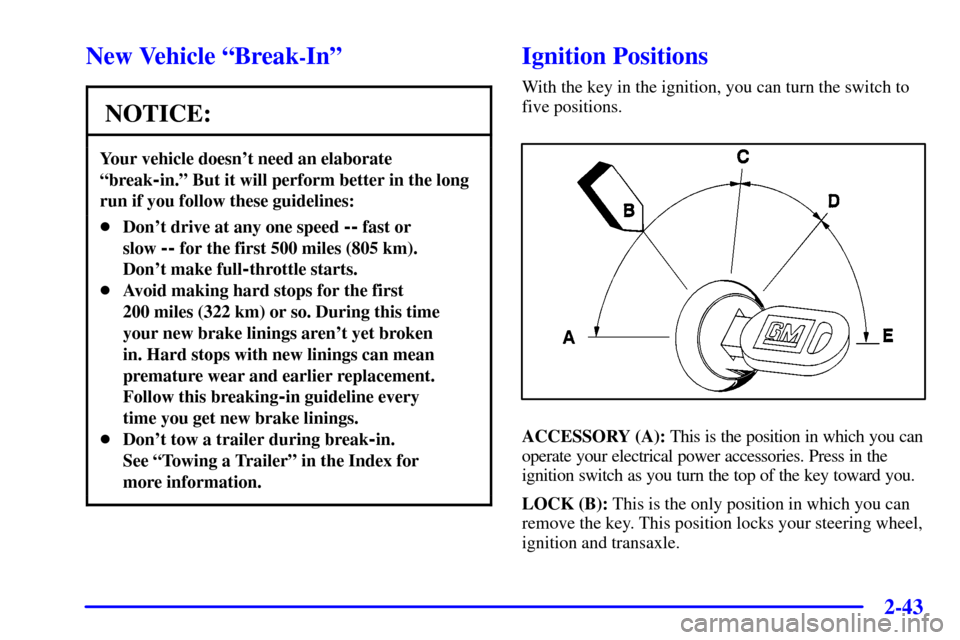
With the key in the ignition, you can turn the switch to
five positions.
ACCESSORY (A): This is the position in which you can
operate your electrical power accessories. Press in the
ignition switch as you turn the top of the key toward you.
LOCK (B): This is the only position in which you can
remove the key. This position locks your steering wheel,
ignition and transaxle.
Page 157 of 460
2-44
NOTICE:
If your key seems stuck in LOCK and you can't
turn it, be sure you are using the correct key; if
so, is it all the way in? If it is, then turn the
steering wheel left and right while you turn the
key hard. But turn the key only with your hand.
Using a tool to force it could break the key or the
ignition switch. If none of this works, then your
vehicle needs service.
OFF (C): This position unlocks the steering wheel,
ignition and transaxle, but does not send electrical
power to any accessories. Use this position if your
vehicle must be pushed or towed, but never try to
push
-start your vehicle. A warning chime will sound if
you open the driver's door when the ignition is off and
the key is in the ignition.RUN (D): This is the position to which the switch
returns after you start your engine and release the
switch. The switch stays in RUN when the engine is
running. But even when the engine is not running,
you can use RUN to operate your electrical power
accessories, and to display some instrument panel
warning lights.
START (E): This position starts the engine. When the
engine starts, release the key. The ignition switch will
return to RUN for normal driving.
If the engine is not running, ACCESSORY and RUN are
positions that allow you to operate your electrical
accessories, such as the radio.
Retained Accessory Power (RAP)
With RAP, the power windows (option), the power rear
quarter windows (if equipped), audio system and the
optional electronic level control (ELC) will continue to
work up to 10 minutes after the ignition key is turned to
OFF and none of the doors are opened.
Page 161 of 460
2-48
Automatic Transaxle Operation
Maximum engine speed is limited when you're in
PARK (P) or NEUTRAL (N), to protect driveline
components from improper operation.
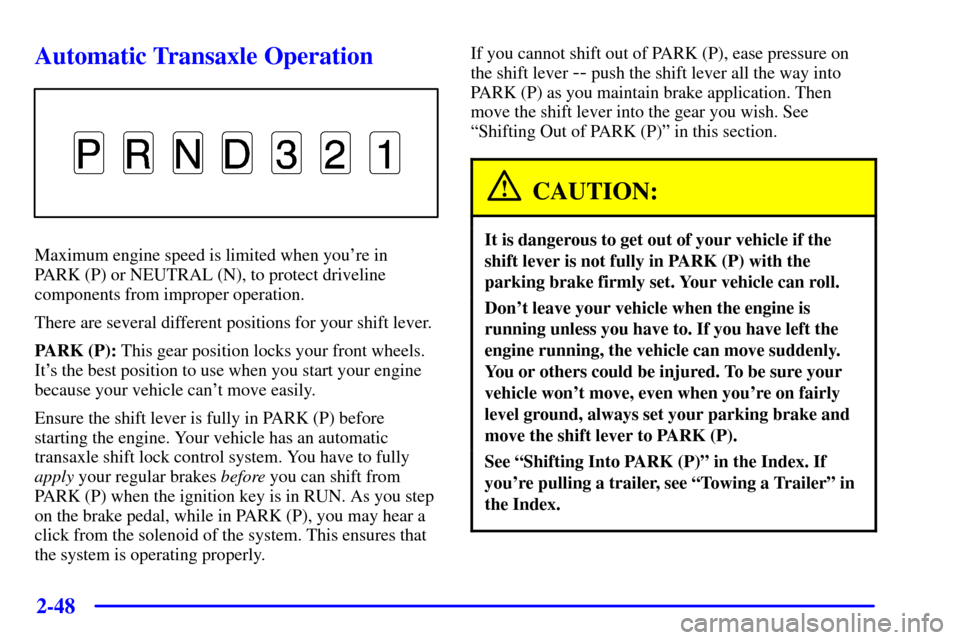
There are several different positions for your shift lever.
PARK (P): This gear position locks your front wheels.
It's the best position to use when you start your engine
because your vehicle can't move easily.
Ensure the shift lever is fully in PARK (P) before
starting the engine. Your vehicle has an automatic
transaxle shift lock control system. You have to fully
apply your regular brakes before you can shift from
PARK (P) when the ignition key is in RUN. As you step
on the brake pedal, while in PARK (P), you may hear a
click from the solenoid of the system. This ensures that
the system is operating properly.If you cannot shift out of PARK (P), ease pressure on
the shift lever
-- push the shift lever all the way into
PARK (P) as you maintain brake application. Then
move the shift lever into the gear you wish. See
ªShifting Out of PARK (P)º in this section.
CAUTION:
It is dangerous to get out of your vehicle if the
shift lever is not fully in PARK (P) with the
parking brake firmly set. Your vehicle can roll.
Don't leave your vehicle when the engine is
running unless you have to. If you have left the
engine running, the vehicle can move suddenly.
You or others could be injured. To be sure your
vehicle won't move, even when you're on fairly
level ground, always set your parking brake and
move the shift lever to PARK (P).
See ªShifting Into PARK (P)º in the Index. If
you're pulling a trailer, see ªTowing a Trailerº in
the Index.
Page 167 of 460
2-54
2. Move the shift lever into PARK (P) like this:
�Pull the lever toward you.
�Move the lever up as far as it will go.
3. Turn the ignition key to LOCK.
4. Remove the key and take it with you. If you can
leave your vehicle with the ignition key in your
hand, your vehicle is in PARK (P).