Page 63 of 460
1-51
Rear Seat Outside Passenger Positions
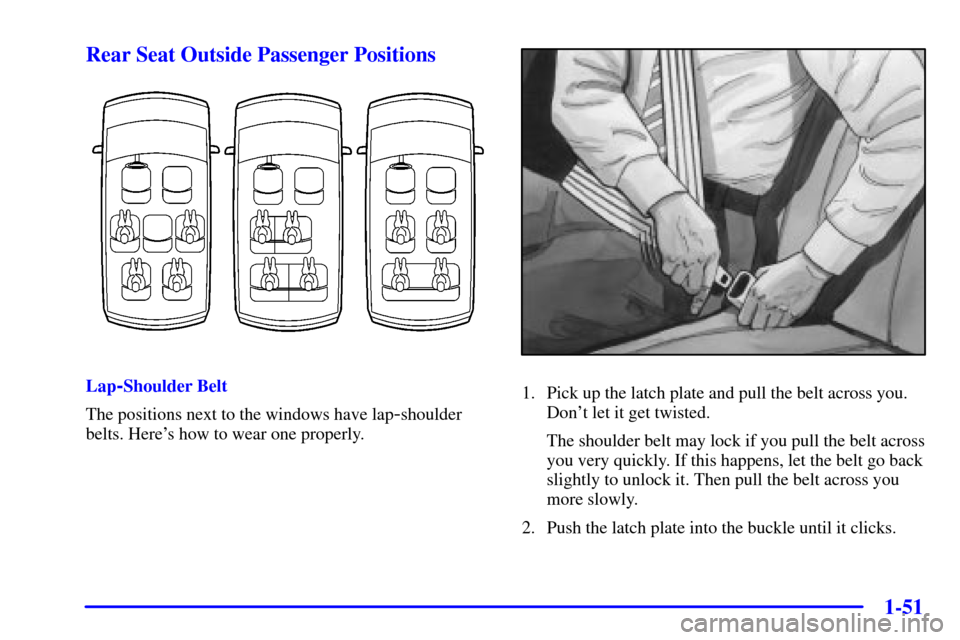
Lap-Shoulder Belt
The positions next to the windows have lap
-shoulder
belts. Here's how to wear one properly.
1. Pick up the latch plate and pull the belt across you.
Don't let it get twisted.
The shoulder belt may lock if you pull the belt across
you very quickly. If this happens, let the belt go back
slightly to unlock it. Then pull the belt across you
more slowly.
2. Push the latch plate into the buckle until it clicks.
Page 66 of 460
1-54
The safety belt locks if there's a sudden stop or a crash,
or if you pull the belt very quickly out of the retractor.
CAUTION:
You can be seriously hurt if your shoulder belt is
too loose. In a crash, you would move forward
too much, which could increase injury. The
shoulder belt should fit against your body.
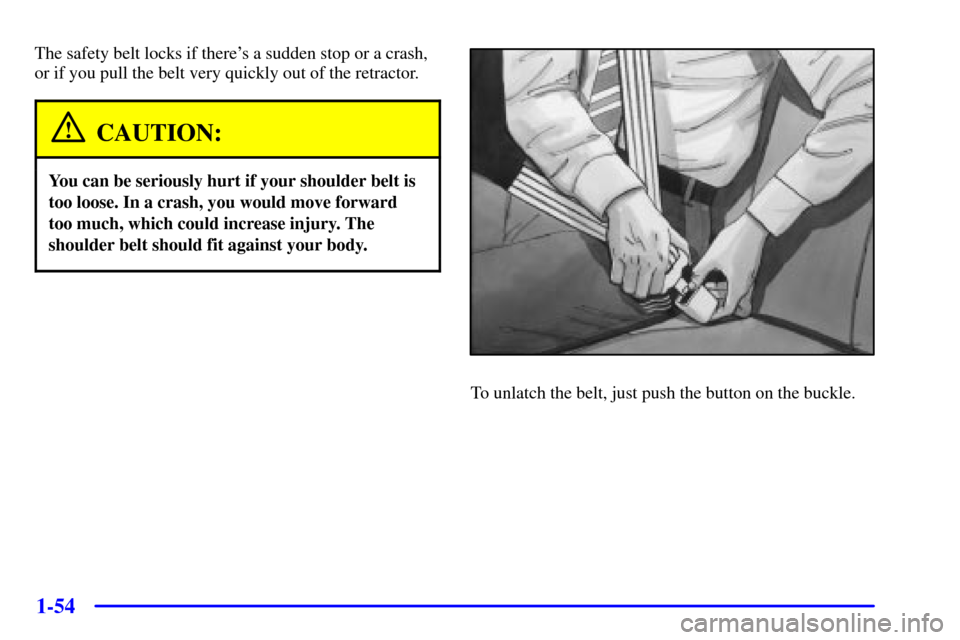
To unlatch the belt, just push the button on the buckle.
Page 99 of 460
1-87
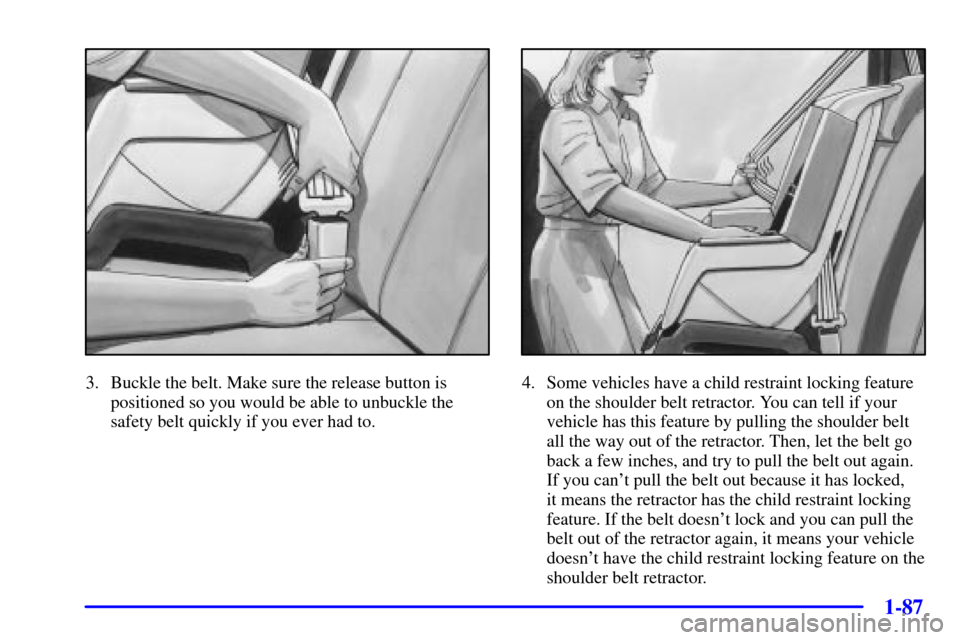
3. Buckle the belt. Make sure the release button is
positioned so you would be able to unbuckle the
safety belt quickly if you ever had to.4. Some vehicles have a child restraint locking feature
on the shoulder belt retractor. You can tell if your
vehicle has this feature by pulling the shoulder belt
all the way out of the retractor. Then, let the belt go
back a few inches, and try to pull the belt out again.
If you can't pull the belt out because it has locked,
it means the retractor has the child restraint locking
feature. If the belt doesn't lock and you can pull the
belt out of the retractor again, it means your vehicle
doesn't have the child restraint locking feature on the
shoulder belt retractor.
Page 100 of 460
1-88
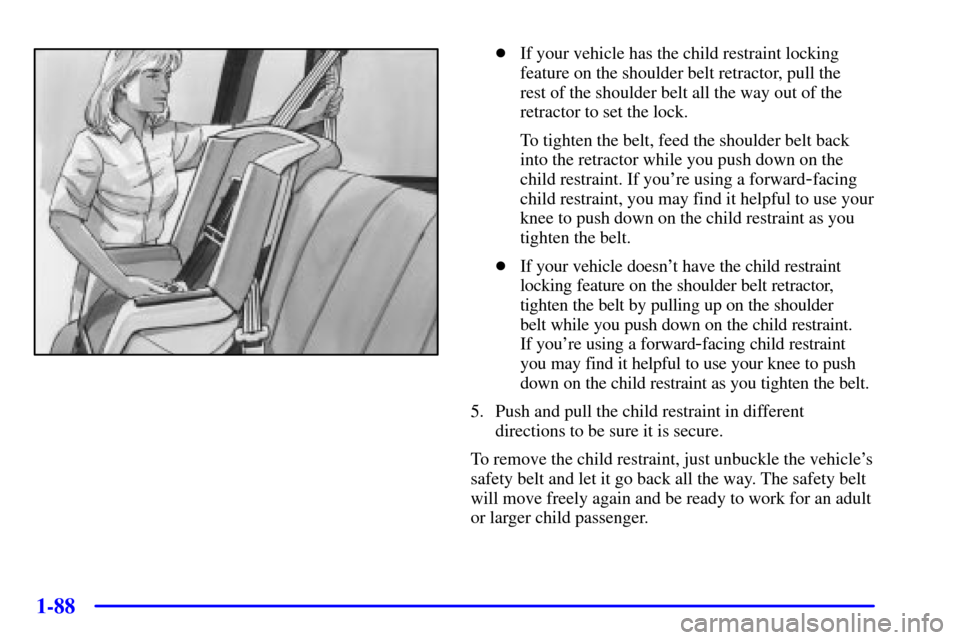
�If your vehicle has the child restraint locking
feature on the shoulder belt retractor, pull the
rest of the shoulder belt all the way out of the
retractor to set the lock.
To tighten the belt, feed the shoulder belt back
into the retractor while you push down on the
child restraint. If you're using a forward
-facing
child restraint, you may find it helpful to use your
knee to push down on the child restraint as you
tighten the belt.
�If your vehicle doesn't have the child restraint
locking feature on the shoulder belt retractor,
tighten the belt by pulling up on the shoulder
belt while you push down on the child restraint.
If you're using a forward
-facing child restraint
you may find it helpful to use your knee to push
down on the child restraint as you tighten the belt.
5. Push and pull the child restraint in different
directions to be sure it is secure.
To remove the child restraint, just unbuckle the vehicle's
safety belt and let it go back all the way. The safety belt
will move freely again and be ready to work for an adult
or larger child passenger.
Page 107 of 460
1-95
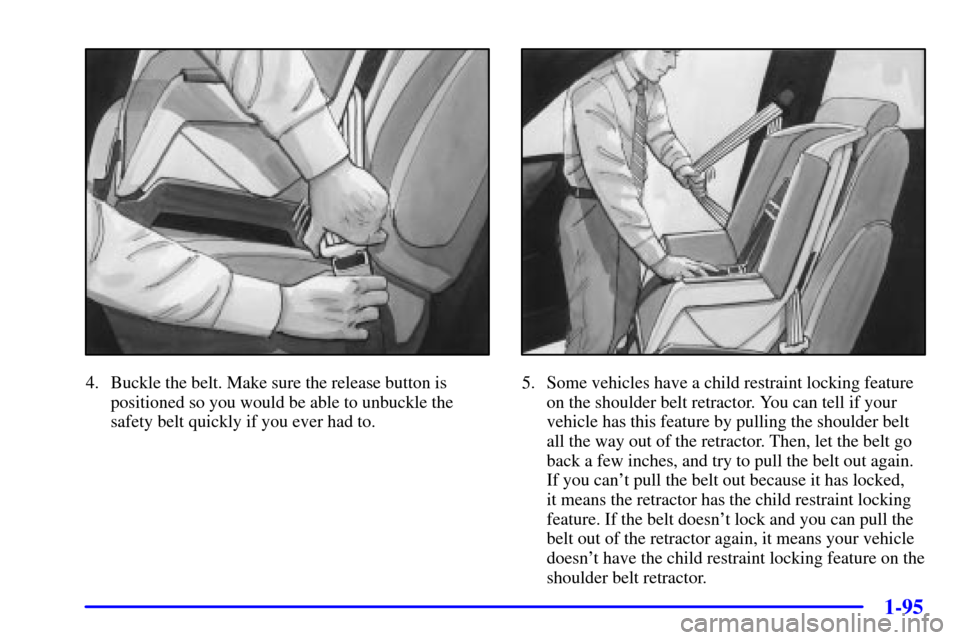
4. Buckle the belt. Make sure the release button is
positioned so you would be able to unbuckle the
safety belt quickly if you ever had to.5. Some vehicles have a child restraint locking feature
on the shoulder belt retractor. You can tell if your
vehicle has this feature by pulling the shoulder belt
all the way out of the retractor. Then, let the belt go
back a few inches, and try to pull the belt out again.
If you can't pull the belt out because it has locked,
it means the retractor has the child restraint locking
feature. If the belt doesn't lock and you can pull the
belt out of the retractor again, it means your vehicle
doesn't have the child restraint locking feature on the
shoulder belt retractor.
Page 108 of 460
1-96
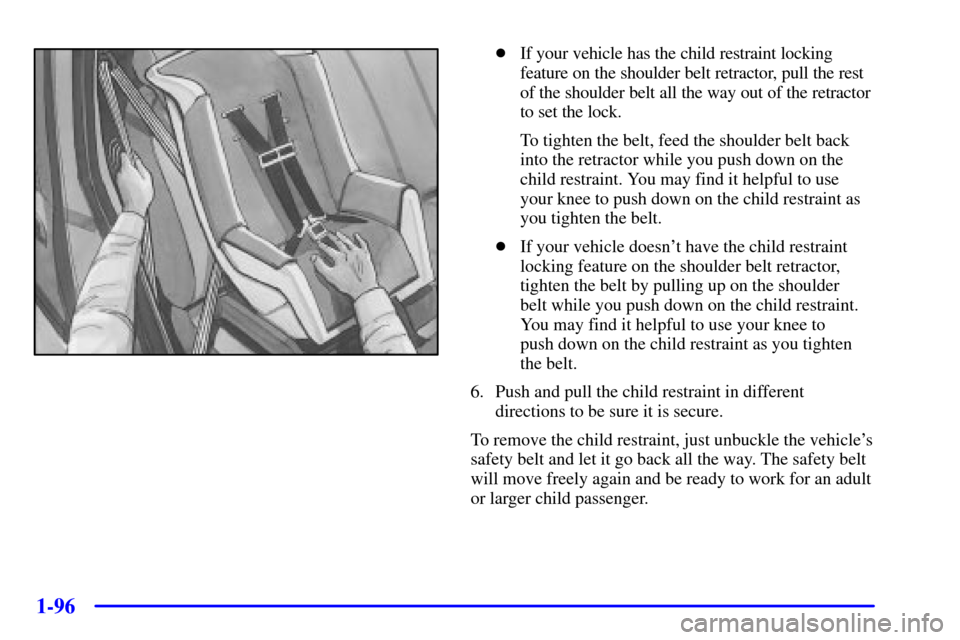
�If your vehicle has the child restraint locking
feature on the shoulder belt retractor, pull the rest
of the shoulder belt all the way out of the retractor
to set the lock.
To tighten the belt, feed the shoulder belt back
into the retractor while you push down on the
child restraint. You may find it helpful to use
your knee to push down on the child restraint as
you tighten the belt.
�If your vehicle doesn't have the child restraint
locking feature on the shoulder belt retractor,
tighten the belt by pulling up on the shoulder
belt while you push down on the child restraint.
You may find it helpful to use your knee to
push down on the child restraint as you tighten
the belt.
6. Push and pull the child restraint in different
directions to be sure it is secure.
To remove the child restraint, just unbuckle the vehicle's
safety belt and let it go back all the way. The safety belt
will move freely again and be ready to work for an adult
or larger child passenger.
Page 114 of 460
2-
2-1
Section 2 Features and Controls
Here you can learn about the many standard and optional features on your vehicle, and information on starting,
shifting and braking. Also explained are the instrument panel and the warning systems that tell you if everything is
working properly
-- and what to do if you have a problem.
2
-2 Windows
2
-5 Keys
2
-7 Door Locks
2
-10 Remote Keyless Entry System (Option)
2
-16 Multifunction Alarm Locks and Lighting Choices
2
-26 Dual Sliding Doors
2
-28 Power Sliding Door (Option)
2
-36 Liftgate
2
-37 Theft
2
-38 Content Theft-Deterrent (Option)
2
-41 PASS-Key� III
2
-43 New Vehicle ªBreak-Inº
2
-43 Ignition Positions
2
-45 Starting Your Engine
2
-46 Engine Coolant Heater (If Equipped)
2
-48 Automatic Transaxle Operation
2
-52 Parking Brake
2
-53 Shifting Into PARK (P)2
-56 Shifting Out of PARK (P)
2
-56 Parking Over Things That Burn
2
-57 Engine Exhaust
2
-57 Running Your Engine While You're Parked
2
-59 Turn Signal/Multifunction Lever
2
-66 Exterior Lamps
2
-67 Interior Lamps
2
-72 Storage Compartments
2
-84 Accessory Inflator System (Option)
2
-86 Accessory Power Outlets
2
-87 OnStar� System (If Equipped)
2
-90 HomeLink� Transmitter (Option)
2
-94 The Instrument Panel -- Your
Information System
2
-98 Warning Lights, Gages, Messages and Indicators
2
-108 Message Center
2
-116 Driver Information Center (DIC) (Option)
2
-119 Rear Parking Assist (Option)
Page 119 of 460
2-6
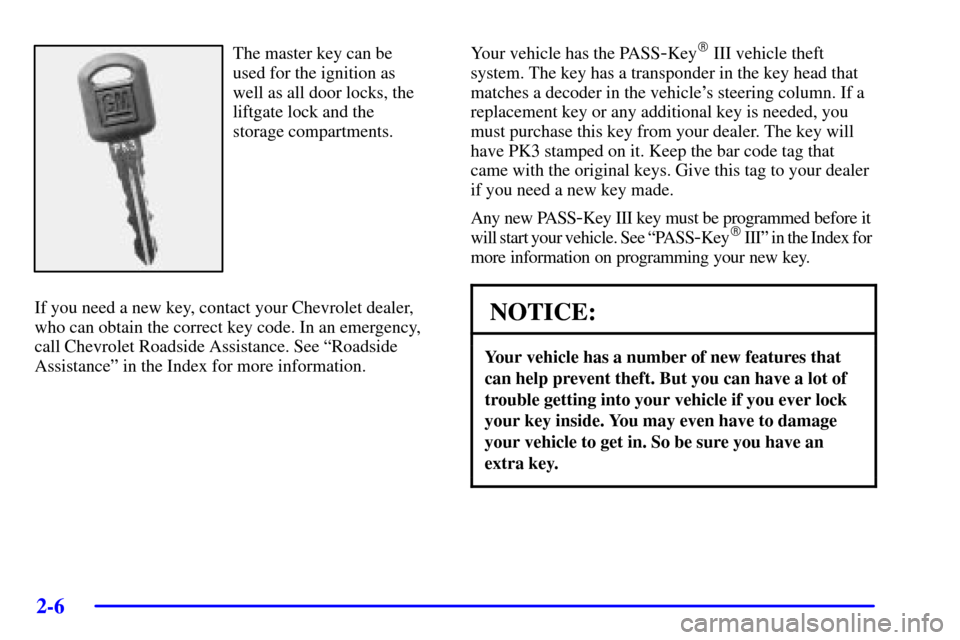
The master key can be
used for the ignition as
well as all door locks, the
liftgate lock and the
storage compartments.
If you need a new key, contact your Chevrolet dealer,
who can obtain the correct key code. In an emergency,
call Chevrolet Roadside Assistance. See ªRoadside
Assistanceº in the Index for more information.Your vehicle has the PASS-Key� III vehicle theft
system. The key has a transponder in the key head that
matches a decoder in the vehicle's steering column. If a
replacement key or any additional key is needed, you
must purchase this key from your dealer. The key will
have PK3 stamped on it. Keep the bar code tag that
came with the original keys. Give this tag to your dealer
if you need a new key made.
Any new PASS
-Key III key must be programmed before it
will start your vehicle. See ªPASS
-Key� IIIº in the Index for
more information on programming your new key.
NOTICE:
Your vehicle has a number of new features that
can help prevent theft. But you can have a lot of
trouble getting into your vehicle if you ever lock
your key inside. You may even have to damage
your vehicle to get in. So be sure you have an
extra key.