Page 218 of 460
2-105
NOTICE:
Modifications made to the engine, transaxle,
exhaust, intake or fuel system of your vehicle or
the replacement of the original tires with other
than those of the same Tire Performance Criteria
(TPC) can affect your vehicle's emission controls
and may cause the SERVICE ENGINE
SOON or CHECK ENGINE light to come on.
Modifications to these systems could lead to
costly repairs not covered by your warranty.
This may also result in a failure to pass a
required Emission Inspection/Maintenance test.
This light should come on, as a check to show you it is
working, when the ignition is on and the engine is not
running. If the light doesn't come on, have it repaired.
This light will also come on during a malfunction in one
of two ways:
�Light Flashing
-- A misfire condition has been
detected. A misfire increases vehicle emissions and
may damage the emission control system on your
vehicle. Dealer or qualified service center diagnosis
and service may be required.�Light On Steady
-- An emission control system
malfunction has been detected on your vehicle.
Dealer or qualified service center diagnosis and
service may be required.
If the Light Is Flashing
The following may prevent more serious damage to
your vehicle:
�Reducing vehicle speed.
�Avoiding hard accelerations.
�Avoiding steep uphill grades.
�If you are towing a trailer, reduce the amount of
cargo being hauled as soon as it is possible.
If the light stops flashing and remains on steady, see
ªIf the Light Is On Steadyº following.
If the light continues to flash, when it is safe to do so,
stop the vehicle. Find a safe place to park your vehicle.
Turn the key off, wait at least 10 seconds and restart the
engine. If the light remains on steady, see ªIf the Light
Is On Steadyº following. If the light is still flashing,
follow the previous steps, and drive the vehicle to your
dealer or qualified service center for service.
Page 228 of 460
2-115
PASS-Key� III Security Message
United States Canada
If you are ever driving and this message comes on and
stays on, you will be able to restart your engine if you
turn it off.
Your PASS
-Key III system, however, is not working
properly and must be serviced by your dealer. Your
vehicle is not protected by the PASS
-Key III system
at this time. See ªPASS
-Key IIIº in the Index for
more information.
Low Fuel Warning Message
United States Canada
If your fuel is low, the warning message will come on
and stay on until you add fuel.
If the warning message is still on after adding fuel, you
need to reset the warning message. To reset the warning
message, turn the ignition to OFF then to ON. If the
message stays on, see your dealer right away.
Page 281 of 460

4-3
Drunken Driving
Death and injury associated with drinking and driving is
a national tragedy. It's the number one contributor to
the highway death toll, claiming thousands of victims
every year.
Alcohol affects four things that anyone needs to drive
a vehicle:
�Judgment
�Muscular Coordination
�Vision
�Attentiveness.
Police records show that almost half of all motor
vehicle
-related deaths involve alcohol. In most cases,
these deaths are the result of someone who was drinking
and driving. In recent years, about 16,000 annual motor
vehicle
-related deaths have been associated with the use
of alcohol, with more than 300,000 people injured.
Many adults
-- by some estimates, nearly half the
adult population
-- choose never to drink alcohol,
so they never drive after drinking. For persons under 21,
it's against the law in every U.S. state to drink alcohol.
There are good medical, psychological and
developmental reasons for these laws.The obvious way to solve the leading highway safety
problem is for people never to drink alcohol and then
drive. But what if people do? How much is ªtoo muchº
if the driver plans to drive? It's a lot less than many
might think. Although it depends on each person
and situation, here is some general information on
the problem.
The Blood Alcohol Concentration (BAC) of someone
who is drinking depends upon four things:
�The amount of alcohol consumed
�The drinker's body weight
�The amount of food that is consumed before and
during drinking
�The length of time it has taken the drinker to
consume the alcohol.
According to the American Medical Association, a
180
-lb. (82 kg) person who drinks three 12-ounce
(355 ml) bottles of beer in an hour will end up with a
BAC of about 0.06 percent. The person would reach the
same BAC by drinking three 4
-ounce (120 ml) glasses
of wine or three mixed drinks if each had 1
-1/2 ounces
(45 ml) of a liquor like whiskey, gin or vodka.
Page 309 of 460
4-31
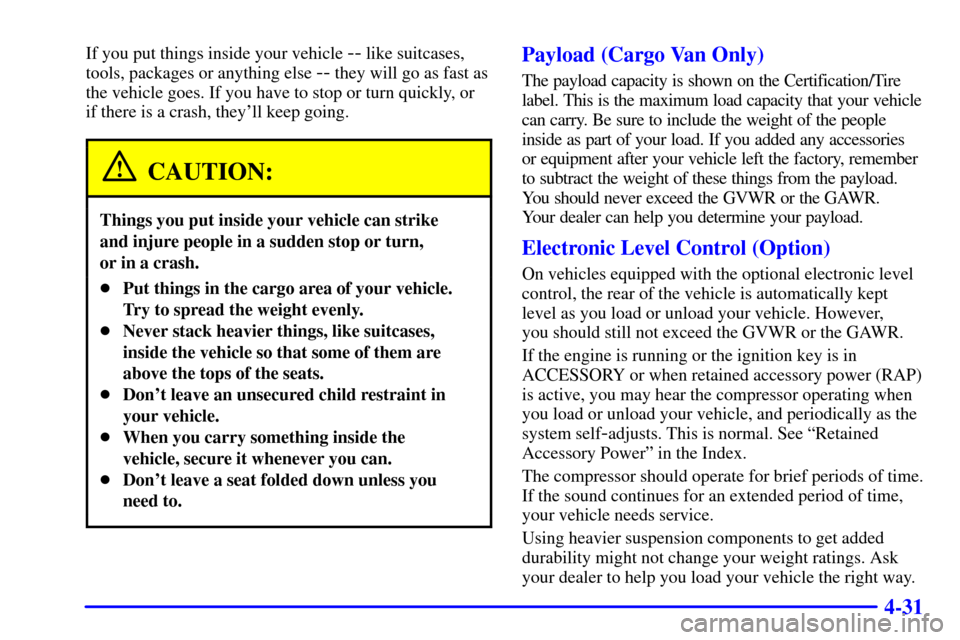
If you put things inside your vehicle -- like suitcases,
tools, packages or anything else
-- they will go as fast as
the vehicle goes. If you have to stop or turn quickly, or
if there is a crash, they'll keep going.
CAUTION:
Things you put inside your vehicle can strike
and injure people in a sudden stop or turn,
or in a crash.
�Put things in the cargo area of your vehicle.
Try to spread the weight evenly.
�Never stack heavier things, like suitcases,
inside the vehicle so that some of them are
above the tops of the seats.
�Don't leave an unsecured child restraint in
your vehicle.
�When you carry something inside the
vehicle, secure it whenever you can.
�Don't leave a seat folded down unless you
need to.
Payload (Cargo Van Only)
The payload capacity is shown on the Certification/Tire
label. This is the maximum load capacity that your vehicle
can carry. Be sure to include the weight of the people
inside as part of your load. If you added any accessories
or equipment after your vehicle left the factory, remember
to subtract the weight of these things from the payload.
You should never exceed the GVWR or the GAWR.
Your dealer can help you determine your payload.
Electronic Level Control (Option)
On vehicles equipped with the optional electronic level
control, the rear of the vehicle is automatically kept
level as you load or unload your vehicle. However,
you should still not exceed the GVWR or the GAWR.
If the engine is running or the ignition key is in
ACCESSORY or when retained accessory power (RAP)
is active, you may hear the compressor operating when
you load or unload your vehicle, and periodically as the
system self
-adjusts. This is normal. See ªRetained
Accessory Powerº in the Index.
The compressor should operate for brief periods of time.
If the sound continues for an extended period of time,
your vehicle needs service.
Using heavier suspension components to get added
durability might not change your weight ratings. Ask
your dealer to help you load your vehicle the right way.
Page 319 of 460
5-2
Hazard Warning Flashers
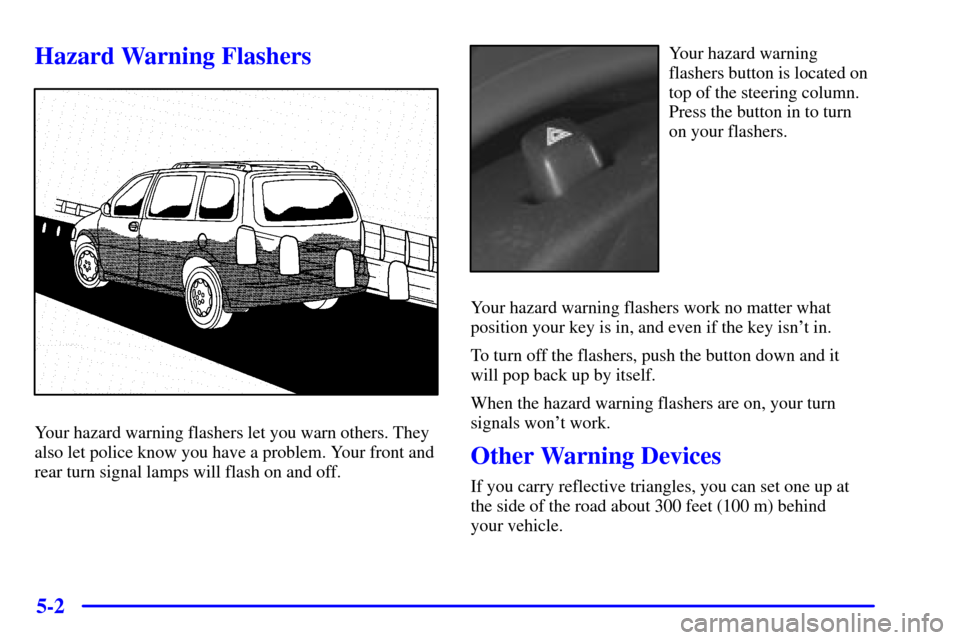
Your hazard warning flashers let you warn others. They
also let police know you have a problem. Your front and
rear turn signal lamps will flash on and off.
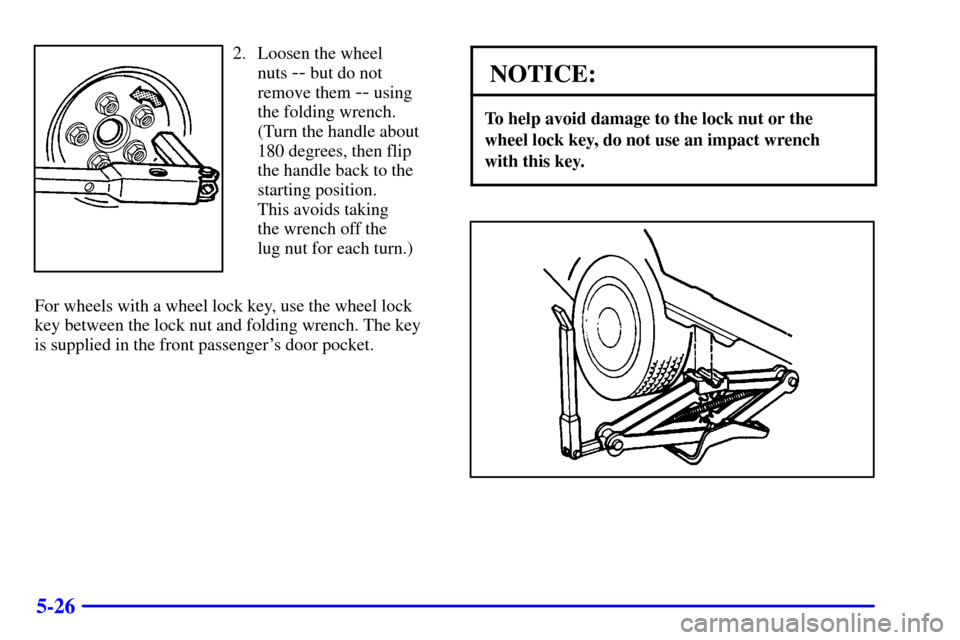
Your hazard warning
flashers button is located on
top of the steering column.
Press the button in to turn
on your flashers.
Your hazard warning flashers work no matter what
position your key is in, and even if the key isn't in.
To turn off the flashers, push the button down and it
will pop back up by itself.
When the hazard warning flashers are on, your turn
signals won't work.
Other Warning Devices
If you carry reflective triangles, you can set one up at
the side of the road about 300 feet (100 m) behind
your vehicle.
Page 343 of 460
5-26
2. Loosen the wheel
nuts
-- but do not
remove them
-- using
the folding wrench.
(Turn the handle about
180 degrees, then flip
the handle back to the
starting position.
This avoids taking
the wrench off the
lug nut for each turn.)
For wheels with a wheel lock key, use the wheel lock
key between the lock nut and folding wrench. The key
is supplied in the front passenger's door pocket.NOTICE:
To help avoid damage to the lock nut or the
wheel lock key, do not use an impact wrench
with this key.
Page 367 of 460
6-16
How to Reset the Change Engine Oil Message
1. With the ignition key in RUN but the engine off,
repeatedly push the trip/reset button until OIL
is displayed.
2. When OIL is displayed, push and hold the trip/reset
button for five seconds. The number will disappear
and be replaced by 100 (indicating 100% oil
life remaining).
3. Turn the key to OFF.
If the change engine oil message comes back on,
the engine oil life monitor has not reset. Repeat
the procedure.
What to Do with Used Oil
Did you know that used engine oil contains certain
elements that may be unhealthy for your skin and could
even cause cancer? Don't let used oil stay on your skin
for very long. Clean your skin and nails with soap and
water, or a good hand cleaner. Wash or properly throw
away clothing or rags containing used engine oil. See
the manufacturer's warnings about the use and disposal
of oil products.Used oil can be a real threat to the environment. If you
change your own oil, be sure to drain all free
-flowing oil
from the filter before disposal. Don't ever dispose of oil
by putting it in the trash, pouring it on the ground, into
sewers, or into streams or bodies of water. Instead,
recycle it by taking it to a place that collects used oil. If
you have a problem properly disposing of your used oil,
ask your dealer, a service station or a local recycling
center for help.
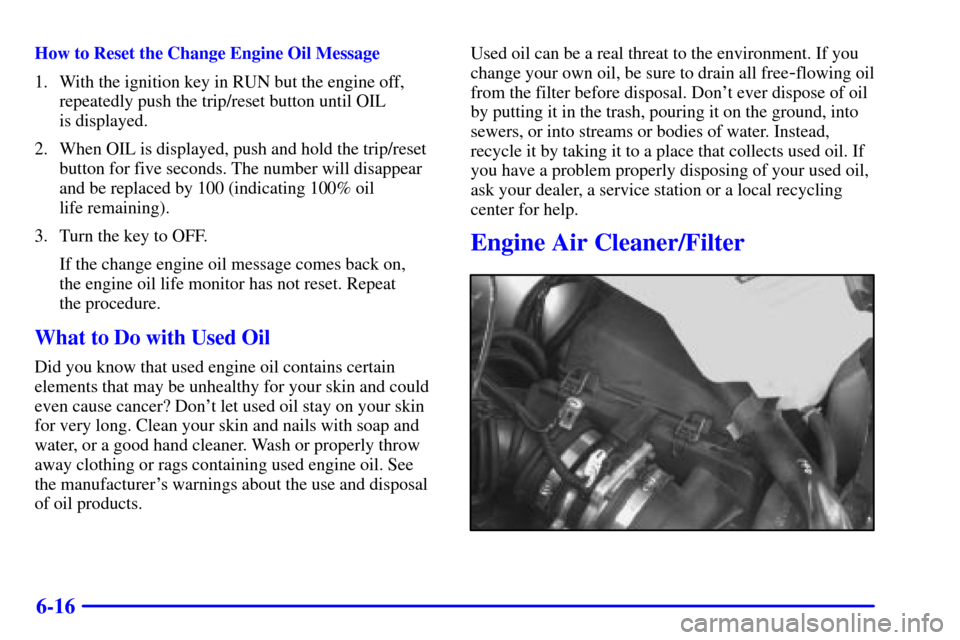
Engine Air Cleaner/Filter
Page 378 of 460
6-27
Power Steering Fluid
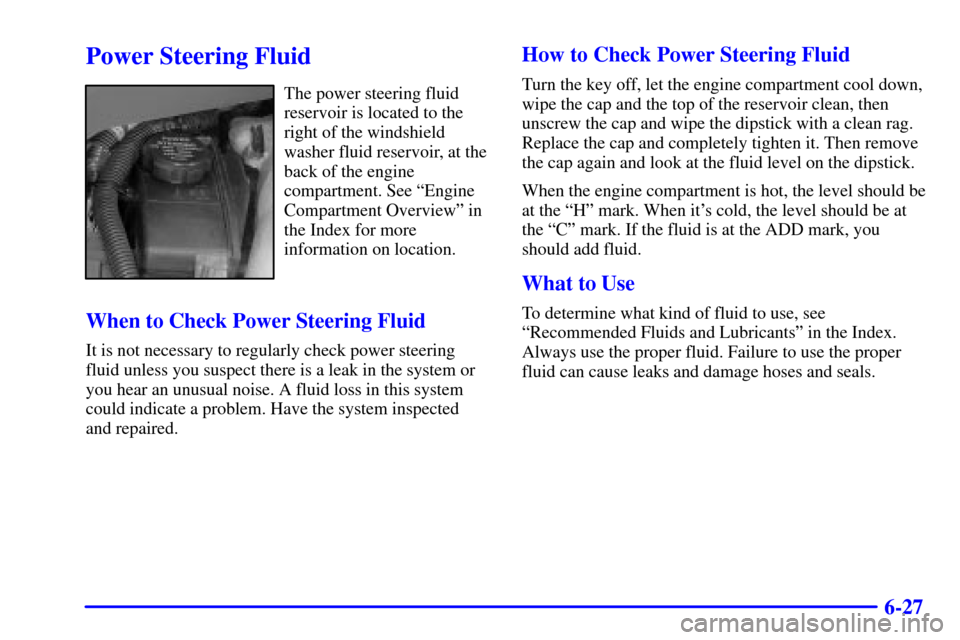
The power steering fluid
reservoir is located to the
right of the windshield
washer fluid reservoir, at the
back of the engine
compartment. See ªEngine
Compartment Overviewº in
the Index for more
information on location.
When to Check Power Steering Fluid
It is not necessary to regularly check power steering
fluid unless you suspect there is a leak in the system or
you hear an unusual noise. A fluid loss in this system
could indicate a problem. Have the system inspected
and repaired.
How to Check Power Steering Fluid
Turn the key off, let the engine compartment cool down,
wipe the cap and the top of the reservoir clean, then
unscrew the cap and wipe the dipstick with a clean rag.
Replace the cap and completely tighten it. Then remove
the cap again and look at the fluid level on the dipstick.
When the engine compartment is hot, the level should be
at the ªHº mark. When it's cold, the level should be at
the ªCº mark. If the fluid is at the ADD mark, you
should add fluid.
What to Use
To determine what kind of fluid to use, see
ªRecommended Fluids and Lubricantsº in the Index.
Always use the proper fluid. Failure to use the proper
fluid can cause leaks and damage hoses and seals.