Page 142 of 460
2-29
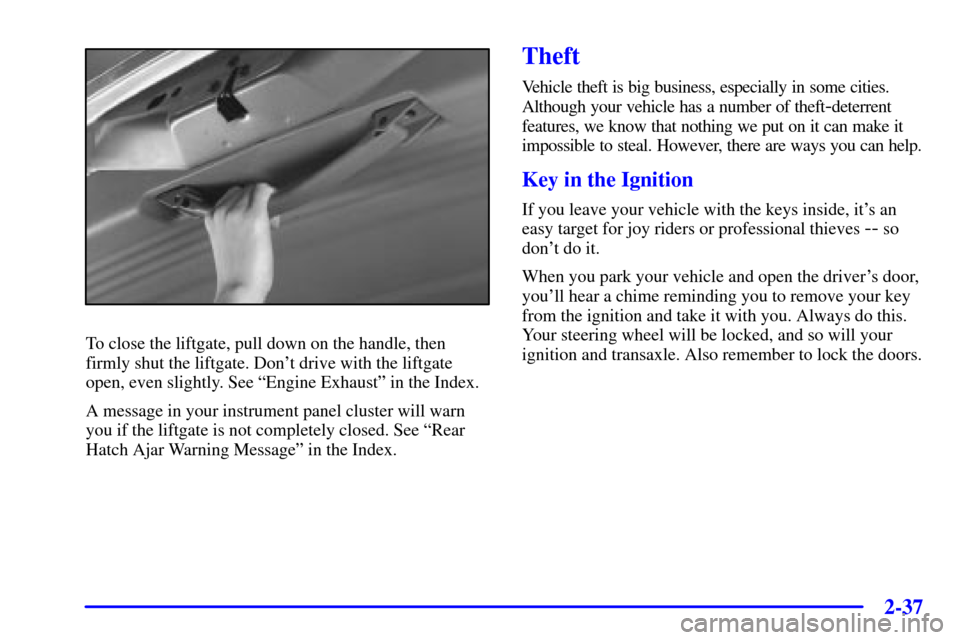
If you have the optional
power sliding door, this
switch is located in
the overhead
console switchbank.
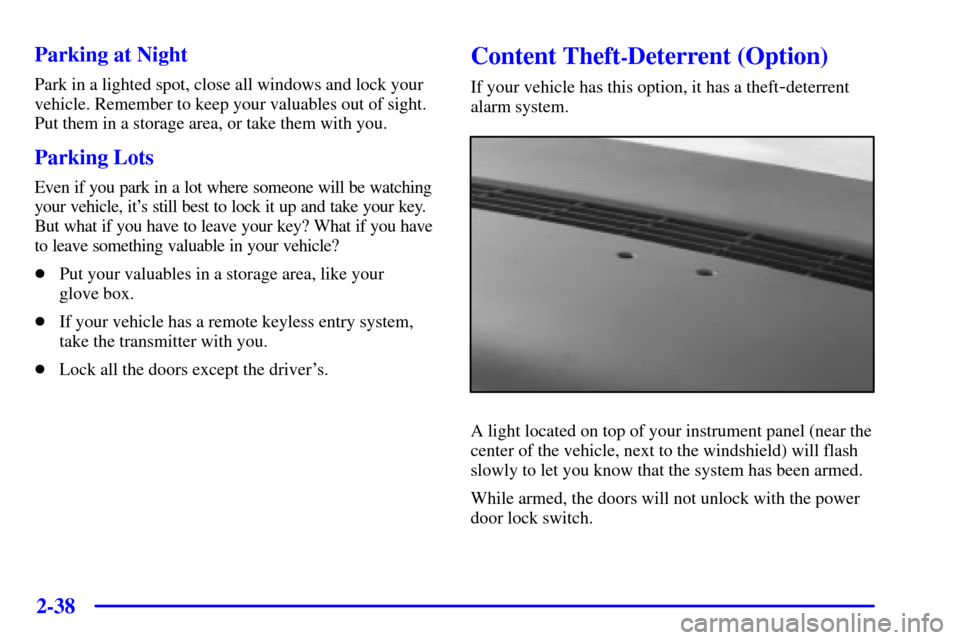
These switches are located
in the overhead console
switchbank, if you have
the optional dual power
sliding doors.The power sliding door and the power sliding door
override is one switch. The left switch is for the driver's
side power sliding door and the right switch is for the
passenger's side sliding door.
Pushing the bottom of the switch(es) turns the power to
the sliding door(s) off. When the power sliding door(s)
is off, you will not be able to open the door(s) in the
following ways:
�When using the power sliding door switch(es)
located on the overhead console switchbank,
�when using the wall
-mounted switch in front of the
driver's or passenger's sliding door, or
�when using the optional remote keyless entry transmitter.
NOTICE:
When your vehicle goes through an automatic
car wash, be sure the power sliding door is
turned off. If it isn't, the power sliding door may
open accidentally.
Page 148 of 460

2-35
If any of these conditions occur, the power sliding door
will need to be reset. If your vehicle has the optional
dual power sliding doors, both doors will have to be
reset. To do this, follow the directions listed here.
It will be easier if you read through them once before
beginning this procedure.
1. Check to be sure the power sliding door is unlocked
and securely closed.
2. Turn the ignition key to OFF.
3. If on, turn the power sliding door override
switch off.
4. Remove fuse 29 from the underhood fuse and relay
center. Leave it out for 30 seconds.
5. Reinstall the fuse and wait 10 seconds.
6. Turn the power sliding door override switch on.7. Push either of the power door buttons to open the
power sliding door.
8. Open the door.
9. Wait five seconds and close the door by pushing
either power door button.
10. Wait five seconds and repeat Steps 7 through 9.
If the door does not rest in the fully open position
after repeating Step 7, repeat Steps 7 through 9 again.
If the door still does not operate correctly, see your
dealer for service.
Canceling the Sliding Door Security Lock
1. Unlock the sliding door and open the door from
the outside.
2. Move the security lock lever all the way down.
The sliding door lock will now work normally.
Page 149 of 460
2-36
Liftgate
To unlock the liftgate from the outside, turn the key in
the cylinder clockwise. To lock the liftgate using the
key, turn the key counterclockwise.
Open the liftgate using the handle located above the
license plate. Once slightly opened, the liftgate will rise
by itself. Lamps in the rear of the vehicle will come on,
illuminating the rear cargo area. See ªInterior Lampsº in
the Index.
NOTICE:
Be sure there are no overhead obstructions, such
as a garage door, before you open the liftgate.
You could slam the liftgate into something and
break the glass.
CAUTION:
It can be dangerous to drive with the liftgate
open because carbon monoxide (CO) gas can
come into your vehicle. You can't see or smell
CO. It can cause unconsciousness and even death.
If you must drive with the liftgate open or if
electrical wiring or other cable connections must
pass through the seal between the body and
the liftgate:
�Make sure all other windows are shut.
�Turn the fan on your heating or cooling
system to its highest speed with the setting
on bi
-level (outside air button is pressed).
That will force outside air into your vehicle.
See ªComfort Controlsº in the Index.
�If you have air outlets on or under the
instrument panel, open them all the way.
See ªEngine Exhaustº in the Index.
Page 150 of 460
2-37
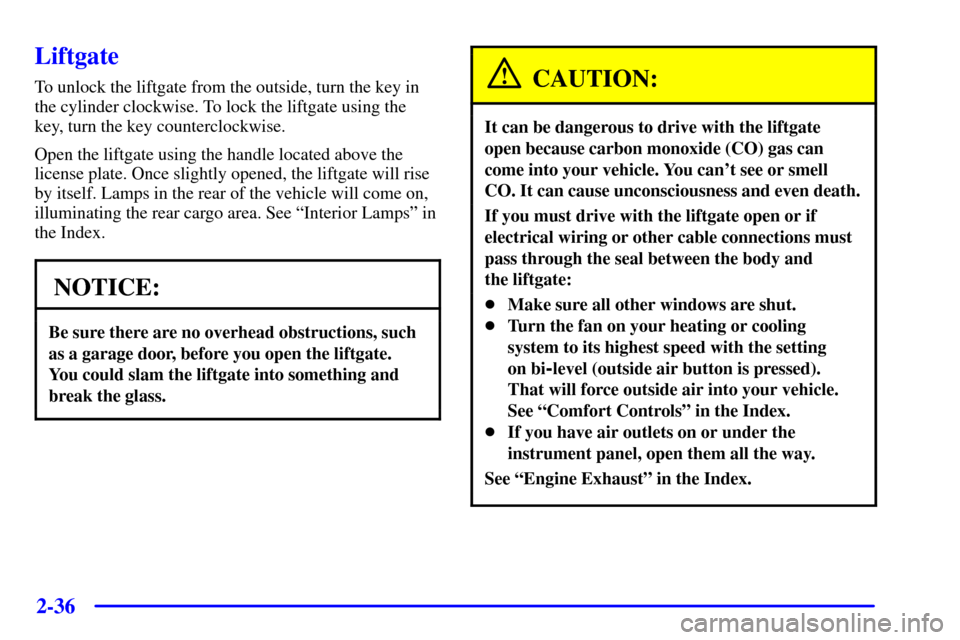
To close the liftgate, pull down on the handle, then
firmly shut the liftgate. Don't drive with the liftgate
open, even slightly. See ªEngine Exhaustº in the Index.
A message in your instrument panel cluster will warn
you if the liftgate is not completely closed. See ªRear
Hatch Ajar Warning Messageº in the Index.
Theft
Vehicle theft is big business, especially in some cities.
Although your vehicle has a number of theft
-deterrent
features, we know that nothing we put on it can make it
impossible to steal. However, there are ways you can help.
Key in the Ignition
If you leave your vehicle with the keys inside, it's an
easy target for joy riders or professional thieves
-- so
don't do it.
When you park your vehicle and open the driver's door,
you'll hear a chime reminding you to remove your key
from the ignition and take it with you. Always do this.
Your steering wheel will be locked, and so will your
ignition and transaxle. Also remember to lock the doors.
Page 151 of 460
2-38 Parking at Night
Park in a lighted spot, close all windows and lock your
vehicle. Remember to keep your valuables out of sight.
Put them in a storage area, or take them with you.
Parking Lots
Even if you park in a lot where someone will be watching
your vehicle, it's still best to lock it up and take your key.
But what if you have to leave your key? What if you have
to leave something valuable in your vehicle?
�Put your valuables in a storage area, like your
glove box.
�If your vehicle has a remote keyless entry system,
take the transmitter with you.
�Lock all the doors except the driver's.
Content Theft-Deterrent (Option)
If your vehicle has this option, it has a theft-deterrent
alarm system.
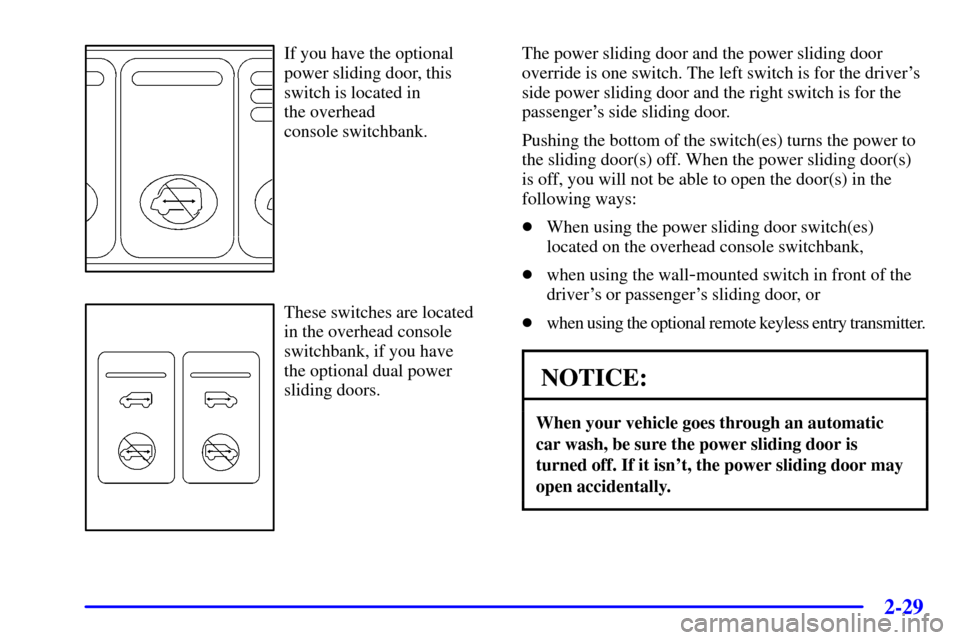
A light located on top of your instrument panel (near the
center of the vehicle, next to the windshield) will flash
slowly to let you know that the system has been armed.
While armed, the doors will not unlock with the power
door lock switch.
Page 152 of 460

2-39
Once armed, the alarm will go off if someone tries to
enter the vehicle (without using the remote keyless entry
transmitter or a key), breaks a window, tries to damage
the vehicle or turns the ignition to ON. The horn will
sound and the parking lamps will flash for up to
two minutes.
When the alarm is armed, the liftgate may be opened
with the remote keyless entry transmitter or with a key.
Arming with the Power Lock Switch
Your alarm system will arm when you use either power
door lock switch to lock the doors while any door or the
liftgate is open and the key is removed from the ignition.
If you would like to turn on power door lock switch
arming, see ªMultifunction Alarm Locks and Lighting
Choicesº in the Index.
The security light flashes quickly to let you know when
the system is ready to arm with the power door lock
switches. The security light will stop flashing and stay
on when you press the rear of the power door lock
switch, to let you know the system is arming. After all
doors and the liftgate are closed and locked, the security
light will begin flashing at a very slow rate to let you
know the system is armed.
Arming with the Remote Keyless
Entry Transmitter
Your alarm system will arm when you use your remote
keyless entry transmitter to lock the doors, if the key is
not in the ignition. The security light will turn on to let
you know the system is arming. After all doors and the
liftgate are closed and locked, the security light will
begin flashing at a very slow rate to let you know the
system is armed.
Arming with Your Key
Your alarm system will arm when you use your key to
lock the doors. The security light will turn on to let you
know the system is arming. After all doors and the
liftgate are closed and locked, the security light will
begin flashing at a very slow rate to let you know the
system is armed. If you would like your key not to arm
the system, see ªMultifunction Alarm Locks and
Lighting Choicesº in the Index.
Arming Confirmation
If remote unlock confirmation is on, your parking lamps
will flash to let you know when your alarm system has
disarmed. If you would not like the parking lamps to
flash, see ªMultifunction Alarm Locks and Lighting
Choicesº in the Index.
Page 153 of 460

2-40 Disarming with the Remote Keyless
Entry Transmitter
Your alarm system will disarm when you use your
remote keyless entry transmitter to unlock the doors.
The security light will stop flashing to let you know the
system is no longer armed.
Disarming with Your Key
Your alarm system will disarm when you use your key
to unlock the doors. The security light will stop flashing
to let you know the system is no longer armed. If you
would like your key not to disarm the alarm system, see
ªMultifunction Alarm Locks and Lighting Choicesº in
the Index.
Nuisance Alarms
If you experience nuisance alarms (alarms which are not
caused by the opening of a door or the liftgate and are
not desirable), you may need to reduce the damage
detection sensitivity. Try programming the content
theft
-deterrent to Mode 1.
If you continue to experience nuisance alarms, you
may want to try turning off damage detection by
programming your content theft
-deterrent to Mode 2.
If you are still having trouble with nuisance alarms, you
can turn off the content theft
-deterrent system by
programming your content theft
-deterrent to Mode 3.
See ªMultifunction Alarm Locks and Lighting Choicesº
in the Index for more information. See your dealer or
qualified technician for service.
Page 154 of 460
2-41
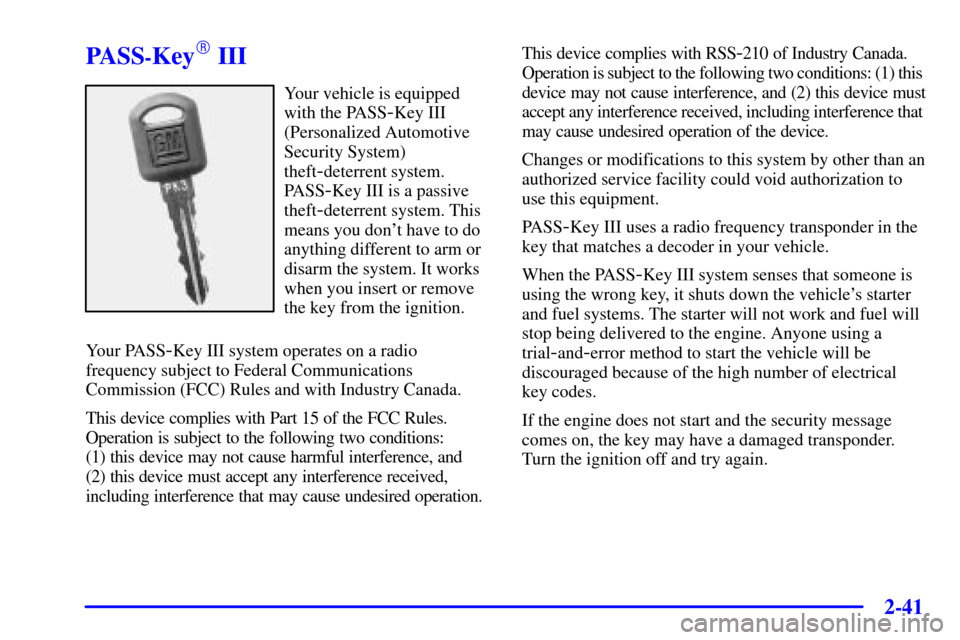
PASS-Key� III
Your vehicle is equipped
with the PASS
-Key III
(Personalized Automotive
Security System)
theft
-deterrent system.
PASS
-Key III is a passive
theft
-deterrent system. This
means you don't have to do
anything different to arm or
disarm the system. It works
when you insert or remove
the key from the ignition.
Your PASS
-Key III system operates on a radio
frequency subject to Federal Communications
Commission (FCC) Rules and with Industry Canada.
This device complies with Part 15 of the FCC Rules.
Operation is subject to the following two conditions:
(1) this device may not cause harmful interference, and
(2) this device must accept any interference received,
including interference that may cause undesired operation.This device complies with RSS
-210 of Industry Canada.
Operation is subject to the following two conditions: (1) this
device may not cause interference, and (2) this device must
accept any interference received, including interference that
may cause undesired operation of the device.
Changes or modifications to this system by other than an
authorized service facility could void authorization to
use this equipment.
PASS
-Key III uses a radio frequency transponder in the
key that matches a decoder in your vehicle.
When the PASS
-Key III system senses that someone is
using the wrong key, it shuts down the vehicle's starter
and fuel systems. The starter will not work and fuel will
stop being delivered to the engine. Anyone using a
trial
-and-error method to start the vehicle will be
discouraged because of the high number of electrical
key codes.
If the engine does not start and the security message
comes on, the key may have a damaged transponder.
Turn the ignition off and try again.