Page 83 of 383
2-21
If this happens and the starter won't work, turn the
ignition off. Clean and dry the key, wait three minutes
and try again. If the starter still won't work, wait three
minutes and try the other ignition key. At this time, you
may also want to check the fuses (see ªFuses and Circuit
Breakersº in the Index). If the starter won't work with
the other key, your vehicle needs service. If your vehicle
does start, the first ignition key may be faulty. See your
dealer or a locksmith who can service the PASS
-Key.
If you accidentally use a key that has a damaged or
missing resistor pellet, you will see no SECURITY
light. You don't have to wait three minutes before trying
the proper key.
If the resistor pellet is damaged or missing, the starter
won't work. Use the other ignition key, and see your
dealer or a locksmith who can service the PASS
-Key to
have a new key made.
If the SECURITY light comes on while driving, have
your vehicle serviced as soon as possible.
If you lose or damage a PASS
-Key ignition key, see your
dealer or a locksmith who can service PASS
-Key. In an
emergency, call Chevrolet Roadside Assistance. See
ªRoadside Assistanceº in the Index for more information.
New Vehicle ªBreak-Inº
NOTICE:
Your vehicle doesn't need an elaborate
ªbreak
-in.º But it will perform better in the long
run if you follow these guidelines:
�Keep your speed at 55 mph (88 km/h) or
less for the first 500 miles (805 km).
�Don't drive at any one speed
-- fast or
slow
-- for the first 500 miles (805 km).
Don't make full
-throttle starts.
�Avoid making hard stops for the first
200 miles (322 km) or so. During this time
your new brake linings aren't yet broken
in. Hard stops with new linings can mean
premature wear and earlier replacement.
Follow this breaking
-in guideline every
time you get new brake linings.
Page 95 of 383
2-33 One to Four Shift Light
(Manual Transmission)
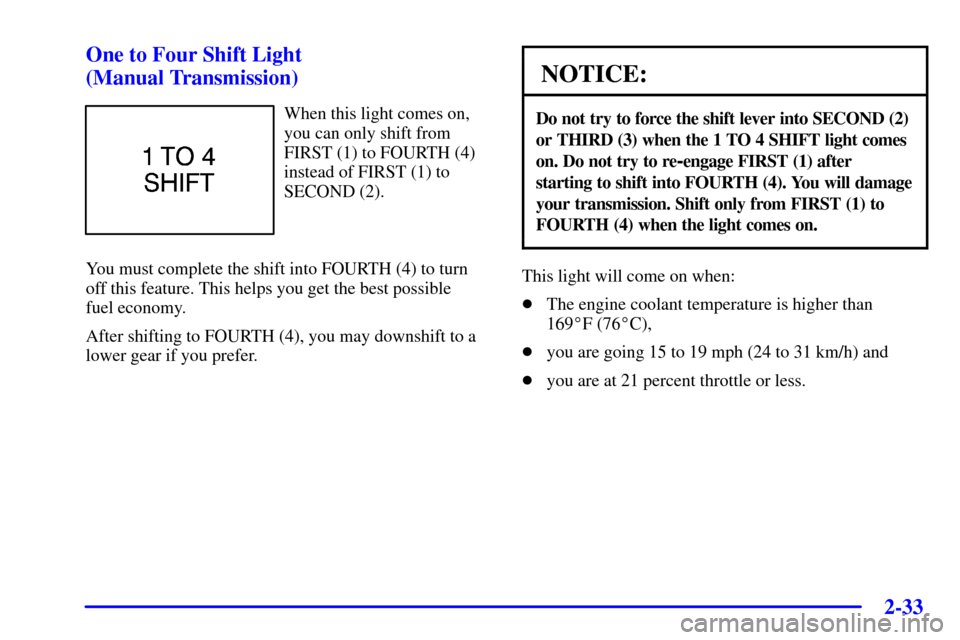
When this light comes on,
you can only shift from
FIRST (1) to FOURTH (4)
instead of FIRST (1) to
SECOND (2).
You must complete the shift into FOURTH (4) to turn
off this feature. This helps you get the best possible
fuel economy.
After shifting to FOURTH (4), you may downshift to a
lower gear if you prefer.
NOTICE:
Do not try to force the shift lever into SECOND (2)
or THIRD (3) when the 1 TO 4 SHIFT light comes
on. Do not try to re
-engage FIRST (1) after
starting to shift into FOURTH (4). You will damage
your transmission. Shift only from FIRST (1) to
FOURTH (4) when the light comes on.
This light will come on when:
�The engine coolant temperature is higher than
169�F (76�C),
�you are going 15 to 19 mph (24 to 31 km/h) and
�you are at 21 percent throttle or less.
Page 97 of 383
2-35
Parking Brake
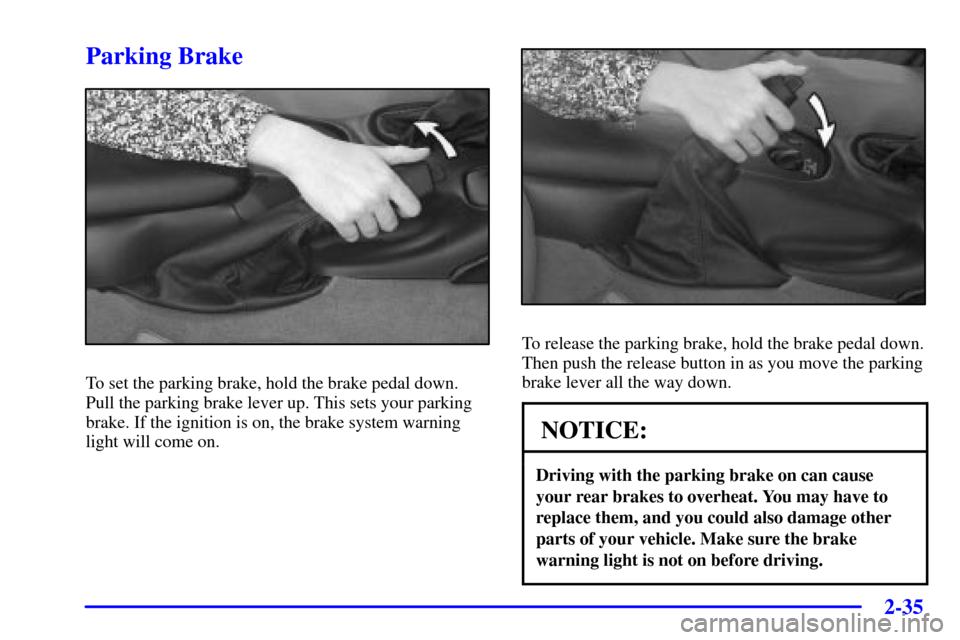
To set the parking brake, hold the brake pedal down.
Pull the parking brake lever up. This sets your parking
brake. If the ignition is on, the brake system warning
light will come on.
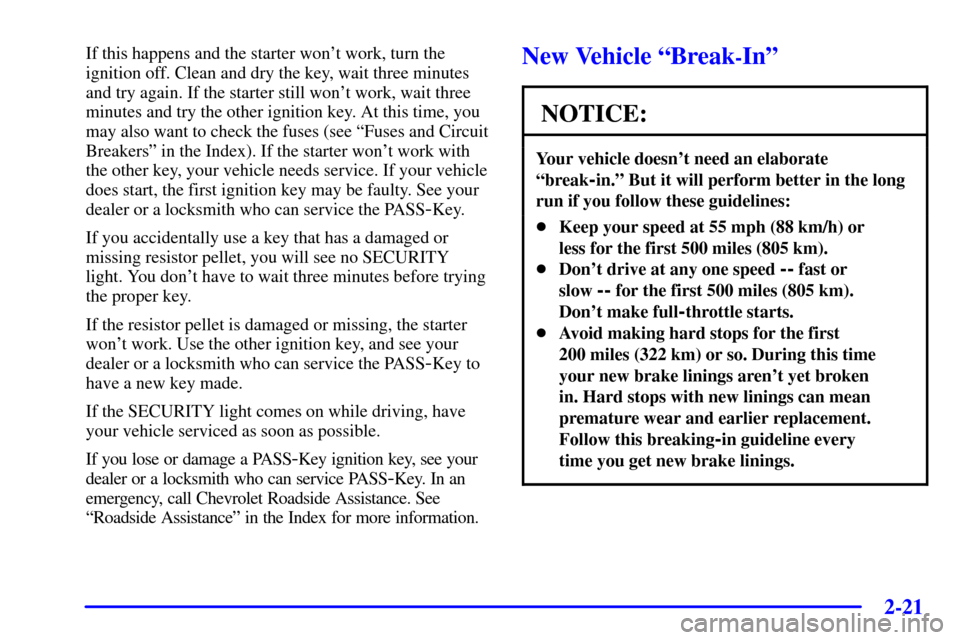
To release the parking brake, hold the brake pedal down.
Then push the release button in as you move the parking
brake lever all the way down.
NOTICE:
Driving with the parking brake on can cause
your rear brakes to overheat. You may have to
replace them, and you could also damage other
parts of your vehicle. Make sure the brake
warning light is not on before driving.
Page 107 of 383

2-45
You can open the doors manually using the knob next to
the headlamp assembly. Turn the knob counterclockwise
until the doors are open. Turn the knob clockwise to
close the doors manually.
The headlamp doors should be open when driving in
icy or snowy conditions to prevent the doors from
freezing closed and when washing the vehicle to help
clean the headlamps.
NOTICE:
In order to avoid possible contact of the hood to
the headlamp doors, either take care in raising
the hood with the headlamps up, or turn off the
headlamps prior to opening the hood.
Headlamp High/Low-Beam Changer
To change the headlamps from low beam to high or high
to low, push the turn signal lever all the way forward.
When the high beams
are on, this light on the
instrument panel cluster
also will be on. To change
the headlamps from high to
low, pull the lever rearward.
Lamps on Reminder
If you turn the ignition off and leave the headlamps or
parking lamps on and open a door, you will hear a chime
reminding you to turn off the lamps.
Flash-to-Pass Feature
To use the flash-to-pass feature, momentarily pull the
turn signal lever toward you. The high
-beam indicator
will flash to indicate to the other driver that you intend
to pass. If the low
-beam headlamps are off and you have
the optional fog lamps on, the fog lamps will flash.
Page 108 of 383
2-46
Windshield Wipers
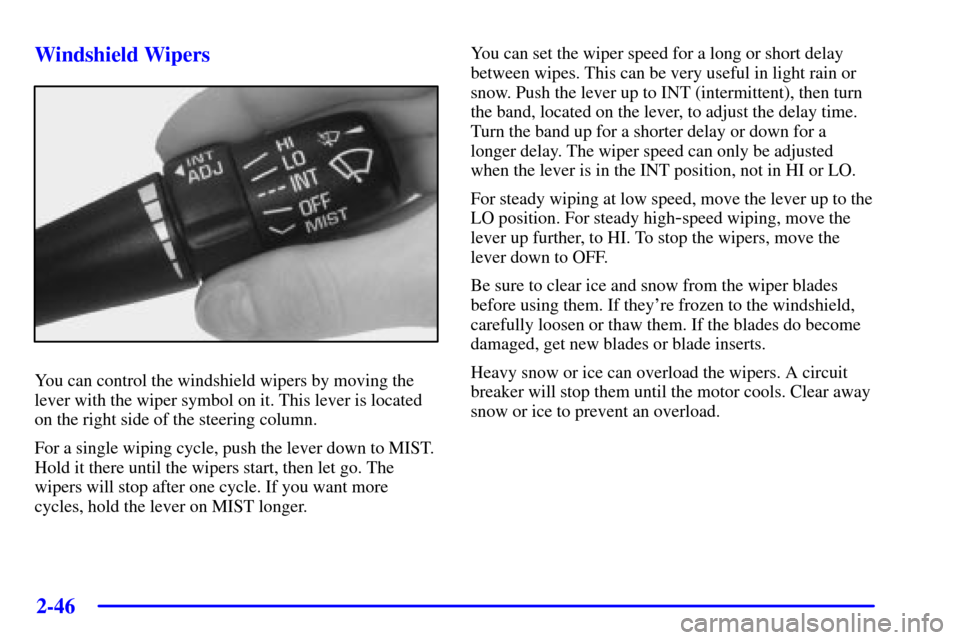
You can control the windshield wipers by moving the
lever with the wiper symbol on it. This lever is located
on the right side of the steering column.
For a single wiping cycle, push the lever down to MIST.
Hold it there until the wipers start, then let go. The
wipers will stop after one cycle. If you want more
cycles, hold the lever on MIST longer.You can set the wiper speed for a long or short delay
between wipes. This can be very useful in light rain or
snow. Push the lever up to INT (intermittent), then turn
the band, located on the lever, to adjust the delay time.
Turn the band up for a shorter delay or down for a
longer delay. The wiper speed can only be adjusted
when the lever is in the INT position, not in HI or LO.
For steady wiping at low speed, move the lever up to the
LO position. For steady high
-speed wiping, move the
lever up further, to HI. To stop the wipers, move the
lever down to OFF.
Be sure to clear ice and snow from the wiper blades
before using them. If they're frozen to the windshield,
carefully loosen or thaw them. If the blades do become
damaged, get new blades or blade inserts.
Heavy snow or ice can overload the wipers. A circuit
breaker will stop them until the motor cools. Clear away
snow or ice to prevent an overload.
Page 112 of 383
2-50
�Move the cruise switch to R/A. Hold it there until
you get up to the speed you want, then release the
switch. (To increase your speed in very small
amounts, move the switch to R/A briefly, then
release it. Each time you do this, the vehicle will go
about 1 mph (1.6 km/h) faster.)
The Driver Information Center (DIC) will display the
cruise set speed.
Reducing Speed While Using Cruise Control
There are two ways to reduce speed while using
cruise control:
�Push in the SET button at the end of the lever until
you reach the lower speed you want, then release it.
�To slow down in very small amounts, push the
SET button briefly. Each time you do this, you'll
go about 1 mph (1.6 km/h) slower.
The Driver Information Center (DIC) will display the
cruise set speed.Passing Another Vehicle While Using Cruise Control
Use the accelerator pedal to increase speed. When you
take your foot off the pedal, the vehicle will slow down
to the cruise control speed you set earlier.
Using Cruise Control on Hills
How well your cruise control will work on hills depends
upon your speed, load and the steepness of the hills.
When going downhill, you may have to brake or shift to
a lower gear to keep your speed down. Of course,
applying the brake takes you out of cruise control.
Many drivers find this to be too much trouble and don't
use cruise control on steep hills.
Ending Cruise Control
There are two ways to turn off the cruise control:
�Step lightly on the brake pedal or push the clutch
pedal, if you have a manual transmission vehicle.
�Move the cruise switch to OFF.
The Driver Information Center (DIC) will display the
message ªCRUISE DISENGAGED.º
Erasing Speed Memory
When you turn off the cruise control or the ignition,
cruise control set speed memory is erased.
Page 113 of 383
2-51
Exterior Lamps
Daytime Running Lamps
Daytime Running Lamps (DRL) can make it easier for
others to see the front of your vehicle during the day.
DRL can be helpful in many different driving
conditions, but they can be especially helpful in the
short periods after dawn and before sunset. Fully
functional daytime running lights are required on all
vehicles first sold in Canada.
The DRL system will make the front turn signal lamps
come on when the following conditions are met:
�The ignition is on,
�the headlamp switch is off and
�the parking brake is released.
When the DRL are on, only the front turn signal lamps
will be on. The headlamps, taillamps, sidemarker and
other lamps won't be on. Your instrument panel won't
be lit up either.
To idle the vehicle with the DRL off, set the parking
brake while the ignition is in OFF. Then start the
vehicle. The DRL, headlamps and parking lamps will
stay off until you release the parking brake.
As with any vehicle, you should turn on the regular
headlamp system when you need it.
Fog Lamps (If Equipped)
Use the fog lamps for better vision in foggy or misty
conditions. Your parking lamps or low
-beam headlamps
must be on or the fog lamps won't work.
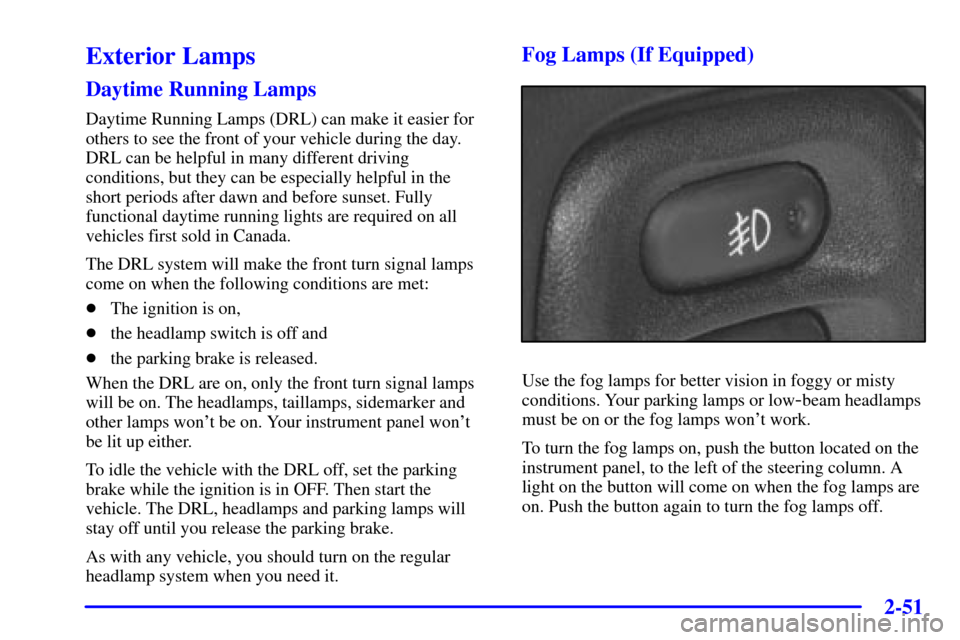
To turn the fog lamps on, push the button located on the
instrument panel, to the left of the steering column. A
light on the button will come on when the fog lamps are
on. Push the button again to turn the fog lamps off.
Page 114 of 383

2-52
Twilight Sentinel� Automatic Lamp
Control (Optional, Standard in Canada)
Twilight Sentinel can turn your lamps on and off for
you. A light sensor on top of the instrument panel makes
the Twilight Sentinel work, so be sure it isn't covered.
You can customize your vehicle to turn Twilight
Sentinel on or off (except for vehicles first sold in
Canada). See ªDriver Information Center (DIC)º in the
Index to turn this feature on or off.
When Twilight Sentinel is turned on, you will see the
following happen:
�When it's dark enough outside, the front turn signal
lamps (DRL) will go off, and the headlamps and
parking lamps will come on. The other lamps that
come on with headlamps will also come on.
�When it's bright enough outside, the headlamps will
go off, and the front turn signal lamps (DRL) will
come on, as long as the headlamp switch is in the
OFF position.
With Twilight Sentinel turned on, you can idle the
vehicle with the lamps off, even when it's dark outside.
First set the parking brake while the ignition is in OFF.
Then start the vehicle. The lamps will stay off until you
release the parking brake.Twilight Sentinel also provides exterior illumination as
you leave the vehicle. If Twilight Sentinel has turned on
the lamps when you turn off the ignition, your lamps
will remain on until:
�The headlamp switch is moved from OFF to the
parking lamp position, or
�a delay time that you select has elapsed.
See ªDriver Information Center (DIC)º in the Index to
select the delay time that you want. You can also select
no delay time.
If you turn off the ignition with the headlamp switch in
the parking lamp or headlamp position, the Twilight
Sentinel delay will not occur. The lamps will turn off as
soon as the switch is turned off.
As with any vehicle, you should turn on the regular
headlamp system when you need it.