Page 55 of 383
1-37
CAUTION:
A child in a rear-facing child restraint can be
seriously injured or killed if the passenger's air
bag inflates. This is because the back of the
rear
-facing child restraint would be very close to
the inflating air bag. Do not use a rear
-facing
child restraint in this vehicle unless the
passenger's air bag has been turned off.
If a forward-facing child restraint is suitable for
your child, always move the passenger seat as far
back as it will go.
CAUTION:
If the air bag readiness light ever comes on when
you have turned off the air bag, it means that
something may be wrong with the air bag system.
The passenger's air bag could inflate even though
the switch is off. If this ever happens, don't let
anyone whom the national government has
identified as a member of a passenger air bag
risk group sit in the passenger's position (for
example, don't secure a rear
-facing child
restraint in your vehicle) until you have your
vehicle serviced. See ªAir Bag Off Switchº in
the Index.
Page 61 of 383

1-43
Safety Belt Extender
If the vehicle's safety belt will fasten around you, you
should use it.
But if a safety belt isn't long enough to fasten, your
dealer will order you an extender. It's free. When you go
in to order it, take the heaviest coat you will wear, so the
extender will be long enough for you. The extender will
be just for you, and just for the seat in your vehicle that
you choose. Don't let someone else use it, and use it
only for the seat it is made to fit. To wear it, just attach it
to the regular safety belt.
Checking Your Restraint Systems
Now and then, make sure the safety belt reminder light
and all your belts, buckles, latch plates, retractors and
anchorages are working properly. Look for any other
loose or damaged safety belt system parts. If you see
anything that might keep a safety belt system from
doing its job, have it repaired.
Torn or frayed safety belts may not protect you in a
crash. They can rip apart under impact forces. If a belt is
torn or frayed, get a new one right away.
Also look for any opened or broken air bag covers, and
have them repaired or replaced. (The air bag system
does not need regular maintenance.)
Page 63 of 383
2-
2-1
Section 2 Features and Controls
Here you can learn about the many standard and optional features on your vehicle, and information on starting,
shifting and braking. Also explained are the instrument panel and the warning systems that tell you if everything is
working properly
-- and what to do if you have a problem.
2
-2 Windows
2
-4 Keys
2
-6 Door Locks
2
-7 Memory (Option)
2
-9 Remote Keyless Entry (RKE) System
2
-14 Hatch/Trunk Lid Release
2
-19 Theft-Deterrent System
2
-20 PASS-Key�
2-21 New Vehicle ªBreak-Inº
2
-22 Ignition Switch
2
-24 Starting Your Engine
2
-26 Engine Coolant Heater (Canada Only)
2
-28 Automatic Transmission Operation
2
-31 Manual Transmission Operation
2
-35 Parking Brake
2
-36 Shifting Into PARK (P)
(Automatic Transmission Only)
2
-38 Shifting Out of PARK (P)
(Automatic Transmission)2
-38 Parking Your Vehicle (Manual Transmission
Models Only)
2
-39 Parking Over Things That Burn
2
-39 Engine Exhaust
2
-40 Running Your Engine While You're Parked
(Automatic Transmission)
2
-40 Limited-Slip Rear Axle
2
-41 Selective Real Time Damping (SRTD) (Option)
2
-43 Turn Signal/Multifunction Lever
2
-51 Exterior Lamps
2
-53 Interior Lamps
2
-54 Mirrors
2
-57 Storage Compartments
2
-62 Roof Panel (If Equipped)
2
-69 Convertible Top (Option)
2
-76 The Instrument Panel -- Your
Information System
2
-80 Warning Lights, Gages and Messages
2
-93 Driver Information Center (DIC)
Page 70 of 383

2-8
The MEMORY buttons are located on the driver's door,
above the power mirror controls. The MEMORY
buttons can store and recall settings for up to three
drivers. Use button ª1º to store the settings for the
first driver, button ª2º for a second driver or press
buttons 1 and 2 at the same time for a third driver.
To store your memory settings:
1. Adjust your settings for the driver's seat position,
outside rearview mirror positions, and telescopic
steering wheel (if equipped).
2. Press and hold a MEMORY button. The light above
the MEMORY button will glow steady for one
second and then flash once when the settings are
complete. Then the light will go off.
3. Set the climate control temperature, fan speed and
mode settings, radio presets, tone, volume, playback
mode (AM/FM, tape or CD), tape direction and
compact disc position.
Your memory settings are now programmed. Any
changes that are made to the audio system and climate
controls while driving will be automatically stored when
the ignition key is turned off.When first entering your vehicle, after pressing the
unlock button on your remote keyless entry transmitter
or a MEMORY button, a recall of your settings will
occur when the door is closed and the ignition key is in
the ignition switch. As the memory settings are recalled,
the light above the button will flash until the correct
settings are achieved, then glow for five seconds
when complete.
A memory recall can be stopped by pressing any
memory seat, mirror or steering column position button.
When your remote keyless entry transmitter has been
programmed to driver 1, 2 or 3, and you insert the key into
the ignition, memory will also occur. Drivers 1, 2 and
3 correspond to the order in which your remote keyless
entry transmitters were programmed. See ªFob Trainingº
in the Index for more information.
Memory recall will not work if the vehicle is moving.
Memory recall will be temporarily interrupted during
engine crank.
Page 79 of 383
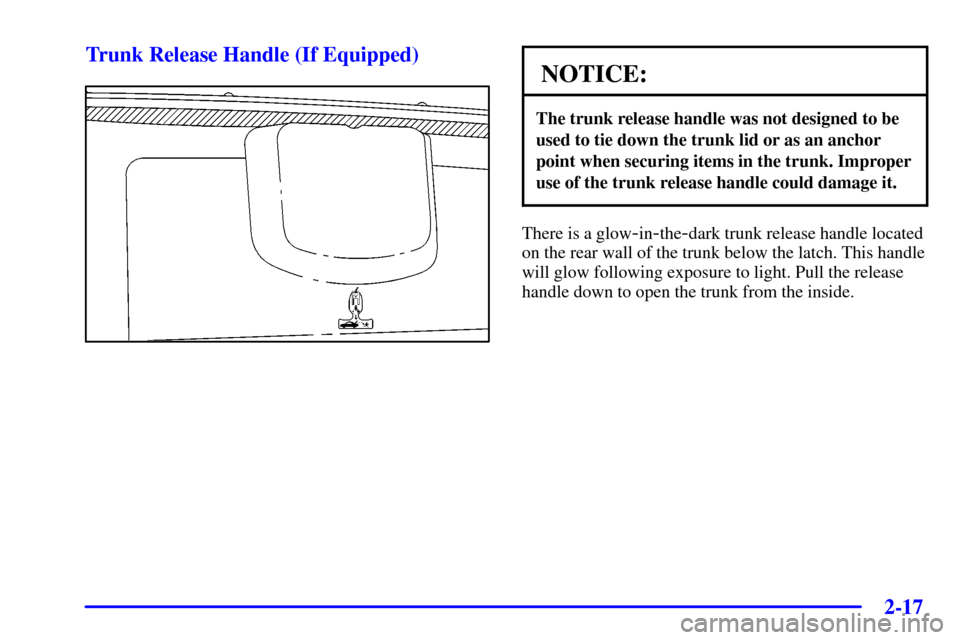
2-17 Trunk Release Handle (If Equipped)
NOTICE:
The trunk release handle was not designed to be
used to tie down the trunk lid or as an anchor
point when securing items in the trunk. Improper
use of the trunk release handle could damage it.
There is a glow-in-the-dark trunk release handle located
on the rear wall of the trunk below the latch. This handle
will glow following exposure to light. Pull the release
handle down to open the trunk from the inside.
Page 80 of 383

2-18
Theft
Vehicle theft is big business, especially in some cities.
Although your vehicle has a number of theft
-deterrent
features, we know that nothing we put on it can make it
impossible to steal. However, there are ways you can help.
Key in the Ignition
If you leave your vehicle with the keys inside, it's an
easy target for joy riders or professional thieves
-- so
don't do it.
When you park your vehicle and open the driver's door,
you'll hear a chime reminding you to remove your key
from the ignition and take it with you. Always do this.
Your ignition will be locked. If you have an automatic
transmission, it will be locked. If you have a manual
transmission, the steering wheel will also be locked.
And remember to lock the doors.
Parking at Night
Park in a lighted spot, close all windows and lock your
vehicle. Remember to keep your valuables out of sight.
Put them in a storage area, or take them with you.
Parking Lots
Even if you park in a lot where someone will be
watching your vehicle, it's still best to lock it up and
take your keys. But what if you have to leave your key?
Do not leave valuables in your vehicle, since there
would be no place to secure them.
Page 81 of 383

2-19
Theft-Deterrent System
Your vehicle is equipped with a theft-deterrent
alarm system.
With this system, the
SECURITY light will
flash as you open the door
(if your ignition is off). This
light reminds you to arm the
theft
-deterrent system.
Arming the System
Use one of the two following items listed here to arm
the system:
�Press the lock button on the remote keyless
entry transmitter.
�Open the door. (The SECURITY light should flash.)
Lock the door with the power door lock switch. The
SECURITY light will stop flashing and stay on.
Close the door. The SECURITY light should go off.
Testing the Alarm
Use the following to test the system:
1. Make sure the hatch/trunk lid is latched.
2. Lower the window on the driver's door.
3. Manually arm the system.
4. Close the doors and wait 15 seconds.
5. Reach through the open window and manually
unlock the driver's door.
6. Open the door. The alarm should sound.
7. Turn off the alarm.
If the alarm is inoperative, check to see if the horn
works. If not, check the horn fuse. See ªFuses and
Circuit Breakersº in the Index. If the horn works, but
the alarm doesn't go off, see your dealer.
Page 82 of 383

2-20
Disarming the System
Always use your key or the remote keyless entry
transmitter to unlock a door. Unlocking a door any other
way will set off the alarm. If your alarm sounds, listed
below are the ways you can disarm it:
�Unlock the driver's door with your key.
�Put the key in the ignition.
�Press the unlock button on the remote keyless
entry transmitter.
Now, if a door or the hatch/trunk lid is opened without
the key or the remote keyless entry transmitter, the
alarm will go off. Your horn will sound for two minutes,
then it will go off to save battery power. And, your
vehicle won't start.
The theft
-deterrent system won't arm if you lock the
driver's door with a key, the manual door lock, or if you
use the power door lock after the doors are closed.
If your passenger stays in the vehicle when you leave
with the keys, have the passenger lock the vehicle after
the doors are closed. This way the alarm won't arm, and
your passenger won't set it off.
PASS-Key�
Your vehicle is equipped
with the PASS
-Key
(Personalized Automotive
Security System)
theft
-deterrent system.
PASS
-Key is a passive
theft
-deterrent system.
It works when you insert
or remove the key from
the ignition.
PASS
-Key uses a resistor pellet in the ignition key that
matches a decoder in your vehicle.
When the PASS
-Key system senses that someone is using
the wrong key, it shuts down the vehicle's starter and fuel
systems. For about three minutes, the starter won't work
and fuel won't go to the engine. If someone tries to start
your vehicle again or uses another key during this time,
the shutdown period will start over again. This discourages
someone from randomly trying different keys with
different resistor pellets in an attempt to make a match.
The key must be clean and dry before it's inserted in the
ignition or the engine may not start. If the SECURITY
light comes on, the key may be dirty or wet.