Page 76 of 383
2-14
Hatch/Trunk Lid Release
To use the hatch/trunk lid release on vehicles with an
automatic transmission, your vehicle must be in
PARK (P) or NEUTRAL (N). For manual transmissions,
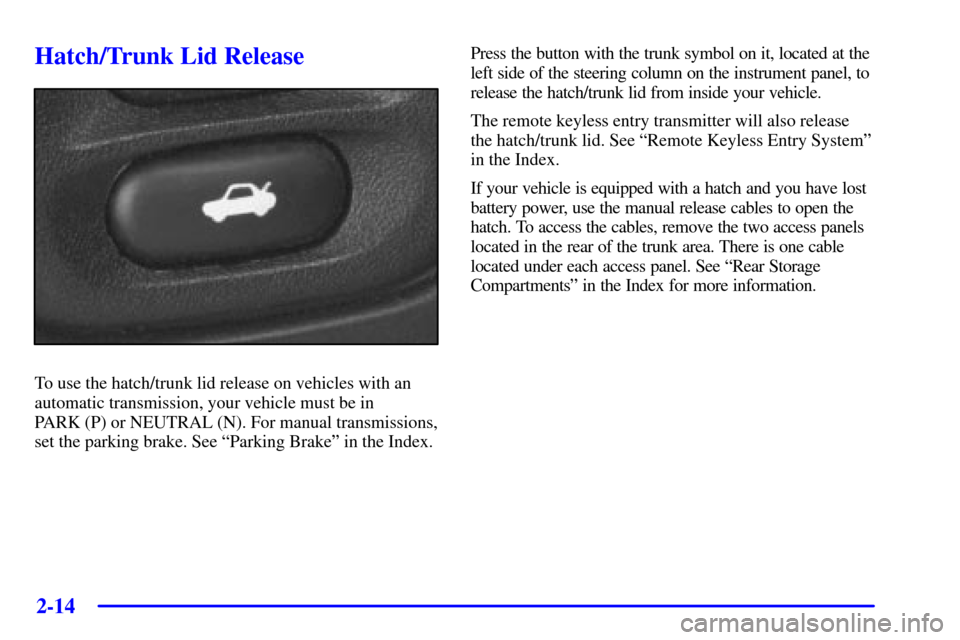
set the parking brake. See ªParking Brakeº in the Index.Press the button with the trunk symbol on it, located at the
left side of the steering column on the instrument panel, to
release the hatch/trunk lid from inside your vehicle.
The remote keyless entry transmitter will also release
the hatch/trunk lid. See ªRemote Keyless Entry Systemº
in the Index.
If your vehicle is equipped with a hatch and you have lost
battery power, use the manual release cables to open the
hatch. To access the cables, remove the two access panels
located in the rear of the trunk area. There is one cable
located under each access panel. See ªRear Storage
Compartmentsº in the Index for more information.
Page 78 of 383
2-16
CAUTION:
It can be dangerous to drive with the hatch/trunk
lid open because carbon monoxide (CO) gas can
come into your vehicle. You can't see or smell
CO. It can cause unconsciousness and even death.
If you must drive with the hatch/trunk lid open
or if electrical wiring or other cable connections
must pass through the seal between the body and
the hatch/trunk lid:
�Make sure all other windows are shut.
�Turn the fan on your heating or cooling
system to its highest speed with the setting
on BI
-LEVEL or VENT. That will force
outside air into your vehicle. See ªComfort
Controlsº in the Index.
�If you have air outlets on or under the
instrument panel, open them all the way.
See ªEngine Exhaustº in the Index.
NOTICE:
If you put things in the hatch/trunk area, be sure
they won't break the glass when you close it.
Never slam the hatch/trunk lid down. You could
break the glass or damage the defogger grid.
When you close the hatch/trunk lid, make sure
you pull down from the center, not the sides. If
you pull the hatch/trunk lid down from the side
too often, the weatherstrip can be damaged.
NOTICE:
Do not store heavy or sharp objects in the rear
storage compartments located in the hatch/trunk
area. If you do, the objects could damage
the underbody.
Page 85 of 383
2-23
CAUTION:
If you have a manual transmission, removing the
key from the ignition switch will lock the steering
column and result in a loss of ability to steer the
vehicle. This could cause a collision. If you need
to turn the engine off while the vehicle is moving,
turn the key to ACC.
NOTICE:
If your key seems stuck in OFF and you can't
turn it, be sure you are using the correct key; if
so, is it all the way in? Turn the key only with
your hand. Using a tool to force it could break
the key or the ignition switch. If none of this
works, then your vehicle needs service.
ON: This is the position to which the switch returns
after you start the engine and release the switch. The
switch stays in ON when the engine is running. But even
when the engine is not running, you can use ON to
operate your electrical power accessories and to display
some instrument panel cluster messages and telltales.
START: This position starts the engine. When the
engine starts, release the key. The ignition switch will
return to ON for normal driving.
When the engine is not running, ACC and ON allow you
to operate your electrical accessories, such as the radio.
A warning tone will sound if you open the driver's door
when the ignition is in OFF or ACC and the key is
in the ignition.
Retained Accessory Power (RAP)
With RAP, your power windows and the audio system
will continue to work for up to 15 minutes after the
ignition key is turned to OFF and neither door is opened.
If a door is opened, the power windows and audio
system will shut off.
Page 105 of 383

2-43
Turn Signal/Multifunction Lever
The multifunction lever on the left side of the steering
column includes the following:
�Turn and Lane Change Signals
�Headlamps
�Headlamp High/Low
-Beam Changer
�Flash
-to-Pass Feature
�Cruise Control
Turn and Lane Change Signals
The turn signal has two upward (for right) and
two downward (for left) positions. These positions allow
you to signal a turn or a lane change.
To signal a turn, move the multifunction lever all the
way up or down. When the turn is finished, the lever
will return automatically.
An arrow on the instrument
panel cluster will flash in
the direction of the turn or
lane change.
To signal a lane change, just raise or lower the lever
until the arrow starts to flash. Hold it there until you
complete your lane change. The lever will return by
itself when you release it.
If you signal a turn or a lane change and the arrows flash
faster than normal, a signal bulb may be burned out.
If a bulb is burned out, replace it to help avoid an
accident. If the arrows don't go on at all when you
signal a turn, check the fuses and check for burned
-out
bulbs. See ªFuses and Circuit Breakersº in the Index.
Page 107 of 383

2-45
You can open the doors manually using the knob next to
the headlamp assembly. Turn the knob counterclockwise
until the doors are open. Turn the knob clockwise to
close the doors manually.
The headlamp doors should be open when driving in
icy or snowy conditions to prevent the doors from
freezing closed and when washing the vehicle to help
clean the headlamps.
NOTICE:
In order to avoid possible contact of the hood to
the headlamp doors, either take care in raising
the hood with the headlamps up, or turn off the
headlamps prior to opening the hood.
Headlamp High/Low-Beam Changer
To change the headlamps from low beam to high or high
to low, push the turn signal lever all the way forward.
When the high beams
are on, this light on the
instrument panel cluster
also will be on. To change
the headlamps from high to
low, pull the lever rearward.
Lamps on Reminder
If you turn the ignition off and leave the headlamps or
parking lamps on and open a door, you will hear a chime
reminding you to turn off the lamps.
Flash-to-Pass Feature
To use the flash-to-pass feature, momentarily pull the
turn signal lever toward you. The high
-beam indicator
will flash to indicate to the other driver that you intend
to pass. If the low
-beam headlamps are off and you have
the optional fog lamps on, the fog lamps will flash.
Page 113 of 383
2-51
Exterior Lamps
Daytime Running Lamps
Daytime Running Lamps (DRL) can make it easier for
others to see the front of your vehicle during the day.
DRL can be helpful in many different driving
conditions, but they can be especially helpful in the
short periods after dawn and before sunset. Fully
functional daytime running lights are required on all
vehicles first sold in Canada.
The DRL system will make the front turn signal lamps
come on when the following conditions are met:
�The ignition is on,
�the headlamp switch is off and
�the parking brake is released.
When the DRL are on, only the front turn signal lamps
will be on. The headlamps, taillamps, sidemarker and
other lamps won't be on. Your instrument panel won't
be lit up either.
To idle the vehicle with the DRL off, set the parking
brake while the ignition is in OFF. Then start the
vehicle. The DRL, headlamps and parking lamps will
stay off until you release the parking brake.
As with any vehicle, you should turn on the regular
headlamp system when you need it.
Fog Lamps (If Equipped)
Use the fog lamps for better vision in foggy or misty
conditions. Your parking lamps or low
-beam headlamps
must be on or the fog lamps won't work.
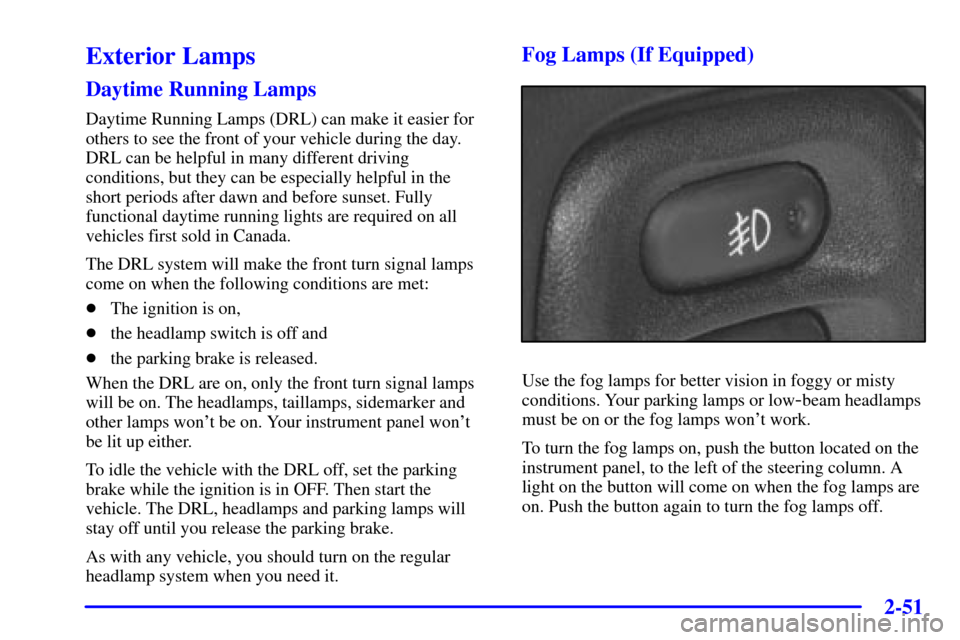
To turn the fog lamps on, push the button located on the
instrument panel, to the left of the steering column. A
light on the button will come on when the fog lamps are
on. Push the button again to turn the fog lamps off.
Page 114 of 383

2-52
Twilight Sentinel� Automatic Lamp
Control (Optional, Standard in Canada)
Twilight Sentinel can turn your lamps on and off for
you. A light sensor on top of the instrument panel makes
the Twilight Sentinel work, so be sure it isn't covered.
You can customize your vehicle to turn Twilight
Sentinel on or off (except for vehicles first sold in
Canada). See ªDriver Information Center (DIC)º in the
Index to turn this feature on or off.
When Twilight Sentinel is turned on, you will see the
following happen:
�When it's dark enough outside, the front turn signal
lamps (DRL) will go off, and the headlamps and
parking lamps will come on. The other lamps that
come on with headlamps will also come on.
�When it's bright enough outside, the headlamps will
go off, and the front turn signal lamps (DRL) will
come on, as long as the headlamp switch is in the
OFF position.
With Twilight Sentinel turned on, you can idle the
vehicle with the lamps off, even when it's dark outside.
First set the parking brake while the ignition is in OFF.
Then start the vehicle. The lamps will stay off until you
release the parking brake.Twilight Sentinel also provides exterior illumination as
you leave the vehicle. If Twilight Sentinel has turned on
the lamps when you turn off the ignition, your lamps
will remain on until:
�The headlamp switch is moved from OFF to the
parking lamp position, or
�a delay time that you select has elapsed.
See ªDriver Information Center (DIC)º in the Index to
select the delay time that you want. You can also select
no delay time.
If you turn off the ignition with the headlamp switch in
the parking lamp or headlamp position, the Twilight
Sentinel delay will not occur. The lamps will turn off as
soon as the switch is turned off.
As with any vehicle, you should turn on the regular
headlamp system when you need it.
Page 115 of 383
2-53
Interior Lamps
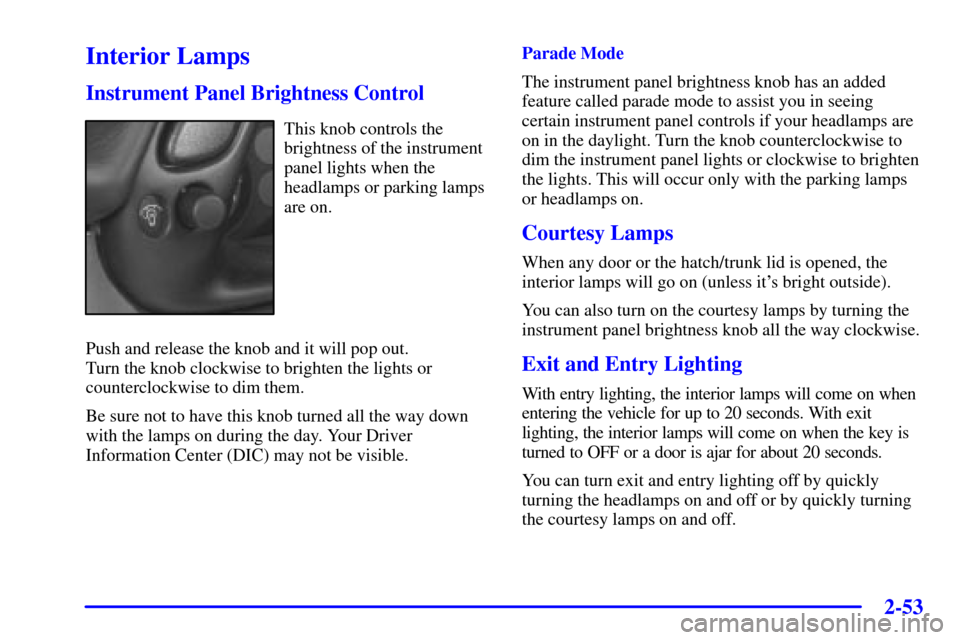
Instrument Panel Brightness Control
This knob controls the
brightness of the instrument
panel lights when the
headlamps or parking lamps
are on.
Push and release the knob and it will pop out.
Turn the knob clockwise to brighten the lights or
counterclockwise to dim them.
Be sure not to have this knob turned all the way down
with the lamps on during the day. Your Driver
Information Center (DIC) may not be visible.Parade Mode
The instrument panel brightness knob has an added
feature called parade mode to assist you in seeing
certain instrument panel controls if your headlamps are
on in the daylight. Turn the knob counterclockwise to
dim the instrument panel lights or clockwise to brighten
the lights. This will occur only with the parking lamps
or headlamps on.
Courtesy Lamps
When any door or the hatch/trunk lid is opened, the
interior lamps will go on (unless it's bright outside).
You can also turn on the courtesy lamps by turning the
instrument panel brightness knob all the way clockwise.
Exit and Entry Lighting
With entry lighting, the interior lamps will come on when
entering the vehicle for up to 20 seconds. With exit
lighting, the interior lamps will come on when the key is
turned to OFF or a door is ajar for about 20 seconds.
You can turn exit and entry lighting off by quickly
turning the headlamps on and off or by quickly turning
the courtesy lamps on and off.