Page 82 of 383

2-20
Disarming the System
Always use your key or the remote keyless entry
transmitter to unlock a door. Unlocking a door any other
way will set off the alarm. If your alarm sounds, listed
below are the ways you can disarm it:
�Unlock the driver's door with your key.
�Put the key in the ignition.
�Press the unlock button on the remote keyless
entry transmitter.
Now, if a door or the hatch/trunk lid is opened without
the key or the remote keyless entry transmitter, the
alarm will go off. Your horn will sound for two minutes,
then it will go off to save battery power. And, your
vehicle won't start.
The theft
-deterrent system won't arm if you lock the
driver's door with a key, the manual door lock, or if you
use the power door lock after the doors are closed.
If your passenger stays in the vehicle when you leave
with the keys, have the passenger lock the vehicle after
the doors are closed. This way the alarm won't arm, and
your passenger won't set it off.
PASS-Key�
Your vehicle is equipped
with the PASS
-Key
(Personalized Automotive
Security System)
theft
-deterrent system.
PASS
-Key is a passive
theft
-deterrent system.
It works when you insert
or remove the key from
the ignition.
PASS
-Key uses a resistor pellet in the ignition key that
matches a decoder in your vehicle.
When the PASS
-Key system senses that someone is using
the wrong key, it shuts down the vehicle's starter and fuel
systems. For about three minutes, the starter won't work
and fuel won't go to the engine. If someone tries to start
your vehicle again or uses another key during this time,
the shutdown period will start over again. This discourages
someone from randomly trying different keys with
different resistor pellets in an attempt to make a match.
The key must be clean and dry before it's inserted in the
ignition or the engine may not start. If the SECURITY
light comes on, the key may be dirty or wet.
Page 86 of 383
2-24
Starting Your Engine
This vehicle has a computer system that monitors engine
speed, throttle and pedal position, and records the
current status.
Automatic Transmission
Move your shift lever to PARK (P) or NEUTRAL (N).
Your engine won't start in any other position
-- that's a
safety feature. To restart when you're already moving,
use NEUTRAL (N) only.
NOTICE:
Don't try to shift to PARK (P) if your vehicle is
moving. If you do, you could damage the
transmission. Shift to PARK (P) only when your
vehicle is stopped.
Manual Transmission
The gear selector should be in NEUTRAL and the parking
brake engaged. Hold the clutch pedal to the floor and start
the engine. Your vehicle won't start if the clutch pedal is
not all the way down
-- that's a safety feature.
1. With your foot off the accelerator pedal, turn the
ignition key to START. When the engine starts, let
go of the key. The idle speed will go down as your
engine gets warm.
NOTICE:
Holding your key in START for longer than
15 seconds at a time will cause your battery to be
drained much sooner. And the excessive heat can
damage your starter motor. Wait about 15 seconds
between each try to help avoid draining your
battery or damaging your starter.
Page 116 of 383
2-54
Reading Lamps
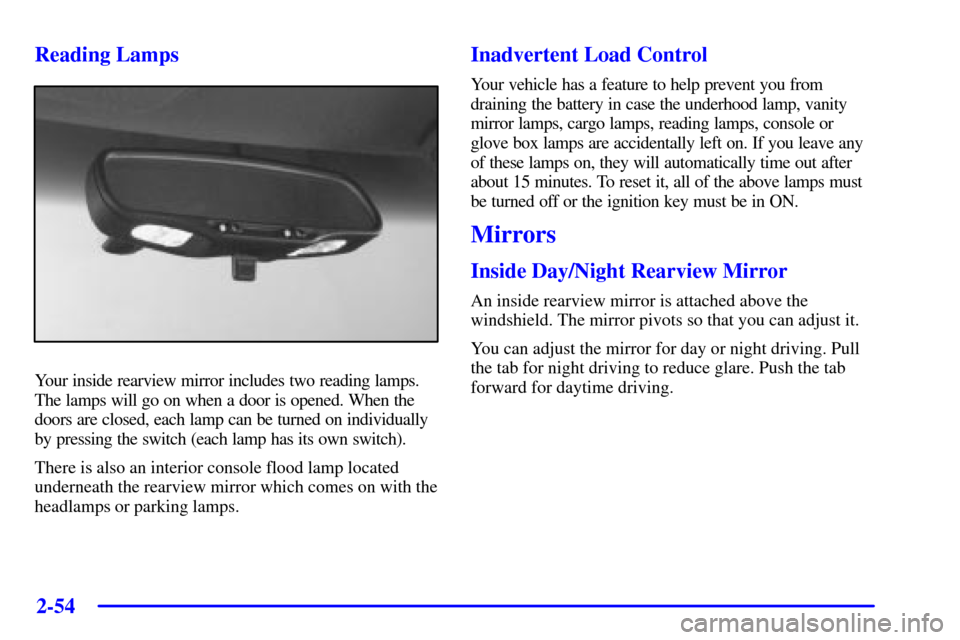
Your inside rearview mirror includes two reading lamps.
The lamps will go on when a door is opened. When the
doors are closed, each lamp can be turned on individually
by pressing the switch (each lamp has its own switch).
There is also an interior console flood lamp located
underneath the rearview mirror which comes on with the
headlamps or parking lamps.
Inadvertent Load Control
Your vehicle has a feature to help prevent you from
draining the battery in case the underhood lamp, vanity
mirror lamps, cargo lamps, reading lamps, console or
glove box lamps are accidentally left on. If you leave any
of these lamps on, they will automatically time out after
about 15 minutes. To reset it, all of the above lamps must
be turned off or the ignition key must be in ON.
Mirrors
Inside Day/Night Rearview Mirror
An inside rearview mirror is attached above the
windshield. The mirror pivots so that you can adjust it.
You can adjust the mirror for day or night driving. Pull
the tab for night driving to reduce glare. Push the tab
forward for daytime driving.
Page 123 of 383
2-61
Accessory Power Outlet
The accessory power outlet is located inside the center
console storage compartment, on the forward left side.
Remove the tethered cap to use the outlet. The outlet can
be used to connect electrical equipment such as a cellular
telephone or CB radio. Be sure to follow the installation
instructions included with the equipment. Leave the cap on
when the accessory power outlet is not in use.
Certain power accessory plugs may not be compatible to the
power accessory outlet and could result in blown vehicle or
adapter fuses. If you experience a problem see you dealer for
additional information on the power accessory outlets.
NOTICE:
When using the accessory power outlet:
�The maximum load of any electrical
equipment should not exceed 15 amps.
�Be sure to turn off any electrical equipment
when not in use. Leaving electrical
equipment on for extended periods can
drain the battery.
NOTICE:
Power outlets are designed for accessory plugs
only. Do not hang any type of accessory or
accessory bracket from the plug. Improper use of
the power outlet can cause damage not covered
by your warranty.
We recommend that you see a qualified technician or your
dealer for the proper installation of your equipment.
Page 134 of 383
2-72
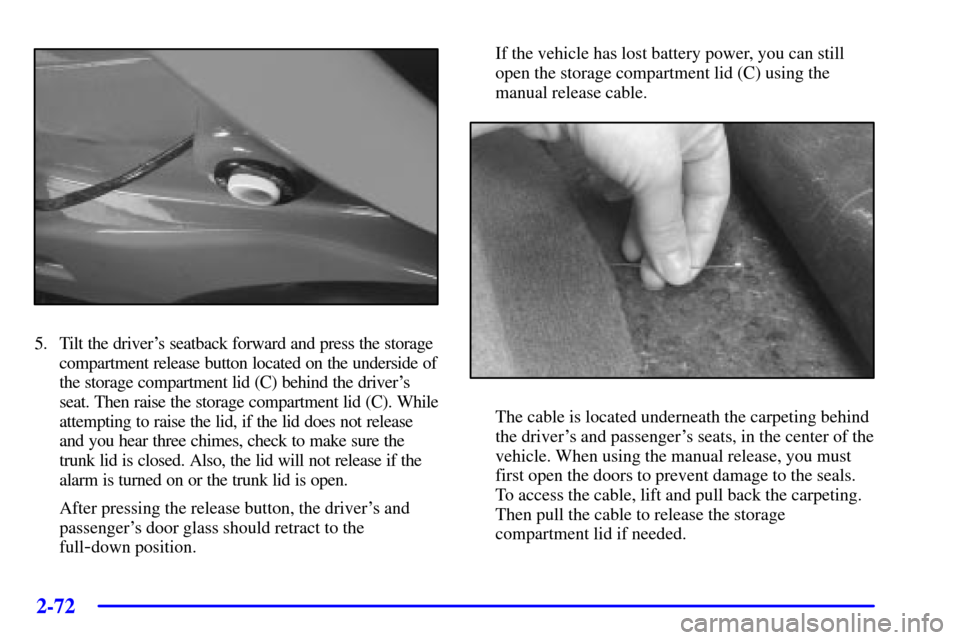
5. Tilt the driver's seatback forward and press the storage
compartment release button located on the underside of
the storage compartment lid (C) behind the driver's
seat. Then raise the storage compartment lid (C). While
attempting to raise the lid, if the lid does not release
and you hear three chimes, check to make sure the
trunk lid is closed. Also, the lid will not release if the
alarm is turned on or the trunk lid is open.
After pressing the release button, the driver's and
passenger's door glass should retract to the
full
-down position.If the vehicle has lost battery power, you can still
open the storage compartment lid (C) using the
manual release cable.
The cable is located underneath the carpeting behind
the driver's and passenger's seats, in the center of the
vehicle. When using the manual release, you must
first open the doors to prevent damage to the seals.
To access the cable, lift and pull back the carpeting.
Then pull the cable to release the storage
compartment lid if needed.
Page 136 of 383
2-74
Raising the Convertible Top
1. Park on a level surface, set the parking brake firmly
and shift an automatic transmission into PARK (P).
Shift a manual transmission into REVERSE (R).
Lower both windows and sun visors and turn the
ignition key to OFF.
2. Tilt the driver's seat forward and press the storage
compartment release button, or use the manual
release cable if battery power has been lost. Lift the
storage compartment lid (C). (After pressing the
release button, the driver and passenger door glass
should retract to the full
-down position, if they have
not already been lowered.)
3. Pull the top up by firmly gripping the front edge (A)
of the convertible top with your hand and applying a
brisk, firm upward and forward motion to get the top
in the full
-up position.
Page 145 of 383
2-83
CAUTION:
If the air bag readiness light ever comes on when
you have turned off the air bag, it means that
something may be wrong with the air bag system.
The passenger's air bag could inflate even though
the switch is off. If this ever happens, don't let
anyone whom the national government has
identified as a member of a passenger air bag
risk group sit in the passenger's position
(for example, don't secure a rear
-facing child
restraint in your vehicle) until you have your
vehicle serviced.
Voltmeter
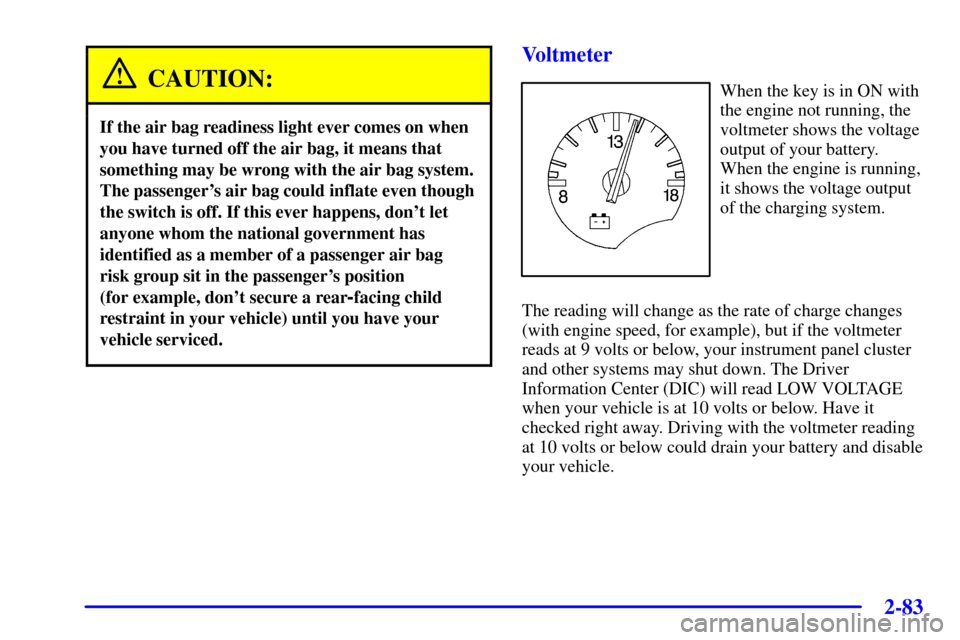
When the key is in ON with
the engine not running, the
voltmeter shows the voltage
output of your battery.
When the engine is running,
it shows the voltage output
of the charging system.
The reading will change as the rate of charge changes
(with engine speed, for example), but if the voltmeter
reads at 9 volts or below, your instrument panel cluster
and other systems may shut down. The Driver
Information Center (DIC) will read LOW VOLTAGE
when your vehicle is at 10 volts or below. Have it
checked right away. Driving with the voltmeter reading
at 10 volts or below could drain your battery and disable
your vehicle.
Page 152 of 383

2-90
Emissions Inspection and Maintenance Programs
Some state/provincial and local governments have or
may begin programs to inspect the emission control
equipment on your vehicle. Failure to pass this
inspection could prevent you from getting a
vehicle registration.
Here are some things you need to know in order to help
your vehicle pass an inspection:
Your vehicle will not pass this inspection if the
CHECK ENGINE light is on or not working properly.
Your vehicle will not pass this inspection if the
OBD (on
-board diagnostic) system determines that
critical emission control systems have not been
completely diagnosed by the system. The vehicle would
be considered not ready for inspection. This can happen
if you have recently replaced your battery or if your
battery has run down. The diagnostic system is designed
to evaluate critical emission control systems during
normal driving. This may take several days of routine
driving. If you have done this and your vehicle still does
not pass the inspection for lack of OBD system
readiness, see your dealer or qualified service center to
prepare the vehicle for inspection.
Engine Oil Pressure Gage
United States Canada
The engine oil pressure gage shows the engine oil
pressure in psi (pounds per square inch) or
kPa (kilopascals) when the engine is running.
Oil pressure should be 20 to 80 psi (140 to 550 kPa).
In certain situations such as long, extended idles on hot
days, it could read as low as 6 psi (40 kPa) and still be
considered normal. It may vary with engine speed,
outside temperature and oil viscosity, but readings above
the shaded area show the normal operating range.
Readings in the shaded area tell you that the engine is
low on oil, or that you might have some other oil
problem. See ªEngine Oilº in the Index.