Page 111 of 363
2-53 Cruise Control (Option)
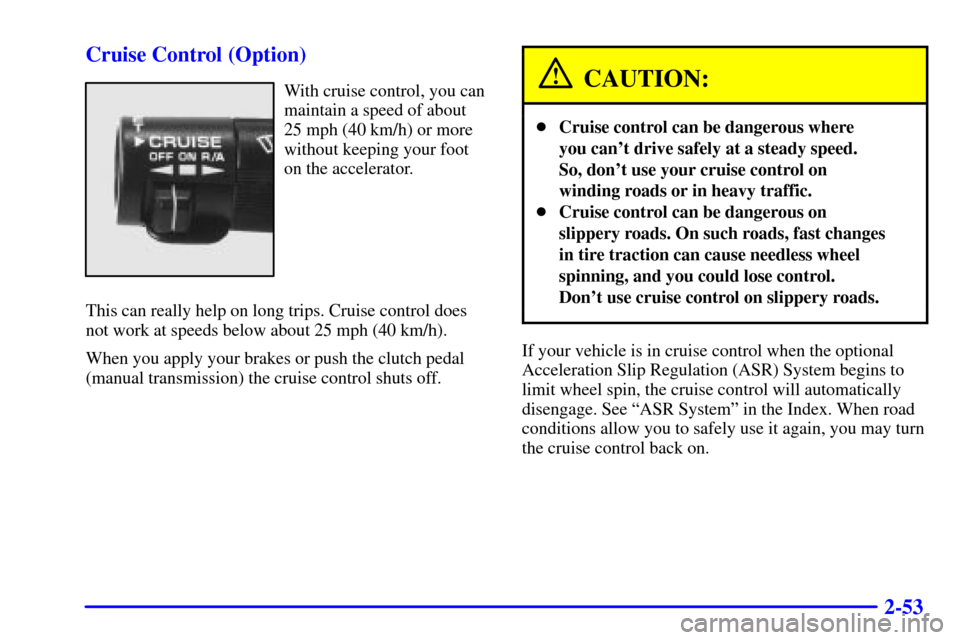
With cruise control, you can
maintain a speed of about
25 mph (40 km/h) or more
without keeping your foot
on the accelerator.
This can really help on long trips. Cruise control does
not work at speeds below about 25 mph (40 km/h).
When you apply your brakes or push the clutch pedal
(manual transmission) the cruise control shuts off.CAUTION:
�Cruise control can be dangerous where
you can't drive safely at a steady speed.
So, don't use your cruise control on
winding roads or in heavy traffic.
�Cruise control can be dangerous on
slippery roads. On such roads, fast changes
in tire traction can cause needless wheel
spinning, and you could lose control.
Don't use cruise control on slippery roads.
If your vehicle is in cruise control when the optional
Acceleration Slip Regulation (ASR) System begins to
limit wheel spin, the cruise control will automatically
disengage. See ªASR Systemº in the Index. When road
conditions allow you to safely use it again, you may turn
the cruise control back on.
Page 121 of 363
2-63
Ashtray and Cigarette Lighter
Lift up the cover to open the ashtray. To remove it, lift
up on the right side of the ashtray. If you have an
automatic transmission, the ashtray is near the front of
the console. If you have a manual transmission, the
ashtray is near the cupholder.
NOTICE:
Don't put papers and other things that burn into
your ashtrays. If you do, cigarettes or other smoking
materials could set them on fire, causing damage.
To use the lighter, push it in all the way and let go.
When it's ready, it will pop back out by itself.
NOTICE:
Don't hold a cigarette lighter in with your hand
while it is heating. If you do, it won't be able to
back away from the heating element when it's
ready. That can make it overheat, damaging the
lighter and the heating element.
If you plug accessories into your cigarette lighter, such
as heating devices or air compressors, these accessories
should have a rated current of less than 15 amps.
Exceeding this limit will result in a blown fuse.
Sun Visors
To block out glare, you can swing down the visors.
You can also swing them to the side.
Visor Vanity Mirror
Pull down the sun visor and lift the cover to expose the
vanity mirror.
Page 130 of 363
2-72
Convertible Top (If Equipped)
The following procedures explain the proper operation
of your convertible top.
Lowering Your Convertible Top
NOTICE:
Don't leave your convertible out with the top
down for any long periods of time. The sun and
the rain can damage your seat material and other
things inside your vehicle.
1. It is recommended that you park on a level surface.
Set the parking brake firmly. Shift an automatic
transmission into PARK (P) or a manual
transmission into REVERSE (R).
2. Turn the ignition to ACC or RUN.
3. Lower both sun visors.
NOTICE:
It is not recommended that you raise or lower the
top while the vehicle is moving.
NOTICE:
Don't lower the top if it is damp or wet. When
the top is down, trapped water can cause stains,
mildew and damage to the inside of your vehicle.
Be sure to dry off the top before you lower it.
NOTICE:
It is not recommended to lower the top if the vehicle
is out in cold weather (0�F/
-18�C or lower), or you
may damage top components.
NOTICE:
Before lowering the convertible top into the
storage area, be sure there are no objects in the
way of the folded, stored top. The weight of a
stored top on items in the storage area will cause
the convertible top back glass to break.
Page 135 of 363
2-77 Raising Your Convertible Top
1. Park on a level surface and set the parking brake
firmly. If you have an automatic transmission, shift
into PARK (P). If you have a manual transmission,
shift into REVERSE (R).
2. Turn the ignition to ACC or RUN (or RAP must
be active).
3. Then lower both sun visors and lower both windows
at least 3 inches (8 cm). If the boot cover is in place,
it must be removed first.
NOTICE:
It is not recommended that you raise or lower the
top while the vehicle is moving.
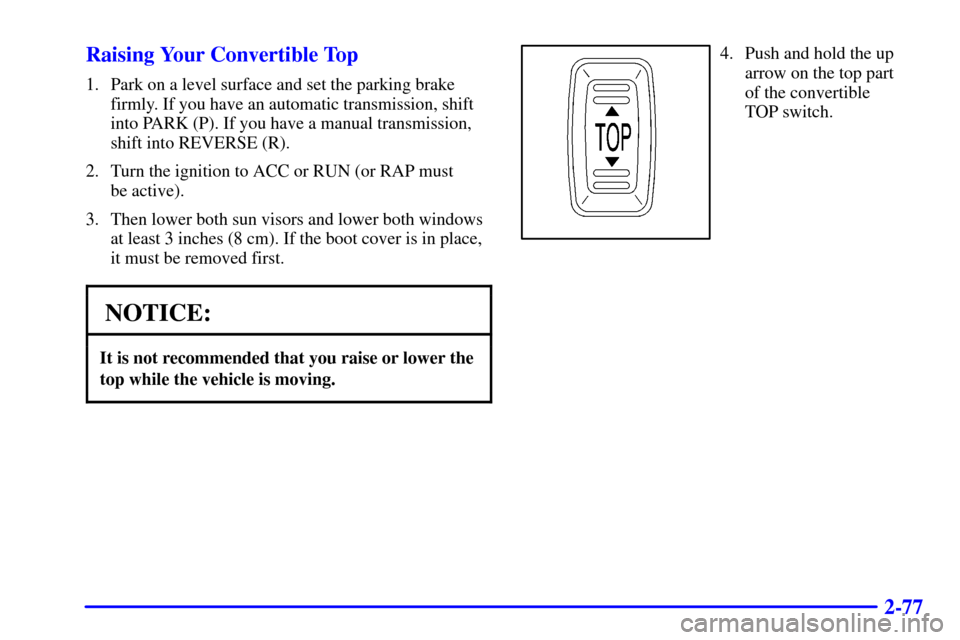
4. Push and hold the up
arrow on the top part
of the convertible
TOP switch.
Page 139 of 363
2-81
The main components of your instrument panel are the following:
A. Air Vents
B. Main Lamp Control
C. Instrument Panel Cluster
D. Horn
E. Fog Lamp Switch (Option)
F. Acceleration Slip Regulation (ASR) Button
or Second
-Gear Start Button
(V6 Automatic without ASR) (Option)
G. Audio System
H. Comfort Control System
I. Glove BoxJ. Remote Hatch Release (If Equipped)
K. Audio Steering Wheel Controls (If Equipped)
L. Rear Window Defogger Button
M. Convertible Top Switch (If Equipped)
N. Ashtray
O. Shift Lever (Automatic Transmission Shown)
P. Cupholders
Q. Storage Console
R. Parking Brake Lever
S. Cigarette Lighter
T. Accessory Power Outlet
Page 219 of 363

4-37 Turn Signals When Towing a Trailer
When you tow a trailer, your vehicle may need a
different turn signal flasher and/or extra wiring. Check
with your dealer. The arrows on your instrument panel
will flash whenever you signal a turn or lane change.
Properly hooked up, the trailer lamps will also flash,
telling other drivers you're about to turn, change lanes
or stop.
When towing a trailer, the arrows on your instrument
panel will flash for turns even if the bulbs on the trailer
are burned out. Thus, you may think drivers behind you
are seeing your signal when they are not. It's important
to check occasionally to be sure the trailer bulbs are
still working.
Driving On Grades
Reduce speed and shift to a lower gear before you
start down a long or steep downgrade. If you don't
shift down, you might have to use your brakes so
much that they would get hot and no longer work well.
On a long uphill grade, shift down and reduce your
speed to around 45 mph (70 km/h) to reduce the
possibility of engine and transmission overheating.If you are towing a trailer and you have an automatic
transmission with overdrive, you may prefer to drive in
DRIVE (D) instead of AUTOMATIC OVERDRIVE (�)
or, as you need to, a lower gear. Or, if you have a
manual transmission with FIFTH (5) gear and you are
towing a trailer, it is better not to use FIFTH (5) gear.
Just drive in FOURTH (4) or, as you need to, a lower
gear. If you have a manual transmission with SIXTH (6)
gear, drive in FIFTH (5) or, as you need to, a lower gear.
Parking on Hills
CAUTION:
You really should not park your vehicle, with a
trailer attached, on a hill. If something goes
wrong, your rig could start to move. People can
be injured, and both your vehicle and the trailer
can be damaged.
Page 220 of 363

4-38
But if you ever have to park your rig on a hill, here's
how to do it:
1. Apply your regular brakes, but don't shift into
PARK (P) yet, or into gear for a manual transmission.
2. Have someone place chocks under the trailer wheels.
3. When the wheel chocks are in place, release the
regular brakes until the chocks absorb the load.
4. Reapply the regular brakes. Then apply your parking
brake and then shift to PARK (P) or REVERSE (R)
for a manual transmission.
5. Release the regular brakes.
When You Are Ready to Leave After
Parking on a Hill
1. Apply your regular brakes and hold the pedal down
while you:
�Start your engine;
�Shift into a gear; and
�Release the parking brake.
2. Let up on the brake pedal.
3. Drive slowly until the trailer is clear of the chocks.
4. Stop and have someone pick up and store the chocks.
Maintenance When Trailer Towing
Your vehicle will need service more often when you're
pulling a trailer. See the Maintenance Schedule for more
on this. Things that are especially important in trailer
operation are automatic transmission fluid (don't
overfill), engine oil, axle lubricant, drive belts, cooling
system and brake system. Each of these is covered in
this manual, and the Index will help you find them
quickly. If you're trailering, it's a good idea to review
this information before you start your trip.
Check periodically to see that all hitch nuts and bolts
are tight.
Engine Cooling When Trailer Towing
Your cooling system may temporarily overheat during
severe operating conditions. See ªEngine Overheatingº
in the Index.
Page 224 of 363
5-4
2. Get the vehicles close enough so the jumper cables
can reach, but be sure the vehicles aren't touching
each other. If they are, it could cause a ground
connection you don't want. You wouldn't be able
to start your vehicle, and the bad grounding could
damage the electrical systems.
To avoid the possibility of the vehicles rolling, set
the parking brake firmly on both vehicles involved
in the jump starting procedure. Put an automatic
transmission in PARK (P) and a manual transmission
in NEUTRAL (N) before setting the parking brakes.
3. Turn off the ignition on both vehicles. Turn off all
lamps that aren't needed, and radios. This will avoid
sparks and help save both batteries. And it could
save your radio!
NOTICE:
If you leave your radio on, it could be badly
damaged. The repairs wouldn't be covered by
your warranty.
4. Open the hoods.
Find the positive (+) and negative (
-) terminals on
each battery.
CAUTION:
Using a match near a battery can cause battery
gas to explode. People have been hurt doing this,
and some have been blinded. Use a flashlight if
you need more light.
Be sure the battery has enough water. You don't
need to add water to the ACDelco� battery
installed in every new GM vehicle. But if a
battery has filler caps, be sure the right amount
of fluid is there. If it is low, add water to take
care of that first. If you don't, explosive gas
could be present.
Battery fluid contains acid that can burn you.
Don't get it on you. If you accidentally get it in
your eyes or on your skin, flush the place with
water and get medical help immediately.