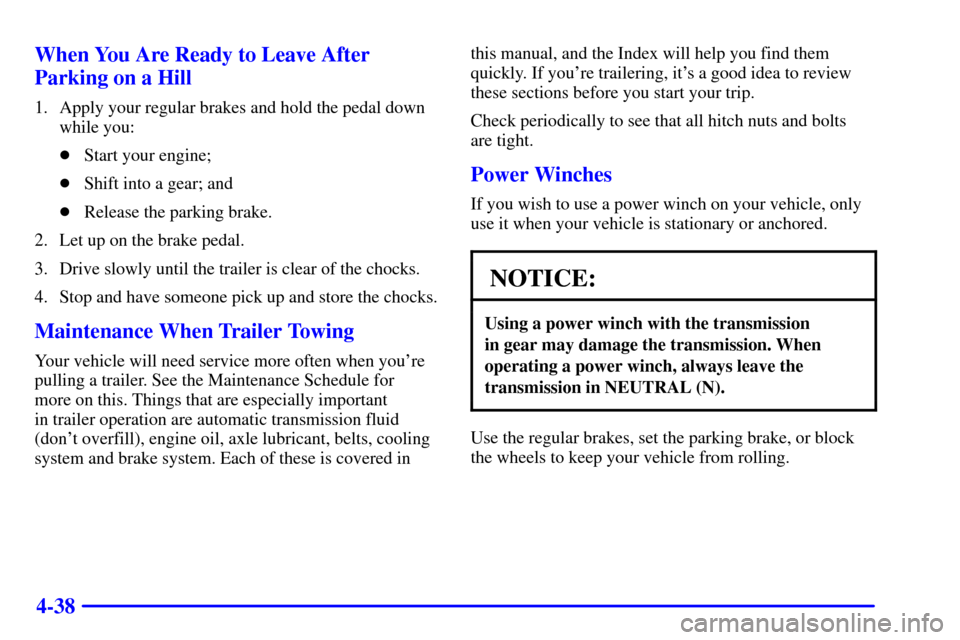
4-38 When You Are Ready to Leave After
Parking on a Hill
1. Apply your regular brakes and hold the pedal down
while you:
�Start your engine;
�Shift into a gear; and
�Release the parking brake.
2. Let up on the brake pedal.
3. Drive slowly until the trailer is clear of the chocks.
4. Stop and have someone pick up and store the chocks.
Maintenance When Trailer Towing
Your vehicle will need service more often when you're
pulling a trailer. See the Maintenance Schedule for
more on this. Things that are especially important
in trailer operation are automatic transmission fluid
(don't overfill), engine oil, axle lubricant, belts, cooling
system and brake system. Each of these is covered inthis manual, and the Index will help you find them
quickly. If you're trailering, it's a good idea to review
these sections before you start your trip.
Check periodically to see that all hitch nuts and bolts
are tight.
Power Winches
If you wish to use a power winch on your vehicle, only
use it when your vehicle is stationary or anchored.
NOTICE:
Using a power winch with the transmission
in gear may damage the transmission. When
operating a power winch, always leave the
transmission in NEUTRAL (N).
Use the regular brakes, set the parking brake, or block
the wheels to keep your vehicle from rolling.
6-49 Wheel Alignment and Tire Balance
The wheels on your vehicle were aligned and balanced
carefully at the factory to give you the longest tire life
and best overall performance.
Scheduled wheel alignment and wheel balancing are not
needed. However, if you notice unusual tire wear or
your vehicle pulling one way or the other, the alignment
may need to be reset. If you notice your vehicle
vibrating when driving on a smooth road, your wheels
may need to be rebalanced.
Wheel Replacement
Replace any wheel that is bent, cracked, or badly
rusted or corroded. If wheel nuts keep coming loose,
the wheel, wheel bolts and wheel nuts should be
replaced. If the wheel leaks air, replace it (except some
aluminum wheels, which can sometimes be repaired).
See your dealer if any of these conditions exist.
Your dealer will know the kind of wheel you need.
Each new wheel should have the same load
-carrying
capacity, diameter, width, offset and be mounted the
same way as the one it replaces.If you need to replace any of your wheels, wheel bolts
or wheel nuts, replace them only with new GM original
equipment parts. This way, you will be sure to have the
right wheel, wheel bolts and wheel nuts for your vehicle.
CAUTION:
Using the wrong replacement wheels, wheel bolts
or wheel nuts on your vehicle can be dangerous.
It could affect the braking and handling of your
vehicle, make your tires lose air and make you
lose control. You could have a collision in which
you or others could be injured. Always use
the correct wheel, wheel bolts and wheel nuts
for replacement.
6-66
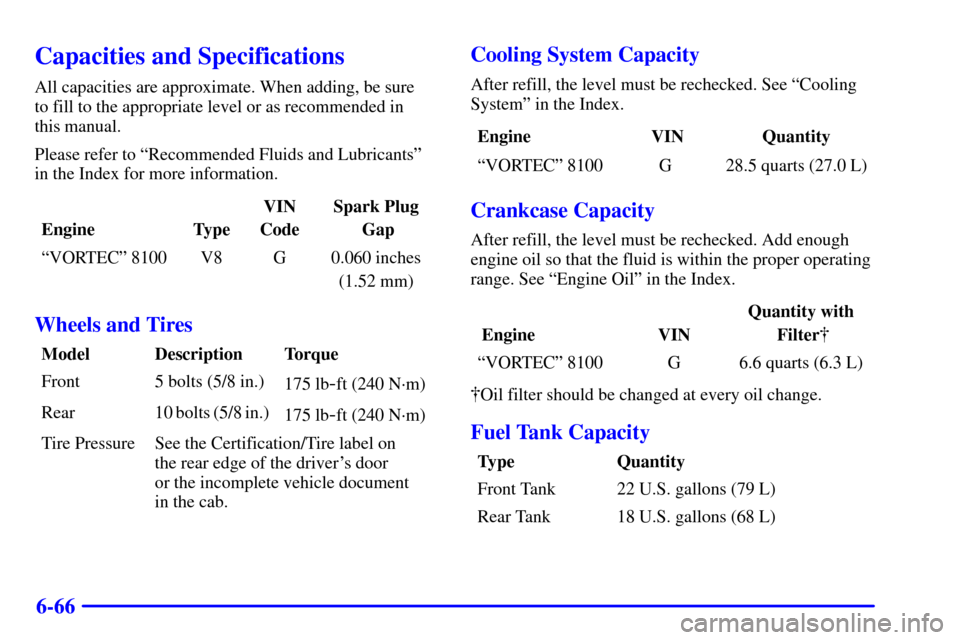
Capacities and Specifications
All capacities are approximate. When adding, be sure
to fill to the appropriate level or as recommended in
this manual.
Please refer to ªRecommended Fluids and Lubricantsº
in the Index for more information.
Engine TypeVIN
CodeSpark Plug
Gap
ªVORTECº 8100 V8 G 0.060 inches
(1.52 mm)
Wheels and Tires
Model Description Torque
Front 5 bolts (5/8 in.)
175 lb
-ft (240 N´m)
Rear 10 bolts (5/8 in.)
175 lb
-ft (240 N´m)
Tire Pressure See the Certification/Tire label on
the rear edge of the driver's door
or the incomplete vehicle document
in the cab.
Cooling System Capacity
After refill, the level must be rechecked. See ªCooling
Systemº in the Index.
Engine VIN Quantity
ªVORTECº 8100 G 28.5 quarts (27.0 L)
Crankcase Capacity
After refill, the level must be rechecked. Add enough
engine oil so that the fluid is within the proper operating
range. See ªEngine Oilº in the Index.
Engine VINQuantity with
Filter�
ªVORTECº 8100 G 6.6 quarts (6.3 L)
�Oil filter should be changed at every oil change.
Fuel Tank Capacity
Type Quantity
Front Tank 22 U.S. gallons (79 L)
Rear Tank 18 U.S. gallons (68 L)