Page 305 of 371
6-23 How to Add Fluid
Refer to the Maintenance Schedule to determine what
kind of transaxle fluid to use. See ªRecommended
Fluids and Lubricantsº in the Maintenance
Schedule booklet.
If the fluid level is low, add only enough of the proper
fluid to bring the level into the cross
-hatched area on
the dipstick.
1. Pull out the dipstick.
2. Using a long
-neck funnel, add enough fluid at the
dipstick hole to bring it to the proper level.
It doesn't take much fluid, generally less than
one pint (0.5 L). Don't overfill.
NOTICE:
We recommend you use only fluid labeled
DEXRON�-III, because fluid with that label is
made especially for your automatic transaxle.
Damage caused by fluid other than DEXRON
�-III
is not covered by your new vehicle warranty.
3. After adding fluid, recheck the fluid level as
described under ªHow to Check.º
4. When the correct fluid level is obtained,
push the dipstick back in all the way and turn
the handle clockwise. Reinstall the engine
air cleaner/filter assembly.
How to Reset the Transaxle Fluid
Change Indicator
After the transaxle fluid has been changed, display the
TRANS FLUID LIFE message by pressing the INFO
button. Then press and hold the INFO RESET button
until the display shows ª100º. This resets the transaxle
fluid life index. The percentage of transaxle fluid life
remaining may be checked at any time by pressing the
INFO button several times until the TRANS FLUID
LIFE message appears.
Page 332 of 371
6-50
By pressing the INFO button, the DIC screen will show
which tire(s) has the low or high pressure condition.
See ªInflation
-- Tire Pressureº in the Index for
information regarding correct tire inflation. If a tire is
low, you should stop as soon as possible and check all
your tires for damage. If a tire is flat, see ªIf a Tire
Goes Flatº in the Index.
NOTICE:
Do not use a tire sealant if your vehicle is equipped
with Tire Pressure Monitors. The liquid sealant
can damage the tire pressure monitor sensors.
Once a low or high tire pressure condition is detected,
the TPM system will display the CHECK TIRE
MESSAGE each time the engine is started, until
the tire(s) are set to the correct inflation pressure.
The Tire Loading
-Information Label, which is located
on the rear edge of the driver's door, shows the correct
inflation pressure for the tires on your vehicle.The TPM system also allows the driver to check the
air pressure status of each road tire using the Driver
Information Center (DIC). Each tire's air pressure will
be listed individually, in the following order: LF (left
front or driver's side front tire), RF (right front or
passenger's side front tire), RR (right rear or passenger's
side rear tire) and LR (left rear or driver's side rear tire).
See ªInflation
-- Tire Pressureº in the Index for
information regarding correct tire inflation. Also, see
ªDriver Information Center (DIC)º in the Index for
information on the DIC controls and displays.
If the DIC display doesn't show tire pressures or
the SERVICE TPM SYSTEM message appears,
see your dealer for service. The TPM system may not
work properly while the compact spare tire is installed.
Anytime you replace one or more tires or rotate your
tires, the TPM system will need to be reset. A special
tool is needed to reset the sensor identification codes,
see your dealer for service.
The TPM system can alert you about a low or high tire
pressure condition, but it doesn't replace normal tire
maintenance. See ªTiresº in the Index.
Page 333 of 371
6-51 Tire Inspection and Rotation
Tires should be rotated every 6,000 to 8,000 miles
(10 000 to 13 000 km). Any time you notice unusual
wear, rotate your tires as soon as possible and check
wheel alignment. Also check for damaged tires or
wheels. See ªWhen It's Time for New Tiresº and
ªWheel Replacementº later in this section for
more information.
The purpose of regular rotation is to achieve more
uniform wear for all tires on the vehicle. The first
rotation is the most important. See ªScheduled
Maintenance Servicesº in the Maintenance Schedule
booklet for scheduled rotation intervals.
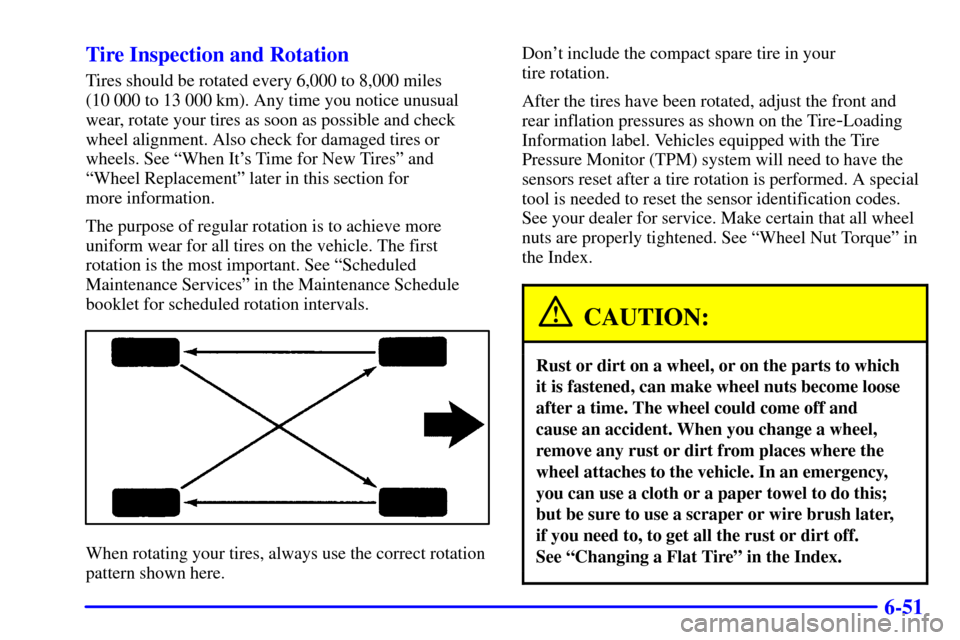
When rotating your tires, always use the correct rotation
pattern shown here.Don't include the compact spare tire in your
tire rotation.
After the tires have been rotated, adjust the front and
rear inflation pressures as shown on the Tire
-Loading
Information label. Vehicles equipped with the Tire
Pressure Monitor (TPM) system will need to have the
sensors reset after a tire rotation is performed. A special
tool is needed to reset the sensor identification codes.
See your dealer for service. Make certain that all wheel
nuts are properly tightened. See ªWheel Nut Torqueº in
the Index.
CAUTION:
Rust or dirt on a wheel, or on the parts to which
it is fastened, can make wheel nuts become loose
after a time. The wheel could come off and
cause an accident. When you change a wheel,
remove any rust or dirt from places where the
wheel attaches to the vehicle. In an emergency,
you can use a cloth or a paper towel to do this;
but be sure to use a scraper or wire brush later,
if you need to, to get all the rust or dirt off.
See ªChanging a Flat Tireº in the Index.
Page 337 of 371
6-55 Wheel Alignment and Tire Balance
The wheels on your vehicle were aligned and balanced
carefully at the factory to give you the longest tire life
and best overall performance.
Scheduled wheel alignment and wheel balancing are
not needed. However, if you notice unusual tire wear or
your vehicle pulling one way or the other, the alignment
may need to be reset. If you notice your vehicle
vibrating when driving on a smooth road, your wheels
may need to be rebalanced.
Wheel Replacement
Replace any wheel that is bent, cracked, or badly
rusted or corroded. If wheel nuts keep coming loose,
the wheel, wheel bolts and wheel nuts should be
replaced. If the wheel leaks air, replace it (except some
aluminum wheels, which can sometimes be repaired).
See your dealer if any of these conditions exist.
Your dealer will know the kind of wheel you need.
Each new wheel should have the same load
-carrying
capacity, diameter, width, offset and be mounted the
same way as the one it replaces.
If you need to replace any of your wheels, wheel bolts
or wheel nuts, replace them only with new GM original
equipment parts. This way, you will be sure to have the
right wheel, wheel bolts and wheel nuts for your vehicle.
CAUTION:
Using the wrong replacement wheels, wheel bolts
or wheel nuts on your vehicle can be dangerous.
It could affect the braking and handling of your
vehicle, make your tires lose air and make you
lose control. You could have a collision in which
you or others could be injured. Always use
the correct wheel, wheel bolts and wheel nuts
for replacement.
NOTICE:
The wrong wheel can also cause problems with
bearing life, brake cooling, speedometer or
odometer calibration, headlamp aim, bumper
height, vehicle ground clearance and tire or tire
chain clearance to the body and chassis.
See ªChanging a Flat Tireº in the Index for
more information.