2001 CADILLAC SEVILLE height
[x] Cancel search: heightPage 15 of 371
1-3 Adaptive Seat Control (If Equipped)
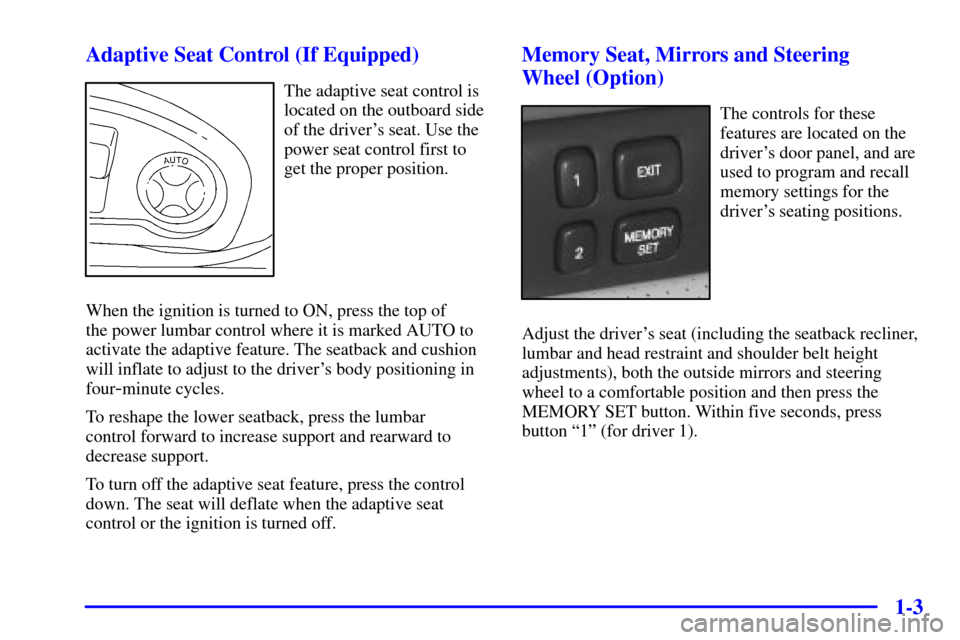
The adaptive seat control is
located on the outboard side
of the driver's seat. Use the
power seat control first to
get the proper position.
When the ignition is turned to ON, press the top of
the power lumbar control where it is marked AUTO to
activate the adaptive feature. The seatback and cushion
will inflate to adjust to the driver's body positioning in
four
-minute cycles.
To reshape the lower seatback, press the lumbar
control forward to increase support and rearward to
decrease support.
To turn off the adaptive seat feature, press the control
down. The seat will deflate when the adaptive seat
control or the ignition is turned off.
Memory Seat, Mirrors and Steering
Wheel (Option)
The controls for these
features are located on the
driver's door panel, and are
used to program and recall
memory settings for the
driver's seating positions.
Adjust the driver's seat (including the seatback recliner,
lumbar and head restraint and shoulder belt height
adjustments), both the outside mirrors and steering
wheel to a comfortable position and then press the
MEMORY SET button. Within five seconds, press
button ª1º (for driver 1).
Page 16 of 371

1-4
A second mirror, seating and steering wheel position
can be programmed by repeating the above steps and
pressing button ª2º (for driver 2). Each time a memory
button is pressed, a single beep will sound. Each time
button 1 or 2 is pressed and released while the vehicle is
in PARK (P), the memory positions will be recalled.
Each time button 1 or 2 is pressed and held while the
vehicle is out of PARK (P), the memory positions will
be recalled.
To stop recall movement of the memory seat and
steering wheel at any time, press one of the power seat,
steering wheel or mirror controls.
Two personalized exit positions can be set by first
recalling the driving position (by pressing 1 or 2),
then positioning the steering wheel and seat in the
desired exit positions and then pressing and releasing
the MEMORY SET button and, within five seconds,
pressing the EXIT button. With the vehicle in PARK (P),
the exit position for either previously set driver can be
recalled by pressing the EXIT button. The mirrors,
power lumbar and power head restraint and shoulder belt
height positions will not be stored or recalled for the
exit positions.If you use the remote keyless entry transmitter to enter
your vehicle, automatic seat and mirror movement will
occur. The numbers on the back of the transmitters,
1 and 2, correspond to the numbers on the buttons on
the door panel.
When the key is placed in the ignition in OFF or when
the unlock button is pressed on the remote keyless entry
transmitter, the seats and mirrors will automatically
adjust to the programmed position.
Programming for automatic seat, steering wheel and
mirror movement is done through the Driver Information
Center (DIC). You can choose to either select or not
select automatic seat and mirror movement using the
remote keyless entry transmitter, placing your key in
the ignition, or by exiting the vehicle. For programming
information, see ªVehicle Programming and
Personalization Featuresº in the Index.
Page 17 of 371
1-5 Heated Seats (Option)
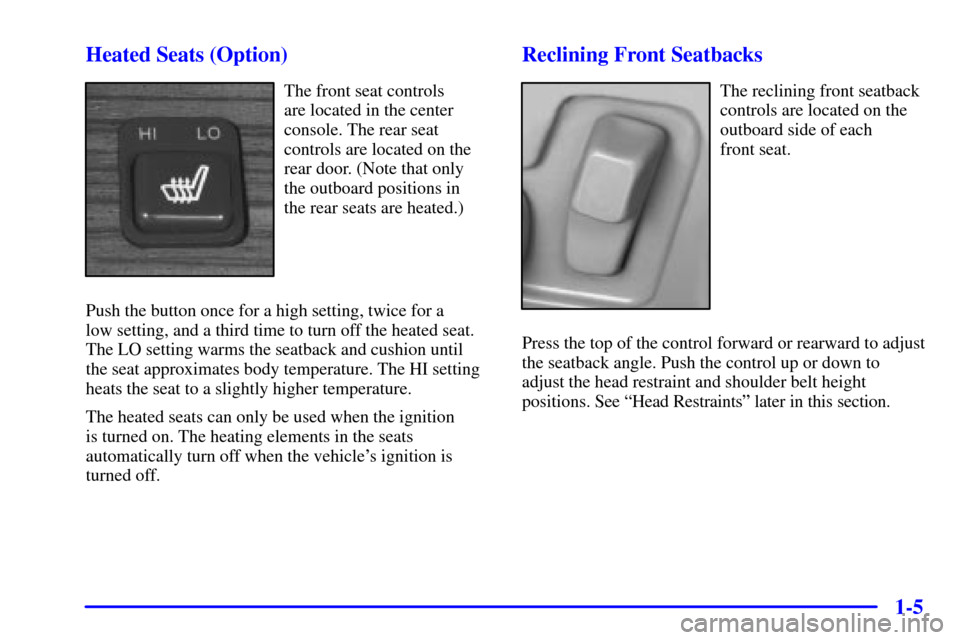
The front seat controls
are located in the center
console. The rear seat
controls are located on the
rear door. (Note that only
the outboard positions in
the rear seats are heated.)
Push the button once for a high setting, twice for a
low setting, and a third time to turn off the heated seat.
The LO setting warms the seatback and cushion until
the seat approximates body temperature. The HI setting
heats the seat to a slightly higher temperature.
The heated seats can only be used when the ignition
is turned on. The heating elements in the seats
automatically turn off when the vehicle's ignition is
turned off.
Reclining Front Seatbacks
The reclining front seatback
controls are located on the
outboard side of each
front seat.
Press the top of the control forward or rearward to adjust
the seatback angle. Push the control up or down to
adjust the head restraint and shoulder belt height
positions. See ªHead Restraintsº later in this section.
Page 19 of 371
1-7 Head Restraints
The switches to move your
head restraints are located
on the outboard side of
each front seat.
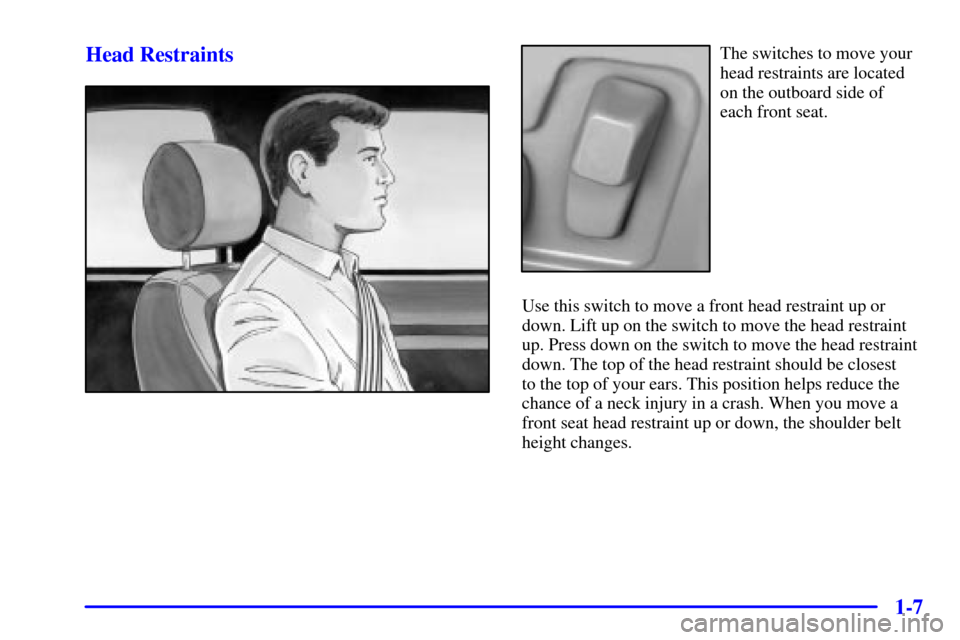
Use this switch to move a front head restraint up or
down. Lift up on the switch to move the head restraint
up. Press down on the switch to move the head restraint
down. The top of the head restraint should be closest
to the top of your ears. This position helps reduce the
chance of a neck injury in a crash. When you move a
front seat head restraint up or down, the shoulder belt
height changes.
Page 27 of 371

1-15
4. Push the latch plate into the buckle until it clicks.
Pull up on the latch plate to make sure it is secure.
If the belt isn't long enough, see ªSafety Belt
Extenderº at the end of this section.
Make sure the release button on the buckle is
positioned so you would be able to unbuckle the
safety belt quickly if you ever had to.The lap part of the belt should be worn low and snug on
the hips, just touching the thighs. In a crash, this applies
force to the strong pelvic bones. And you'd be less
likely to slide under the lap belt. If you slid under it,
the belt would apply force at your abdomen. This could
cause serious or even fatal injuries. The shoulder belt
should go over the shoulder and across the chest.
These parts of the body are best able to take belt
restraining forces.
The safety belt locks if there's a sudden stop or crash,
or if you pull the belt very quickly out of the retractor.
Shoulder Belt Height Adjuster
When you move a front seat head restraint, the shoulder
belt height changes. See ªHead Restraintsº in the Index.
Page 51 of 371
1-39
CAUTION:
Children who are up against, or very close to,
any air bag when it inflates can be seriously
injured or killed. Air bags plus lap
-shoulder belts
offer outstanding protection for adults and older
children, but not for young children and infants.
Neither the vehicle's safety belt system nor its
air bag system is designed for them. Young
children and infants need the protection that a
child restraint system can provide.
Q:What are the different types of add-on
child restraints?
A:Add-on child restraints, which are purchased
by the vehicle's owner, are available in four basic
types. Selection of a particular restraint should
take into consideration not only the child's weight,
height and age but also whether or not the restraint
will be compatible with the motor vehicle in which
it will be used.
For most basic types of child restraints, there are
many different models available. When purchasing
a child restraint, be sure it is designed to be used
in a motor vehicle. If it is, the restraint will have a
label saying that it meets federal motor vehicle
safety standards.
The restraint manufacturer's instructions that
come with the restraint state the weight and
height limitations for a particular child restraint.
In addition, there are many kinds of restraints
available for children with special needs.
Page 315 of 371

6-33
Properly torqued wheel nuts are necessary to help
prevent brake pulsation. When tires are rotated, inspect
brake pads for wear and evenly tighten wheel nuts in
the proper sequence to GM torque specifications.
Brake linings should always be replaced as complete
axle sets.
See ªBrake System Inspectionº in the Maintenance
Schedule booklet under Part C ªPeriodic
Maintenance Inspections.º
Brake Pedal Travel
See your dealer if the brake pedal does not return to
normal height, or if there is a rapid increase in pedal
travel. This could be a sign of brake trouble.
Brake Adjustment
Every time you apply the brakes, with or without the
vehicle moving, your brakes adjust for wear.
Replacing Brake System Parts
The braking system on a vehicle is complex. Its many
parts have to be of top quality and work well together if
the vehicle is to have really good braking. Your vehicle
was designed and tested with top
-quality GM brake parts.
When you replace parts of your braking system
-- for
example, when your brake linings wear down and you
have to have new ones put in
-- be sure you get new
approved GM replacement parts. If you don't, your
brakes may no longer work properly. For example,
if someone puts in brake linings that are wrong for your
vehicle, the balance between your front and rear brakes
can change
-- for the worse. The braking performance
you've come to expect can change in many other ways
if someone puts in the wrong replacement brake parts.
Page 337 of 371
6-55 Wheel Alignment and Tire Balance
The wheels on your vehicle were aligned and balanced
carefully at the factory to give you the longest tire life
and best overall performance.
Scheduled wheel alignment and wheel balancing are
not needed. However, if you notice unusual tire wear or
your vehicle pulling one way or the other, the alignment
may need to be reset. If you notice your vehicle
vibrating when driving on a smooth road, your wheels
may need to be rebalanced.
Wheel Replacement
Replace any wheel that is bent, cracked, or badly
rusted or corroded. If wheel nuts keep coming loose,
the wheel, wheel bolts and wheel nuts should be
replaced. If the wheel leaks air, replace it (except some
aluminum wheels, which can sometimes be repaired).
See your dealer if any of these conditions exist.
Your dealer will know the kind of wheel you need.
Each new wheel should have the same load
-carrying
capacity, diameter, width, offset and be mounted the
same way as the one it replaces.
If you need to replace any of your wheels, wheel bolts
or wheel nuts, replace them only with new GM original
equipment parts. This way, you will be sure to have the
right wheel, wheel bolts and wheel nuts for your vehicle.
CAUTION:
Using the wrong replacement wheels, wheel bolts
or wheel nuts on your vehicle can be dangerous.
It could affect the braking and handling of your
vehicle, make your tires lose air and make you
lose control. You could have a collision in which
you or others could be injured. Always use
the correct wheel, wheel bolts and wheel nuts
for replacement.
NOTICE:
The wrong wheel can also cause problems with
bearing life, brake cooling, speedometer or
odometer calibration, headlamp aim, bumper
height, vehicle ground clearance and tire or tire
chain clearance to the body and chassis.
See ªChanging a Flat Tireº in the Index for
more information.