Page 312 of 371
6-30
Brakes
Brake Fluid
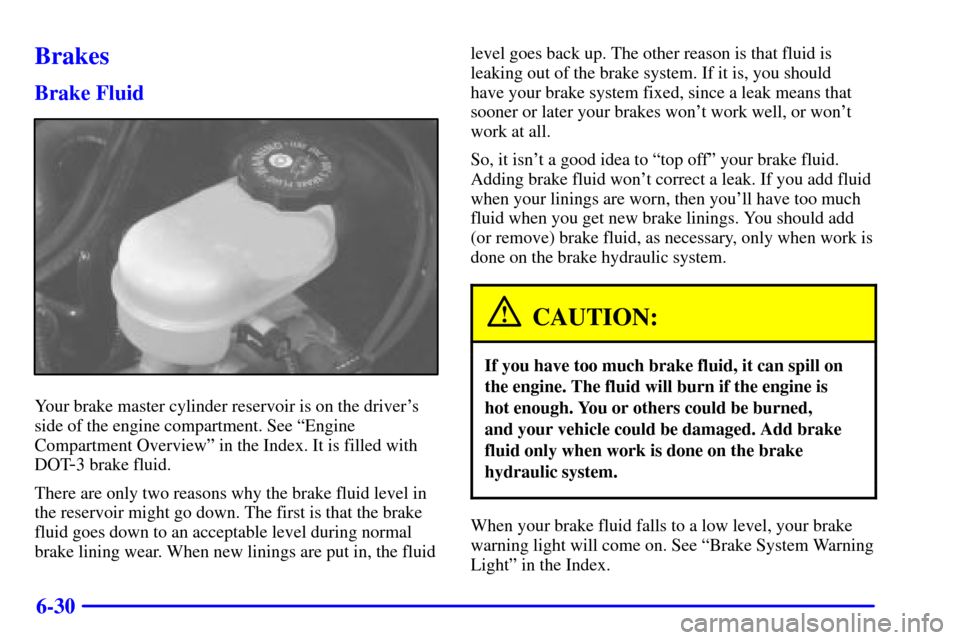
Your brake master cylinder reservoir is on the driver's
side of the engine compartment. See ªEngine
Compartment Overviewº in the Index. It is filled with
DOT
-3 brake fluid.
There are only two reasons why the brake fluid level in
the reservoir might go down. The first is that the brake
fluid goes down to an acceptable level during normal
brake lining wear. When new linings are put in, the fluidlevel goes back up. The other reason is that fluid is
leaking out of the brake system. If it is, you should
have your brake system fixed, since a leak means that
sooner or later your brakes won't work well, or won't
work at all.
So, it isn't a good idea to ªtop offº your brake fluid.
Adding brake fluid won't correct a leak. If you add fluid
when your linings are worn, then you'll have too much
fluid when you get new brake linings. You should add
(or remove) brake fluid, as necessary, only when work is
done on the brake hydraulic system.
CAUTION:
If you have too much brake fluid, it can spill on
the engine. The fluid will burn if the engine is
hot enough. You or others could be burned,
and your vehicle could be damaged. Add brake
fluid only when work is done on the brake
hydraulic system.
When your brake fluid falls to a low level, your brake
warning light will come on. See ªBrake System Warning
Lightº in the Index.
Page 314 of 371
6-32 Brake Wear
Your vehicle has four-wheel disc brakes.
Disc brake pads have built
-in wear indicators that make
a high
-pitched warning sound when the brake pads are
worn and new pads are needed. The sound may come and
go or be heard all the time your vehicle is moving (except
when you are pushing on the brake pedal firmly).
CAUTION:
The brake wear warning sound means that soon
your brakes won't work well. That could lead to
an accident. When you hear the brake wear
warning sound, have your vehicle serviced.
Your vehicle also has electronic wear sensors that let you
know when the brake pads are significantly worn and
new pads are needed. The CHANGE BRAKE PADS
message will be displayed on the Driver Information
Center when the brake pads are worn and need to be
replaced. See ªChange Brake Pads Messageº in
the Index.
CAUTION:
The CHANGE BRAKE PADS message or the
high
-pitched warning sound means that soon
your brakes won't work well. That could lead to
an accident. When the CHANGE BRAKE PADS
message comes on and stays on, have your
vehicle serviced.
NOTICE:
Continuing to drive with worn-out brake pads
could result in costly brake repair.
Some driving conditions or climates may cause a brake
squeal when the brakes are first applied or lightly
applied. This does not mean something is wrong with
your brakes.
Page 318 of 371
6-36
Bulb Replacement
For the proper type of replacement bulb, see
ªReplacement Bulbsº in the Index.
For any bulb changing procedure not listed in this
section, contact your dealer service department.
High Intensity Discharge (HID) Lighting
(If Equipped)
CAUTION:
The low beam High Intensity Discharge lighting
system operates at a very high voltage. If you try
to service any of the system components, you
could be seriously injured. Have your dealer or
a qualified technician service them.
Halogen Bulbs
CAUTION:
Halogen bulbs have pressurized gas inside
and can burst if you drop or scratch the bulb.
You or others could be injured. Be sure to read
and follow the instructions on the bulb package.
Page 322 of 371
6-40
If your vehicle is damaged in an accident, the headlamp
aim may be affected. Aim adjustment to the low beam
may be necessary if it is difficult to see lane markers
(for horizontal aim), or if oncoming drivers flash their
high beams at you (for vertical aim). If you believe
your headlamps need to be re
-aimed, we recommend
that you take your vehicle to your dealer for service.
However, it is possible for you to re
-aim your
headlamps as described in the following procedure.
NOTICE:
To make sure your headlamps are aimed
properly, read all the instructions before
beginning. Failure to follow these instructions
could cause damage to headlamp parts.
The vehicle should be properly prepared as follows:
�The vehicle should be placed so the headlamps are
25 ft. (7.6 m) from a light colored wall or other
flat surface.
�The vehicle must have all four tires on a perfectly
level surface which is level all the way to the wall or
other flat surface.
�The vehicle should be placed so it is perpendicular
to the wall or other flat surface.
�The vehicle should not have any snow, ice or mud
attached to it.
�The vehicle should be fully assembled and all other
work stopped while headlamp aiming is being done.
�The vehicle should be normally loaded with a full
tank of fuel and one person or 160 lbs. (75 kg) on
the driver's seat.
�Tires should be properly inflated.
�Start the vehicle and rock it to level the suspension.
Headlamp aiming is done with the vehicle low beam
lamps. The high beam lamps will be correctly aimed
if the low beam lamps are aimed properly.
Page 335 of 371
6-53
CAUTION:
Mixing tires could cause you to lose control while
driving. If you mix tires of different sizes or types
(radial and bias
-belted tires), the vehicle may not
handle properly, and you could have a crash.
Using tires of different sizes may also cause
damage to your vehicle. Be sure to use the same
size and type tires on all wheels.
It's all right to drive with your compact spare,
though. It was developed for use on your vehicle.
CAUTION:
If you use bias-ply tires on your vehicle, the
wheel rim flanges could develop cracks after
many miles of driving. A tire and/or wheel could
fail suddenly, causing a crash. Use only radial
-ply
tires with the wheels on your vehicle.
Uniform Tire Quality Grading
Quality grades can be found where applicable on the
tire sidewall between tread shoulder and maximum
section width. For example:
Treadwear 200 Traction AA Temperature A
The following information relates to the system
developed by the United States National Highway
Traffic Safety Administration, which grades tires by
treadwear, traction and temperature performance.
(This applies only to vehicles sold in the United States.)
The grades are molded on the sidewalls of most
passenger car tires. The Uniform Tire Quality Grading
system does not apply to deep tread, winter
-type snow
tires, space
-saver or temporary use spare tires, tires with
nominal rim diameters of 10 to 12 inches (25 to 30 cm),
or to some limited
-production tires.
While the tires available on General Motors passenger
cars and light trucks may vary with respect to these
grades, they must also conform to federal safety
requirements and additional General Motors Tire
Performance Criteria (TPC) standards.
Page 346 of 371

6-64
GM Vehicle Care/Appearance Materials
PART NUMBERSIZEDESCRIPTIONUSAGE
99495423 in. x 25 in.Polishing Cloth ± Wax TreatedExterior polishing cloth
105017216 oz. (0.473 L)Tar and Road Oil RemoverRemoves tar, road oil and asphalt
105017316 oz. (0.473 L)Chrome Cleaner and PolishUse on chrome, stainless steel, nickel, copper and brass
105017416 oz. (0.473 L)White Sidewall Tire CleanerRemoves soil and black marks from whitewalls
105021432 oz. (0.946 L)Vinyl CleanerCleans vinyl tops, upholstery and convertible tops
105042723 oz. (0.680 L)Glass CleanerRemoves dirt, grime, smoke and fingerprints
1052918**8 oz. (0.237 L)Armor All� ProtectantProtects leather, wood, acrylics, Plexiglas�, plastic,
rubber and vinyl
105292516 oz. (0.473 L)Multi-Purpose
Interior CleanerCleans carpets, seats, interior trim, door panels
and floor mats
105292916 oz. (0.473 L)Wheel CleanerSpray on and rinse with water
10529308 oz. (0.237 L)Capture Dry Spot RemoverAttracts, absorbs and removes soils on fabric
123457212.5 sq. ft.Synthetic ChamoisShines vehicle without scratching
1234572512 oz. (0.354 L)Silicone Tire ShineSpray on tire shine
12377964*16 oz. (0.473 L)Finish EnhancerRemoves dust, fingerprints and surface contaminants
12377966*16 oz. (0.473 L)Cleaner WaxRemoves light scratches and oxidation and protects finish
12377984*16 oz. (0.473 L)Surface CleanerRemoves contaminants, blemishes and swirl marks
See your General Motors Parts Department for these products.
See ªRecommended Fluids and Lubricantsº in the Maintenance Schedule booklet.
* For exterior use only.
** Not recommended for use on instrument panels.
Page 349 of 371
6-67 Fuses and Circuit Breakers
The wiring circuits in your vehicle are protected from
short circuits by a combination of fuses and circuit
breakers. This greatly reduces the chance of fires caused
by electrical problems.
Look at the silver
-colored band inside the fuse. If the
band is broken or melted, replace the fuse. Be sure you
replace a bad fuse with a new one of the identical size
and rating. If a MaxiFuse should blow, see your dealer
for service immediately.
If you ever have a problem on the road and don't have a
spare fuse, you can ªborrowº one that has the same
amperage. Pick some feature of your vehicle that you
can get along without
-- like the radio or cigarette
lighter
-- and use its fuse, if it is the correct amperage.
Replace it as soon as you can.
The MaxiFuses are located in two Bussed Electrical
Centers (BEC), one located near the engine
compartment on the passenger's side and the other
under the rear seat on the driver's side. If a MaxiFuse
should blow, have your vehicle serviced by your
dealer immediately.Underhood Junction Block
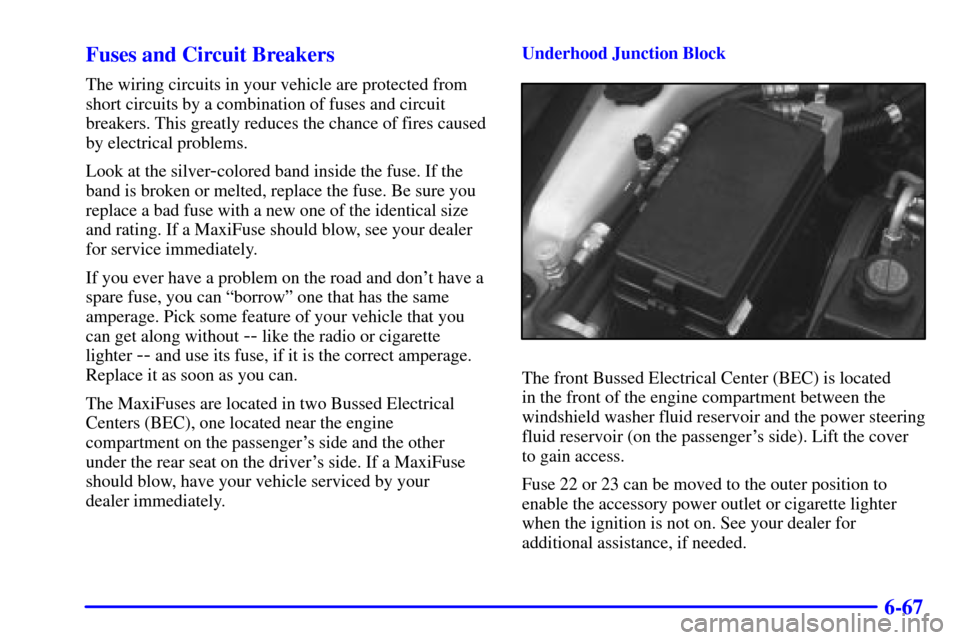
The front Bussed Electrical Center (BEC) is located
in the front of the engine compartment between the
windshield washer fluid reservoir and the power steering
fluid reservoir (on the passenger's side). Lift the cover
to gain access.
Fuse 22 or 23 can be moved to the outer position to
enable the accessory power outlet or cigarette lighter
when the ignition is not on. See your dealer for
additional assistance, if needed.
Page 351 of 371
6-69
Minifuses Usage
22 Auxiliary Power, (Cltr2)
23 Cigar Lighter
24 Daytime Running Lamps
25 Horn
26 Air Conditioner Clutch
Micro Relays Usage
27 Headlamp High Beam
28 Headlamp Low Beam
29 Fog Lamps
30 Daytime Running Lamps
31 Horn
32 Air Conditioner Clutch
Mini Relays Usage
33 Not Used
34 Accessory
35 Not UsedMini Relays Usage
36 Starter 1
37 Cooling Fan Secondary
38 Ignition 1
39 Cooling Fan Series/Parallel
40 Cooling Fan Primary
Maxibreaker Usage
41 Starter
42 Export Use
MaxiFuses Usage
43 Not Used
44 Antilock Brake System
45 Air Pump
46 Cooling Fan Secondary
47 Cooling Fan Primary
The spare fuses are located in numbers 48 through 52.
The fuse puller is located in number 53.