Page 10 of 170

Contents
Overview
Controls and features
Cockpit16
Instrument cluster18
Indicator and warning lamps20
Hazard warning flashers24
Warning triangle24
First-aid kit24
Refueling25
Fuel quality26
Tire inflation pressure26
Locks and security systems:
Keys30
Electronic vehicle
immobilizer31
Central locking system32
Opening and closing Ð from the
outside32
Using the key32
Using the remote control33
Opening and closing Ð from the
inside36
Luggage compartment lid37
Alarm system38
Electric power windows40
The automatic convertible
top41
Adjustments:
Seats45
Steering wheel47
Mirrors47
Car Memory, Key Memory48
Passenger safety systems:
Safety belts50
Airbags51
Transporting children safely53
Driving:
Ignition and steering lock55
Starting the engine56
Turning the engine off56
Parking brake57
Manual transmission58
Turn signal indicator/Headlamp
flasher58
Washer/Wiper system59
Rear window defroster60
Cruise control61
Everything under control:
Odometer62
Tachometer62
Fuel gauge62
Coolant temperature gauge63
Service Interval Display63
Clock64
Multi-Information Radio (MIR)64
Technology for safety and
driving convenience:
Dynamic Stability Control
(DSC)65
Dynamic Performance
Control66
Tire Pressure Warning (RDW)67
Contents
Page 11 of 170

11n
Controls and features
Operation, care and maintenance
Lamps:
Side lamps/low beams69
Instrument panel lighting69
High beams/parking lamps70
Rear fog lamp70
Interior lamps70
Reading lamps71
Controlling the climate for
pleasant driving:
Heating and ventilation/
Air conditioner72
Seat heating77
Interior conveniences:
Glove compartment78
Storage compartments78
Drink holder80
Cellular phone81
Ashtray81
Cigarette lighter82
Loading and transporting:
Cargo loading83
Special operating instructions:
Break-in procedures86
Driving notes87
Catalytic converter87
Antilock Brake System (ABS)88
Dynamic Brake Control
(DBC)90
Disc brakes90
Brake system91
Winter operation92
Power steering94
Cellular phone94
Radio reception94
Wind deflector95
Hardtop96
Wheels and tires:
Tire inflation pressure98
Tire condition98
Tire replacement99
Tire rotation100
Wheel and tire
combinations101
Special features of winter
tires102
Snow chains102
Approved wheel and tire
specifications103
Under the hood:
Hood104
Engine compartment106
Washer fluids108
Washer nozzles108
Engine oil109
Coolant111
Brake fluid112
Vehicle Identification
Number113
Maintenance and care:
The BMW Maintenance
System114
Caring for your vehicle115
Airbags121
Vehicle storage122
Laws and regulations:
Technical modifications123
California Proposition 65
Warning123
OBD interface socket124
Page 17 of 170
17n
IndexDataTechnologyRepairsCar careControlsOverview
Cockpit
1
d
Turn signal indicator58
>
Parking lamps70
>
High beams70
>
Headlamp flasher58
2 Side lamps/Low beams69
3 Washer/Wiper system59
4 Hazard warning flashers24
5 Central locking system32
6 Rear window defroster for the
hardtop60
7 Shift lever58
To engage reverse gear, pull the
lever across the gate to the left to
overcome the detent
8 Cruise control61
9 Adjusting the steering wheel47
10 Horn: entire surface
11 Rear fog lamp70
12 Unlocking the hood104
13
d
Unlocking the luggage
compartment lid37
>
Unlocking the fuel filler door25
Page 20 of 170

20n
Indicator and warning lamps
Technology that monitors itself
Many of the systems for your BMW
monitor themselves automatically, both
during engine starts and while you are
driving. Indicator and warning lamps
identified by "
l
" are tested for proper
operation whenever the ignition key is
turned. They each light up once for
different periods of time.
The indicator lamps signal defects in
monitored systems either by remaining
lit after the engine is started or by
coming on in the course of normal
vehicle operation. Refer to the following
section for detailed information on how
to respond to the various types of warn-
ings.
Red: stop immediately
Battery charge current
The alternator is no longer
charging the battery. Indicates a
defect in the alternator drive belt or the
charging circuit. Please contact the
nearest BMW center.
Never attempt to continue driving
if the V-belt is defective: the
engine could overheat and sustain
serious damage. A broken or damaged
V-belt will also lead to a sudden
increase in steering effort.
<
Engine oil pressure
l
Stop vehicle and switch off
engine immediately. Check the
engine oil level and top up as required.
If the oil level is correct, please contact
the nearest BMW center.
Do not continue driving. The
engine could sustain damage
owing to inadequate lubrication.
<
Tire Pressure Warning (RDW)
l
Flashing warning lamp in addi-
tion to an acoustic signal: a tire
failure has occurred. Carefully reduce
speed to less than 50 mph (80 km/h),
and avoid hard braking or steering
maneuvers.
For additional information, refer to
page 67.
Brake warning lamp
l
If the lamp comes on when the
parking brake is not engaged,
check the brake fluid level. Before
driving further, be sure to read the
notes on pages 91 and 112.
Brake warning lamp for Cana-
dian models.
Page 28 of 170
28n
Locks and security systems:
Keys30
Electronic vehicle
immobilizer31
Central locking system32
Opening and closing Ð from the
outside32
Using the key32
Using the remote control33
Opening and closing Ð from the
inside36
Luggage compartment lid37
Alarm system38
Electric power windows40
The automatic convertible
top41
Adjustments:
Seats45
Steering wheel47
Mirrors47
Car Memory, Key Memory48
Passenger safety systems:
Safety belts50
Airbags51
Transporting children safely53
Controls
Page 29 of 170

Overview
Controls and features
Operation, care
and maintenance
Owner service procedures
Technical data
Index Advanced technology
29n
IndexDataTechnologyRepairsCar careControlsOverview
Driving:
Ignition and steering lock55
Starting the engine56
Turning the engine off56
Parking brake57
Manual transmission58
Turn signal indicator/Headlamp
flasher58
Washer/Wiper system59
Rear window defroster60
Cruise control61
Everything under control:
Odometer62
Tachometer62
Fuel gauge62
Coolant temperature gauge63
Service Interval Display63
Clock64
Multi-Information Radio (MIR)64
Technology for safety and
driving convenience:
Dynamic Stability Control
(DSC)65
Dynamic Performance
Control66
Tire Pressure Warning (RDW)67Lamps:
Side lamps/Low beams69
Instrument panel lighting69
High beams/Parking lamps70
Rear fog lamp70
Interior lamps70
Reading lamps71
Controlling the climate for
pleasant driving:
Heating and ventilation/
Air conditioner72
Seat heating77
Interior conveniences:
Glove compartment78
Storage compartments78
Drink holder80
Cellular phone81
Ashtray81
Cigarette lighter82
Loading and transporting:
Cargo loading83
Page 30 of 170

30n
Keys1 The key memory functions are stored
in the remote-control key, refer to
page 48
There is an extended-life battery
in every master key that is
charged automatically in the steering
lock every time you drive.
For this reason, if you have a master
key that is not in regular use, use that
key approximately once every year
while driving for an extended period to
charge the battery. Also refer to
page 33.< 520de142
2 Spare key for storage in a safe place,
such as in your wallet. This key is not
intended for continuous use
3 Door and ignition key
The lock for the glove compartment
cannot be operated with this key.
This is recommended for valet
parking, etc.
There is a key case available for using
your master key on a regular basis.
Replacement keysReplacement keys are available exclu-
sively through your BMW center. Your
BMW center is obligated to ensure that
a person requesting a key is authorized
to do so, since the keys are an integral
element of the security system (refer to
"Electronic vehicle immobilizer" in the
following columns).
If possible, take all of the master
keys that belong to the vehicle
with you when you pick up your
replacement key.
Whenever you receive a new replace-
ment key, turn it once to position 2 in
the ignition lock (ignition switched on)
and then back, so that the electronic
vehicle immobilizer can initialize the
new key.<
Page 31 of 170
31n
IndexDataTechnologyRepairsCar careControlsOverview
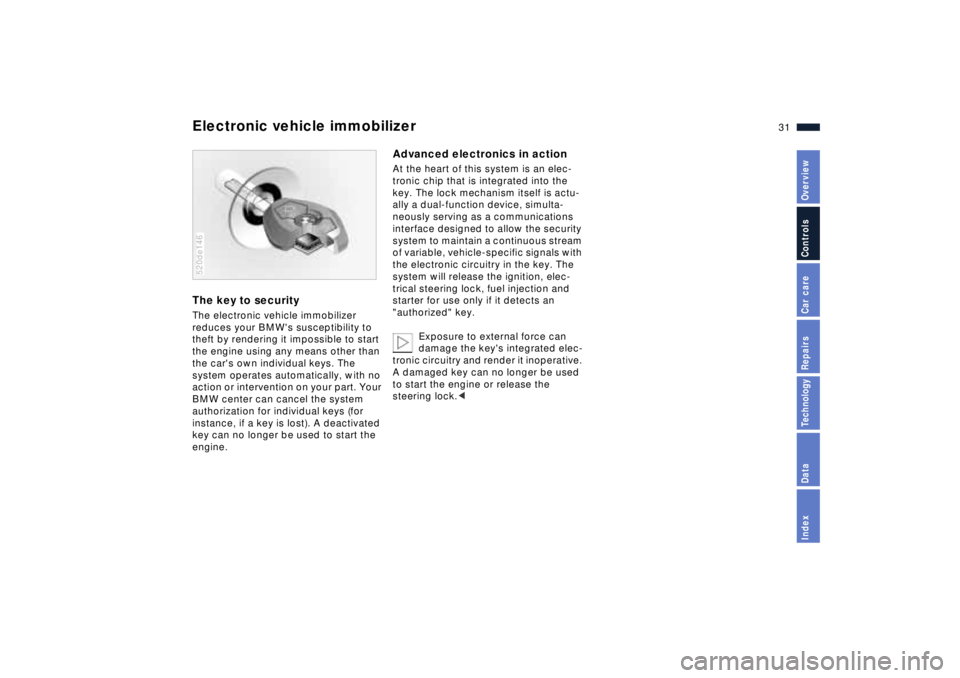
Electronic vehicle immobilizer The key to securityThe electronic vehicle immobilizer
reduces your BMW's susceptibility to
theft by rendering it impossible to start
the engine using any means other than
the car's own individual keys. The
system operates automatically, with no
action or intervention on your part. Your
BMW center can cancel the system
authorization for individual keys (for
instance, if a key is lost). A deactivated
key can no longer be used to start the
engine.520de146
Advanced electronics in actionAt the heart of this system is an elec-
tronic chip that is integrated into the
key. The lock mechanism itself is actu-
ally a dual-function device, simulta-
neously serving as a communications
interface designed to allow the security
system to maintain a continuous stream
of variable, vehicle-specific signals with
the electronic circuitry in the key. The
system will release the ignition, elec-
trical steering lock, fuel injection and
starter for use only if it detects an
"authorized" key.
Exposure to external force can
damage the key's integrated elec-
tronic circuitry and render it inoperative.
A damaged key can no longer be used
to start the engine or release the
steering lock.<

