2001 BMW Z8 ECU
[x] Cancel search: ECUPage 3 of 170

Congratulations, and thank you for choosing a BMW.
Thorough familiarity with your vehicle will provide you with enhanced control and
security when you drive it. We therefore have this request:
Please take the time to read this Owner's Manual and familiarize yourself with the
information that we have compiled for you before starting off in your ne w BMW. It
contains important data and instructions intended to help you derive maximum use
and satisfaction from your BMW's unique range of technical features. The manual
also contains information on care and maintenance designed to enhance operating
safety and contribute to maintaining the value of your vehicle throughout an
extended service life.
This manual is supplemented by a Service and Warranty Information Booklet
(US models) or a Warranty and Service Guide Booklet (Canadian models).
We recommend that you read the applicable publication thoroughly.
Your BMW is covered by the following warranties:
Ð New Vehicle Limited Warranty
Ð Limited Warranty Rust Perforation
Ð Federal Emissions System Defect Warranty
Ð Federal Emissions Performance Warranty
Ð California Emissions Control System Limited Warranty
Detailed information concerning these warranties is provided in the Service and
Warranty Information Booklet (US models) or in the Warranty and Service Guide
Booklet (Canadian models).
We wish you an enjoyable driving experience.
BMW AG
Page 10 of 170

Contents
Overview
Controls and features
Cockpit16
Instrument cluster18
Indicator and warning lamps20
Hazard warning flashers24
Warning triangle24
First-aid kit24
Refueling25
Fuel quality26
Tire inflation pressure26
Locks and security systems:
Keys30
Electronic vehicle
immobilizer31
Central locking system32
Opening and closing Ð from the
outside32
Using the key32
Using the remote control33
Opening and closing Ð from the
inside36
Luggage compartment lid37
Alarm system38
Electric power windows40
The automatic convertible
top41
Adjustments:
Seats45
Steering wheel47
Mirrors47
Car Memory, Key Memory48
Passenger safety systems:
Safety belts50
Airbags51
Transporting children safely53
Driving:
Ignition and steering lock55
Starting the engine56
Turning the engine off56
Parking brake57
Manual transmission58
Turn signal indicator/Headlamp
flasher58
Washer/Wiper system59
Rear window defroster60
Cruise control61
Everything under control:
Odometer62
Tachometer62
Fuel gauge62
Coolant temperature gauge63
Service Interval Display63
Clock64
Multi-Information Radio (MIR)64
Technology for safety and
driving convenience:
Dynamic Stability Control
(DSC)65
Dynamic Performance
Control66
Tire Pressure Warning (RDW)67
Contents
Page 25 of 170
25n
IndexDataTechnologyRepairsCar careControlsOverview
Refueling Fuel filler door
Before filling the tank, shut off the
engine. If you do not, fuel cannot
flow into the tank and the Service
Engine Soon lamp may come on.<
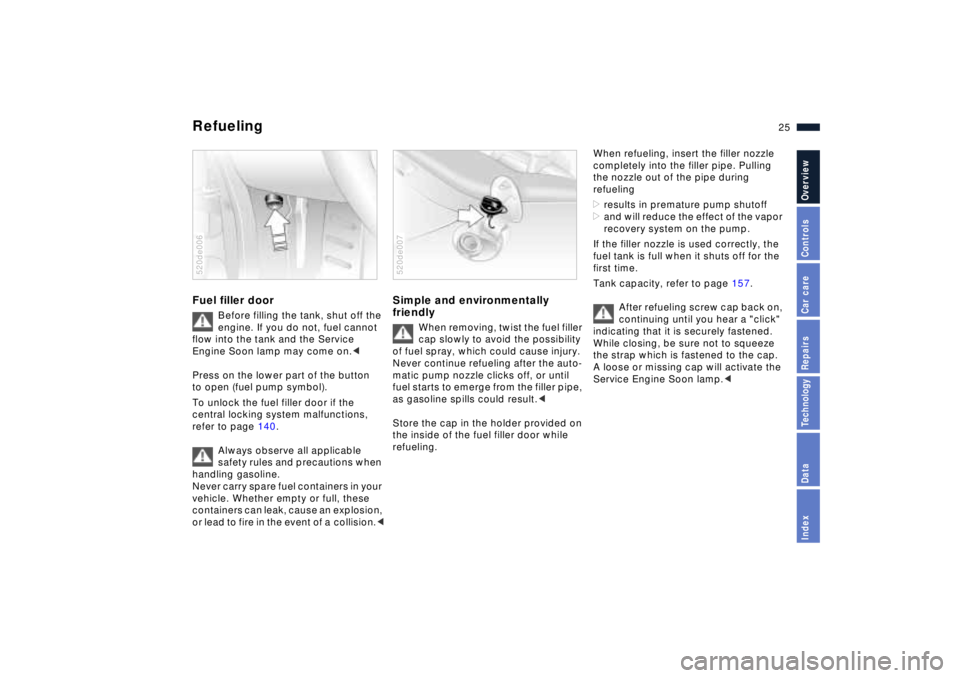
Press on the lower part of the button
to open (fuel pump symbol).
To unlock the fuel filler door if the
central locking system malfunctions,
refer to page 140.
Always observe all applicable
safety rules and precautions when
handling gasoline.
Never carry spare fuel containers in your
vehicle. Whether empty or full, these
containers can leak, cause an explosion,
or lead to fire in the event of a collision.<
520de006
Simple and environmentally
friendly
When removing, twist the fuel filler
cap slowly to avoid the possibility
of fuel spray, which could cause injury.
Never continue refueling after the auto-
matic pump nozzle clicks off, or until
fuel starts to emerge from the filler pipe,
as gasoline spills could result.<
Store the cap in the holder provided on
the inside of the fuel filler door while
refueling.
520de007
When refueling, insert the filler nozzle
completely into the filler pipe. Pulling
the nozzle out of the pipe during
refueling
>results in premature pump shutoff
>and will reduce the effect of the vapor
recovery system on the pump.
If the filler nozzle is used correctly, the
fuel tank is full when it shuts off for the
first time.
Tank capacity, refer to page 157.
After refueling screw cap back on,
continuing until you hear a "click"
indicating that it is securely fastened.
While closing, be sure not to squeeze
the strap which is fastened to the cap.
A loose or missing cap will activate the
Service Engine Soon lamp.<
Page 28 of 170

28n
Locks and security systems:
Keys30
Electronic vehicle
immobilizer31
Central locking system32
Opening and closing Ð from the
outside32
Using the key32
Using the remote control33
Opening and closing Ð from the
inside36
Luggage compartment lid37
Alarm system38
Electric power windows40
The automatic convertible
top41
Adjustments:
Seats45
Steering wheel47
Mirrors47
Car Memory, Key Memory48
Passenger safety systems:
Safety belts50
Airbags51
Transporting children safely53
Controls
Page 30 of 170

30n
Keys1 The key memory functions are stored
in the remote-control key, refer to
page 48
There is an extended-life battery
in every master key that is
charged automatically in the steering
lock every time you drive.
For this reason, if you have a master
key that is not in regular use, use that
key approximately once every year
while driving for an extended period to
charge the battery. Also refer to
page 33.< 520de142
2 Spare key for storage in a safe place,
such as in your wallet. This key is not
intended for continuous use
3 Door and ignition key
The lock for the glove compartment
cannot be operated with this key.
This is recommended for valet
parking, etc.
There is a key case available for using
your master key on a regular basis.
Replacement keysReplacement keys are available exclu-
sively through your BMW center. Your
BMW center is obligated to ensure that
a person requesting a key is authorized
to do so, since the keys are an integral
element of the security system (refer to
"Electronic vehicle immobilizer" in the
following columns).
If possible, take all of the master
keys that belong to the vehicle
with you when you pick up your
replacement key.
Whenever you receive a new replace-
ment key, turn it once to position 2 in
the ignition lock (ignition switched on)
and then back, so that the electronic
vehicle immobilizer can initialize the
new key.<
Page 31 of 170
31n
IndexDataTechnologyRepairsCar careControlsOverview
Electronic vehicle immobilizer The key to securityThe electronic vehicle immobilizer
reduces your BMW's susceptibility to
theft by rendering it impossible to start
the engine using any means other than
the car's own individual keys. The
system operates automatically, with no
action or intervention on your part. Your
BMW center can cancel the system
authorization for individual keys (for
instance, if a key is lost). A deactivated
key can no longer be used to start the
engine.520de146
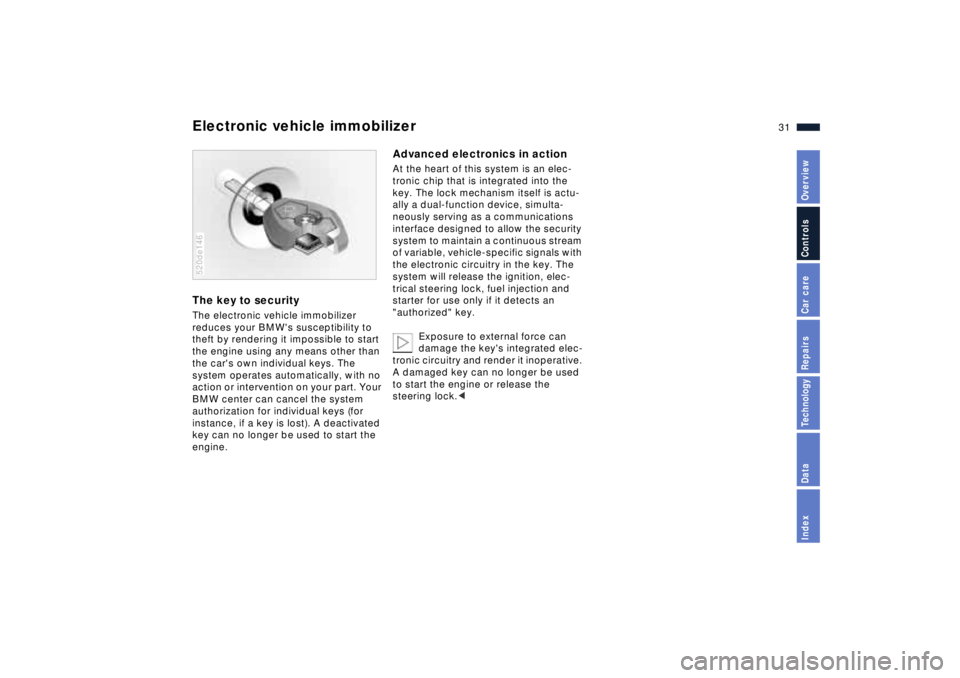
Advanced electronics in actionAt the heart of this system is an elec-
tronic chip that is integrated into the
key. The lock mechanism itself is actu-
ally a dual-function device, simulta-
neously serving as a communications
interface designed to allow the security
system to maintain a continuous stream
of variable, vehicle-specific signals with
the electronic circuitry in the key. The
system will release the ignition, elec-
trical steering lock, fuel injection and
starter for use only if it detects an
"authorized" key.
Exposure to external force can
damage the key's integrated elec-
tronic circuitry and render it inoperative.
A damaged key can no longer be used
to start the engine or release the
steering lock.<
Page 34 of 170
34n
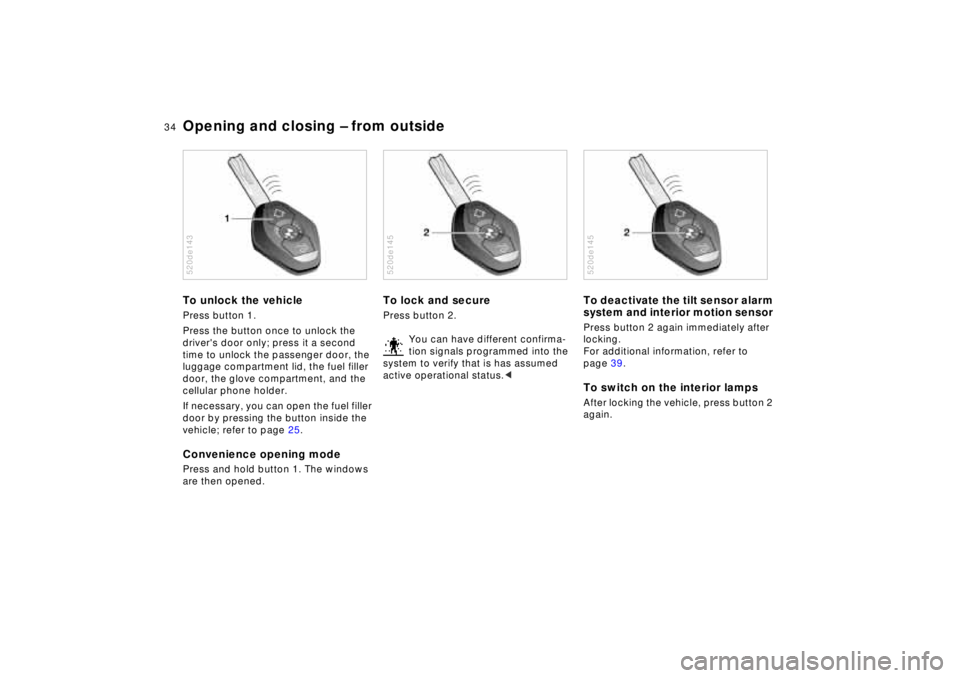
Opening and closing Ð from outsideTo unlock the vehiclePress button 1.
Press the button once to unlock the
driver's door only; press it a second
time to unlock the passenger door, the
luggage compartment lid, the fuel filler
door, the glove compartment, and the
cellular phone holder.
If necessary, you can open the fuel filler
door by pressing the button inside the
vehicle; refer to page 25.Convenience opening modePress and hold button 1. The windows
are then opened.520de143
To lock and secure Press button 2.
You can have different confirma-
tion signals programmed into the
system to verify that is has assumed
active operational status.<520de145
To deactivate the tilt sensor alarm
system and interior motion sensor Press button 2 again immediately after
locking.
For additional information, refer to
page 39.To switch on the interior lamps After locking the vehicle, press button 2
again.520de145
Page 38 of 170

38n
Alarm systemThe conceptThe vehicle alarm system responds
>when a door, the hood or the luggage
compartment lid is opened
>to movement inside the vehicle
(interior motion sensor)
>to variations in the vehicle's tilt angle
such as those occurring during
attempts to steal the wheels or tow
the vehicle
>to interruption of battery voltage.
The system responds to attempts of
unauthorized vehicle incursion and theft
by simultaneously activating the
following
>an alarm sounds for 30 seconds
>the hazard warning flashers are acti-
vated for approx. five minutes
>the high beams flash on and off in the
same rhythm.
To activate and deactivate the
alarm systemWhen the vehicle is locked or unlocked
via a door lock or with the remote
control, the alarm system is also simul-
taneously armed or disarmed.
The interior motion sensor and tilt alarm
sensor are activated approx.
30 seconds after you have finished
locking the vehicle.
The system indicates that it has been
correctly armed by switching on the
hazard warning flashers for a single
cycle and by emitting an acoustic
signal.
You can select the individual
confirmation signal used to indi-
cate that the alarm system has been
armed or disarmed.<
Indicator lamp displaysThe indicator lamp is located in the
inside rear view mirror's rotary knob.
>The indicator lamp flashes continu-
ously: the system is armed>The indicator lamp ßashes during
arming: a door, the hood or luggage
compartment lid is not completely
closed. Even if you do not respond by
securing the affected area, the system
starts to monitor all other points and
the indicator lamp reverts to contin-
uous, uninterrupted operation once
ten seconds have elapsed. The interior
motion sensor remains off>The indicator lamp goes out during
disarming: no manipulation or
attempted intrusions have been
detected in the period since the
system was armed520de014