Page 135 of 170

135n
IndexDataTechnologyRepairsCar careControlsOverview
Changing a wheel Run-flat tiresYour BMW Z8 roadster is equipped
with run-flat tires.
The assembly consists of self-support-
ing tires mounted on specially-designed
wheel rims. Special reinforcement
elements support the sidewalls in the
event of pressure loss. Although tire
performance is then restricted, the
vehicle can still be driven on the
deflated tire for a limited distance. Your
vehicle is equipped with a tire pressure
monitor that signals you in case of a flat
tire.
In the event of a flat tire The red indicator lamp on the instru-
ment panel will flash in the event of a
flat tire. In addition, a gong will sound.
Refer to page 67.
Carefully reduce speed to less than
50 mph (80 km/h), avoiding any hard
braking or steering maneuvers while
doing so.
You will still be able to drive approx.
155 miles (250 km) on your run-flat tire,
until you can get to a safe place to park,
a gas station, or to the nearest BMW
center. Under minimum vehicle loading,
it could conceivably last more than
155 miles (250 km).
If you cannot immediately determine
which tire is defective just by looking
at it, then check the tire pressure in all
four tires.Have your BMW center replace
your tires. For safety reasons, do
not have run-flat tires repaired. Your
BMW center has been trained to work
with the run-flat tires and is equipped
with the necessary special tools.<
If necessary, please have your
BMW center switch the tires on
your vehicle from summer to winter
tires, or the reverse.<
Page 145 of 170

145n
IndexDataTechnologyRepairsCar careControlsOverview
Towing the vehicle
Avoid "off-center" towing. Be sure
that the tow rope is pulled tightly
when the towing vehicle begins to
move.<
The towed vehicle should always
be the lighter of the two vehicles.
If this is not the case, it is no longer
possible to control vehicle response.<
Tow-startingFor instructions on jump starting, refer
to page 143.
Never attempt to use your vehicle to
push another vehicle, since damage to
the energy-absorbing bumpers could
result.
Towing a vehicle1 Put the manual-shift gear lever in
neutral
2 Towing speed:
Max. 45 mph (70 km/h)
3 Towing distance:
Max. 95 miles (150 km)
4 Leave the ignition key in position 1
to ensure that the brake lamps, turn
signals, horn and windshield wipers
remain operative, and to prevent the
steering lock detent from engaging
5 Switch on the hazard-warning system
(comply with country-specific regula-
tions).
Find some means of identifying the
vehicle in tow, e. g. place a sign or
warning triangle in the rear window.
Make sure that the ignition key
remains in position 1 even
when the electrical system has failed
to prevent the steering lock from
engaging. The steering and brakes are
without power assist when the engine is
not running. This means that increased
effort is required for steering and
braking.<
Towing with a commercial tow
truck>Do not tow with sling-type equipment
>Use a wheel lift or flat bed equipment
>Please comply with applicable towing
laws.
Never allow passengers to ride in a
towed vehicle for any reason.<520us014
Page 148 of 170
148n
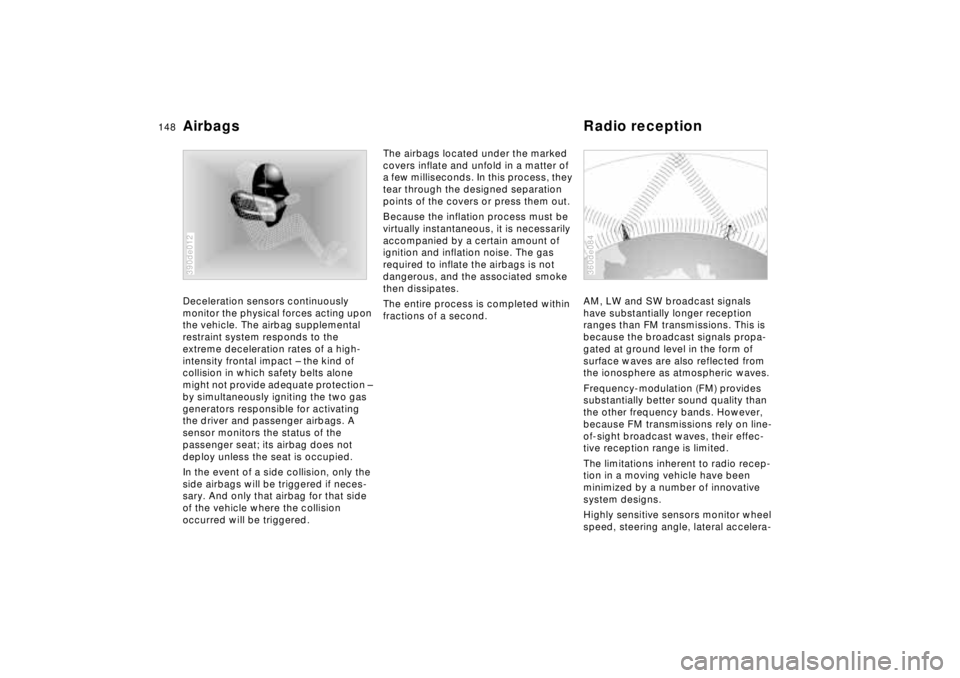
Deceleration sensors continuously
monitor the physical forces acting upon
the vehicle. The airbag supplemental
restraint system responds to the
extreme deceleration rates of a high-
intensity frontal impact Ð the kind of
collision in which safety belts alone
might not provide adequate protection Ð
by simultaneously igniting the two gas
generators responsible for activating
the driver and passenger airbags. A
sensor monitors the status of the
passenger seat; its airbag does not
deploy unless the seat is occupied.
In the event of a side collision, only the
side airbags will be triggered if neces-
sary. And only that airbag for that side
of the vehicle where the collision
occurred will be triggered.
390de012
The airbags located under the marked
covers inflate and unfold in a matter of
a few milliseconds. In this process, they
tear through the designed separation
points of the covers or press them out.
Because the inflation process must be
virtually instantaneous, it is necessarily
accompanied by a certain amount of
ignition and inflation noise. The gas
required to inflate the airbags is not
dangerous, and the associated smoke
then dissipates.
The entire process is completed within
fractions of a second.AM, LW and SW broadcast signals
have substantially longer reception
ranges than FM transmissions. This is
because the broadcast signals propa-
gated at ground level in the form of
surface waves are also reflected from
the ionosphere as atmospheric waves.
Frequency-modulation (FM) provides
substantially better sound quality than
the other frequency bands. However,
because FM transmissions rely on line-
of-sight broadcast waves, their effec-
tive reception range is limited.
The limitations inherent to radio recep-
tion in a moving vehicle have been
minimized by a number of innovative
system designs.
Highly sensitive sensors monitor wheel
speed, steering angle, lateral accelera-
360de084
Airbags Radio reception
Page 166 of 170

Everything from A to ZService Interval
Display63, 114
Shelves78, 79
Side airbags51
Side lamps69
bulb replace-
ment129t
Side marker lamps69
Skid control93
Slippery roads93
Snow chains92, 103
Socket82
for flashlights82
for power supplies82
for vacuum cleaners82
Sound system, refer to the
separate Owner's Manual
Spare key30
Spark plugs158
Speaker81
Specified engine oil110
Speedometer18
Starting56
problems87t, 143
Steel wheels103
Steering94
Steering wheel lock55
Stopping the vehicle56
Storage areas78, 79
Storing your vehicle122
Stroke154
Summer tires101Switching off the engine56
Switching off the interior
motion sensor39t
Switching off the tilt sensor
alarm system39t
Symbols4, 136
TTachometer62
Tail lamps130
bulb replacement130t
Tank capacity157
Technical data154
Technical
modifications6, 123
Telephone81
Temperature display
outside temperature64
Temperature gauge
engine coolant63
Temperature
selection74, 75
Tilt alarm34
Tilt alarm sensor39
Tire codes101
Tire damage98t
Tire inflation
pressure26, 98
Tire pressure monitor67
Tire Pressure Warning
(RDW)67
Tire replacement99, 100Tire rotation100
Tire specifications103
Tire tread98
Tools128t
Torque154
Tow fittings144t
Tow starting144t
Towing the vehicle144t
Track155
Traction Control System
refer to DSC65
Transmission58
Transmitter key30
Tread depth, tires98
Trip odometer62
Trunk lid, refer to luggage
compartment lid37
Turn signal indicator23, 58
Turning radius155
UUniform Tire Quality
Grading100
Unusually high steering
effort20, 94
Use anti-freeze112t
radiator112t
Used batteries,
disposal138t
VVacuum cleaner82
Vehicle battery136, 158
Vehicle care
exterior117
interior119
Vehicle equipment
options and accessories5
Vehicle Identification
Number (VIN)113
Vehicle immobilizer31
Vehicle painting117
Vehicle storage122
Vehicle weight156
Vehicle, starting56
Vehicle, stopping56
Ventilation72
draft-free75
Vinyl upholstery, care119WWarning lamps20
Washer nozzles,
adjusting108t
Washer reservoir,
filling108t
Washing your car115
Water on roadways87
Waxing, paintwork118
Wear indicator in the
tires99
Weights156
Page:
< prev 1-8 9-16 17-24