2001 BMW M ROADSTER COUPE tow
[x] Cancel search: towPage 12 of 171

Contents
Owner service procedures
Advanced technology
Technical data
Replacement procedures:
Onboard tool kit128
Windshield wiper blades128
Lamps and bulbs129
Master key with battery-
powered lamp134
Changing a wheel135
Repairing a flat tire135
Battery140
Fuses142
In case of electrical
malfunction:
Power convertible top143
Fuel filler door143
Assistance, giving and
receiving:
Jump-starting144
Towing the vehicle145Airbags150
Radio reception150
Dynamic Stability Control
(DSC)151
Safety belt tensioner151
Interior rearview mirror with
automatic dimming
feature152
Limited slip differential153Engine specifications156
Dimensions157
Weights158
Capacities159
Electrical system160
Drive belts160
ProCarManuals.com
Page 37 of 171
37n
IndexDataTechnologyRepairsCar careControlsOverview
Manual convertible top – roadsterWeather protectionThe convertible top combines reliable
protection from the elements with
simple, convenient operation. Here are
a few tips to ensure that you have plea-
sure with your roadster.
It is advisable to close the convertible
top when the vehicle is parked. The
closed convertible top not only protects
the passenger compartment from
unforeseeable damage from the
weather, it also provides a certain
degree of theft protection. In addition,
keep valuables only in the locked
luggage compartment, even with the
convertible top closed.
Never mount a roof-mounted luggage
rack on the convertible top. Please
contact your BMW center for suitable
securing devices and additional acces-
sories.
To prevent damage, do not operate the
convertible top at temperatures at or
below the freezing point.
To open 1 With the doors closed, lower the side
windows a few inches (centimeters).
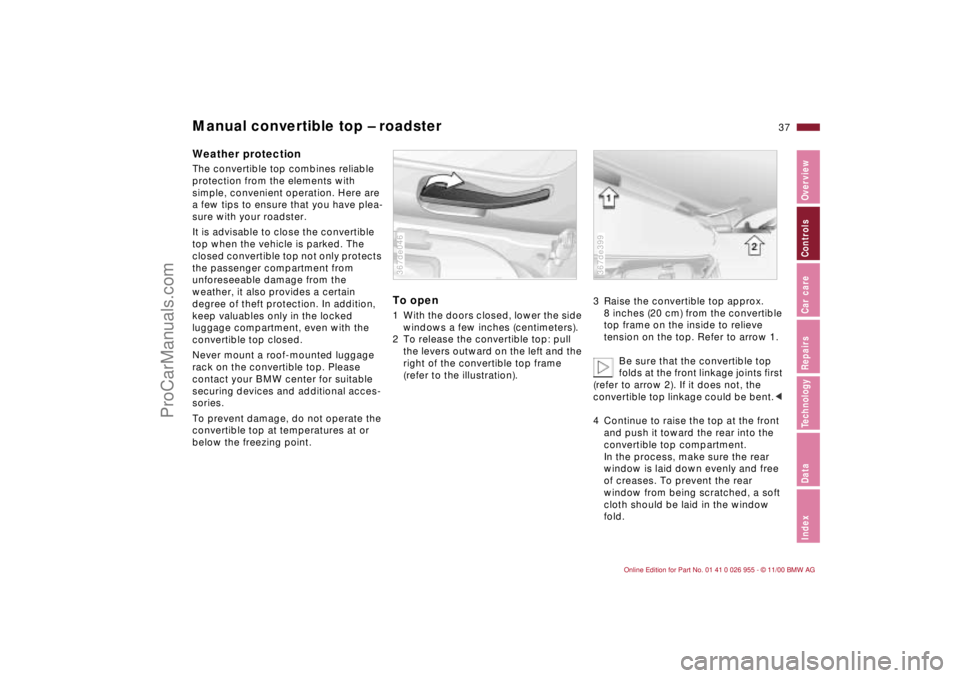
2 To release the convertible top: pull
the levers outward on the left and the
right of the convertible top frame
(refer to the illustration).367de046
3 Raise the convertible top approx.
8 inches (20 cm) from the convertible
top frame on the inside to relieve
tension on the top. Refer to arrow 1.
Be sure that the convertible top
folds at the front linkage joints first
(refer to arrow 2). If it does not, the
convertible top linkage could be bent.<
4 Continue to raise the top at the front
and push it toward the rear into the
convertible top compartment.
In the process, make sure the rear
window is laid down evenly and free
of creases. To prevent the rear
window from being scratched, a soft
cloth should be laid in the window
fold.367de399
ProCarManuals.com
Page 53 of 171
53n
IndexDataTechnologyRepairsCar careControlsOverview
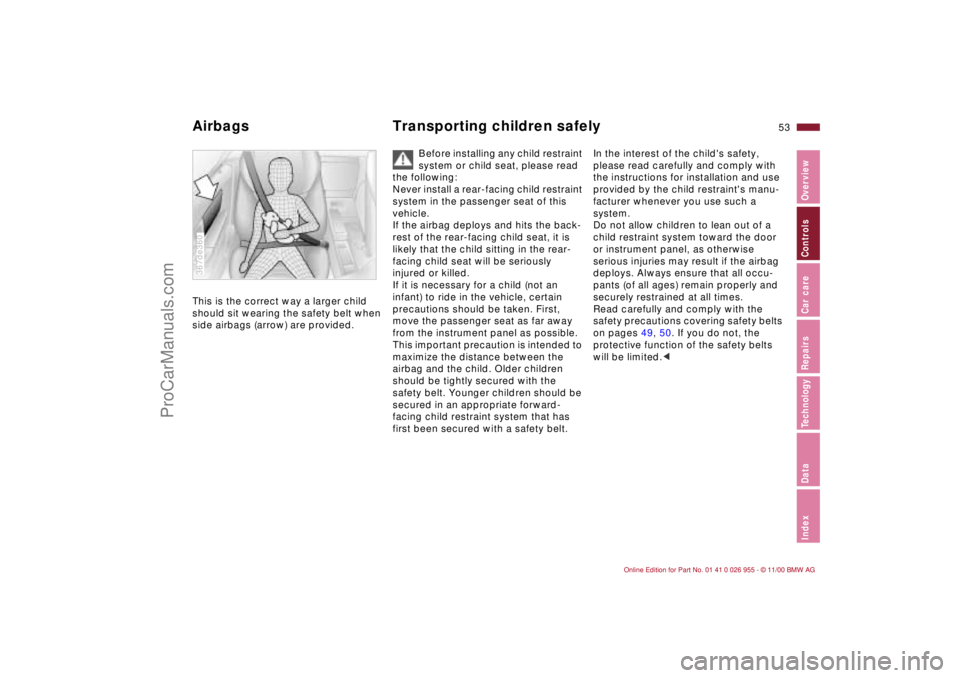
Airbags Transporting children safely This is the correct way a larger child
should sit wearing the safety belt when
side airbags (arrow) are provided.367de360
Before installing any child restraint
system or child seat, please read
the following:
Never install a rear-facing child restraint
system in the passenger seat of this
vehicle.
If the airbag deploys and hits the back-
rest of the rear-facing child seat, it is
likely that the child sitting in the rear-
facing child seat will be seriously
injured or killed.
If it is necessary for a child (not an
infant) to ride in the vehicle, certain
precautions should be taken. First,
move the passenger seat as far away
from the instrument panel as possible.
This important precaution is intended to
maximize the distance between the
airbag and the child. Older children
should be tightly secured with the
safety belt. Younger children should be
secured in an appropriate forward-
facing child restraint system that has
first been secured with a safety belt.
In the interest of the child's safety,
please read carefully and comply with
the instructions for installation and use
provided by the child restraint's manu-
facturer whenever you use such a
system.
Do not allow children to lean out of a
child restraint system toward the door
or instrument panel, as otherwise
serious injuries may result if the airbag
deploys. Always ensure that all occu-
pants (of all ages) remain properly and
securely restrained at all times.
Read carefully and comply with the
safety precautions covering safety belts
on pages 49, 50. If you do not, the
protective function of the safety belts
will be limited.<
ProCarManuals.com
Page 73 of 171

73n
IndexDataTechnologyRepairsCar careControlsOverview
Heating and ventilation/Air conditioner 1 Airflow toward the windshield and
side windows
2 Airflow toward upper body
The rotary dials allow infinitely vari-
able regulation of the air supply. You
can change the airflow direction with
the lever in the center of the vent or
by rotating the vent grille75
3 Front footwell ventilation
4 Air distribution onto the
>windows
>upper body
>footwell
All intermediate settings are
possible74
5 Temperature74
6 Air supply
The heating and ventilation are oper-
ational beginning with position 174
7 Air conditioner74
8 Recirculated air mode74
ProCarManuals.com
Page 74 of 171
74n
Heating and ventilation/Air conditionerAir distribution
You can direct the airflow onto
the windows , toward the
upper body and into the foot-
well . All intermediate settings are
possible. In position , a small volume
of air is directed onto the windows in
order to keep them free of condensa-
tion.
A "6 o'clock" position is recommended
as the normal operating setting.
Temperature
In order to increase the temper-
ature of the passenger compart-
ment, turn to the right (red). For
rapid heating, turn completely to the
right. Then select an interior tempera-
ture which is pleasant for you.
Air supply
You can select blower speeds
from 1 to 4. Both heating and
ventilation become more effec-
tive as the airflow rate is increased. In
position 0, the blower and the heater
are switched off.
Air conditioner
The air is cooled and dehumidi-
fied and – depending on the
temperature setting – warmed
again when the air conditioner is
switched on.
Depending on the weather, the wind-
shield may fog over briefly when the
engine is started.
At outside temperatures below approx.
41 7 (+5 6), switch off the air condi-
tioner. This will help to prevent the
windows from fogging up.
If the windows fog over directly after
switching the air conditioner off, switch
it on again.
Condensation forms in the air
conditioner system during opera-
tion, which then exits under the vehicle.
Traces of condensed water of this kind
are thus normal.<
Recirculated air mode
If there are unpleasant odors in
the incoming air, you can
temporarily block the airflow.
The system then recirculates the air
currently within the vehicle.
If the windows fog over in the
recirculated air mode, switch this
mode off and increase the air supply as
required.<
ProCarManuals.com
Page 82 of 171
82n
Cargo loadingStowing cargoIf you are transporting cargo in your
coupe:
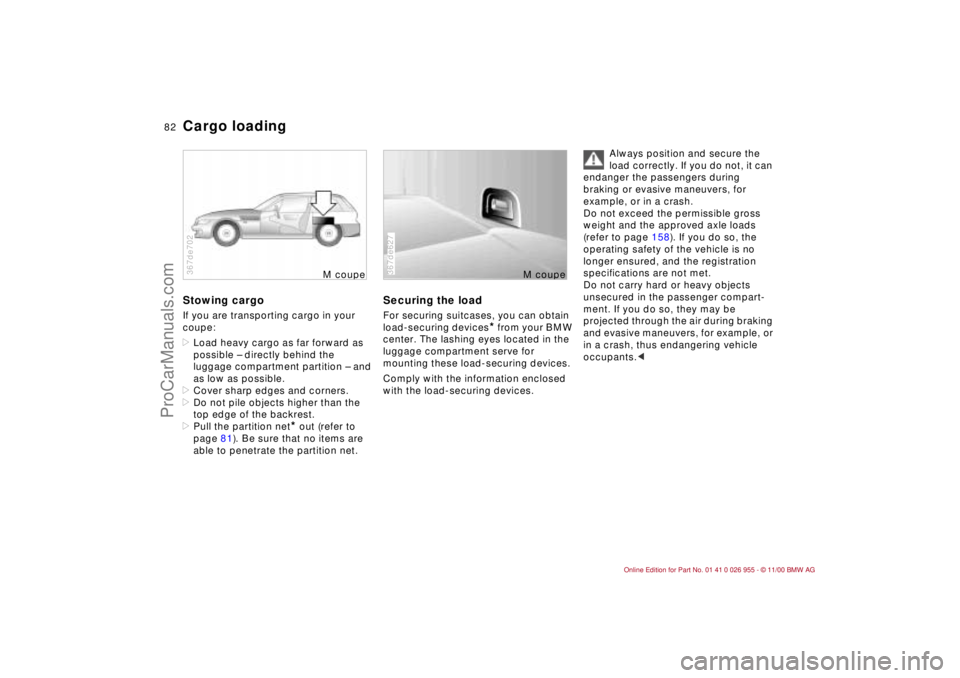
>Load heavy cargo as far forward as
possible – directly behind the
luggage compartment partition – and
as low as possible.
>Cover sharp edges and corners.
>Do not pile objects higher than the
top edge of the backrest.
>Pull the partition net
* out (refer to
page 81). Be sure that no items are
able to penetrate the partition net.
367de702
M cou
pe
Securing the loadFor securing suitcases, you can obtain
load-securing devices
* from your BMW
center. The lashing eyes located in the
luggage compartment serve for
mounting these load-securing devices.
Comply with the information enclosed
with the load-securing devices.
367de627
M cou
pe
Always position and secure the
load correctly. If you do not, it can
endanger the passengers during
braking or evasive maneuvers, for
example, or in a crash.
Do not exceed the permissible gross
weight and the approved axle loads
(refer to page 158). If you do so, the
operating safety of the vehicle is no
longer ensured, and the registration
specifications are not met.
Do not carry hard or heavy objects
unsecured in the passenger compart-
ment. If you do so, they may be
projected through the air during braking
and evasive maneuvers, for example, or
in a crash, thus endangering vehicle
occupants.<
ProCarManuals.com
Page 86 of 171

86n
To ensure that your vehicle provides
maximum economy throughout a long
service life, we request that you
observe the following:
Engine and differentialUp to 1,200 miles (2,000 km):
Drive with varying engine and road
speeds, but do not exceed 4,500 rpm
or 100 mph (150 km/h).
Comply with local and state maximum
speed limits.
Refrain from using full throttle and avoid
pressing the accelerator beyond the
"Kickdown" point.
After you have driven 1,200 miles
(2,000 km), you can gradually increase
the engine and road speeds.
You should also comply with these
break-in procedures if the engine or
differential is replaced later in the
course of the vehicle's service life.
TiresDue to technical factors associated with
their manufacture, tires do not achieve
their full traction potential until an initial
break-in period has elapsed. You should
therefore drive with extra caution during
the initial 200 miles (300 km).
Comply with local and state maximum
speed limits.
When the vehicle is operated on
wet or slushy roads, a wedge of
water may form between the tire and
the road surface. This phenomenon is
referred to as aquaplaning or hydro-
planing, and can lead to partial or
complete loss of traction, vehicle
control and braking effectiveness.
Reduce your speed on wet roads.<
Brake systemApprox. 300 miles (500 km) must
elapse before the brake pads and discs
achieve the optimal surface and wear
pattern.
To break-in the separate parking brake
drums, apply the parking brake lightly
when coasting to a standstill (at a traffic
signal, for instance), provided that
traffic conditions allow you to do so.
To avoid corrosion, repeat this proce-
dure from time to time.
The brake lamps do not light up
when the parking brake is applied.
Vacuum for the brake system booster
on your BMW is available only when the
engine is running. When you move the vehicle with the engine off – for instance
,
by towing – substantially higher levels
of pedal force will be required to brake
the vehicle.<
ClutchThe clutch will reach optimal function
after approx. 300 miles (500 km). Shift
gears carefully during the break-in
period.
Break-in procedure
ProCarManuals.com
Page 88 of 171

88n
Catalytic converterThe catalytic converter reduces harmful
exhaust emissions.
It is designed for use with unleaded fuel
only. Even minute quantities of lead
would be enough to permanently
damage both the catalytic converter
and the system's oxygen sensor.
To ensure efficient, trouble-free engine
operation and to avoid potential
damage:
>Be sure to comply with the scheduled
maintenance requirements.
>Fill the fuel tank well before it is
empty.
>Tow-start the vehicle only when the
engine is cold. Tow-starting when the
engine is warm could cause unburned
fuel to ignite to the catalytic converter,
resulting in significant damage. It is
better to start the vehicle with an
outside starting aid.>Avoid any other situations in which
the fuel would not be (completely)
burned, for instance:
Frequent or consecutive extended
starting attempts or repeated starting
attempts when the engine fails to
start. (Shutting down and restarting
an engine which is running properly
does not present a problem.)
Never let the engine run with any of
the spark plug connectors discon-
nected.Be sure to comply with the
instructions above to prevent
unburned fuel from reaching the cata-
lytic converter. This could cause over-
heating, leading to serious damage to
the catalytic converter.
Extreme temperatures occur at the
catalytic converter on this and every
catalyst-equipped vehicle. Heat shields
are installed adjacent to some sections
of the exhaust system. Never remove
these shields; do not apply under-
coating to their surfaces.
When driving, standing while the engine
is idling, or when parking, be careful to
avoid contact between the hot exhaust
system and easily-flammable materials
(hay, dry grass, leaves, etc.). Such
contact could cause a fire, resulting in
personal injuries and property
damage.<
ProCarManuals.com