2001 BMW M ROADSTER COUPE service
[x] Cancel search: servicePage 99 of 171
99n
IndexDataTechnologyRepairsCar careControlsOverview
Tire replacementTo maintain good handling and vehicle
response, use only tires of a single tread
configuration from a single manufac-
turer. BMW tests and approves wheel
and tire specifications. Refer to
page 103.DOT Quality GradesTread wear
Traction AA A B C
Temperature A B C
All passenger vehicle tires must
conform to Federal Safety
Requirements in addition to these
grades.
when tested under controlled condi-
tions on a specified government test
course.
For example, a tire graded 150 would
wear one and one-half (1g) times as
well on the government course as a tire
graded 100. The relative performance
of tires depends upon the actual condi-
tions of their use, however, and may
depart significantly from the norm due
to variations in driving habits, service
practices and differences in road char-
acteristics and climate.TractionThe traction grades, from highest to
lowest, are AA, A, B and C.
Those grades represent the tire's ability
to stop on wet pavement as measured
under controlled conditions on speci-
fied government test surfaces of
asphalt and concrete. A tire marked C
may have poor traction performance.
The traction grade assigned to
this tire is based on straight-
ahead braking traction tests, and does
not include acceleration, cornering,
aquaplaning, or peak traction charac-
teristics.
tire's resistance to the generation of
heat and its ability to dissipate heat
when tested under controlled condi-
tions on a specified indoor laboratory
test wheel.
Sustained high temperature can cause
the material of the tire to degenerate
and reduce tire life, and excessive
temperature can lead to a sudden flat
tire. The grade C corresponds to a level
of performance which all passenger
vehicle tires must meet under the
Federal Motor Vehicle Safety Standard
No. 109. Grades B and A represent
higher levels of performance on the
laboratory test wheel than the minimum
required by law.
The temperature grade for this tire
is established for a tire that is
properly inflated and not overloaded.
Excessive speed, underinflation, or
excessive loading, either separately or
in combination, can cause heat buildup
and possible tire failure.
tread shoulder and maximum section
width. For example:
Tread wear 200 Traction AA
Temperature A
ProCarManuals.com
Page 102 of 171
102n
Special features of winter tires Snow chains
*
Choosing the right tireBMW recommends winter tires (M+S
radial tires) for operation under
inclement winter driving conditions.
While so-called all season tires (M+S
designation) provide better winter trac-
tion than summer tires with the load
ratings H, V, W, Y and ZR, they gener-
ally do not achieve the performance of
winter tires.
In the interests of sure tracking and safe
steering response, mount winter tires
which are made by the same manufac-
turer and which have the same tread
pattern at all four wheels.Comply with recommended speed
Never exceed the maximum
speed for which the winter tires
are rated.
Unprofessional attempts by laymen to
service tires can lead to damage and
accidents.
Have this work performed by skilled
professionals only. Any BMW center
has the required technical knowledge
and the proper equipment and will be
happy to assist you.<
Tire condition, tire pressureOnce the tire wears to below 0.16 in
(4 mm), winter tires display a percep-
tible decrease in their ability to cope
with winter driving conditions, and
should be replaced in the interest of
safety.
Comply with the specified tire inflation
pressures – and be sure to have the
wheel and tire assemblies balanced
every time you change the tires.The use of narrow-link BMW snow
chains on winter tires is approved only
in pairs and only on the rear wheels.
Comply with all manufacturer's safety
precautions when mounting the chains.
Deactivate the Tire Pressure
Warning (RDW) when using snow
chains. The snow chains can lead to
malfunction warnings and undetected
losses in pressure.
For further information, refer to
page 67.<
ProCarManuals.com
Page 110 of 171

110n
Engine oilSpecified engine oilsThe quality of the engine oil which is
selected has critical significance for the
operation and service life of an engine.
Based on extensive testing, BMW has
approved only certain engine oils.
Use only approved "BMW High Perfor-
mance Synthetic Oil."
If you are unable to obtain "BMW High
Performance Synthetic Oil", you can
add small amounts of synthetic oil in
between oil changes. Only use oils with
the API SH specification or higher.
Ask your BMW center for details
concerning the specific "BMW
High Performance Synthetic Oil" or
"synthetic oils" which have been
approved.<
You can also call BMW of North
America at 1-800-831-1117 or visit this
website: www.bmwusa.com to obtain
this information.
Viscosity – ratingsViscosity is the oil flow rating as estab-
lished in SAE classes.
The selection of the correct SAE class
depends on the climatic conditions in
the area where you drive your BMW.
Approved oils are in SAE classes
5W-40 and 5W-30.<
These oils may be utilized in all ambient
temperatures.
530us200
ProCarManuals.com
Page 112 of 171
112n
Coolant Brake fluid Checking coolant levelThe correct coolant level when the
engine is cold (approx. +68 7/+20 6).
Unscrew the cap from the expansion
tank.
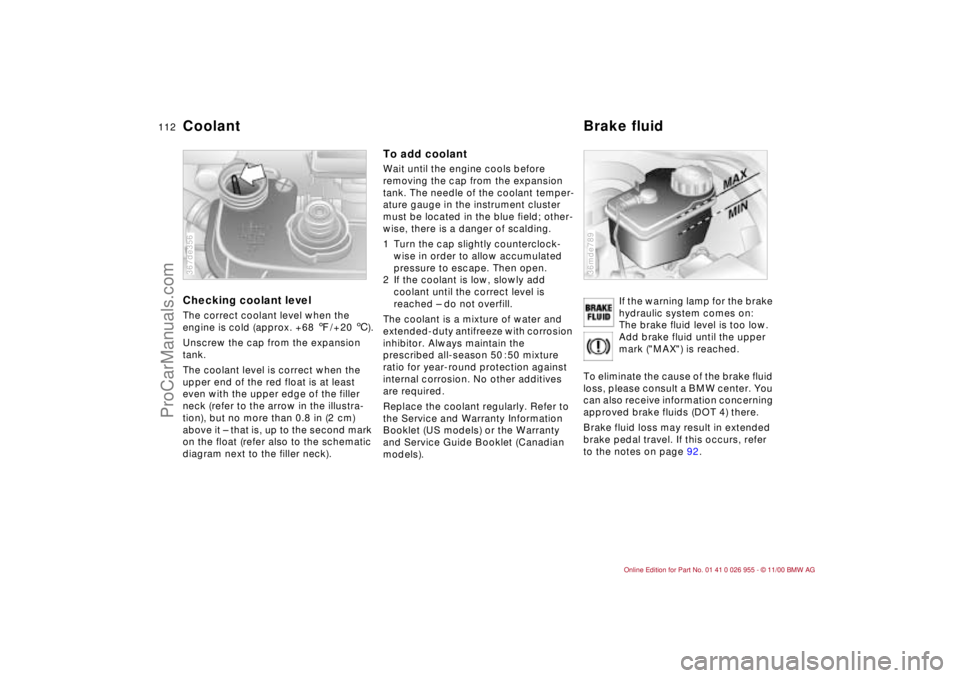
The coolant level is correct when the
upper end of the red float is at least
even with the upper edge of the filler
neck (refer to the arrow in the illustra-
tion), but no more than 0.8 in (2 cm)
above it – that is, up to the second mark
on the float (refer also to the schematic
diagram next to the filler neck).367de356
To add coolantWait until the engine cools before
removing the cap from the expansion
tank. The needle of the coolant temper-
ature gauge in the instrument cluster
must be located in the blue field; other-
wise, there is a danger of scalding.
1 Turn the cap slightly counterclock-
wise in order to allow accumulated
pressure to escape. Then open.
2 If the coolant is low, slowly add
coolant until the correct level is
reached – do not overfill.
The coolant is a mixture of water and
extended-duty antifreeze with corrosion
inhibitor. Always maintain the
prescribed all-season 50 : 50 mixture
ratio for year-round protection against
internal corrosion. No other additives
are required.
Replace the coolant regularly. Refer to
the Service and Warranty Information
Booklet (US models) or the Warranty
and Service Guide Booklet (Canadian
models).If the warning lamp for the brake
hydraulic system comes on:
The brake fluid level is too low.
Add brake fluid until the upper
mark ("MAX") is reached.
To eliminate the cause of the brake fluid
loss, please consult a BMW center. You
can also receive information concerning
approved brake fluids (DOT 4) there.
Brake fluid loss may result in extended
brake pedal travel. If this occurs, refer
to the notes on page 92.
36mde789
ProCarManuals.com
Page 113 of 171

113n
IndexDataTechnologyRepairsCar careControlsOverview
Brake fluid Vehicle Identification Number
Brake fluid is hygroscopic, that is,
it absorbs moisture from the air
over time.
In order to ensure the operating safety
and reliability of the brake system, have
the brake fluid changed every two years
by a BMW center. Refer also to the
Service and Warranty Information
Booklet (US models) or the Warranty
and Service Guide Booklet (Canadian
models).
Brake fluid is hazardous to health and
will damage the vehicle's paint. You
should always store it in its original
container and in a location which is
inaccessible to children. Avoid brake
fluid spills. Do not fill brake fluid beyond
the "MAX" mark in the reservoir. The
brake fluid could ignite upon contact
with hot engine parts and cause serious
burns.<
Comply with the applicable envi-
ronmental laws regulating the
disposal of brake fluid.<
The Vehicle Identification Number is
located in the engine compartment
below the windshield (arrow) and on the
top of the instrument panel. 367us053
ProCarManuals.com
Page 114 of 171
114n
The BMW Maintenance System has
been designed as a reliable means of
providing maximum driving and oper-
ating safety – and as cost-effectively as
possible for you.
Please keep in mind that regular main-
tenance is not only necessary for the
safety of your vehicle, but also plays a
significant role in maintaining the resale
value of your vehicle.
36mus731
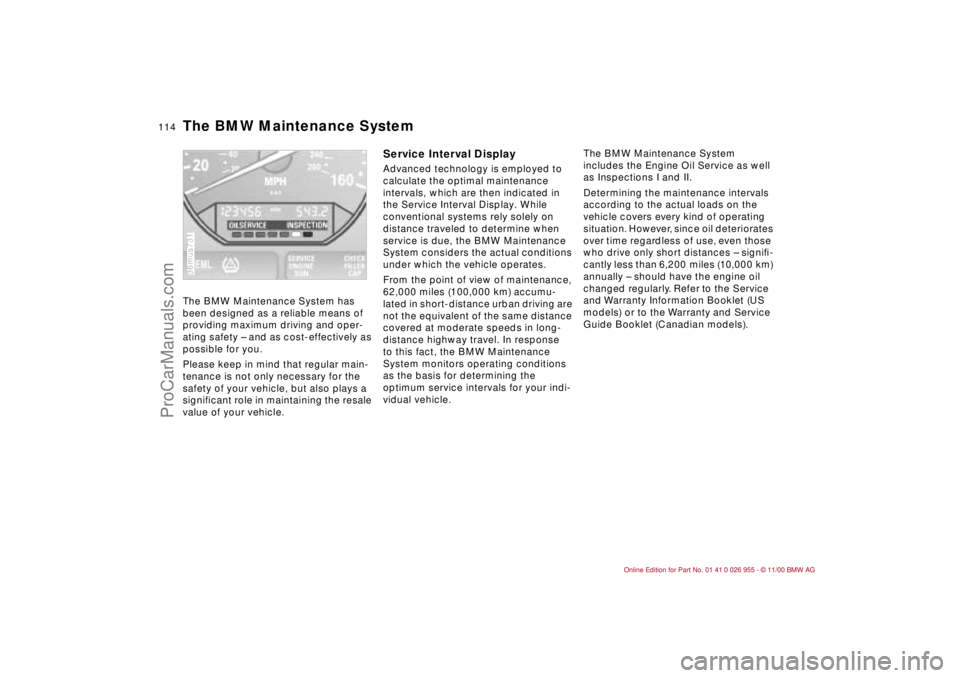
Service Interval DisplayAdvanced technology is employed to
calculate the optimal maintenance
intervals, which are then indicated in
the Service Interval Display. While
conventional systems rely solely on
distance traveled to determine when
service is due, the BMW Maintenance
System considers the actual conditions
under which the vehicle operates.
From the point of view of maintenance,
62,000 miles (100,000 km) accumu-
lated in short-distance urban driving are
not the equivalent of the same distance
covered at moderate speeds in long-
distance highway travel. In response
to this fact, the BMW Maintenance
System monitors operating conditions
as the basis for determining the
optimum service intervals for your indi-
vidual vehicle. The BMW Maintenance System
includes the Engine Oil Service as well
as Inspections I and II.
Determining the maintenance intervals
according to the actual loads on the
vehicle covers every kind of operating
situation. However, since oil deteriorates
over time regardless of use, even those
who drive only short distances – signifi-
cantly less than 6,200 miles (10,000 km)
annually – should have the engine oil
changed regularly. Refer to the Service
and Warranty Information Booklet (US
models) or to the Warranty and Service
Guide Booklet (Canadian models).
The BMW Maintenance System
ProCarManuals.com
Page 115 of 171

115n
IndexDataTechnologyRepairsCar careControlsOverview
The BMW Maintenance System Caring for your vehicleService and Warranty Information
Booklet (US models)/Warranty
and Service Guide Booklet
(Canadian models)For detailed information on required
maintenance items and the work
involved, please refer to the Service
and Warranty Information Booklet (US
models) or to the Warranty and Service
Guide Booklet (Canadian models).
Depending upon operating conditions,
it may be advisable to have the body
checked for damage from rocks or
gravel at the same time as a precaution
against rust.Have your BMW center do the
maintenance and repair.
Your BMW center is always informed on
the latest maintenance work and repair
techniques and is equipped with the
required special tools. In addition,
checking parts known from experience
to be subject to wear is a permanent
part of the maintenance specifications.
Be sure that all maintenance work is
confirmed in the Service and Warranty
Information Booklet (US models) or the
Warranty and Service Guide Booklet
(Canadian models). These entries will
constitute your proof that the vehicle
has received regular maintenance. They
are also required for warranty claims.<
Washing your vehicleYou can wash your BMW by hand or in
an automatic car wash – even when it is
new. Car wash systems that do not
employ brushes are preferable.
Loosen and remove tough dirt and
dead insects before washing the
vehicle.
To prevent spots, avoid washing when
the hood is still warm, or immediately
after and during exposure to strong
sunlight.
If a brushless car wash is unavailable
and a brush car wash must be used,
modern systems with soft brushes are
preferable. In order to protect the
convertible top, special waxing
programs may not be selected for the
M roadster. The small amount of
beading wax always used in automatic
car washes will not harm your vehicle's
finish.
ProCarManuals.com
Page 119 of 171

119n
IndexDataTechnologyRepairsCar careControlsOverview
Caring for your vehicleCaring for the vehicle finishRegular washing is a preventive
measure against long-term effects from
substances which are harmful to the
vehicle's finish, especially if you drive
your vehicle in areas with high levels of
air pollution or aggressive natural
substances (tree resins, pollen).
Nevertheless, you should immediately
remove especially aggressive
substances. Failure to do so can lead to
changes in the paint's chemical struc-
ture or to discoloration. Gasoline spilled
during refueling, oil, grease and brake
fluid should always be cleaned away
immediately, as should bird droppings
(finish damage).
Any contamination remaining on the
surface of the vehicle will be especially
conspicuous after washing. Use
cleaning fluid or alcohol with a clean
cloth or cotton pad to remove. Remove
tar spots with tar remover. After
cleaning, the affected areas should be
waxed to ensure continued protection.
Use the cleaning and car-care
products that you can obtain at
your BMW center.<
Waxing your vehicleProtect the finish using carnauba or
synthetic-based waxes only.
The best way to determine when the
finish needs to be waxed is by noting
when water stops beading on the
surface.
You can use a glass cleaner to remove
any wax or silicone that may have been
left on the windows during waxing.
Use the cleaning and car-care
products that you can obtain at
your BMW center.<
Paint damageYou can touch up minor paint flaws with
BMW spray paint or a BMW touchup
stick.
The color code for your vehicle is
provided on a tag located near the
vehicle data plate and on the first page
of the Service and Warranty Information
Booklet (US models) or the Warranty
and Service Guide Booklet (Canadian
models).
Damage caused by flying stones,
scratches, etc., must be touched up
without delay to prevent rust from
forming.
If corrosion has started to form in an
area with paint damage, remove all rust
and clean the area. Finally, apply the
finish coat. Wait a few days, then polish
the repaired area. Finish by applying a
wax preservative.
More extensive paint damage should
be repaired professionally in accor-
dance with the manufacturer's instruc-
tions. Your BMW center uses original
BMW finish materials in accordance
with approved repair procedures.
Use the cleaning and car-care
products that you can obtain at
your BMW center.<
ProCarManuals.com